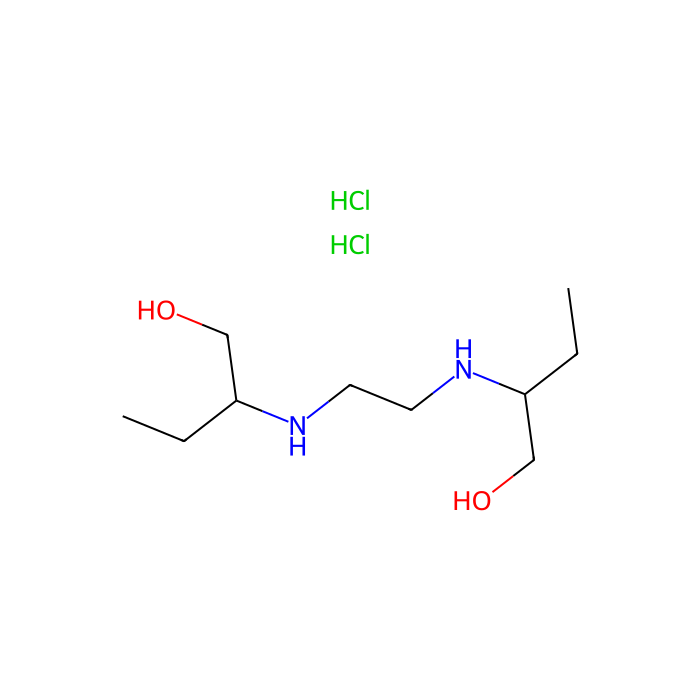
Ethambutol 2HCl (CL40881) is a bacteriostatic antimycobacterial agent, which obstructs the formation of cell wall by inhibitingarabinosyl transferases. In vitro
In vivo
Ethambutol is efficient in animal model. 100 mg/kg Ethambutol given orally 15 days post i.v. infection 1 ×/week for 5 weeks, induces a lower log CFU compared with untreatment (4.59 vs 5.07). Cell Data
cell lines:
Concentrations:
Incubation Time:
Powder Purity:≥100%
Spécifications
Spécifications et pureté
10mM in DMSO
Mécanismes biochimiques et physiologiques
Ethambutol 2HCl (CL40881) is a bacteriostatic antimycobacterial agent, which obstructs the formation of cell wall by inhibiting arabinosyl transferases.
Conditions de stockage de stockage
Store at -80°C
Expédié en
Dry ice packs + Cold packs
Ce produit nécessite l'expédition en chaîne froide. Les services terrestres et autres services économiques ne sont pas disponibles.
Type d'action
INHIBITOR
Mécanisme d'action
Arabinosyltransferase A inhibitor
Noms et identifiants
Isomères SMILES
CC[C@@H](CO)NCCN[C@@H](CC)CO.Cl.Cl
WGK Allemagne
3
RTECS
EL3854000
CAS alternatif
3577-94-4
Poids moléculaire
277.23
Données avancées
Certificats (CoA, COO, BSE/TSE et tableau d'analyse)
C of A & Other Certificates(BSE/TSE, COO):
Analytical Chart:
Propriétés chimiques et physiques
Rotation spécifique [α]
6° (C=10,H2O)
Point de fusion (°C)
199 °C
Sécurité et dangers (GHS)
Signal
Warning
Mentions de danger
H227:Combustible liquid
Conseils de prudence
P210:Keep away from heat, hot surface, sparks, open flames and other ignition sources. - No smoking.
P403+P235:Store in a well-ventilated place. Keep cool.
P501:Dispose of contents/container to an approved waste disposal plant.
WGK Allemagne
3
RTECS
EL3854000
Index Merck
3720
Calculateurs de solution
Molarity Calculator
Determine the necessary mass, volume, or concentration for preparing a solution.
Dilution Calculator
Determine the dilution needed to prepare a stock solution.
Reconstitution Calculator
Avis
Avis des clients
Application Protocols
No manufacturer-tested bioassay or analytical protocols are specified for this item. General suggestions for lab use:
Stock preparation for screening: dissolve in sterile water or DMSO to 10–100 mM (literature practice), filter-sterilize (0.22 μm) if required, and dispense into single-use aliquots to avoid repeated freeze–thaw.
Derivatization control: use as a positive control for primary amine derivatization (e.g., OPA, Fmoc) and for ion-exchange chromatography method development.
Item-specific validated applications, recommended dilutions, and positive controls: Not specified for this item; refer to CoA/Spec Sheet.
Biological Roles
This section provides general biochemical context for a polyfunctional diamine dihydrochloride; it does not imply medical or clinical use.
Chemical class: small, chiral, aliphatic diamine with terminal alcohols; capable of forming stable dications in water (literature).
Interactions: protonated amines engage in ionic interactions with polyanions (e.g., nucleic acids, acidic polysaccharides) and participate in hydrogen bonding; the alcohols add further H-bonding capacity.
Metal binding: diamines can chelate divalent cations (e.g., Cu2+, Ni2+) in vitro, forming coordination complexes (literature). Such complexes are of interest for analytical chemistry and model studies.
Membrane transport surrogates: the balance of hydrophilicity and cationic charge influences uptake in model systems (e.g., liposomes, transport assays), especially when comparing free base vs. salt forms (literature).
Assay relevance: as a highly water-soluble cationic small molecule, it can serve as a reference for charge-dependent retention in ion-exchange chromatography or for benchmarking derivatization reactions targeting primary amines.
Note: No biological activity or therapeutic claims are made for this catalog listing. Use is restricted to research and laboratory investigations.
Buffer Applications
Ethambutol 2HCl is not a conventional buffering agent and does not constitute a defined buffer system with a known pKa pair like TRIS or phosphate. However, practical notes for aqueous handling (general guidance):
Aqueous solutions of the dihydrochloride are acidic due to HCl counterions; measured pH depends on concentration. Adjust pH with suitable bases (e.g., NaOH) if neutrality is required.
If using in enzyme or cell-based assays, prepare in an appropriate buffer (e.g., phosphate, HEPES) to maintain target pH and ionic strength; confirm compatibility with primary amines (which can interact with activated esters or aldehydes in certain buffer systems).
For ion-exchange studies, the dicationic nature at neutral pH makes it a useful probe of cation-exchange resin capacity and elution behavior. No standard buffer recipe is associated with this compound.
Green Alternatives
Selection of media for handling ethambutol 2HCl can influence environmental impact. Consider greener solvents and practices (general guidance):
Prefer water when feasible: the dihydrochloride is water-soluble, enabling purely aqueous operations that minimize organic solvent use.
If an organic cosolvent is required, consider bio-based or safer polar solvents (e.g., glycerol, propylene glycol, ethanol) over high-toxicity aprotics.
Comparison (general literature perspective):
Water vs DMSO vs Ethanol (for stock solutions)
Water: greenest option; no VOCs; may require pH adjustment; excellent for salt form.
Ethanol: renewable origin possible; good compromise for moderate solubility; flammable.
Process considerations:
Avoid chlorinated organics for extractions where alternatives (ethyl acetate, MTBE, 2-MeTHF) are viable—note that as a salt, ethambutol 2HCl favors aqueous phases; convert to free base before extraction if needed.
Employ minimal solvent volumes, and recycle/retask aqueous solutions when consistent with contamination controls.
Energy use: the product requires cold storage (−80°C). Plan consolidated shipments and efficient freezer utilization to reduce energy footprint while maintaining quality.
Pharmaceutical Uses
No clinical or therapeutic claims are made. The following pertains to laboratory/formulation contexts only (general/literature guidance):
Role in labs: a well-defined, water-soluble small molecule standard that can be used for method development, system suitability, and calibration of analytical procedures involving primary amines (e.g., derivatization assays with OPA/Fmoc).
Salt form advantages: the dihydrochloride exhibits predictable aqueous solubility and stability relative to the free base, simplifying preparation of reference solutions.
Pharmacopeial context: where applicable, analysts may reference public monographs for identity/purity tests of related substances; this listing does not assert compliance with any pharmacopeia. Confirm requirements with your quality unit.
Formulation research: as a representative diamine dihydrochloride, it can be used to study excipient compatibility with cationic APIs (e.g., interactions with anionic polymers, stability against Maillard-type reactions with reducing sugars).
Physical Properties
Item-specific specifications are not provided unless stated below. Values given are general literature information for ethambutol dihydrochloride and should be used for context only.
Appearance: Not specified for this item; refer to CoA/Spec Sheet.
pKa (free base, literature): diamine with two basic centers; typical reported pKa values are in the range pKa1 ~6–7 and pKa2 ~9–10 for the conjugate acids; as 2HCl the amines are fully protonated in neutral water.
LogP (free base, literature): low to moderate hydrophilicity is expected for the salt; the free base is more lipophilic than the dihydrochloride.
Refractive index/UV cutoff: Not specified for this item; refer to CoA/Spec Sheet.
Quality and Grades
Grade/Purity: Not specified for this item; refer to CoA/Spec Sheet.
Context for professional users:
In the absence of an explicit grade (e.g., ≥98%, HPLC, USP/EP), users should verify suitability via CoA parameters such as assay (by titration/HPLC), residual solvents, water content (KF), chloride content, and chromatographic purity profile. Item-specific numeric limits are not provided here.
Alcohol- and amine-containing salts can exhibit polymorphism or variable hydration; confirm form (anhydrous vs. hydrate) by XRPD/TGA if critical to your application (general guidance).
For analytical applications, low-level UV background and well-resolved HPLC profiles are desirable; ask for chromatograms if needed.
If chirality is relevant (ethambutol is typically used as the enantiopure (2R,2'R) free base in literature), verify optical purity or enantiomeric ratio on the CoA when applicable to your methods. This listing does not specify stereochemical purity; refer to CoA/Spec Sheet.
Reaction and Applications
As a chiral, bifunctional diamine bearing two terminal alcohols, ethambutol (as 2HCl) can serve as a versatile intermediate or auxiliary in research settings (general/literature context). While widely known as a bioactive small molecule, in synthetic chemistry its features enable:
Ligand/auxiliary roles: the free base functions as a bidentate diamine ligand for transition metals (e.g., Cu, Ni, Pd) in coordination studies and can template chirality transfer or recognition events (literature).
Polyfunctional scaffold: two primary alcohols and two amine sites allow orthogonal protection strategies, furnishing amino alcohols, carbamates, ureas, amides, and ethers. This makes it a useful hydrophilic linker or spacer in conjugation chemistry.
Chiral resolution/recognition: the enantiopure free base has been explored as a chiral selector in certain separations and as a resolving agent for acidic substrates (literature).
Salt-specific utility: the dihydrochloride offers enhanced water solubility for aqueous-phase transformations, ion-exchange processes, or for forming additional salts (e.g., sulfonates) via metathesis.
Practical tips:
If metal coordination is intended, convert to free base (careful basification and extraction) to avoid chloride/acid interference.
Protecting groups: Boc- or Cbz-protection of amines under mild base; alcohols can be protected as silyl ethers (TBS/TBDPS) or carbonates.
Regioselectivity: stepwise functionalization often benefits from differential protection of one amine or one alcohol to control subsequent coupling steps.
Reaction Conditions
General literature guidance for working with diamine/diol scaffolds similar to ethambutol; adjust to your specific route and avoid treating this as a product specification.
Cbz-protection: Cbz–Cl, biphasic Na2CO3(aq)/CH2Cl2 or THF; 0–25°C.
Protection of alcohols:
TBS-protection: TBS–Cl, imidazole in DMF, 0–25°C; 2–16 h; 70–90% common for primary alcohols (literature).
Carbonate formation: CDI or triphosgene in THF/CH2Cl2, 0–25°C.
Amide coupling from amines:
EDCI/HOBt or HATU in DMF/DCM, 0–25°C; 1–12 h; often >70% yields with optimized conditions.
Ether formation from alcohols:
Tosylation (TsCl, pyridine, 0–5°C then rt) followed by SN2 with desired nucleophile; monitor for over-activation.
Metal complexation (free base):
Complexes form readily with Cu(II)/Ni(II) salts in alcohol/water mixtures at ambient temperature; stoichiometry 1:1 or 1:2 ligand:metal depending on conditions (literature).
Notes:
Start from the dihydrochloride in water; adjust pH and extract to obtain the free base for nonaqueous steps.
Maintain stereochemistry by avoiding strong base/heat that could promote undesired side reactions.
Chloride from the salt may affect coupling reagents; wash thoroughly or exchange counterions as needed.
Safety and Handling
Authoritative safety classification for this specific item is not provided here. Always consult the product SDS for definitive information.
GHS classification, pictograms, signal word, H-statements: Not specified for this item; refer to SDS.
Anticipated hazards (general for diamine dihydrochloride salts; literature/experience): may cause irritation to eyes, skin, and respiratory tract. Low volatility; dust generation should be minimized.
PPE: use lab coat, safety glasses or splash goggles, and appropriate chemically resistant gloves (e.g., nitrile). Handle powders in a fume hood or ventilated enclosure to minimize inhalation of particulates.
Handling tips:
Hygroscopic tendency is common for amine hydrochloride salts; keep containers tightly closed and minimize exposure to ambient humidity.
Avoid contact with strong bases (which can liberate the free base) and strong oxidizers.
Use clean, dry tools to prevent adventitious moisture.
First-aid (general guidance; defer to SDS):
Inhalation: move to fresh air; seek medical attention if symptoms persist.
Skin/eye contact: rinse with water for at least 15 minutes; remove contaminated clothing; seek medical advice if irritation continues.
Ingestion: rinse mouth; do not induce vomiting; seek medical attention.
Spills and disposal: Collect solids with minimal dusting; dispose of waste according to institutional and local regulations. Avoid release to the environment.
Solvent Selection
Ethambutol 2HCl is a polar, dicationic organic salt; solvent choice should reflect its ionic character and target use.
Polarity and miscibility (literature/general):
Water: preferred solvent; the dihydrochloride is freely soluble at ambient temperature.
Polar protic organics (methanol, ethanol): often soluble; solubility decreases with less polar alcohols.
Polar aprotics (DMSO, DMF): highly soluble; useful for preparing concentrated stock solutions when water is incompatible.
Nonpolar solvents (ethers, hydrocarbons, chlorinated solvents): poor to negligible solubility.
Practical selection:
Aqueous work: dissolve directly in water or buffer at the desired ionic strength; confirm pH as the solution will be acidic due to HCl counterions.
Organic synthesis contexts: if the free base is required, basify an aqueous solution and extract into an organic solvent, or neutralize in situ under controlled conditions.
Bioassay screening: prepare concentrated stocks in sterile water or DMSO; filter-sterilize if required by protocol.
Comparison (general):
Water vs DMSO: water avoids DMSO-related assay artifacts but may limit solubility of co-formulated hydrophobic components; DMSO enables mixed-solvent dosing but may require final DMSO ≤1–2% v/v in biological assays.
Drying and pH: because the salt contributes chloride and protons, aqueous solutions tend to pH ~2–4 depending on concentration; adjust with suitable base if a neutral pH is needed.
Storage and Reconstitution
Follow the item-specific conditions provided by Aladdin Scientific for this SKU.
Storage conditions (as supplied): Store at −80°C (Product Data). Keep container tightly closed. Protect from moisture; amine hydrochloride salts can be hygroscopic.
Shipping: Shipped on dry ice packs + cold packs (Product Data) to maintain low temperature and mitigate thermal excursions.
Stability considerations (general): prolonged exposure to ambient humidity may lead to clumping or variable hydration. Avoid repeated temperature cycling; use aliquots.
Reconstitution (general guidance for research use):
Solvents: high solubility in water; also soluble in DMSO. Choose solvent compatible with your application.
Concentrations: common laboratory stock levels are 10–100 mM in water or DMSO (literature practice). Verify complete dissolution; gentle warming (≤37°C) and vortexing/sonication can assist.
pH: aqueous solutions will be acidic due to HCl; adjust pH only if necessary for downstream compatibility.
Sterilization: if sterility is required, filter through a 0.22 μm membrane; avoid heat sterilization of concentrated solutions.
In-use storage of solutions (general):
Short term (hours–days): 2–8°C.
Long term (weeks–months): aliquot and store at −20°C to −80°C; minimize freeze–thaw cycles.
Research use only. Not for human or veterinary use.
Structure and Identity
Ethambutol 2HCl (ethambutol dihydrochloride) is a small-molecule, chiral, diamine salt bearing two primary amino groups and two terminal alcohols; supplied as the doubly protonated hydrochloride.
InChIKey: Not specified for this item; refer to CoA/Spec Sheet.
SMILES: Not specified for this item; refer to CoA/Spec Sheet.
Structural features (general chemistry description):
Core scaffold: a flexible C2-bridged diamine (–NH–CH2–CH2–NH–) flanked by two butanol chains (terminal –CH2–CH2–CH2–CH2–OH), with defined stereochemistry at the two carbon atoms bearing the hydroxyls (commonly reported as (2R,2'R) in the free base; literature).
Functional groups: two protonated primary amines (as 2HCl salt), two primary alcohols; no aromatic rings, no carbonyls, no heteroaromatic systems.
Ionization: as the dihydrochloride, both amines are protonated; the compound exists as a dication with two chloride counterions in neutral aqueous media (literature).
Synthetic Utility
Ethambutol’s functional handle set (two primary amines and two primary alcohols) provides rich derivatization space (general/literature perspective):
Urea/carbamate formation with phosgene equivalents (e.g., triphosgene, CDI) to tune H-bonding and rigidity.
Reductive amination and alkylation to access secondary/tertiary diamines.
Alcohols:
Esterification (DCC/DMAP, EDCI) to introduce lipophilicity or cleavable linkers.
Ether formation (Williamson/Ts-mesylate displacement) after converting –OH to good leaving groups (tosylates/mesylates).
Silyl protection (TBS/TBDPS) for orthogonal amine-first sequences.
As a chiral building block: use of enantiopure free base allows chirality transfer or installation of stereodefined motifs in target molecules; the two stereocenters can serve as chiral directors (literature).
Coordination chemistry: free base serves as chelating ligand; forming complexes that can be leveraged for catalysis screens or materials assembly.
Salt handling:
Convert to free base for nonaqueous transformations by basifying an aqueous solution (e.g., Na2CO3/NaOH) and extracting; minimize exposure to strong base to avoid elimination or overalkylation side reactions.
Target Specificity
Not applicable. This product is a small-molecule chemical, not an antibody, enzyme, or targeted biological reagent. No target/epitope specificity information applies.
Foire aux questions
How should this product be stored?
Store at ?80 °C. Ultra-low temperature storage is required to maintain the specified shelf life.
How is this product shipped?
This product ships frozen with dry ice and cold packs. Unpack on arrival and transfer it to the storage condition stated above; handle dry ice with insulated gloves in a ventilated area.
What are the CAS number, molecular formula and molecular weight?
The CAS Number is 1070-11-7, the molecular formula is C10H26Cl2N2O2, and the molecular weight is 277.23 g/mol.
What documentation is provided?
Available product documentation, including Certificates of Analysis (COA), Safety Data Sheets (SDS), and specification sheets, is shown in the product document area. Document availability and access follow the current site policy.
Nous utilisons des cookies pour garantir le bon fonctionnement du site et, lorsque cela est autorisé, pour améliorer votre expérience. Vous pouvez gérer vos préférences à tout moment dans les Paramètres. Pour en savoir plus, consultez notre Politique relative aux cookies.
Souhaitez-vous que nous vous envoyions un message lorsque des réductions seront disponibles?
Me rappeler plus tard
Merci ! Veuillez vérifier votre boîte de réception e-mail pour confirmer.
Products are supplied to verified businesses, institutions, and qualified professionals for research and development use only. Not for use in humans, animals, diagnosis, or therapy.