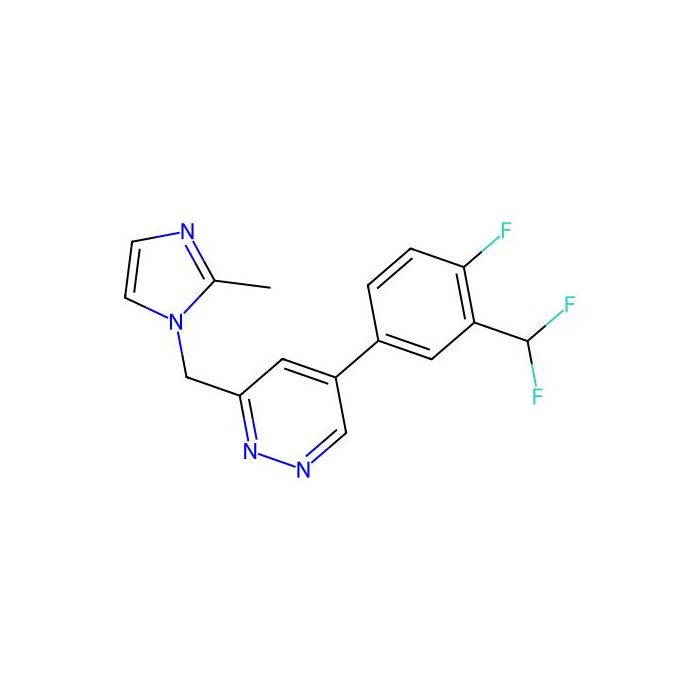
This compound belongs to the class of organic compounds known as phenylpyridazines. These are organic compounds containing a pyridazine ring substituted by a phenyl group.
External Descriptors
Not available
1. Djoumbou Feunang Y, Eisner R, Knox C, Chepelev L, Hastings J, Owen G, Fahy E, Steinbeck C, Subramanian S, Bolton E, Greiner R, and Wishart DS. ClassyFire: Automated Chemical Classification With A Comprehensive, Computable Taxonomy. Journal of Cheminformatics, 2016, 8:61.
Certificats (CoA, COO, BSE/TSE et tableau d'analyse)
C of A & Other Certificates(BSE/TSE, COO):
Analytical Chart:
Propriétés chimiques et physiques
Poids moléculaire
318.300 g/mol
XLogP3
2.300
Hydrogen Bond Donor Count
0
Hydrogen Bond Acceptor Count
6
Rotatable Bond Count
4
Exact Mass
318.109 Da
Monoisotopic Mass
318.109 Da
Topological Polar Surface Area
43.600 Ų
Heavy Atom Count
23
Formal Charge
0
Complexity
384.000
Isotope Atom Count
0
Defined Atom Stereocenter Count
0
Undefined Atom Stereocenter Count
0
Defined Bond Stereocenter Count
0
Undefined Bond Stereocenter Count
0
The total count of all stereochemical bonds
0
Covalently-Bonded Unit Count
1
Calculateurs de solution
Molarity Calculator
Determine the necessary mass, volume, or concentration for preparing a solution.
Dilution Calculator
Determine the dilution needed to prepare a stock solution.
Reconstitution Calculator
Avis
Avis des clients
Application Protocols
Item-specific (from Product Data):
No validated application protocols are provided for this product. It is supplied for research use only.
General assay setup guidance for small-molecule NMDAR ligands (not item-specific):
Stock preparation: Dissolve EVT-101 free base in anhydrous DMSO to 10–50 mM. Store small aliquots to avoid freeze–thaw and adsorption losses.
Working solutions: Prepare serial dilutions in assay buffer immediately before use. Maintain constant DMSO across all wells/samples (commonly 0.03–0.3% v/v).
Calcium imaging assay: Use cultured neurons or GluN2B-expressing cell lines. Pre-load with a calcium indicator dye; stimulate with glutamate/glycine under Mg2+-controlled conditions; assess inhibition profile across a concentration range.
Electrophysiology (whole-cell patch clamp): Express defined NMDAR subunits; apply ligand by fast perfusion; record current inhibition and kinetics. Include vehicle and positive control antagonists.
Radioligand binding: Perform displacement assays using membranes expressing NMDAR subunits with an appropriate radiolabeled ligand; fit binding isotherms for apparent affinity.
Data quality tips:
Verify solubility at the highest test concentration; inspect for precipitation.
Mitigate adsorption by using low-binding plates or glass vials.
Run replicate curves on different days and include inter-assay controls to monitor performance.
For definitive, product-specific instructions (e.g., recommended dilutions, tested applications), refer to the CoA/Spec Sheet if provided.
Biological Roles
Item-specific (from Product Data):
Research use note: For research use only.
Literature/general (for context; not a medical claim):
EVT-101 is described in the literature as a selective small-molecule ligand of the N-methyl-D-aspartate receptor (NMDAR), with preferential activity toward receptors containing the GluN2B (NR2B) subunit. Such molecules are used to probe excitatory neurotransmission and synaptic plasticity pathways in neurons.
By modulating NMDAR function, NR2B-selective ligands enable dissection of subunit-specific signaling, calcium influx dynamics, and downstream pathways including CaMKII/CREB-related transcriptional responses in neuronal cultures and brain slices.
Typical research applications include: pharmacological validation of receptor subunit composition, separation of synaptic versus extrasynaptic NMDAR contributions, and establishing selectivity profiles against other ionotropic glutamate receptors (AMPA/kainate) or other NMDAR subunits (GluN2A/2C/2D).
Considerations in biological systems:
Off-target binding can occur with CNS-active chemotypes; comprehensive profiling is advised when interpreting phenotypes.
Free base vs salt can influence uptake and apparent potency in cells due to pH-dependent ionization and membrane partitioning; maintain controlled buffer pH and consistent vehicle conditions.
Documentation and controls:
Employ positive controls (well-characterized NR2B ligands) and negative controls (inactive analogs or vehicle) to benchmark responses.
Use orthogonal readouts (radioligand binding, calcium imaging, patch clamp) to confirm mechanism.
Buffer Applications
Applicability statement:
EVT-101 is a bioactive small molecule rather than a buffering agent. It is not used to maintain pH or ionic strength. This section provides practical notes on incorporating the compound into biological buffers for assays.
Practical guidance (general, not item-specific):
Vehicle: Prepare concentrated stocks in DMSO; dilute into assay buffer (e.g., HEPES-, Tris-, or phosphate-buffered saline) immediately before use.
pH considerations: For free bases, solubility often increases at mildly acidic pH due to protonation. Avoid large pH shifts that could perturb receptor function; maintain physiological pH (7.2–7.4) for neuronal assays unless protocol dictates otherwise.
Minimizing precipitation:
Add compound solution slowly to vigorously mixed buffer.
Keep final DMSO fraction consistent across samples (commonly 0.03–0.3% v/v) and validated for your system.
Include small amounts of non-ionic surfactant (e.g., 0.01% Pluronic F-127) only if compatible and needed to reduce aggregation.
Adsorption control: Pre-rinse plastics with buffer containing the same DMSO percentage; consider glass vials for working solutions if losses are suspected.
Not specified for this item; refer to CoA/Spec Sheet for any product-specific buffer compatibility notes, pH stability ranges, or recommended vehicles if provided.
Green Alternatives
Context:
As a bioactive small molecule, EVT-101 is not a process solvent or bulk reagent; therefore, “green alternatives” considerations mainly concern solvent choices and handling practices during assay preparation rather than replacement of the compound itself.
Greener handling strategies (general, not item-specific):
Prefer DMSO over DMF/NMP where feasible due to comparatively better toxicity profile and biodegradability data, keeping final assay concentrations as low as practical (≤0.1–0.5% v/v).
Use aqueous buffers with minimal organic cosolvent when solubility allows (pH-adjusted to increase solubility of free bases).
Minimize single-use plastics; use glass vials for stock storage to reduce adsorption and waste. Employ low-dead-volume tips to cut solvent usage.
Scale solutions to immediate need to reduce disposal volumes; segregate halogenated and non-halogenated organic waste streams.
Comparison of common solvent choices (general):
DMSO: high solvency, lower volatility and flammability; potential skin absorption enhancer—use good PPE.
Ethanol/Isopropanol: greener but lower solvency for many heteroaromatic amines; may be suitable for intermediate dilutions or cleaning.
DMF/NMP: powerful but with reproductive toxicity concerns; avoid when alternatives suffice.
Process chemistry note:
If EVT-101 were used in synthetic steps (less common for a finished tool compound), consider alternative greener solvents (2-MeTHF, CPME, propylene carbonate) for ancillary operations such as salt formation or recrystallization, validating purity and polymorph outcomes.
Pharmaceutical Uses
Applicability statement:
This product is supplied strictly for research use only. It is not an excipient and is not approved for human or veterinary use, clinical diagnostics, or therapeutic applications.
Literature/general context (not a claim for this product):
Small-molecule NMDAR modulators, including NR2B-selective ligands, have been investigated in preclinical/early development settings as pharmacological tools. In formulation research, free base versus salt forms can be compared to assess solubility, stability, and developability characteristics.
Formulation research considerations (general):
Salt screening: If converting the free base to a salt for internal research, common pharmaceutically acceptable acids (e.g., HCl, fumaric, maleic, mesylate) may alter solubility and solid-state form. Characterize resulting salts by DSC, PXRD, and moisture sorption.
Enabling formulations: For in vivo exploratory studies (non-clinical research), co-solvent systems (e.g., PEG400/EtOH/saline), cyclodextrin inclusion, or lipid-based vehicles are sometimes used to enhance apparent solubility of hydrophobic amines. Evaluate pH, osmolality, and vehicle tolerability in the relevant model.
Stability: Monitor for oxidative or hydrolytic degradation under stressed conditions; protect from light and air as needed.
Compliance note:
No compendial (USP/EP) monographs are implied for this item. Any formulation or dosing studies must remain within non-clinical research frameworks and comply with institutional and regulatory policies.
Physical Properties
Item-specific (from Product Data):
Appearance: Not specified for this item; refer to CoA/Spec Sheet.
Grade/Purity: Not specified for this item; refer to CoA/Spec Sheet.
Molecular weight: Not specified for this item; refer to CoA/Spec Sheet.
Aggregation and solubility: Small-molecule amine free bases of this class are commonly sparingly soluble in water at neutral pH, with markedly increased solubility in polar aprotic organic solvents (e.g., DMSO) and in aqueous buffers upon acidification (formation of soluble protonated species).
Stock solutions: Typical screening compounds are prepared as 10–50 mM stocks in anhydrous DMSO, then diluted into assay buffers; precipitation risk rises as the neutral free base fraction increases (higher pH, lower cosolvent).
Partitioning: Basic, aromatic research ligands often exhibit moderate-to-high logP/logD at pH 7.4, affecting membrane permeability and nonspecific binding; exact values for EVT-101 should be sourced from primary literature or the CoA.
Melting range, boiling point, density, refractive index, pKa: Not specified for this item; consult CoA/Spec Sheet or literature for the specific CAS (627525-33-1).
Practical notes:
If handling as a solid, allow to equilibrate to room temperature in a desiccator before opening to minimize moisture uptake.
Visually inspect solutions for haze or precipitate after dilution into aqueous media; gentle warming (≤37 °C) and sonication can aid dissolution if compatible with your assay.
Quality and Grades
Item-specific (from Product Data):
Grade/Purity: Not specified for this item; refer to CoA/Spec Sheet.
Supplied form: Free base (neutral form), facilitating dissolution in organic solvents and enabling user-controlled salt formation if desired for specific applications.
General guidance on quality for small-molecule screening compounds (not item-specific):
Research-grade small molecules are typically qualified by LC–MS purity (area %), supported by 1H NMR, and occasionally HRMS/elemental analysis. Low non-volatile residue and low water content are preferred for accurate weighing and solution preparation, but exact specifications are item-dependent.
If UV-based assays are planned, low-UV-absorbing impurities are important. Where “HPLC grade” is mentioned for solvents, it implies minimized UV background; for solids like EVT-101, rely on chromatographic purity data.
Free base vs salt: The free base offers flexibility in preparing custom salts (e.g., HCl, mesylate) for solubility tuning. Verify stoichiometry and counterions if converting forms.
What to check on the CoA for this item:
Identity confirmation (NMR/MS), purity (%), water content (if reported), residual solvents, and any stabilizers.
Recommended retest date and storage guidance specific to this lot.
Documentation: For regulated environments, retain CoA/SDS and record in-house incoming QC (LC–MS trace, melting behavior, and potency check in a reference assay if applicable).
Reaction and Applications
Item-specific (from Product Data):
The product is offered within a “small molecules and compound libraries” category with “For research use only”. No synthetic reagent applications are specified for this item.
Applicability statement:
EVT-101 free base is primarily employed as a bioactive reference/ligand in discovery biology and pharmacology research rather than as a general-purpose synthetic reagent. As such, classical organic reaction applications (e.g., cross-coupling, Grignard) are not typically relevant for this product.
Literature/general research uses (not item-specific; see also Target Specificity):
Tool compound for mechanistic studies of ionotropic glutamate receptors in neuronal systems.
Comparative control in screening cascades evaluating selectivity versus related receptor subtypes.
Practical guidance for biological applications:
Prepare concentrated DMSO stocks and perform serial dilutions into assay buffer immediately before use to minimize adsorption losses and degradation.
Use polypropylene labware to limit adsorption; glass may be preferable for long-term stock storage.
Include vehicle controls at matched DMSO concentrations; confirm lack of precipitation at assay temperature and ionic strength.
Note: If you intend to derivatize or immobilize EVT-101 for probe development, consult original structural literature and perform small-scale feasibility studies; reactivity of the free base amine (if present) may allow linker attachment, but exact functional groups must be confirmed from the CoA or primary references.
Reaction Conditions
Applicability statement:
Not typically applicable. EVT-101 free base is used as a bioactive tool compound rather than as a substrate/reagent in synthetic transformations.
If chemical modification is pursued for probe generation (general guidance only; verify functional groups from CoA/literature):
Solvents: Dry acetonitrile, DCM, DMF, or DMSO depending on reaction type and solubility.
Bases/Acids: Mild organic bases (DIPEA, TEA) for acylations/alkylations of amines; non-nucleophilic bases (Hünig’s base) when selectivity is required. Avoid strong acids/bases that can cause ring opening or demethylation of sensitive heteroaromatics.
Temperatures: 0–25 °C for acylations/urea formations; 25–60 °C for SNAr or reductive aminations as compatible with stability.
Catalysts: For reductive amination, NaBH3CN or picoline borane in protic/aprotic media; for urea/carbamate formation, activated carbonates (e.g., DSC, CDI) under anhydrous conditions.
Workup: Quench carefully; remove residual reagents that may interfere with bioassays (e.g., CDI byproducts). Finish with preparative HPLC and thorough drying.
Note:
These conditions are generic and provided for context. They are not specific to EVT-101, and suitability must be confirmed experimentally.
Safety and Handling
Item-specific (from Product Data):
GHS classification: Not specified for this item; refer to SDS.
Signal word / H-statements / Pictograms: Not specified for this item; refer to SDS.
Storage conditions: Room temperature (per Product Data). Protect from light and moisture as general good practice for small-molecule libraries unless otherwise stated on CoA.
General laboratory precautions (not item-specific; follow your institutional EHS and the product SDS):
PPE: Use lab coat, safety glasses, and appropriate chemically resistant gloves (e.g., nitrile). Handle powders in a fume hood to avoid inhalation of dust or aerosols.
Avoid ingestion, inhalation, and skin contact. Prevent environmental release. Use secondary containment for solutions, especially DMSO stocks which can enhance dermal absorption of solutes.
First aid (general): If on skin or in eyes, rinse with water for ≥15 minutes and remove contaminated clothing; if inhaled, move to fresh air; if swallowed, rinse mouth. Seek medical attention per SDS guidance.
Incompatibilities: Strong oxidizers and strong acids/bases may cause degradation; avoid prolonged exposure to heat, light, and moisture. For amine free bases, avoid contact with acid chlorides/anhydrides unless intended for derivatization.
Waste & spill response:
Collect spills with inert absorbent; dispose via licensed chemical waste contractor. Do not discharge to drains. Decontaminate surfaces with appropriate solvent, followed by detergent and water.
Definitive safety information resides in the current SDS for this CAS/product; always consult the SDS prior to use.
Solvent Selection
Item-specific (from Product Data):
No specific solvent recommendations are provided. Storage at room temperature is indicated.
Literature/general practices for basic, heteroaromatic small molecules (apply with verification for EVT-101):
Primary solvent for stocks: Anhydrous DMSO (typical 10–50 mM). Offers broad solvating power and compatibility with biochemical and cell-based assays at ≤0.1–0.5% v/v final DMSO.
Alternative strong solvents: DMF, NMP. Use only if compatible with the assay system and plastics in use.
Aqueous solubility: Often limited at neutral pH for free bases; increases in mildly acidic buffers (e.g., 10–50 mM acetate or citrate, pH 4.5–6) due to protonation. Beware of assay interference from pH shifts.
Miscibility/partitioning: Expect strong partitioning into membranes and plastics; precondition pipette tips and assay plates with solvent or surfactant-containing buffer when accurate low-µM dosing is required.
Selection tips:
For receptor-binding or electrophysiology assays, keep final DMSO low to protect cell integrity and channel function; validate vehicle controls at the same DMSO content.
For in vitro enzyme assays, screen in buffered aqueous media with a small DMSO fraction; monitor for precipitation by light scattering or visual inspection.
Comparison (general):
DMSO: highest solvency, broadly compatible; may extract plasticizers and permeate skin.
DMF/NMP: potent solvents but higher toxicity and potential assay interference; use sparingly.
Alcohols (MeOH/EtOH): moderate solvency; can be acceptable for intermediate dilutions if compatible with the assay.
Storage and Reconstitution
Item-specific (from Product Data):
Storage condition: Room temperature.
Shipped in: Not specified for this item; refer to CoA/Spec Sheet.
Appearance: Not specified for this item; refer to CoA/Spec Sheet.
General reconstitution guidance for small-molecule free bases (not item-specific):
Upon receipt, allow container to reach room temperature before opening. Handle solids in a dry environment to limit moisture uptake.
Prepare a concentrated stock in anhydrous DMSO (typical 10–50 mM). Mix gently to dissolve; brief sonication or warming to 25–37 °C can aid dissolution if compatible with stability.
Filter sterilization (0.22 µm PTFE) may be used for cell-based assays if needed, recognizing possible adsorption losses; alternatively, prepare fresh sterile stocks in a biosafety cabinet.
Aliquot stocks into amber vials or low-bind tubes to minimize light exposure and adsorption. Store tightly capped. If freezing aliquots, avoid repeated freeze–thaw cycles; thaw at room temperature and vortex to re-homogenize.
Stability monitoring:
Periodically check for discoloration or precipitate. Confirm potency/purity by LC–MS before critical experiments, especially after extended storage.
Disposal:
Dispose of expired or unused solutions via appropriate organic waste streams in accordance with institutional and local regulations.
Structure and Identity
Item-specific (from Product Data):
Product name: EVT-101 free base (SKU: E669223)
CAS: 627525-33-1
Category: Small molecules and compound libraries (研究/筛选用途)
Storage: Room temperature
InChIKey: 30484 (note: provided string appears incomplete; see CoA/Spec Sheet)
SMILES: Not specified for this item; refer to CoA/Spec Sheet.
Molecular formula: Not specified for this item; refer to CoA/Spec Sheet.
Molecular weight: Not specified for this item; refer to CoA/Spec Sheet.
Literature/general notes (not item-specific):
EVT-101 is reported in the literature as a small-molecule, nitrogen-containing heteroaromatic scaffold used as a selective ligand for ionotropic glutamate receptor subtypes (see Target Specificity tab). 2D depictions typically show an aromatic/heteroaromatic core with basic amine functionality consistent with a “free base” form.
“Free base” indicates the neutral, non-salt form; protonation state will vary with pH in solution.
Structural features (general, based on literature character of the chemotype; verify against the CoA for this lot):
Likely contains one or more aromatic/heteroaromatic rings and a basic amine center enabling salt formation; H-bond acceptors/donors and lipophilicity will influence CNS-relevant ADME in research models.
Identity verification guidance (general best practice):
Confirm identity by LC–MS (exact mass), 1H/13C NMR, and, if applicable, HRMS. Compare to reference spectra from reputable databases for the exact CAS/CID listed above.
Synthetic Utility
Applicability statement:
EVT-101 free base is sold as a finished bioactive research compound. It is not typically used as a synthetic building block or reagent.
General considerations (if derivatization is contemplated for probe development; verify structure first from CoA/literature):
The “free base” designation suggests the presence of a basic nitrogen that could be derivatized (e.g., acylation, alkylation) or converted to a salt. Any modification risks altering receptor affinity/selectivity; SAR must be re-established.
Installation of linkers for biotinylation or photoaffinity tags typically targets solvent-exposed positions identified by docking or SAR data; confirm that functionalization does not disrupt key pharmacophore features required for NR2B binding.
For immobilization or pull-down assays, consider carbamate/urethane linkages or amide couplings if an aniline/alkylamine is present; optimize spacer length to preserve activity.
Practical tips:
Conduct small-scale test reactions and analyze by LC–MS to ensure clean conversions without over-alkylation or degradation of heteroaromatic cores.
Purify derivatives by preparative HPLC to remove closely related impurities that may confound biological readouts.
If no derivatization is planned, this section is not typically applicable; focus on Biological Roles, Target Specificity, and Application Protocols.
Target Specificity
Item-specific (from Product Data):
No target data are provided on the product page.
Literature/general (for scientific context; verify with primary sources for your use case):
EVT-101 has been reported as a selective modulator/antagonist of the NMDA receptor with preference for the GluN2B (NR2B) subunit-containing receptors. Such ligands typically bind within the receptor’s channel-associated or allosteric binding domains and are used to parse subunit-specific functions in neuronal systems.
Species: Binding and functional data are commonly generated in human and rodent receptor systems expressed heterologously or in native neurons.
Selectivity: Researchers generally benchmark against GluN2A, GluN2C, and GluN2D subunits and against other ionotropic glutamate receptors to confirm NR2B selectivity. Quantitative Ki/IC50 values are assay-dependent and should be obtained from the primary literature for the exact structure and conditions.
Experimental controls:
Include reference NR2B ligands and pan-NMDAR antagonists as comparators.
Confirm mechanism with orthogonal assays (radioligand displacement, calcium imaging, patch-clamp recordings) to distinguish channel block from allosteric modulation.
Caution:
Potency and selectivity can depend on temperature, Mg2+/glycine levels, and expression systems; replicate key findings under your assay conditions.
We use cookies to ensure the website functions properly and, where permitted, to improve your experience. You can manage your preferences at any time in Settings. Learn more in our Cookie Policy.
Shall we send you a message when we have discounts available?
Remind me later
Thank you! Please check your email inbox to confirm.
Products are supplied to verified businesses, institutions, and qualified professionals for research and development use only. Not for use in humans, animals, diagnosis, or therapy.