
Linear and Angular Furanocoumarin Scaffolds: Conjugated Structures, Dual-Site Photoaddition, and DNA Cross-Linking
Linear and Angular Furanocoumarin Scaffolds: Conjugated Structures, Dual-Site Photoaddition, and DNA Cross-Linking
Introduction
Furanocoumarins are a class of tricyclic compounds formed by the further fusion of a five-membered oxygen-containing heterocycle onto the benzene ring of coumarin. Unlike the hydroxylation, methoxylation, or alkylation of simple coumarins, fusion of an aromatic furan ring directly changes the ring connectivity, molecular rigidity, and π-electron system of the parent scaffold, while creating a furan-side 4′,5′ double bond in addition to the original coumarin 3,4 double bond. Common natural furanocoumarin structures mainly include the linear psoralen type and the angular angelicin type. The principal difference between these two scaffolds is the position at which the five-membered furan ring is fused to the benzene ring of coumarin.[1,2]
In the linear psoralen type, the furan ring is fused primarily across coumarin C6-C7, forming a relatively extended tricyclic scaffold; in the angular angelicin type, it is fused primarily across C7-C8, producing a bent tricyclic outline.[2] Psoralen and angelicin have the same molecular formula, C₁₁H₆O₃, but differ in their ring-connectivity topology. Consequently, they exhibit marked differences in molecular geometry, the relative orientation of their reactive double bonds, and their typical photochemical behavior.
1 Fusion of the Five-Membered Furan Ring and Scaffold Types
1.1 Expansion of the Coumarin Parent Scaffold into a Tricyclic System
Coumarin itself consists of a benzene ring fused to an α-pyrone ring. In furanocoumarins, an additional five-membered furan ring is formed on the benzene ring; the three rings share some carbon atoms and constitute a highly rigid fused system.
In aromatic furanocoumarins, one lone pair on the furan oxygen participates in the aromatic π system of the five-membered ring. Once the five-membered furan ring has become aromatic and fused with coumarin, more continuous π-orbital coupling is established among the furan ring, benzene ring, and α-pyrone moiety. Compared with a flexible prenyl side chain, ring fusion also restricts the free rotation of the new structure relative to the coumarin parent scaffold, thereby altering both the extent of electron delocalization and the conformational freedom of the molecule.[1]
This structural change can be summarized as follows:
Bicyclic coumarin parent scaffold → fused aromatic five-membered oxygen-containing heterocycle → restricted conformational freedom and expanded π-orbital coupling
→ increased rigidity and an extended planar conjugated scaffold → formation of a new furan-side 4′,5′ unsaturated reactive site.
1.2 Linear Psoralen and Angular Angelicin
The distinction between linear and angular forms refers to the position at which the five-membered furan ring is fused to the benzene ring of coumarin and to the resulting molecular outline.
Scaffold type | Principal fusion position | Representative parent compound | Structural outline | Principal structural features |
Linear psoralen type | C6-C7 | Psoralen | Relatively extended | The furan ring and α-pyrone ring are situated on opposite sides of the central benzene ring |
Angular angelicin type | C7-C8 | Angelicin | Bent | The furan ring and α-pyrone ring are arranged angularly |
A 2024 review of furanocoumarins classified C6-C7 fusion as the linear psoralen structure and C7-C8 fusion as the angular angelicin structure.[2]
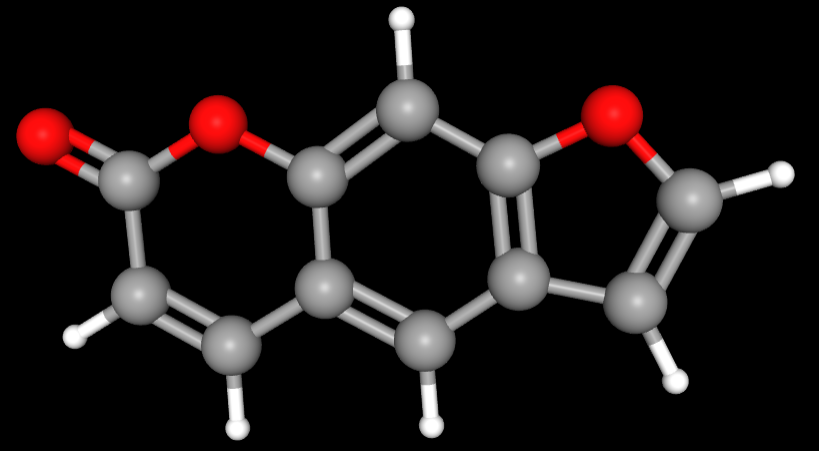
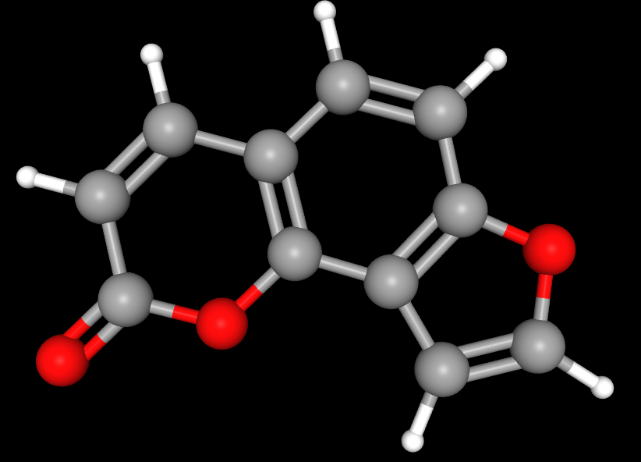
Scaffold structures of linear psoralen and angular angelicin. The structure on the left is psoralen, and that on the right is angelicin. The two compounds have the same basic elemental composition but differ in the position of furan-ring fusion. Linear psoralen has a relatively extended tricyclic scaffold, whereas angular angelicin has a bent molecular outline. A change in ring connectivity also changes the relative spatial orientation of the furan-side 4′,5′ double bond and the α-pyrone-side 3,4 double bond within the entire molecule. This geometric difference is one of the important structural factors underlying the distinct typical photoaddition behaviors of the two scaffold types.[2]
1.3 Distinction Between Dihydrofuranocoumarins and Aromatic Furanocoumarins
The formation of a five-membered oxygen-containing ring does not necessarily mean that the ring already possesses a fully aromatic furan electronic structure.
Marmesin is a typical dihydrofuranocoumarin. Its five-membered ring still contains a saturated carbon atom and therefore cannot form the same fully continuous aromatic π system as psoralen.
In psoralen biosynthesis, marmesin can undergo oxidative carbon-chain cleavage catalyzed by psoralen synthase, accompanied by aromatization of the furan ring, ultimately yielding psoralen.[1] This transformation can be summarized as follows:
Partially saturated five-membered ring → enzymatic oxidation and carbon-chain cleavage → aromatization of the furan ring → formation of the psoralen 4′,5′ double bond and tricyclic conjugated system.
2 Effects of Fusion Topology on the Conjugated System and Molecular Geometry
2.1 Ring Fusion Increases Rigidity and Restricts Conformational Changes
When a prenyl group or another side chain is attached to the benzene ring of a simple coumarin, the side chain usually retains one or more rotatable single bonds. Fusion of the furan ring instead fixes a carbon chain that might otherwise possess conformational freedom into a five-membered ring sharing two carbon atoms with coumarin.
The main resulting changes include:
①a decrease in the number of rotatable bonds;
②high rigidity of the tricyclic core;
③structural constraint on the relative orientation of the π orbitals;
④fixation of the furan-side double bond in a defined spatial position.
Rigidity and planarity affect not only electronic transitions but also the stacking and intercalation behavior of furanocoumarins with other planar aromatic systems.
2.2 An Expanded Conjugated System Does Not Necessarily Mean a Fixed Bathochromic Shift
After the furan ring becomes aromatic and fuses with coumarin, the number of atoms participating in π-electron delocalization increases. However, the absorption position is determined by the actual energy gap between the ground and excited states; it cannot be inferred from “expansion of the conjugated system” that all furanocoumarins undergo the same degree of bathochromic shift.
Early experimental studies of psoralen and 8-methoxypsoralen showed that their ultraviolet absorption and emission properties are affected by both molecular structure and the surrounding medium.[3]
2.3 Side-Chain Substitution on the Linear Furanocoumarin Parent Scaffold
Once the psoralen scaffold is established, hydroxylation, methoxylation, or alkenyloxy substitution may occur at different positions. Examples include:
①bergapten (5-methoxypsoralen);
②xanthotoxin (also known as methoxsalen; 8-methoxypsoralen);
③isopimpinellin (5,8-dimethoxypsoralen);
All three retain the linear psoralen parent scaffold fused across C6-C7 and differ only in the positions and number of methoxy groups.[1,2]
Imperatorin (8-prenyloxypsoralen), isoimperatorin (5-prenyloxypsoralen), and bergamottin (5-geranyloxypsoralen) all retain the linear psoralen parent scaffold.[1] The prenyloxy groups of imperatorin and isoimperatorin are attached at C8 and C5, respectively, whereas bergamottin bears a longer geranyloxy carbon chain at C5.
The prenyloxy and geranyloxy groups are connected to the parent scaffold through an oxygen atom and introduce side chains containing rotatable single bonds outside the rigid tricyclic scaffold. Variations in side-chain length and attachment position alter the nonpolar surface area, conformational freedom, and local spatial shape of the molecule, thereby affecting solvation, molecular stacking, and hydrophobic interactions.
3 Light Absorption, Excited States, and Molecular Preorganization
3.1 Excitation by Long-Wavelength Ultraviolet Light
Psoralen-type compounds can absorb light in the ultraviolet A (UVA) region. After absorbing a photon, a molecule enters an excited state from the ground state and may subsequently undergo internal conversion, intersystem crossing, energy dissipation, or a chemical reaction.[3,4]
Light absorption alone does not guarantee the formation of a photoadduct. Effective covalent reaction also requires:
absorption of a photon of an appropriate wavelength
→ formation of a reactive excited state with a sufficiently long lifetime
→ approach to the reaction substrate
→ suitable orientations of the two double bonds for bond formation
→ photocycloaddition.
3.2 Planar Tricyclic Structure and Deoxyribonucleic Acid Intercalation
Deoxyribonucleic acid (DNA) is a well-characterized experimental system for studying photochemical structure–property relationships in psoralens.
Psoralens possess a relatively planar tricyclic conjugated scaffold that can intercalate between adjacent DNA base pairs. Using an oligonucleotide model containing a 5′-TA site, Spielmann et al. characterized the local conformational changes in DNA accompanying the conversion of a psoralen derivative from a furan-side monoadduct to an interstrand cross-link.[5] After intercalation into DNA, either the furan-side 4′,5′ double bond or the α-pyrone-side 3,4 double bond of psoralen can approach the C5=C6 double bond of thymine, providing the spatial conditions required for subsequent [2+2] photocycloaddition.[4–6]
The role of this noncovalent preorganization is as follows:
planar fused scaffold → entry into the base-stacking region → restriction of molecular translation and rotation → increased probability that the photoreactive double bond and the pyrimidine double bond attain a suitable distance and orientation.
Photoaddition is still influenced by substituents, excited-state lifetime, and the local DNA conformation.
3.3 Positions of Small Substituents and Photoaddition Pathways
In DNA systems rich in adenine–thymine base pairs, photoaddition of 8-methoxypsoralen (8-MOP) and 4,5′,8-trimethylpsoralen (TMP) occurs mainly on the furan side. Time-resolved spectroscopic results show that both proceed through a psoralen-localized triplet excited state and a triplet biradical intermediate before forming photoaddition products.[4]
5-Methoxypsoralen (5-MOP) exhibits different regioselectivity. Infrared spectroscopic results support the predominant formation of a pyrone-side photoaddition product; this product lacks a characteristic signal suitable for real-time monitoring within the ultraviolet–visible detection range used in the study, and its formation process was therefore not directly resolved by the same transient absorption method.[4]
Methoxy substitution at C5 or C8 and multiple methyl substitutions are associated with differences in photoaddition regioselectivity and excited-state reaction processes. The specific reaction outcome is also affected by the DNA-binding state, excitation conditions, and triplet-state formation efficiency.[4]
4 Two Unsaturated Sites and [2+2] Photocycloaddition
4.1 Furan-Side 4′,5′ Double Bond
The aromatic psoralen parent scaffold contains a furan-side 4′,5′ double bond. Under suitable photoexcitation and spatial arrangement, this double bond can undergo [2+2] photocycloaddition with the C5=C6 double bond of thymine, generating a covalent monoadduct containing a cyclobutane structure.[5,6]
4.2 α-Pyrone-Side 3,4 Double Bond
The second photoreactive site in psoralen is the 3,4 double bond of the α-pyrone ring. This double bond can likewise undergo [2+2] photocycloaddition with the C5=C6 double bond of a pyrimidine. Psoralen can therefore form two types of monoadduct:
①Furan-side monoadduct: involving the 4′,5′ double bond;
②Pyrone-side monoadduct: involving the 3,4 double bond.
The two types of monoadduct do not have identical subsequent photochemical properties. Experimental and structural studies show that, under suitable conditions, a furan-side monoadduct can absorb a second photon, allowing the unreacted 3,4 double bond to react further with thymine on the other DNA strand and thereby form an interstrand cross-link; pyrone-side monoadducts generally lack the same capacity for a second photochemical reaction.[5,6]
5 Monoadduct Formation and Interstrand Cross-Linking by Linear and Angular Scaffolds
5.1 Sequential Two-Step Photoreaction of Linear Psoralen
After linear psoralen forms a furan-side monoadduct, if the unreacted 3,4 double bond remains close to a pyrimidine on the other DNA strand, absorption of a second photon can drive a second [2+2] cycloaddition.[5,6]
The process can be represented as follows:
intercalation of linear psoralen into DNA → first photoexcitation → furan-side monoadduct → remaining 3,4 double bond retained in a suitable spatial position
→ second photoexcitation → bond formation with thymine on the opposite strand → DNA interstrand cross-link.
Lai et al.[6] quantitatively measured monoadducts and DNA interstrand cross-link products formed by 8-MOP after UVA irradiation in human cells, confirming that the same linear psoralen derivative can generate covalent photoproducts at different reaction stages.
5.2 Typical Monofunctional Photoaddition of Angular Angelicin
Angelicin likewise contains unsaturated structures on both the furan side and the α-pyrone side, but C7-C8 angular fusion changes the overall molecular outline and the relative spatial orientation of the two reactive sites.
In a classic study, Bordin et al. found that angelicin could form covalent photoadducts with pyrimidine bases in DNA upon irradiation with long-wavelength ultraviolet light, but under the corresponding experimental conditions it predominantly formed monofunctional adducts and did not exhibit the DNA interstrand cross-linking behavior typical of linear psoralen.[7]
The effects of the angular structure are mainly reflected in the following sequence:
change in fusion position → conversion of the molecular outline from relatively extended to bent
→ altered spatial orientation of the remaining reactive double bond after the first photoaddition → reduced probability of simultaneously satisfying the distance and orientation requirements of the second DNA strand → predominance of monoadducts under typical conditions.
5.3 Condition Dependence of Cross-Linking by Angular Furanocoumarins and the Effect of Trimethyl Substitution
Angelicin generally forms mainly monoadducts in conventional DNA photoreaction systems.[7] However, this conclusion is system-dependent. In an in situ system involving folded DNA within bacteriophage λ heads, Kittler et al. interpreted angelicin/UVA-induced inhibition of injection as possibly resulting from DNA cross-linking and considered this bifunctional reaction to be subject to a special DNA conformational constraint that may not occur in dilute aqueous DNA solutions.[8]
4,6,4′-Trimethylangelicin exhibits different photochemical properties. Bordin et al. detected DNA interstrand cross-links induced by this compound in Chinese hamster ovary cells; under the experimental conditions, the level of cross-linking was approximately 15% of that produced by 8-methoxypsoralen. HeLa cell experiments using a two-step irradiation method also supported this result.[8] In the same study, 4′-methylangelicin and 4,4′-dimethylangelicin did not exhibit corresponding interstrand cross-linking ability.[9]
These results indicate that angular fusion generally restricts the geometric relationship required for a second photoaddition, but this does not mean that all angular furanocoumarins can undergo only monofunctional photoreactions. Combined methyl substitution at the 4, 6, and 4′ positions can confer a degree of interstrand cross-linking ability on 4,6,4′-trimethylangelicin, whereas fewer methyl substituents do not produce the same result.[9]
Existing experimental results are insufficient to attribute independently the specific structural factors that alter the probability of a second photoaddition to electronic effects, steric hindrance, or local DNA conformation.
6 Further Modulation of Physicochemical Properties and Photoreactivity by Substituents
6.1 Methoxy-Group Position Alters Excited-State Reaction Pathways
Bergapten is 5-methoxypsoralen, whereas xanthotoxin is 8-methoxypsoralen. The two compounds have the same molecular formula, the same linear tricyclic scaffold, and the same number of methoxy groups; they differ only in the position of the methoxy group.
This structural variation simultaneously changes:
①the pathway through which the methoxy group donates electron density into the π system;
②the local electron density of the frontier orbitals;
③the relative excited-state reactivity of the two photoreactive double bonds;
④local spatial interactions with the surrounding medium and DNA.
Diekmann et al. observed that 5-MOP and 8-MOP formed different predominant photoproducts, providing experimental evidence that positional isomerism directly alters the photoreaction pathway.[4]
6.2 Multiple Methyl Substituents Affect Both Electronic and Hydrophobic Properties
4,5′,8-Trimethylpsoralen (TMP) contains three additional methyl groups on the psoralen parent scaffold. Methyl groups can modulate local electron density through inductive effects and hyperconjugation while increasing the nonpolar surface area.
In DNA photoreaction systems, both TMP and 8-MOP undergo triplet-state-mediated addition on the furan side, but their transient kinetics and reaction quantum efficiencies are not identical.[4]
6.3 Prenyloxy and Geranyloxy Groups Mainly Increase Flexible Hydrophobic Surface Area
Imperatorin and isoimperatorin bear prenyloxy groups at different positions, whereas bergamottin carries a longer geranyloxy group.[1]
These side chains are not part of the rigid conjugated framework of the tricyclic core. Their structural effects are mainly expressed as follows:
increased hydrocarbon-chain length → increased nonpolar surface area → relatively weaker hydration and stronger hydrophobic interactions;
and simultaneously:
more rotatable single bonds → greater conformational freedom → possible alteration by bulky side chains of how the tricyclic plane approaches other molecules.
As flexible long side chains are introduced, aqueous solubility, partitioning, and chromatographic retention may change markedly, but photochemical efficiency does not increase monotonically with side-chain length.
Notopterol additionally contains a hydroxyl group on its long alkenyloxy side chain. Compared with a geranyloxy structure lacking a hydroxyl group, it therefore has additional hydrogen-bonding capacity and illustrates the simultaneous presence of a “hydrophobic hydrocarbon chain” and “localized hydration by a hydroxyl group.”[10]
7 Relationships Between Structural Variables and Physicochemical and Photochemical Properties
Structural change | Change in electronic structure or molecular geometry | Principal physicochemical/photochemical outcome | Representative compound |
Addition of an aromatic five-membered furan ring to coumarin | Expanded π-orbital coupling, increased rigidity, and formation of the 4′,5′ double bond | Formation of the characteristic tricyclic furanocoumarin system and a new photoreactive site | Psoralen |
Conversion of the five-membered ring from the dihydro form to the aromatic form | Increased continuity of p orbitals in the five-membered ring | Formation of a complete furan double bond and tricyclic aromatic conjugated system | Marmesin and the psoralen-type scaffold |
Fusion of the furan ring across C6-C7 | A relatively extended scaffold with a specific spatial arrangement of the two photoreactive sites | Further formation of a diadduct is relatively favored after furan-side monoadduct formation | Psoralen and 8-MOP |
Shift of furan-ring fusion to C7-C8 | Bent scaffold and altered spatial orientations of the two reactive double bonds | Parent angelicin predominantly forms monoadducts under typical conditions | Angelicin |
Exchange of C5-OCH₃ and C8-OCH₃ positions | Altered position of electron donation and excited-state distribution | Changes in the photoreactive site and predominant photoproduct | Bergapten and xanthotoxin |
Multiple methyl substitutions | Increased hyperconjugation, hydrophobic surface area, and steric bulk | Altered excited-state kinetics, preassociation, and photoaddition efficiency | 4,5′,8-Trimethylpsoralen |
Introduction of a prenyloxy group | Addition of a flexible hydrocarbon chain and nonpolar surface area | Altered hydration and partitioning properties and increased conformational freedom | Imperatorin and isoimperatorin |
Extension of the prenyl chain to a geranyl group | Further increases in hydrophobic surface area and the number of rotatable bonds | Further changes in partitioning properties and intermolecular interactions | Bergamottin |
Addition of a hydroxyl group to the long chain | Increased local hydrogen-bonding and hydration capacity | Partitioning behavior jointly determined by the hydrophobic hydrocarbon chain and hydrophilic hydroxyl group | Notopterol |
First furan-side [2+2] addition | Conversion of the 4′,5′ double bond into a cyclobutane linkage while retaining the 3,4 double bond | Formation of a monoadduct with the potential for a second photoreaction | 8-MOP, etc. |
Second [2+2] addition | Bond formation between the remaining 3,4 double bond and a pyrimidine on the opposite strand | Formation of a DNA interstrand cross-link | Some linear psoralen derivatives |
Addition of specific substituents to the angular parent scaffold | Simultaneous changes in geometric constraints, electronic effects, and preassociation orientation | Individual angular derivatives can still produce limited interstrand cross-linking | 4,6,4′-Trimethylangelicin |
8 Representative Furanocoumarin-Related Chemicals
Table 1 Linear Psoralen Parent Scaffold and Hydroxy-, Methoxy-, and Methyl-Substituted Derivatives
Category | CAS Number | Aladdin Catalog Number | Name | Specification or Purity | Product Features and Applications |
Linear psoralen parent scaffold | 66-97-7 | Psoralen | ≥98% | The linear furanocoumarin parent scaffold; it can be used to investigate five-membered furan-ring fusion at the 6,7 positions, the tricyclic conjugated system, long-wavelength ultraviolet absorption, and photocycloaddition at the two unsaturated sites. | |
Linear 8-hydroxypsoralen | 2009-24-7 | Xanthotoxol | Analytical standard, ≥98% | Contains a free hydroxyl group at C8 and can be compared with 8-methoxypsoralen to investigate hydrogen bonding, electron distribution, ultraviolet absorption, and photochemical response before and after methylation of the hydroxyl group. | |
Linear 5-hydroxypsoralen | 486-60-2 | Bergaptol | Analytical standard | Contains a free hydroxyl group at C5 and can be paired with bergapten as a C5 hydroxy/O-methylated structural comparison to investigate the effects of substitution state on the conjugated electronic structure, hydrogen bonding, and spectroscopic properties. | |
Linear 5-methoxypsoralen | 484-20-8 | Bergapten | Moligand™, ≥98%(GC) | Substituted with a methoxy group at C5; it can be compared with 8-methoxypsoralen to investigate the effects of methoxy-group position on excited-state electron distribution, ultraviolet absorption, and the reaction tendencies of the two photoreactive double bonds. | |
Linear 8-methoxypsoralen | 298-81-7 | 8-Methoxypsoralen | Moligand™, ≥98% | A representative linear compound substituted with a methoxy group at C8; it can be used to investigate long-wavelength ultraviolet excitation, furan-side photoaddition, sequential dual-site photoreactions, and methoxy-group positional effects. | |
Linear dimethoxypsoralen | 482-27-9 | Isopimpinellin | Analytical standard, ≥98% | Has 5,8-dimethoxy substitution and can be compared with monomethoxy derivatives to investigate the effects of methoxy-group number on π-electron distribution, hydrophobicity, ultraviolet absorption, and photochemical properties. | |
Linear polymethylated psoralen | 3902-71-4 | Trioxsalen | Moligand™, ≥98%(HPLC) | Multiple methyl substitutions retain the photoreactive linear psoralen scaffold; this compound can be used to investigate the effects of methyl substitution on hydrophobic surface area, excited-state processes, molecular preorganization, and photoaddition behavior. |
Table 2 Linear Side-Chain-Substituted Psoralens and Dihydrofuran Derivatives
Category | CAS Number | Aladdin Catalog Number | Name | Specification or Purity | Product Features and Applications |
Linear 5-prenyloxypsoralen | 482-45-1 | Isoimperatorin | Analytical standard, Moligand™, ≥98% | Contains a prenyloxy group at C5 and can be paired with imperatorin as a comparison of positional side-chain isomers to investigate the effects of side-chain position on molecular shape, hydrophobic interactions, ultraviolet response, and photochemical properties. | |
Linear 5-geranyloxypsoralen | 7380-40-7 | Bergamottin | Moligand™, 10 mM in DMSO | Retains the linear psoralen parent scaffold and bears a relatively long geranyloxy side chain; it can be used to investigate the effects of a flexible hydrocarbon chain on hydrophobic surface area, conformational freedom, partitioning behavior, and the spectroscopic response of the parent scaffold. | |
Linear methoxypsoralen with a dihydroxy side chain | 482-25-7 | Byakangelicin | Moligand™, ≥98% | Contains a methoxy group, a dihydroxy side chain, and a stereogenic center; it can be used to investigate the effects of side-chain hydroxylation on hydrogen bonding, hydration, conformation, and the spectroscopic properties of linear psoralen. | |
Linear methoxy-prenyloxypsoralen | 2543-94-4 | Phellopterin | ≥99% | Contains both methoxy and prenyloxy groups and can be compared with cnidilin to investigate the effects on electron distribution, hydrophobicity, conformation, and ultraviolet response after exchanging the positions of the two types of oxygen-containing substituents. | |
Linear 8-prenyloxypsoralen | 482-44-0 | Imperatorin | ≥98%(HPLC) | Contains a prenyloxy group at C8 and can be compared with isoimperatorin to investigate the effects of the same flexible side chain at different positions on molecular geometry, hydrophobic interactions, chromatographic retention, and spectroscopic properties. | |
Linear dihydrofuranocoumarin | 13849-08-6 | Marmesin | ≥98% | Contains a 2,3-dihydrofuran ring and can be compared with aromatic psoralen to investigate the effects of five-membered-ring saturation on p-orbital continuity, molecular rigidity, ultraviolet absorption, and the formation of photoreactive sites. | |
Linear methoxy-prenyloxypsoralen | 14348-22-2 | Cnidilin | ≥98% | Contains both methoxy and prenyloxy groups, with substitution positions different from those in phellopterin; it can be used in comparative studies of positional isomerism, electronic effects, hydrophobic interactions, and spectroscopic response. | |
Linear hydroxy long-chain alkenyloxypsoralen | 88206-46-6 | Notopterol | ≥98% | The linear psoralen parent scaffold bears a hydroxyl-containing long-chain alkenyloxy group and can be used to investigate conformation, partitioning, and spectroscopic properties under the combined influence of a long-chain hydrophobic structure and localized hydroxyl-group hydration. |
Table 3 Angular Angelicin-Type Derivatives
Category | CAS Number | Aladdin Catalog Number | Name | Specification or Purity | Product Features and Applications |
Angular 5-methoxyangelicin | 482-48-4 | Isobergapten | Analytical standard, ≥98% | An angular furanocoumarin containing a methoxy group at C5; it can be used to investigate electron distribution, ultraviolet absorption, and photoaddition behavior under the combined influence of methoxy substitution and angular fusion. | |
Angular 6-methoxyangelicin | 483-66-9 | Sphondin | Moligand™, ≥99% | An angular structure containing a methoxy group at C6; it can be compared with isobergapten to investigate the effects of methoxy-group position on the electronic properties, ultraviolet response, and photoreaction tendencies of the angular tricyclic system. | |
Angular angelicin parent scaffold | 523-50-2 | Angelicin | Moligand™, ≥98% | The angular furanocoumarin parent scaffold; it can be compared with psoralen to investigate the effects of furan-ring fusion at the 7,8 versus 6,7 positions on the molecular outline, the spatial orientations of the two reactive double bonds, and sequential photoaddition behavior. | |
Angular dimethoxyangelicin | 131-12-4 | Pimpinellin | ≥98% | Has a 5,6-dimethoxy angular structure and can be compared with monomethoxy angular compounds to investigate the effects of methoxy-group number and position on the conjugated electronic structure, hydrophobicity, ultraviolet absorption, and photochemical properties. |
Note: The above are representative Aladdin products related to scientific research. Specific applications should be determined in conjunction with product specifications, batch COAs, and the intended reaction or evaluation system. Additional information on product specifications, grades, and COAs can be retrieved from the Aladdin website using the “product name/CAS/catalog number.”
References
[1] Bruni R, Barreca D, Protti M, et al. Botanical Sources, Chemistry, Analysis, and Biological Activity of Furanocoumarins of Pharmaceutical Interest. Molecules, 2019, 24(11): 2163. DOI: 10.3390/molecules24112163.
[2] Bartnik M. Methoxyfuranocoumarins of Natural Origin—Updating Biological Activity Research and Searching for New Directions—A Review. Current Issues in Molecular Biology, 2024, 46(1): 856-883. DOI: 10.3390/cimb46010055.
[3] Yeargers E, Augenstein L. Absorption and Emission Spectra of Psoralen and 8-Methoxypsoralen in Powders and in Solutions. Journal of Investigative Dermatology, 1965, 44: 181-187. DOI: 10.1038/jid.1965.32.
[4] Diekmann J, Theves I, Thom K A, Gilch P. Tracing the Photoaddition of Pharmaceutical Psoralens to DNA. Molecules, 2020, 25(22): 5242. DOI: 10.3390/molecules25225242.
[5] Spielmann H P, Dwyer T J, Sastry S S, Hearst J E, Wemmer D E. DNA Structural Reorganization upon Conversion of a Psoralen Furan-Side Monoadduct to an Interstrand Cross-Link: Implications for DNA Repair. Proceedings of the National Academy of Sciences of the United States of America, 1995, 92(6): 2345-2349. DOI: 10.1073/pnas.92.6.2345.
[6] Lai C, Cao H, Hearst J E, Corash L, Luo H, Wang Y. Quantitative Analysis of DNA Interstrand Cross-Links and Monoadducts Formed in Human Cells Induced by Psoralens and UVA Irradiation. Analytical Chemistry, 2008, 80(22): 8790-8798. DOI: 10.1021/ac801520m.
[7] Bordin F, Marciani S, Baccichetti F R, Dall'Acqua F, Rodighiero G. Studies on the Photosensitizing Properties of Angelicin, an Angular Furocoumarin Forming Only Monofunctional Adducts with the Pyrimidine Bases of DNA. Italian Journal of Biochemistry, 1975, 24(5): 258-267. PMID: 1213877.
[8] Kittler L, Hradecná Z, Sühnel J. Cross-Link Formation of Phage Lambda DNA In Situ Photochemically Induced by the Furocoumarin Derivative Angelicin. Biochimica et Biophysica Acta, 1980, 607(2): 215-220. DOI: 10.1016/0005-2787(80)90074-X.
[9] Bordin F, Marzano C, Gatto C, Carlassare F, Rodighiero P, Baccichetti F. 4,6,4′-Trimethylangelicin Induces Interstrand Cross-Links in Mammalian Cell DNA. Journal of Photochemistry and Photobiology B: Biology, 1994, 26(2): 197-201. DOI: 10.1016/1011-1344(94)07040-7.
[10] PubChem. Notopterol, CID 5320227. National Center for Biotechnology Information.
For more related articles, see below:
Will glycosylation affect the biological activity of recombinant protein?