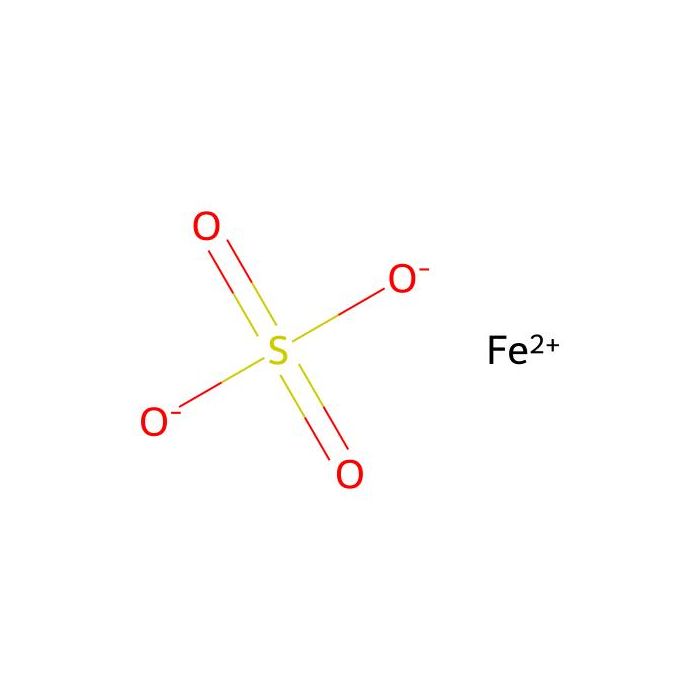
FERROUS SULFATE standard solution - 0.25mol/L in H2O , CAS No.7720-78-7

CAS: 7720-78-7 Cat. No.: F709863 Formule: FeSO4 Poids moléculaire: 151.91 Numéro CE: 231-753-5
DISPONIBLE À COMMANDE
QUALITÉ & PURETÉ 0.25mol/L in H2O
Storage
Room temperature
★
Taille
Allemagne (EU)
USA*
Prix
Qté
500ml
F709863-500ml
Sur commande · 8–12 semaines

100,57€

117,93€
Enregistrer 17,35 € (14.72%)
Enter a quantity for the sizes you want to add.
🧪
Pourquoi cette qualité

0.25mol/L in H2O pour les flux de travail chromatographiques et analytiques sensibles nécessitant une interférence de ligne de base minimale.

🌡

Stockage & expédition

Room temperature Expédition . Consultez le COA spécifique au lot pour les spécifications exactes.

📋

Documents qualité

SDS, COA, fiche technique et fiche de spécifications disponibles au téléchargement. COA spécifique au lot accessible via la recherche par numéro de lot.

📚

Preuve documentaire

Cité dans 291 publications à comité de lecture couvrant la chromatographie, la synthèse organique et les réactions de couplage croisé.

Spécifications

Spécifications et pureté
0.25mol/L in H2O
Conditions de stockage de stockage
Room temperature
Noms et identifiants
Sourires canoniques
[O-]S(=O)(=O)[O-].[Fe+2]
IUPAC Name
iron(2+);sulfate
InChIKey
BAUYGSIQEAFULO-UHFFFAOYSA-L
INCHI
1S/Fe.H2O4S/c;1-5(2,3)4/h;(H2,1,2,3,4)/q+2;/p-2
Isomères SMILES
[O-]S(=O)(=O)[O-].[Fe+2]
CAS alternatif
7720-78-7; 7782-63-0(heptahydrate),15438-31-0 (Parent)
Termes d'entrée MeSH
Aktiferrin;Apo-Ferrous Sulfate;biofer;Ceferro;Conferon;Eisendragees-ratiopharm;Eisensulfat Stada;Feospan;Fer-Gen-Sol;Fer-in-Sol;Feratab;Fero-Gradumet;Ferodan;Ferogradumet;Ferro-Gradumet;Ferrogamma;Ferrograd;FERROinfant;ferrous sulfate;ferrous sulfate, hep
Poids moléculaire
151.91

Documentation

📋 Fiche de données de sécurité (FDS)

Document complet couvrant les dangers, la manipulation, le stockage et la conformité réglementaire.

<<<<<<< HEAD Télécharger la SDS → ======= Télécharger la SDS → >>>>>>> release248-p3

✅ Certificat d'analyse (COA)

Données qualité spécifiques au lot. Saisissez votre numéro de lot pour récupérer le COA exact.

Rechercher le COA →

📊 Fiche technique

Résumé de référence rapide des spécifications et applications du produit.

Voir la fiche technique →

🔬 Fiche de spécifications

Attributs de qualité complets et critères d'acceptation pour cette qualité.

Voir la fiche de spécifications →

Données avancées

Taxonomic Classification

Taxonomy Tree

KingdomInorganic compounds
SuperclassMixed metal/non-metal compounds
ClasseTransition metal oxoanionic compounds
SubclassTransition metal sulfates
Intermediate Tree Nodes Not available
Direct ParentTransition metal sulfates
Alternative Parents Inorganic salts  Inorganic oxides  
Molecular FrameworkNot available
Substituents Transition metal sulfate - Inorganic oxide - Inorganic salt
DescriptionThis compound belongs to the class of inorganic compounds known as transition metal sulfates. These are inorganic compounds in which the largest oxoanion is sulfate, and in which the heaviest atom not in an oxoanion is a transition metal.
External Descriptors metal sulfate - iron molecular entity
Structure 3D
Modèle de structure chimique interactif


Certificats (CoA, COO, BSE/TSE et tableau d'analyse)
C of A & Other Certificates(BSE/TSE, COO):
Analytical Chart:
Propriétés chimiques et physiques
Poids moléculaire151.910 g/mol
XLogP3
Hydrogen Bond Donor Count0
Hydrogen Bond Acceptor Count4
Rotatable Bond Count0
Exact Mass151.887 Da
Monoisotopic Mass151.887 Da
Topological Polar Surface Area88.600 Ų
Heavy Atom Count6
Formal Charge0
Complexity62.200
Isotope Atom Count0
Defined Atom Stereocenter Count0
Undefined Atom Stereocenter Count0
Defined Bond Stereocenter Count0
Undefined Bond Stereocenter Count0
The total count of all stereochemical bonds0
Covalently-Bonded Unit Count2
FAQ et articles
Transition-Metal Salts/Precursor Selection Guide: How “Different Salts of the Same Metal” Start from Different Chemical Realities—and How to Reproduce Results (including a Selection Navigator and Product Tables 1–5)
Procyanidins: Structural Features and Key Points for Research and Application
Phytase: Enzymological Properties, Mechanism of Action, and Applications in Feed and Food
Chlorophyll: Structural Features, Physicochemical Properties, and Key Points for Research and Industrial Applications
Coelenterazine (CTZ) Differences and an Application Overview
Physicochemical Properties of Diphenylamine, Analytical Applications, and a Review of Its DNA Colorimetric Reaction
Types of Inorganic Salts That Can Undergo Reduction Reactions: Nitrates, Sulfur-Containing Salts, Halogen Oxyanion Salts, and Metal Salts
Comparison of Iron Content Detection Methods: TPTZ, 1,10-Phenanthroline, Ferrozine, 2,2'-Bipyridine, and Instrumental Analysis
How Do Collagen Peptides Act on the Skin? From Surface Hydration and Percutaneous Delivery to Fibroblasts and Collagen Homeostasis
What Is “Plant Collagen”? Distinguishing Ingredient Types, Structural Differences, Production Methods, and Skincare Effects
Citations of This Product
Calculateurs de solution
Avis

Avis des clients

Souhaitez-vous que nous vous envoyions un message lorsque des réductions seront disponibles?

Me rappeler plus tard

Merci ! Veuillez vérifier votre boîte de réception e-mail pour confirmer.

Oups ! Les notifications sont désactivées.