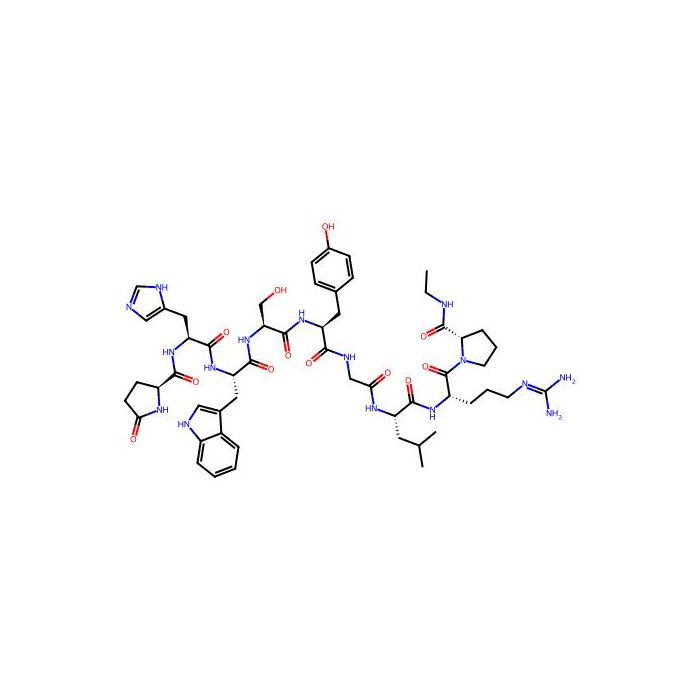
Fertirelin - ≥99% , CAS No.38234-21-8

CAS: 38234-21-8 Cat. No.: F650250 Formule: C55H76N16O12 Poids moléculaire: 1153.29 Numéro CE: 636-807-5 PubChem CID: 188304
DISPONIBLE À COMMANDE
QUALITÉ & PURETÉ ≥99%
Synonyms
Fertirelina|Fertirelin [INN:BAN]|Fertireline [INN-French]|Fertirelinum [INN-Latin]|1-9-Luteinizing hormone-releasing factor (swine),9-(N-ethyl-L-prolinamide)-|Fertirelin (INN)|Fertireline|TAP 031|Fertirelin|TAP-031|Fertirelina [INN-Spanish]|Fertirelin acetate|9-(N-Ethyl-L-prolinamide)-10-deglycinamide
Storage
Desiccated,Store at -80°C
Shipped In
Dry ice packs + Cold packs
★
Taille
Allemagne (EU)
USA*
Prix
Qté
2mg
F650250-2mg
Sur commande · 8–12 semaines
104,91€
5mg
F650250-5mg
Sur commande · 8–12 semaines
174,33€
10mg
F650250-10mg
Sur commande · 8–12 semaines
243,75€
50mg
F650250-50mg
Sur commande · 8–12 semaines
330,52€
Enter a quantity for the sizes you want to add.

Vue d’ensemble

Fertirelin is a GnRH and LH-RH analogue; it also becomes the treatment choice for reversing cow follicular cysts.

In Vivo

Fertirelin, an analog of GnRH 2.5 to 10 times more potent than native GnRH , has become the treatment of choice for reversing follicular cysts . Administration of high doses of Fertirelin is found to reduce superovulatory responses. MCE has not independently confirmed the accuracy of these methods. They are for reference only.

Animal administration

Mice iparious female mice weighed 25-28 g (8-9 weeks) are used throughout the study. The mice are ddY strain and specific pathohen-free. As ovulation can be induced in mice at any time with administration of human chorionic gonadotrophin (hCG), 5.0 IU of hCG is injected subcutaneously into each mouse at 17:00, irrespective of the stage of the estrus cycle. This day is designated as Day 0. Nine groups are established according to the dose of Fertirelin ranging from 0.001 to 1.0 μg , and the administration are carried out at 22:00 on Day 0 and at 2:00, 6:00, 10:00 and 14:00 on Day 1 . aladdin has not independently confirmed the accuracy of these methods. They are for reference only.

Form:Solid

Spécifications

Synonymes
Fertirelina | Fertirelin [INN:BAN] | Fertireline [INN-French] | Fertirelinum [INN-Latin] | 1-9-Luteinizing hormone-releasing factor (swine),9-(N-ethyl-L-prolinamide)- | Fertirelin (INN) | Fertireline | TAP 031 | Fertirelin | TAP-031 | Fertirelina [INN-Spanish] | Fertirelin acetate | 9-(N-Ethyl-L-prolinamide)-10-deglycinamide
Spécifications et pureté
≥99%
Mécanismes biochimiques et physiologiques
Fertirelin is a GnRH and LH-RH analogue; it also becomes the treatment choice for reversing cow follicular cysts.
Conditions de stockage de stockage
Desiccated,Store at -80°C
Expédié en
Dry ice packs + Cold packs
Ce produit nécessite l'expédition en chaîne froide. Les services terrestres et autres services économiques ne sont pas disponibles.
Pureté
≥99%
Noms et identifiants
SMILES
CCNC(=O)C1CCCN1C(=O)C(CCCN=C(N)N)NC(=O)C(CC(C)C)NC(=O)CNC(=O)C(CC2=CC=C(C=C2)O)NC(=O)C(CO)NC(=O)C(CC3=CNC4=CC=CC=C43)NC(=O)C(CC5=CN=CN5)NC(=O)C6CCC(=O)N6
IUPAC Name
(2S)-N-[(2S)-1-[[(2S)-1-[[(2S)-1-[[(2S)-1-[[2-[[(2S)-1-[[(2S)-5-(diaminomethylideneamino)-1-[(2S)-2-(ethylcarbamoyl)pyrrolidin-1-yl]-1-oxopentan-2-yl]amino]-4-methyl-1-oxopentan-2-yl]amino]-2-oxoethyl]amino]-3-(4-hydroxyphenyl)-1-oxopropan-2-yl]amino]-3-hydroxy-1-oxopropan-2-yl]amino]-3-(1H-indol-3-yl)-1-oxopropan-2-yl]amino]-3-(1H-imidazol-5-yl)-1-oxopropan-2-yl]-5-oxopyrrolidine-2-carboxamide
InChIKey
DGCPIBPDYFLAAX-YTAGXALCSA-N
InChI
1S/C55H76N16O12/c1-4-59-53(82)44-12-8-20-71(44)54(83)38(11-7-19-60-55(56)57)66-49(78)39(21-30(2)3)65-46(75)27-62-47(76)40(22-31-13-15-34(73)16-14-31)67-52(81)43(28-72)70-50(79)41(23-32-25-61-36-10-6-5-9-35(32)36)68-51(80)42(24-33-26-58-29-63-33)69-48(77)37-17-18-45(74)64-37/h5-6,9-10,13-16,25-26,29-30,37-44,61,72-73H,4,7-8,11-12,17-24,27-28H2,1-3H3,(H,58,63)(H,59,82)(H,62,76)(H,64,74)(H,65,75)(H,66,78)(H,67,81)(H,68,80)(H,69,77)(H,70,79)(H4,56,57,60)/t37-,38-,39-,40-,41-,42-,43-,44-/m0/s1
Isomères SMILES
CCNC(=O)[C@@H]1CCCN1C(=O)[C@H](CCCN=C(N)N)NC(=O)[C@H](CC(C)C)NC(=O)CNC(=O)[C@H](CC2=CC=C(C=C2)O)NC(=O)[C@H](CO)NC(=O)[C@H](CC3=CNC4=CC=CC=C43)NC(=O)[C@H](CC5=CN=CN5)NC(=O)[C@@H]6CCC(=O)N6
CAS alternatif
38234-21-8,66002-66-2 (acetate)
PubChem CID
188304
Termes d'entrée MeSH
9-(N)-Et-ProNH2-10-des-GlyNH2-LHRH;9-N-Et-ProNH2-LHRH;desGly(10)-Pro(9)-LHRH ethylamide;DGNH-LHRH;fertilerine;fertilerine acetate;fertirelin;fertirelin acetate;GnRH, (N)-Et-ProNH2(9)-;GnRH, N-Et-ProNH2(9)-;LHRH, (N)-Et-ProNH2(9)-;LHRH, (N)-ethylprolinamid
Poids moléculaire
1153.29

Données avancées

Taxonomic Classification

Taxonomy Tree

KingdomOrganic compounds
SuperclassOrganic acids and derivatives
ClasseCarboxylic acids and derivatives
SubclassAmino acids, peptides, and analogues
Intermediate Tree Nodes Peptides
Direct ParentOligopeptides
Alternative Parents Tyrosine and derivatives  Phenylalanine and derivatives  Histidine and derivatives  Leucine and derivatives  N-acyl-alpha amino acids and derivatives  Proline and derivatives  Tryptamines and derivatives  Serine and derivatives  Alpha amino acid amides  Amphetamines and derivatives  3-alkylindoles  N-acylpyrrolidines  Pyrrolidinecarboxamides  1-hydroxy-2-unsubstituted benzenoids  Substituted pyrroles  N-acyl amines  Pyrrolidine-2-ones  Tertiary carboxylic acid amides  Imidazoles  Heteroaromatic compounds  Secondary carboxylic acid amides  Guanidines  Lactams  Propargyl-type 1,3-dipolar organic compounds  Carboximidamides  Azacyclic compounds  Carbonyl compounds  Organopnictogen compounds  Organic oxides  Primary alcohols  Hydrocarbon derivatives  
Molecular FrameworkAromatic heteropolycyclic compounds
Substituents Alpha-oligopeptide - Tyrosine or derivatives - Phenylalanine or derivatives - Histidine or derivatives - Leucine or derivatives - N-acyl-alpha amino acid or derivatives - Proline or derivatives - Alpha-amino acid amide - Triptan - Serine or derivatives - 3-alkylindole - N-substituted-alpha-amino acid - Alpha-amino acid or derivatives - Amphetamine or derivatives - Indole or derivatives - Indole - N-acylpyrrolidine - Pyrrolidine-2-carboxamide - Pyrrolidine carboxylic acid or derivatives - 1-hydroxy-2-unsubstituted benzenoid - Phenol - Monocyclic benzene moiety - Fatty amide - N-acyl-amine - Fatty acyl - Pyrrolidone - 2-pyrrolidone - Substituted pyrrole - Benzenoid - Pyrrole - Tertiary carboxylic acid amide - Azole - Pyrrolidine - Heteroaromatic compound - Imidazole - Secondary carboxylic acid amide - Lactam - Carboxamide group - Guanidine - Propargyl-type 1,3-dipolar organic compound - Organic 1,3-dipolar compound - Carboximidamide - Organoheterocyclic compound - Azacycle - Primary alcohol - Organic nitrogen compound - Hydrocarbon derivative - Carbonyl group - Organic oxygen compound - Organic oxide - Organopnictogen compound - Organonitrogen compound - Organooxygen compound - Alcohol - Aromatic heteropolycyclic compound
DescriptionThis compound belongs to the class of organic compounds known as oligopeptides. These are organic compounds containing a sequence of between three and ten alpha-amino acids joined by peptide bonds.
External Descriptors Not available
Structure 3D
Modèle de structure chimique interactif


Cibles associées (humaines)
LHCGR Tclin Luteinizing hormone/Choriogonadotropin receptor (373 Activities)
Activity TypeRelationActivity valueUnitsAction TypeJournalPubMed IddoiAssay Aladdin ID
GNRHR Tclin Gonadotropin-releasing hormone receptor (3398 Activities)
Activity TypeRelationActivity valueUnitsAction TypeJournalPubMed IddoiAssay Aladdin ID
Mécanismes d'action
Certificats (CoA, COO, BSE/TSE et tableau d'analyse)
C of A & Other Certificates(BSE/TSE, COO):
Analytical Chart:
Propriétés chimiques et physiques
SolubilitéDMSO : ≥ 100 mg/mL (86.71 mM) H2O : 100 mg/mL (86.71 mM; Need ultrasonic)
Poids moléculaire1153.3
XLogP3-1.000
Hydrogen Bond Donor Count15
Hydrogen Bond Acceptor Count14
Rotatable Bond Count30
Exact Mass1152.58 Da
Monoisotopic Mass1152.58 Da
Topological Polar Surface Area432.000 Ų
Heavy Atom Count83
Formal Charge0
Complexity2280.000
Isotope Atom Count0
Defined Atom Stereocenter Count8
Undefined Atom Stereocenter Count0
Defined Bond Stereocenter Count0
Undefined Bond Stereocenter Count0
The total count of all stereochemical bonds0
Covalently-Bonded Unit Count1
Calculateurs de solution
Avis

Avis des clients

Application Protocols

Only product‑validated applications are reported here. For this item, no in‑house validated protocols, recommended dilutions, or positive control samples are provided.

  • Tested applications: Not specified for this item.
  • Suggested starting points: Not provided; users should develop and optimize protocols based on their assay platform and literature precedents for GnRH analogs.

Please consult peer‑reviewed literature for Fertirelin assay conditions relevant to your system and confirm solvent, concentration, and incubation parameters empirically.

Biological Roles

General, literature context (no medical/clinical claims):

  • Class: Fertirelin is a synthetic analog of gonadotropin‑releasing hormone (GnRH), a hypothalamic decapeptide that regulates pituitary secretion of luteinizing hormone (LH) and follicle‑stimulating hormone (FSH) in vertebrates.
  • Mechanism (biochemical): GnRH analogs act at the GnRH receptor (a class A GPCR), typically coupling to Gq/11 to activate phospholipase C, increase intracellular Ca2+, and stimulate downstream kinases and transcriptional programs in pituitary‑derived cells.
  • Structure–function: Modifications in GnRH analogs can enhance receptor affinity, metabolic stability (resistance to endo‑/exopeptidases), and receptor activation kinetics; individual analog sequences dictate potency and duration (specific sequence for this item is not provided).
  • Research relevance: Useful for dissecting GPCR signaling, evaluating receptor desensitization/internalization, examining biased signaling, and benchmarking assay performance across species orthologs (human, rodent, etc.).
  • Degradation pathways: Proteolysis by peptidases, oxidation of susceptible side chains, and deamidation/isomerization under alkaline conditions are common peptide liabilities (literature).

Note: The above describes general biological roles of GnRH analogs for laboratory research. Item‑specific bioactivity data, EC50/IC50 values, and sequence are not specified for this product listing; consult primary literature or the CoA if available.

Buffer Applications

While Fertirelin is not a buffering reagent, appropriate buffer systems are essential for preparing stable peptide solutions for research assays. General, literature‑based guidance:

  • Stock preparation: Dissolve in sterile water, dilute acetic acid (0.1–1%), or DMSO as needed, then dilute into assay buffer. Mildly acidic conditions can improve initial dissolution.
  • Working buffers: PBS (pH 7.2–7.4), HEPES (pH 7.2–7.6), or acetate buffer (pH 4.5–5.5) depending on assay and stability considerations.
  • Ionic strength: 100–150 mM total salt is typical for receptor assays; adjust to minimize non‑specific interactions.
  • Additives: 0.1% BSA or 0.01–0.05% polysorbate can reduce peptide adsorption to plastics and improve recovery (verify no assay interference).
  • Sterility: For cell‑based assays, filter through 0.22 µm after final dilution; prepare in sterile conditions.
  • Storage in buffer: Short‑term at 2–8°C; for longer storage, freeze aliquots at ≤−20°C to −80°C. Avoid repeated freeze–thaw.

Item‑specific buffer compatibility and solution stability are not provided; verify empirically and consult the CoA/Spec Sheet for any lot‑specific recommendations.

Green Alternatives

As a peptide analyte/standard, Fertirelin is typically handled in aqueous media, which are inherently greener than most organic solvents. While “green alternatives” commonly refer to substituting hazardous organic solvents, the following general guidance can reduce environmental impact in peptide workflows:

  • Prefer water‑based buffers over organic solvents for stock and working solutions whenever solubility allows.
  • If a co‑solvent is needed, choose lower‑toxicity options (e.g., glycerol or ethanol) over high‑hazard solvents when compatible with your assay; DMSO remains widely used but should be minimized in volume.
  • Use micro‑scale preparations and high‑concentration stocks to reduce solvent consumption and waste.
  • Implement closed, low‑headspace containers to extend solution lifetime and decrease waste from degradation.

Illustrative comparison (general; not item‑specific):

  • Water/Buffer: Highest EHS profile; excellent for bioassays; may require mild acid for initial dissolution.
  • Ethanol (denatured): Renewable feedstock, relatively low toxicity; limited peptide solubility; can impact cells at modest % v/v.
  • DMSO: Powerful, widely compatible; biodegradable but can carry solutes through skin—minimize exposure and volume.

Waste minimization:

  • Consolidate compatible aqueous waste streams; neutralize acids before disposal per local regulations.
  • Adopt on‑demand reconstitution to avoid discarding aged solutions.

Always confirm solvent compatibility with your specific experimental system.

Pharmaceutical Uses

No therapeutic or clinical claims are made for this product. Item‑specific pharmacopeial status or excipient roles are not provided.

General, non‑clinical laboratory context:

  • Reference standard: GnRH analogs like Fertirelin may be employed as in‑house reference materials for analytical method development (e.g., HPLC/LC–MS) and for system suitability in peptide assays.
  • Formulation research: Useful in pre‑formulation studies exploring peptide solubility, stability (pH/temperature/oxidation), adsorption to containers, and compatibility with excipients (e.g., mannitol, trehalose, polysorbates) under strictly research settings.
  • Device/material interaction studies: Assessment of peptide binding or extractables/leachables from delivery materials (syringes, tubings) in a non‑clinical laboratory setting.

Any use in humans or animals is outside the scope of this listing; the product is provided strictly for research use only. For any regulated application, users must define and qualify their own specifications and reference standards.

Physical Properties

Item‑specific specifications:

  • Appearance: Not specified for this item; refer to CoA/Spec Sheet.
  • Molecular weight: Not specified for this item; refer to CoA/Spec Sheet.
  • Molecular formula: Not specified for this item; refer to CoA/Spec Sheet.
  • Other specifications (water, residual solvents, UV cutoff, metal content, pI, etc.): Not specified for this item; refer to CoA/Spec Sheet.

General/literature expectations for GnRH‑analog peptides (informational only; not item‑specific):

  • Physical state: typically a white to off‑white solid/lyophilized powder when supplied neat or as an acetate salt.
  • Solubility: commonly soluble in water, aqueous buffers, dilute acids (e.g., 0.1% TFA or acetic acid), and polar organics (e.g., DMSO) to millimolar concentrations; final solubility depends on sequence and counterion.
  • pH stability: many peptides show best short‑term stability in mildly acidic solutions (pH ~4–6); neutral pH is often acceptable for working dilutions; alkaline pH may increase deamidation/isomerization (literature).
  • Hygroscopicity: peptide solids can be moisture sensitive; handling under dry conditions is recommended.
  • Optical rotation and extinction coefficients are sequence‑dependent and not provided for this item.

Always confirm actual, lot‑specific values on the CoA/Spec Sheet for experimental planning.

Quality and Grades
  • Grade/purity: Not specified for this item; refer to CoA/Spec Sheet for peptide purity (e.g., HPLC area %), counterion content, and residual solvent status.

How to interpret peptide quality metrics (general guidance for researchers):

  • Peptide purity (HPLC, area %): Indicates chromatographic homogeneity; typical research‑grade peptides range from ~90–98%+, depending on application. For receptor binding/biology, higher purity reduces off‑target artifacts.
  • Identity confirmation: Verified by high‑resolution mass spectrometry (HRMS/ESI‑MS/MALDI) and often by analytical HPLC retention time; some suppliers include amino acid analysis or sequence confirmation. Check the CoA for details.
  • Counterions and salt form: Many peptides are provided as acetate or trifluoroacetate salts; counterion levels can influence solubility and bioassay background. Item‑specific salt form is not specified here.
  • Residual water/solvents and TFA content: Affect net mass and UV response. Not specified for this item.
  • Endotoxin/bioburden: For cell assays, low endotoxin is desirable; levels are not specified for this item.

Recommendation: Match grade/purity to experiment criticality (e.g., analytical reference vs. exploratory screening) and verify all numeric specifications on the CoA/Spec Sheet for the purchased lot.

Reaction and Applications

Manufacturer applications: Not specified for this item in the catalog entry.

Research uses (general, non‑clinical; literature):

  • Receptor pharmacology: Fertirelin is a GnRH‑receptor agonist analog and is frequently used as a reference ligand or positive control for GnRH‑R signaling assays (e.g., Gq/PLC–Ca2+ mobilization, ERK phosphorylation) in recombinant or native systems.
  • Binding studies: Radioligand displacement or fluorescent ligand binding to quantify affinity (Ki/IC50) of test compounds at GnRH‑R; Fertirelin can define assay ceiling responses.
  • Structure–activity investigations: Comparative profiling among GnRH analogs to elucidate residue contributions to potency, receptor bias, and stability (literature).
  • Analytical standard: Method development/validation for LC–UV/LC–MS quantification of GnRH‑like peptides in formulations or in vitro matrices (non‑clinical).

Practical tips (general):

  • Prepare concentrated stocks (e.g., 1–10 mM) in water, dilute acid, or DMSO, then dilute into assay buffer; filter (0.22 µm) if sterility is required.
  • Minimize freeze–thaw of solutions; aliquot stocks.
  • Protect from repeated exposure to ambient light and air to limit oxidation of sensitive residues (e.g., aromatic or sulfur‑containing residues, where present in the analog class; item‑specific sequence not provided).

Note: No medical or veterinary claims are made; for research use only.

Reaction Conditions

No item‑specific reaction conditions are applicable, as Fertirelin is supplied as a finished peptide for research use rather than as a synthetic reagent.

General laboratory handling conditions for peptide solutions (literature):

  • Dissolution: Start with sterile water or dilute acetic acid (0.1–1%). If needed, pre‑wet with a small volume of DMSO, then bring to volume with buffer.
  • Concentration ranges: Stocks commonly 1–10 mM (sequence‑ and solubility‑dependent). Working solutions from pM to µM depending on assay sensitivity.
  • Temperature: Prepare and store on ice or at 2–8°C during short manipulations; avoid prolonged room‑temperature exposure of solutions.
  • Light/oxygen: Protect from strong light and minimize headspace to reduce oxidation of sensitive residues (general peptide precaution).
  • Filtration: 0.22 µm for sterility in cell‑based assays.
  • Stability testing: For method development, perform short forced‑degradation studies (acid/base, oxidative, thermal) to establish chromatographic separation and mass‑spectral fingerprints; conditions and outcomes are sequence‑dependent and not specified here.

Always validate conditions with small‑scale trials and consult the CoA/Spec Sheet for any lot‑specific recommendations.

Safety and Handling
  • GHS classification, signal word, H‑statements, and pictograms: Not specified for this item; consult the product SDS for authoritative safety information.
  • General hazards (peptide solids, literature): Low volatility; avoid inhalation of dust and contact with skin/eyes. Some peptide salts may cause irritation.
  • PPE: Laboratory coat, gloves (nitrile), and safety glasses are recommended. Use a dust mask or work in a fume hood when weighing fine powders.
  • Handling: Minimize exposure to moisture and repeated temperature cycling. Use clean, dedicated tools to prevent cross‑contamination. Reconstitute with sterile solvent when sterility is required.
  • Incompatibilities: Strong oxidizers and strong bases may degrade peptides via side‑chain oxidation or backbone cleavage (literature). Avoid metal contamination for bioassays.
  • First aid (general): If inhaled, move to fresh air; if on skin/eyes, rinse with water for several minutes; if ingested, rinse mouth and seek medical attention. Follow institutional protocols and SDS guidance.
  • Waste: Dispose according to local regulations for laboratory chemicals/biologicals. Deactivate bioactive solutions by appropriate chemical inactivation or high‑temperature incineration per EHS guidance.
  • Transport: Shipped on dry ice and/or cold packs as provided to maintain frozen state and peptide integrity (see Storage & Reconstitution).
Solvent Selection

Item‑specific solubility data are not provided; the following are literature‑based best practices for GnRH‑like peptides:

  • Primary solvents: Water or aqueous buffers are generally preferred. If initial dissolution is difficult, wet the peptide with a minimal volume of DMSO or 0.1–1% acetic acid or TFA, then dilute with buffer.
  • pH considerations: Mild acidity (pH ~4–6) can enhance solubility and stability for many peptides; working solutions for biological assays are often near neutral pH after dilution.
  • Organic co‑solvents: DMSO is commonly used at 2–10% v/v in the final solution to aid dissolution while minimizing biological effects; ethanol or acetonitrile may be used in small fractions for stock preparation.
  • Buffer selection: Phosphate‑buffered saline (PBS), HEPES, or acetate buffers are typical; avoid high concentrations of multivalent cations that could promote aggregation.
  • Avoid: Strong bases and oxidants, which can degrade sensitive residues; prolonged exposure to neat organic solvents at room temperature.

Comparison (general):

  • Water/buffer: Maximizes biological compatibility; may require acidification for dissolution.
  • DMSO: Excellent solvating power; limit final assay concentration to minimize solvent effects.
  • Acetic acid/TFA (dilute): Useful to protonate basic residues and disrupt aggregates; typically diluted away for assays.

Always confirm compatibility with your assay system and verify actual solubility of your lot.

Storage and Reconstitution

Item‑specific storage and shipping:

  • Storage conditions: Desiccated, Store at −80°C (as provided in Product Data). Keep container tightly closed in a dry, inert atmosphere.
  • Shipped in: Dry ice packs + Cold packs (as provided in Product Data) to maintain frozen state during transit.

General reconstitution guidance for peptides (literature; not item‑specific specifications):

  • Reconstitution solvent: Use sterile water, dilute acetic acid (0.1–1%), or an initial small volume of DMSO followed by buffer dilution to the desired concentration. Verify solubility empirically.
  • Aliquoting: Prepare single‑use aliquots immediately after reconstitution to avoid repeated freeze–thaw cycles.
  • Storage of solutions: Short‑term (hours to 1–2 days) at 2–8°C; longer‑term at −20°C to −80°C, protected from light and air. Avoid multiple freeze–thaw cycles.
  • Container considerations: Low‑binding polypropylene tubes or glass vials; consider adding carrier protein (e.g., 0.1% BSA) or a small amount of polysorbate to reduce adsorption, if compatible with your assay.

Note: Appearance, exact solubility limits, concentration of stock solutions, and stability in specific buffers are not specified for this item; refer to the CoA/Spec Sheet and verify in your laboratory system.

Research Use Note: For research use only.

Structure and Identity

Fertirelin is a synthetic peptide analog of gonadotropin‑releasing hormone (GnRH), supplied for research use.

  • Product name: Fertirelin
  • CAS: 38234-21-8
  • PubChem CID: 188304
  • InChIKey: 62543 (as provided; full 27‑character key not specified for this item)
  • SMILES: Not specified for this item; refer to CoA/Spec Sheet.
  • Molecular formula: Not specified for this item; refer to CoA/Spec Sheet.
  • Molecular weight: Not specified for this item; refer to CoA/Spec Sheet.

Structural features (general, literature):

  • Fertirelin belongs to the class of decapeptide GnRH analogs. Such molecules typically feature an N‑terminal pyroglutamyl (pGlu) residue and a C‑terminal amide in the parental GnRH scaffold; individual analogs incorporate residue substitutions and/or terminal modifications to tune potency and stability (literature, not item‑specific).
  • Functional groups expected for GnRH‑like peptides include multiple amide bonds (peptide backbone), side‑chain functionalities (e.g., phenolic, indole, guanidinium/amine, hydroxyl depending on residues), and a terminal amide (literature, not item‑specific).

2D structure description (general, literature):

  • Linear decapeptide backbone connected by amide linkages, often beginning with a cyclic lactam (pyroglutamate) moiety at the N‑terminus and ending with an amidated C‑terminus; side chains project alternately from the backbone, providing polar and aromatic functionalities relevant to GnRH receptor binding. Exact sequence/positions are not specified for this item.
Synthetic Utility

As a finished peptide analog, Fertirelin itself is not typically used as a building‑block reagent. However, in research workflows it can serve as:

  • Analytical calibrant: Benchmark for LC–UV/LC–MS method development, enabling calibration curves, recovery assessments, and stress‑testing of sample preparation protocols for peptides.
  • Conjugation substrate (general): If provided with accessible functional groups (sequence not specified here), peptides can be derivatized at N‑terminus, C‑terminus, or selected side chains using amide coupling, click chemistry (azide/alkyne if present), NHS‑ester acylation of primary amines, or maleimide coupling to thiols (applicability depends on actual sequence and protecting groups; not item‑specific).
  • Comparative SAR tool: Employed alongside other GnRH analogs to probe receptor pharmacology or as a positive control in screening cascades.

Note: Detailed reactivity and site‑selective modification depend on the specific amino acid composition and protecting/counterion state, which are not specified for this item. For synthetic derivatization, confirm the exact sequence and purity on the CoA prior to planning reactions.

Target Specificity

Only item‑specific data are reported in this section.

  • Validated targets, receptor subtype selectivity, species cross‑reactivity, EC50/IC50 values, and binding constants: Not specified for this item; refer to the CoA/Spec Sheet or primary literature for Fertirelin.

General note: Fertirelin is widely described in the literature as a GnRH receptor agonist analog. Exact potency, receptor bias, and species selectivity depend on the specific sequence and experimental system and are not provided with this listing.

Foire aux questions

What is the purity of this product?
This product is supplied at ≥99% purity (chemical assay). Lot-specific values are stated on the Certificate of Analysis.
How should this product be stored?
Store at ?80 °C, desiccated. Keep the container tightly closed with desiccant — the material is moisture-sensitive.
How is this product shipped?
This product ships frozen with dry ice and cold packs. Unpack on arrival and transfer it to the storage condition stated above; handle dry ice with insulated gloves in a ventilated area.
What are the CAS number, molecular formula and molecular weight?
The CAS Number is 38234-21-8, the molecular formula is C55H76N16O12, and the molecular weight is 1153.29 g/mol. InChIKey DGCPIBPDYFLAAX-YTAGXALCSA-N.
What documentation is provided?
Available product documentation, including Certificates of Analysis (COA), Safety Data Sheets (SDS), and specification sheets, is shown in the product document area. Document availability and access follow the current site policy.

Souhaitez-vous que nous vous envoyions un message lorsque des réductions seront disponibles?

Me rappeler plus tard

Merci ! Veuillez vérifier votre boîte de réception e-mail pour confirmer.

Oups ! Les notifications sont désactivées.