GRADE & PURITYMoligand™?Moligand™ — Aladdin's line of ligands and bioactive small molecules. Use for receptor, pathway, and binding studies needing defined small-molecule tools.≥95%
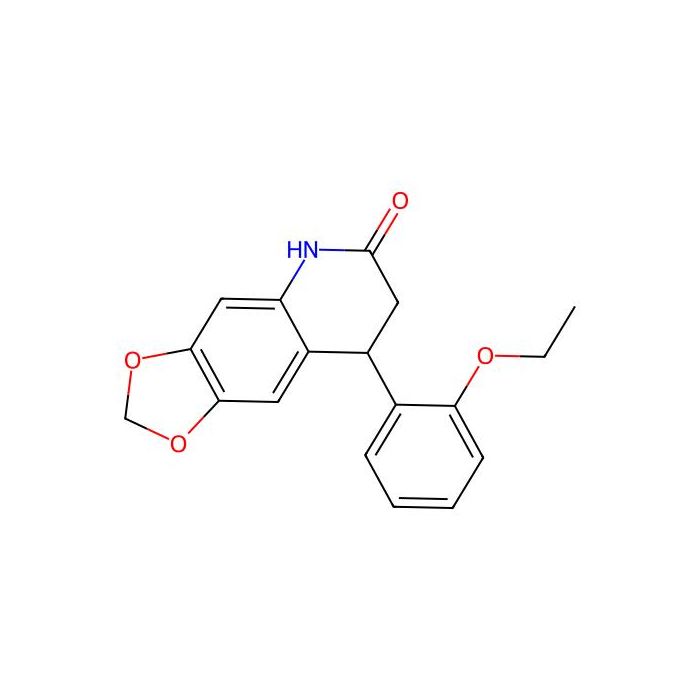
FQI1 is a Late SV40 Factor (LSF) inhibitor. FQI1 inhibits cell proliferation, with IC50s of 3, 0.79, 6.3 μM for NIH/3T3, HeLa, A549 cells. FQI1 can be used for cancer research.
Conditions de stockage de stockage
Store at -20°C
Expédié en
Ice chest + Ice pads
Ce produit nécessite l'expédition en chaîne froide. Les services terrestres et autres services économiques ne sont pas disponibles.
This compound belongs to the class of organic compounds known as phenylquinolines. These are heterocyclic compounds containing a quinoline moiety substituted with a phenyl group.
External Descriptors
Not available
1. Djoumbou Feunang Y, Eisner R, Knox C, Chepelev L, Hastings J, Owen G, Fahy E, Steinbeck C, Subramanian S, Bolton E, Greiner R, and Wishart DS. ClassyFire: Automated Chemical Classification With A Comprehensive, Computable Taxonomy. Journal of Cheminformatics, 2016, 8:61.
Determine the necessary mass, volume, or concentration for preparing a solution.
Dilution Calculator
Determine the dilution needed to prepare a stock solution.
Reconstitution Calculator
Avis
Avis des clients
Application Protocols
No item-specific tested applications are provided. The following general protocols are commonly used for small-molecule research ligands and should be adapted to your assay.
A. Preparation of a 10 mM DMSO stock (general)
Warm the vial to room temperature in a desiccator. Briefly spin down.
Add dry DMSO to achieve 10 mM based on the molecular weight (Not specified here; refer to CoA). Vortex until fully dissolved. If needed, sonicate ≤5 min.
Aliquot into amber microtubes (e.g., 10–50 μL) to avoid repeated freeze–thaw. Store at −20 °C.
B. Serial dilution for 10-point concentration–response (general)
Prepare 10× intermediate stocks in assay buffer with matched vehicle (e.g., 1% DMSO), then dilute 1:10 into assay plates to reach 0.1% DMSO final (adjust to assay tolerance).
Include vehicle-only and positive/negative controls. Mix gently but thoroughly to avoid edge effects.
C. Quick integrity check by LC–MS (general)
Dilute a small aliquot to ~1–10 μM in 50:50 ACN:H2O + 0.1% formic acid.
Inject on a short C18 column; verify a single dominant peak with expected mass. Compare pre- and post-assay samples for stability.
Item-specific dilutions, positive controls, or detection settings: Not specified for this item; refer to CoA/Spec Sheet.
Biological Roles
No target, pathway, or mechanism information is provided in the Product Data for FQI 1 (SKU F698635). To avoid over-interpretation, we do not assign a biological role for this item on this page.
General guidance for small-molecule research ligands (not item-specific):
Such compounds are commonly explored in biochemical binding assays, thermal stabilization/destabilization studies, and phenotypic screens to probe protein function or cellular pathways.
Prior to any complex biological experimentation, confirm compound identity, purity, and stability in the assay matrix; evaluate vehicle tolerance (e.g., max DMSO %); and assess potential assay interference (intrinsic fluorescence, aggregation, redox activity) using counter-screens.
If eventual target assignment is desired, pair functional readouts with orthogonal engagement methods (e.g., CETSA, SPR/MST, activity-based profiling) and apply appropriate statistics and controls.
Important note:
This product is designated For research use only and is not intended for diagnostic, therapeutic, or other clinical applications. Item-specific biological function, potency, or selectivity data are Not specified for this item; refer to CoA/Spec Sheet or contact technical support with the lot number for any available characterization notes.
Buffer Applications
FQI 1 is a small-molecule research ligand and is not itself a buffering agent. No buffer system specifications are provided for this item.
Practical notes for incorporating small-molecule stocks into buffers (general guidance):
Prepare a concentrated DMSO stock (e.g., 10–50 mM) and dilute into the assay buffer to a final DMSO content that your system tolerates (commonly ≤0.1–1% v/v, determine empirically).
For aqueous precipitation upon dilution, consider: warming the buffer to room temperature, adding stock slowly with mixing, using co-solvent (ethanol or ACN at low %), or employing solubilizers (0.1–1% w/v hydroxypropyl-β-cyclodextrin, as compatible).
Maintain consistent vehicle % across controls and treatments. Include a vehicle-only control for baseline correction.
If adsorption to plastics is suspected, pre-condition plates/tips with buffer containing low levels of surfactant (e.g., 0.01–0.05% Tween 20) where assay-compatible.
Item-specific buffer compatibility, pH stability, and ionic-strength tolerance: Not specified for this item; refer to CoA/Spec Sheet.
Green Alternatives
Because FQI 1 is a target-agnostic small-molecule research ligand on this page (no synthesis role specified), “greener alternatives” primarily concern solvent choices and handling practices rather than replacing the molecule itself.
Greener handling strategies (general):
Prefer aqueous-compatible systems when feasible (minimal DMSO/DMF). Employ co-solvents like ethanol or ACN at low percentages, or use solubilizers (cyclodextrins, PEG-400) to reduce dipolar aprotic solvent use.
Minimize mass and concentration of DMSO stocks, aliquot to reduce freeze–thaw waste, and select amber vials to prolong stability.
Implement microscale assays (384/1536-well) to reduce solvent consumption and waste generation.
DMSO: Excellent solubilizer; high boiling point complicates removal and increases energy for cleanup; low volatility improves operator exposure profile.
DMF/NMP: Powerful solvents but subject to stricter EHS scrutiny; avoid where possible in favor of DMSO, ethanol, or ACN.
Ethanol: Biorenewable content, good miscibility; may have assay interference at higher %; flammable.
Acetonitrile: LC–MS friendly; volatile; petrochemical origin; good compromise for analytics.
If synthetic modification of the scaffold is planned (medchem context), consider greener solvents in parallel reactions (2-MeTHF, EtOAc, propylene carbonate) and flow chemistry to cut waste. These are general recommendations; item-specific solvent/stability constraints must be verified experimentally.
Pharmaceutical Uses
Regulatory/compendial status: Not specified for this item; refer to CoA/Spec Sheet. This product is labeled For research use only and is not intended for human or veterinary use.
In early discovery, small-molecule research ligands are commonly formulated as DMSO concentrates for in vitro testing. For pre-formulation screens (solubility/stability only), co-solvents (ethanol, PG/PEG-400), surfactants (polysorbates), or cyclodextrins are explored to map solubility/stability space.
Excipient compatibility, osmolality, and pH-adjustment strategies must be assessed experimentally; none are specified for this item.
Manufacturing/handling notes:
No GMP, ICH Q3 limits, residual solvent specifications, or elemental impurity controls are provided on this page. Do not use for clinical manufacturing.
If you require a defined salt form, polymorph, or particle-size distribution, contact technical support; the current listing does not state such attributes.
Item-specific roles as an API, intermediate, or excipient: Not specified for this item; refer to CoA/Spec Sheet.
Physical Properties
Only limited item-specific physico-chemical data are provided in the Product Data. Do not assume values beyond what is listed on the CoA.
Item-specific values:
Appearance: Not specified for this item; refer to CoA/Spec Sheet.
Molecular weight: Not specified for this item; refer to CoA/Spec Sheet.
Melting point (MP): Not specified for this item; refer to CoA/Spec Sheet.
Boiling point (BP): Not specified for this item; refer to CoA/Spec Sheet.
Density: Not specified for this item; refer to CoA/Spec Sheet.
Solubility: Not specified for this item; refer to CoA/Spec Sheet.
logP/logD: Not specified for this item; refer to CoA/Spec Sheet.
pKa(s): Not specified for this item; refer to CoA/Spec Sheet.
UV–Vis characteristics/UV cutoff: Not specified for this item; refer to CoA/Spec Sheet.
Refractive index: Not applicable unless liquid; not specified for this item.
General guidance (literature/practice):
For novel/unknown small molecules, prepare an analytical 10 mM DMSO stock to quickly gauge UV–Vis and LC–MS response. If water solubility is required, co-solvent systems (e.g., DMSO:buffer ≤1–2% v/v final) can be screened. For poorly soluble solids, sonication and gentle heating (≤40 °C) can aid dissolution, avoiding prolonged exposure that could cause decomposition. Always confirm solubility and stability experimentally for your specific lot.
Quality and Grades
Supplied grade: Moligand (from Product Data). Purity and specific analytical limits are not listed on this page; refer to the CoA/Spec Sheet for the lot-specific purity, analytical methods (e.g., HPLC assay, LC–MS), and acceptance criteria.
What “Moligand” implies (general description):
The Moligand designation is used for research-use small molecules intended for molecular recognition, probe discovery, or biochemical screening. These materials are suitable for in vitro research and method development, but they are not manufactured under GMP and are not intended for diagnostic or therapeutic use.
UV absorbance characteristics, trace impurity limits, residual solvents, and polymorph information—if controlled—will appear on the CoA. In the absence of listed stabilizers or salt forms, assume the free compound unless otherwise stated on the label/CoA.
How to qualify the material for your workflow (best practices):
Verify identity and purity upon receipt (e.g., LC–MS, HPLC, 1H NMR) against CoA acceptance ranges.
If your assay is UV-sensitive or mass-spec–sensitive, check for background absorbance and volatile impurities by a quick scan and headspace GC (as applicable).
For bioassays, confirm solubility and stability in your assay medium across the expected concentration range; pre-screen for adsorption losses to plastics and for carryover in liquid handlers.
Item-specific notes:
Purity grade, water content, metal content, stabilizers: Not specified for this item; refer to CoA/Spec Sheet.
Reaction and Applications
Product FQI 1 is presented as a Moligand-grade small molecule. No synthetic-reagent role or specific reactivity is provided in the Product Data. Accordingly, it is primarily positioned for research screening and biochemical/biophysical evaluation rather than as a transformation reagent.
Applications appropriate for this product category (general guidance):
In vitro biochemical screening: Prepare DMSO stocks and assess binding or functional effects in cell-free assays (e.g., fluorescence polarization, thermal shift, SPR, MST). Validate compound integrity by LC–MS before and after assay runs to exclude decomposition or adsorption losses.
Phenotypic assays (cell-based, where permitted in your institution): Determine vehicle tolerance, run concentration–response curves (e.g., 10-point 1:3 serial dilution), and include orthogonal readouts to reduce assay interference risk.
Target deconvolution workflows: If pursuing protein engagement studies, consider CETSA/TPP, photoaffinity (if a suitable analog is available), or chemoproteomics. These are general strategies and not specific to this item.
Not typically applicable:
Named reactions or catalytic roles (e.g., cross-coupling, reductions) are not indicated and should not be assumed.
Item-specific usage notes:
Manufacturer Applications: Not provided beyond the research-use note. If your use case requires specific stoichiometry/reactivity, verify suitability experimentally and consult our technical team with your lot’s CoA.
Reaction Conditions
Specific reaction conditions are not applicable for this product because it is not presented as a reagent or catalyst. No kinetic, thermodynamic, or catalytic data are provided in the Product Data.
General handling conditions relevant to assay preparation (not synthetic reactions):
Stock preparation: Dissolve the compound in dry DMSO to a convenient concentration (e.g., 10–50 mM). Vortex/sonicate briefly if needed; avoid prolonged heating. Filter if particulate persists.
Working solutions: Dilute into assay buffer with vigorous mixing to minimize local supersaturation; keep final vehicle content consistent across wells.
Stability checks: Use LC–MS or HPLC to monitor integrity after typical assay times (e.g., 1–24 h at ambient or 37 °C). Include light protection if chromophores are suspected.
If you plan chemical transformations with this compound (user-driven medchem):
Begin with microscale scouting under mild conditions. Screen solvent polarity (EtOAc, MeCN, MeOH, toluene, 2-MeTHF) and base/acid additives conservatively. Monitor conversions by LC–MS.
Item-specific reaction media, temperature windows, catalysts, or yields: Not specified for this item; refer to CoA/Spec Sheet.
Safety and Handling
Safety data provided on this page are incomplete. Always consult the official Safety Data Sheet (SDS) for authoritative hazard, exposure, and response information.
From Product Data:
GHS classification: Not specified for this item; refer to SDS.
Signal word: Not specified for this item; refer to SDS.
Hazard statements (H-phrases): Not specified for this item; refer to SDS.
Pictograms: Not specified for this item; refer to SDS.
Storage: Store at −20 °C (from Product Data). Shipped cold (ice chest + ice pads).
General laboratory precautions (good practice):
Handle in a chemical fume hood. Avoid inhalation of dust/aerosols and contact with skin/eyes. Wear appropriate PPE: lab coat, nitrile gloves, and safety glasses or face shield.
If supplied or prepared in DMSO/DMF, prevent skin contact; these solvents can enhance dermal absorption of solutes.
Incompatibilities are structure-dependent; as a conservative approach, keep away from strong oxidizers, strong acids/bases, and reducing agents until compatibility is known.
Special risks: Unknown for this item. No evidence provided for peroxide formation, self-heating, or photosensitivity—assess experimentally and consult SDS.
First-aid overview (consult SDS for details):
Inhalation: Move to fresh air; seek medical attention if symptoms persist.
Skin contact: Remove contaminated clothing; wash with soap and water.
Eye contact: Rinse cautiously with water for several minutes; remove contact lenses if present and easy; seek medical attention.
Ingestion: Rinse mouth; do not induce vomiting unless directed by medical personnel. Seek medical attention.
Solvent Selection
Item-specific solubility data are not provided. The following guidance reflects common practice for small-molecule research ligands and should be verified experimentally for this item.
Primary stock solvent (screening practice):
DMSO is typically the first-choice solvent for preparing concentrated stocks (e.g., 10–50 mM), thanks to broad solvating power. Filter sterilize through 0.22 μm if required for cell-free assays.
Secondary options if DMSO is unsuitable:
DMF, NMP, ethanol, or acetonitrile can be explored. For aqueous work, co-solvent strategies (≤1–2% DMSO or ethanol in buffer) are common.
Aqueous compatibility:
If water solubility is limited, use solubilization aids (cyclodextrins, PEG-400, polysorbate 80) or pH adjustment when chemically compatible. Always confirm chemical stability versus pH and excipients.
DMSO, DMF, NMP: highly polar, fully miscible with water; ACN and ethanol: polar organic, fully miscible with water; isopropanol: miscible with water but may precipitate hydrophobic solutes on dilution.
When to choose alternatives:
For enzyme assays sensitive to DMSO, use ethanol or ACN at ≤0.5% v/v final. For live cells, maintain DMSO ≤0.1–0.2% v/v unless higher tolerance is validated. For mass spectrometry, ACN/H2O with 0.1% formic acid often provides cleaner baselines than DMSO.
Item-specific solubility, partitioning, and pKa: Not specified for this item; refer to CoA/Spec Sheet.
Storage and Reconstitution
From Product Data:
Storage conditions: Store at −20 °C.
Shipping: Ice chest + ice pads. Upon receipt, place immediately in a −20 °C freezer.
General reconstitution guidance (adapt to your needs):
Before opening, allow the sealed container to equilibrate to room temperature in a desiccated environment to prevent moisture condensation.
Reconstitution solvent: If solubility permits, dissolve in dry DMSO to prepare a concentrated stock (e.g., 10–50 mM). Item-specific solubility is Not specified for this item; refer to CoA/Spec Sheet.
Aliquoting: Divide into single-use amber vials/low-bind tubes to avoid repeated freeze–thaw. Typical aliquot size: 10–50 μL.
Freeze–thaw: Minimize cycles. Thaw on ice or at room temperature. Do not heat above ambient unless stability is known.
Light and moisture: In the absence of stability data, store protected from light and moisture (use desiccant and amber containment).
Short- and long-term stability (not item-specific):
Neat solid at −20 °C: Often stable for many months if protected from moisture/light; confirm by CoA and internal QC.
DMSO stock at −20 °C: Typically stable for weeks to months; verify by LC–MS/HPLC before critical experiments. Consider preparing fresh working solutions on the day of use.
Item-specific shelf life, stabilizers, and re-test period: Not specified for this item; refer to CoA/Spec Sheet.
Structure and Identity
Short description: FQI 1 (SKU F698635) is offered as a Moligand-grade small-molecule research ligand. Limited structural metadata is provided on this page; consult the CoA/Spec Sheet for definitive identifiers.
CAS: 599151-35-6 (from Product Data)
PubChem CID: 656346 (from Product Data)
InChIKey: 439771 (as provided; note that standard InChIKeys are 27 characters—verify against CoA/SDS)
SMILES: Not specified for this item; refer to CoA/Spec Sheet.
Molecular formula: Not specified for this item; refer to CoA/Spec Sheet.
Molecular weight: Not specified for this item; refer to CoA/Spec Sheet.
Synonyms/Identifiers: Not specified for this item; refer to CoA/Spec Sheet.
Structural description (general):
The precise 2D structure, ring systems, and functional groups are not listed in the Product Data. For accurate atom connectivity (e.g., heteroaromatics, substituted aryls, stereocenters), consult the lot-specific CoA or SDS. If you import this item into inventory systems, match by CAS and CoA to avoid identifier drift.
Notes for identity confirmation (general, literature/practice):
Typical small-molecule identity confirmation includes 1H/13C NMR, HRMS or LC–MS, and HPLC purity profiling. If chirality is relevant, optical rotation or chiral HPLC can be used. These are general best practices; refer to the supplied CoA for item-specific methods.
Synthetic Utility
No functional-group description or reactivity profile is provided for FQI 1 on this page, and the intended use is as a Moligand research ligand rather than a transformation reagent or building block.
Consequently, synthetic utility is not typically applicable. If you intend to derivatize or use this molecule as a starting point for structure–activity relationship (SAR) studies, please consult the CoA/SDS for structure and stability information and consider the following general best practices:
Confirm the exact structure (NMR, HRMS) and assess chemical stability under the planned reaction conditions before scale-up.
If unknown acid/base sensitivity exists, begin with neutral or mildly basic conditions and monitor by LC–MS to avoid hydrolysis/oxidation.
For late-stage diversification, prioritize chemoselective transformations (e.g., mild cross-couplings, C–H functionalization) only after mapping the molecule’s functional groups.
Item-specific functional groups, leaving groups, redox behavior, and protecting-group strategy: Not specified for this item; refer to CoA/Spec Sheet.
Target Specificity
Only target information provided in Product Data: none.
Antigen/target name: Not provided.
Epitope/binding site: Not provided.
Species reactivity/selectivity: Not provided.
Clone/isotype: Not applicable (small molecule).
Notes:
We do not assign target specificity or mechanism in the absence of item-specific data. If you require target engagement or selectivity information, please consult the CoA/Spec Sheet or contact technical support with the lot number to obtain any available characterization notes.
Need help choosing the grade?
Our grade selection guide covers purity, stabilizer status, and application suitability for all variants in our catalog.
We use cookies to ensure the website functions properly and, where permitted, to improve your experience. You can manage your preferences at any time in Settings. Learn more in our Cookie Policy.
Shall we send you a message when we have discounts available?
Remind me later
Thank you! Please check your email inbox to confirm.
Products are supplied to verified businesses, institutions, and qualified professionals for research and development use only. Not for use in humans, animals, diagnosis, or therapy.

 H2612406