GRADE & PURITYMoligand™?Moligand™ — Aladdin's line of ligands and bioactive small molecules. Use for receptor, pathway, and binding studies needing defined small-molecule tools.≥99%
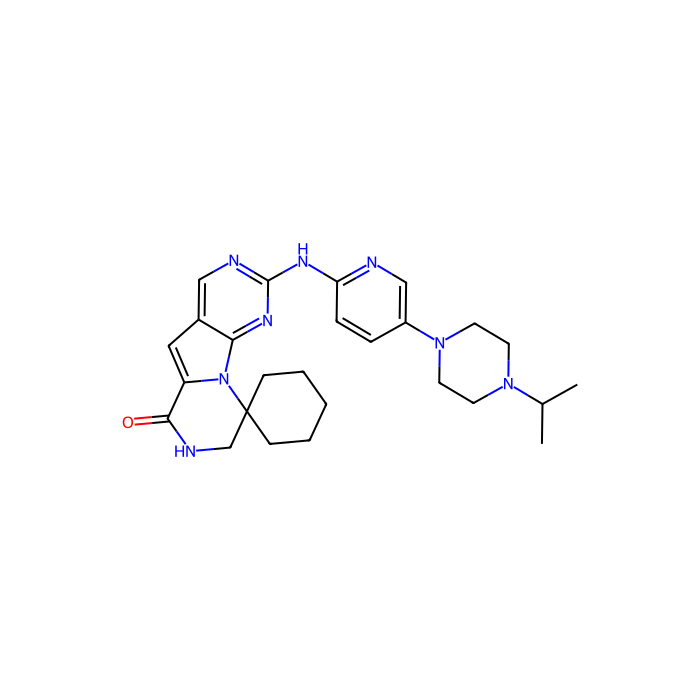
G1T38 is highly potent and selective for CDK4/cyclin D1 and CDK6/cyclin D3 over CDK1, CDK2, CDK5 and CDK7 and their respective binding partners. G1T38 decreases RB1 (RB) phosphorylation, causes a precise G1 arrest, and inhibits cell proliferation in a variety of CDK4/6-dependent tumorigenic cell lines including breast, melanoma, leukemia, and lymphoma cells with EC50 concentrations as low as 23 nM.
In vivo
G1T38 treatment leads to equivalent or improved tumor efficacy compared to the first-in-class CDK4/6 inhibitor, palbociclib, in an ER+ breast cancer xenograft model. Furthermore, G1T38 accumulates in mouse xenograft tumors but not plasma, resulting in less inhibition of mouse myeloid progenitors than after palbociclib treatment. In larger mammals, this difference in pharmacokinetics allows for 28 day continuous dosing of G1T38 in beagle dogs without producing severe neutropenia.
This compound belongs to the class of organic compounds known as pyridinylpiperazines. These are compounds containing a pyridinylpiperazine skeleton, which consists of a pyridine linked (not fused) to a piperazine by a bond by a single bond that is not part of a ring.
External Descriptors
Not available
1. Djoumbou Feunang Y, Eisner R, Knox C, Chepelev L, Hastings J, Owen G, Fahy E, Steinbeck C, Subramanian S, Bolton E, Greiner R, and Wishart DS. ClassyFire: Automated Chemical Classification With A Comprehensive, Computable Taxonomy. Journal of Cheminformatics, 2016, 8:61.
Determine the necessary mass, volume, or concentration for preparing a solution.
Dilution Calculator
Determine the dilution needed to prepare a stock solution.
Reconstitution Calculator
Avis
Avis des clients
Application Protocols
No tested applications or protocols are provided in the Product Data for this item.
Please refer to the literature or develop institution-specific SOPs for:
Enzyme inhibition assays (CDK4/6 activity assays)
Cell-based proliferation and cell-cycle assays
Analytical calibration and stability-indicating LC–MS methods
Any protocol should be validated in-house under your experimental conditions. For item-specific guidance, consult the CoA/Spec Sheet if available.
Biological Roles
Context (literature, non-clinical):
Lerociclib (G1T38) is described in the literature as a small-molecule inhibitor targeting cyclin-dependent kinases 4 and 6 (CDK4/6), central regulators of the G1-to-S phase transition via phosphorylation of the retinoblastoma (Rb) protein.
Inhibition of CDK4/6 reduces Rb phosphorylation, maintaining E2F sequestration and modulating transcriptional programs governing DNA synthesis entry. These effects are used in research to dissect cell-cycle checkpoints, evaluate synthetic lethality hypotheses, and probe pathway crosstalk with mitogenic signaling.
Research utility (for laboratory use only):
Biochemical/biophysical characterization: determine binding affinity and kinase selectivity profiles using enzymology panels, thermal shift assays, or biophysical readouts (SPR, ITC, DSF).
Cell systems: interrogate dependency on CDK4/6 activity across cell models by monitoring proliferation, cell-cycle distribution (flow cytometry), and Rb pathway biomarkers (phospho-Rb immunoblotting).
Systems biology: incorporate as a perturbagen in time-course experiments to parameterize cell-cycle models or quantify feedback in cyclin D–CDK4/6–Rb–E2F networks.
Important: All usage is for research purposes only. No medical, diagnostic, or therapeutic applications are implied.
Buffer Applications
This compound is not a buffer component. However, it is commonly delivered into assay buffers when used as a research tool compound.
Practical notes (general, non-specification):
Stock preparation: dissolve in DMSO to make concentrated stocks (e.g., 10–50 mM). Store aliquots at −20°C.
Working solutions: dilute into assay buffer (e.g., HEPES, Tris, or PBS-based buffers) to achieve target concentrations while keeping final DMSO low (often ≤0.1–1% v/v). Include vehicle controls matched for DMSO.
Adsorption minimization: use low-bind polypropylene tubes/plates; pre-rinse with buffer containing 0.01–0.1% nonionic surfactant if nonspecific binding is observed.
Stability checks: confirm compound stability over the assay timeframe (e.g., by LC–MS at t=0 and endpoint) and assess any precipitation upon buffer dilution.
For precise buffer recipes or pH ranges, consult your specific assay protocol; none are specified for this item.
Green Alternatives
“Green alternatives” are more relevant to solvent/reagent selection than to a specific bioactive ligand. For handling Lerociclib solutions, consider greener choices for the surrounding workflow:
Prefer aqueous buffers with minimal DMSO where assay performance permits (e.g., ≤0.1–0.5% v/v DMSO) to reduce organic solvent use.
When extracting or formulating, choose lower-toxicity, higher-safety-index solvents (e.g., ethanol, isopropanol) when chemically compatible, instead of higher-hazard dipolar aprotics.
For LC method development, water–acetonitrile gradients are generally preferred over water–methanol for lower backpressure and energy use, though methanol has lower toxicity; balance performance with EHS priorities.
Illustrative comparison (general):
DMSO vs PEG400/water cosolvent: DMSO offers superior solvency; PEG/water mixtures may reduce operator exposure but can alter bioavailability in assays.
DMF/NMP vs Cyrene/biobased solvents: Cyrene is a greener dipolar aprotic but may not match solvency or assay compatibility; validate rigorously before substitution.
Note: These are workflow-level suggestions, not item specifications. Validate any solvent substitution for chemical stability, assay fidelity, and instrument compatibility.
Pharmaceutical Uses
No pharmacopeial or excipient role is specified for this item.
Can serve as a reference standard during analytical method development (e.g., LC–UV/MS) for small-molecule stability-indicating assays, impurity profiling, and recovery assessments.
Useful in preformulation research to study solubility, polymorphism, and compatibility with common excipients, if such studies support discovery workflows.
May be incorporated into in vitro DMPK experiments (microsomal stability, plasma protein binding, permeability) as a tool compound; ensure appropriate controls and validated analytical methods.
Note: For research use only. This product is not intended for any clinical application or as a finished pharmaceutical ingredient. No compendial status (USP/EP/JP) or GMP attributes are provided; refer to CoA/Spec Sheet for any available analytical characterization.
Physical Properties
Item-specific physicochemical specifications are not provided in the Product Data.
Appearance: Not specified for this item; refer to CoA/Spec Sheet.
Melting point: Not specified for this item; refer to CoA/Spec Sheet.
Boiling point: Not applicable for a high-MW solid; not specified.
Density: Not specified for this item; refer to CoA/Spec Sheet.
Solubility: Not specified for this item; refer to CoA/Spec Sheet.
LogP, pKa, refractive index: Not specified for this item; refer to CoA/Spec Sheet.
Literature/contextual notes (non-specification):
Small-molecule kinase inhibitors of this class are commonly supplied as crystalline solids with limited aqueous solubility and good solubility in polar aprotic organic solvents (e.g., DMSO). Actual solubility and ionization behavior can vary with salt form and polymorph; confirm experimentally.
For assay preparation, researchers typically prepare concentrated DMSO stocks (e.g., 10–50 mM) and dilute into aqueous buffers with a final DMSO content compatible with the biological system (often ≤0.1–1% v/v), but exact limits should be determined per assay.
Important: Do not treat any of the above contextual statements as item-specific specifications. Obtain definitive property values from the item’s CoA/Spec Sheet or measure them under your laboratory conditions.
Quality and Grades
Grade/Purity: Moligand™ (from Product Data)
What Moligand™ typically implies (general description):
A research-only small-molecule ligand suitable for screening collections, SAR exploration, and target-engagement studies. Lots are commonly verified by orthogonal identity methods (e.g., LC–MS and 1H NMR) and purity assessed by HPLC/UPLC. Exact analytical acceptance criteria, purity percentage, and residual solvent/impurity limits are not specified for this item; refer to CoA/Spec Sheet.
How to use this grade effectively:
Intended for discovery workflows (biochemical/biophysical assays, cell-based screening, reference standard in analytical methods). Not intended for human or veterinary use.
If low UV background or trace-metal specifications are required (e.g., for sensitive spectroscopic assays), verify suitability against the lot-specific CoA.
If stereochemistry or polymorph matters for your application, request confirmatory data (chiral purity, XRPD) where applicable.
What is specific to this listing:
Storage at −20°C and cold shipment are specified, supporting stability during transit and storage. No stabilizers or salt/form information are provided; confirm form (free base vs salt) on the CoA.
Reaction and Applications
Primary use-case: Lerociclib (G1T38) is supplied as a research ligand for screening, target engagement, and reference standard work rather than as a synthetic reagent.
Applications in discovery workflows (general, non-specification):
Biochemical assays: determine inhibitory activity against CDK4/6 or related kinases using enzyme kinetics or binding assays (e.g., TR-FRET, SPR/ITC). Optimize DMSO content and incubation times to achieve equilibrium binding.
Cell-based studies: probe G1/S cell-cycle transitions by treating cell lines and monitoring downstream markers (e.g., Rb phosphorylation) with appropriate vehicle controls; verify permeability and efflux liabilities empirically.
Analytical reference: use as a system suitability or retention-time marker in LC–UV/MS method development; establish calibration curves in relevant matrices.
Not typically applicable:
It is not commonly used as a reagent/solvent in synthetic transformations (e.g., Grignard, cross-coupling). For synthetic chemistry guidance, see the Synthetic Utility tab for brief notes; most users will focus on bioassay deployment.
Reaction Conditions
Not applicable as a synthetic reagent. This product is intended as a research ligand/standard rather than a substrate or catalyst.
If conducting derivatization to create probes or analytical surrogates (general, non-specification):
Solvents: dry DMF, DMSO, or acetonitrile are commonly used for amide couplings or SNAr on heteroaromatics, if suitable reactive handles exist.
Bases/coupling: DIPEA, HATU/EDC systems for amide formation; aryl halide vectors (if present) could be leveraged in Pd-catalyzed cross-couplings with careful protection of basic sites.
Conditions: room temperature to 80°C depending on transformation; inert atmosphere for air/moisture-sensitive steps.
These are general statements for small-molecule heteroaromatics and do not constitute item-specific instructions. Verify the actual functional groups and reactivity from a validated structure before planning any chemistry.
Safety and Handling
Hazard classification for this specific item is not provided in the Product Data.
GHS signal word: Not specified for this item; refer to SDS.
H-statements: Not specified for this item; refer to SDS.
GHS classification/pictograms: Not specified for this item; refer to SDS.
General laboratory safety guidance (non-SDS, good practice):
Handle in a chemical fume hood to avoid inhalation of dust or aerosols. Avoid skin and eye contact.
Personal protective equipment: lab coat, safety glasses or splash goggles, and appropriate chemical-resistant gloves (e.g., disposable nitrile). Consider double-gloving for DMSO stock handling due to dermal permeation concerns.
Avoid incompatibilities typical for organic solids: strong oxidizers, strong acids/bases until compatibility is known. Keep away from ignition sources during weighing and solvent handling.
First aid (overview; defer to SDS): in case of skin contact, wash with soap and water; eye contact, rinse with water for several minutes; inhalation, move to fresh air; ingestion, seek medical attention. Provide SDS to medical responders.
Spill/cleanup: Avoid dust generation; collect with inert absorbent. Dispose in accordance with institutional and local regulations.
Always consult the product’s Safety Data Sheet for authoritative hazard, toxicological, and disposal information before use.
Solvent Selection
For small-molecule kinase-class ligands such as Lerociclib, solvent choice is driven by assay compatibility and compound solubility.
Practical guidance (general, non-specification):
Primary stock solvent: DMSO is commonly used due to broad solvency and assay compatibility at low v/v. Prepare concentrated stocks (e.g., 10–50 mM) and store aliquots at −20°C to minimize freeze–thaw cycles.
Alternative organic solvents: DMF or NMP can dissolve challenging solids but may be less desirable biologically; if used, limit final assay concentrations and include vehicle controls.
Aqueous systems: Direct dissolution in buffers is often limited. Co-solvent strategies (0.1–1% DMSO) or inclusion of surfactants (e.g., 0.01–0.1% nonionic detergents) may aid delivery; confirm that additives do not perturb your assay.
Volatile pre-dissolution: For thin-film hydration, dissolve in a volatile solvent (e.g., methanol, acetonitrile), dry to a film, then rehydrate with buffer plus modest DMSO.
Comparison (general considerations):
DMSO: highest solvency, good chemical compatibility; watch for water uptake and plastic extraction.
Acetonitrile: useful for LC method development and reference standard prep; higher volatility aids removal.
Aqueous PBS/HEPES: preferred for biological assays, but typically require DMSO cosolvent for delivery.
Always confirm solubility and stability experimentally for your specific lot and conditions.
Storage and Reconstitution
From Product Data:
Storage conditions: Store at −20°C.
Shipped in: Ice chest + ice pads.
Research use note: For research use only.
Reconstitution:
Not specified for this item; refer to CoA/Spec Sheet.
General good practice (non-specification):
If supplied as a solid, allow container to warm in a desiccator to room temperature before opening to prevent moisture condensation. Prepare aliquots of DMSO stock (e.g., 10–50 mM) in dry, anhydrous solvent. Store aliquots at −20°C in tightly sealed, inert containers to minimize hydrolysis and oxidation.
If supplied as a solution, confirm solvent, concentration, and any stabilizers on the label/CoA. Avoid repeated freeze–thaw; dispense single-use aliquots.
Protect from light if the structure contains chromophores susceptible to photodegradation; use amber vials where appropriate.
Record preparation date, concentration, and lot number on each aliquot. Assess integrity periodically by LC–MS/UPLC.
Deviations from these general practices should be guided by lot-specific stability data from the CoA/Spec Sheet or internal validation.
Structure and Identity
Lerociclib (G1T38) is a small-molecule research ligand categorized for compound libraries and screening.
SKU: G414063
Product name: Lerociclib (G1T38)
CAS: 1628256-23-4
PubChem CID: 86269224
InChIKey (from Product Data): 443413
SMILES: Not specified for this item; refer to CoA/Spec Sheet.
Molecular formula: Not specified for this item; refer to CoA/Spec Sheet.
Molecular weight: Not specified for this item; refer to CoA/Spec Sheet.
Structural features (general, literature):
Lerociclib is reported in the literature as a cyclin-dependent kinase (CDK) 4/6 inhibitor-class scaffold, typically featuring heteroaromatic ring systems and a kinase hinge-binding pharmacophore. Exact atom connectivity and stereochemistry should be verified from an authoritative structure file (supplier CoA/SDF or PubChem CID 86269224) before modeling or docking.
2D structure description (general):
Expect a multi-ring, nitrogen-containing heteroaromatic core with substituents conferring kinase selectivity and solubility modulation. Confirm ring count, substituent positions, and protonation sites from a verified structural record prior to use in cheminformatics or analytical method development.
Synthetic Utility
Lerociclib (G1T38) is supplied as a bioactive research ligand rather than a building block or reagent; it is not typically used as a functional synthon.
Contextual notes (general):
Molecules in the CDK inhibitor class often comprise polyheteroaromatic frameworks with multiple basic nitrogens. They can participate in salt formation and may display polymorphism—relevant to solid-state studies rather than synthetic transformations.
If derivatization is required for probe development (e.g., biotinylation, photoaffinity tags, or fluorescent conjugates), identification of solvent-exposed vectors from a co-crystal or docking model is recommended. Reaction conditions must be tailored to the specific functional groups present in the confirmed structure; do not proceed without a validated structure file (SDF/MOL).
Bottom line: treat this item as a final ligand for screening and analytical reference use. For synthetic elaboration, source or design appropriate functionalized analogs with well-defined handles.
Target Specificity
Target specificity details are not provided in the Product Data for this catalog listing.
General literature context (not product-specific specifications):
Lerociclib (G1T38) has been described in the literature as a CDK4/6-class inhibitor. Exact selectivity ratios, off-target kinase interactions, and biochemical IC50/Ki values should be taken from peer-reviewed sources or the supplier’s CoA/Spec Sheet for the specific lot.
For this product page, no tested target panel or specificity data are provided.
Need help choosing the grade?
Our grade selection guide covers purity, stabilizer status, and application suitability for all variants in our catalog.
We use cookies to ensure the website functions properly and, where permitted, to improve your experience. You can manage your preferences at any time in Settings. Learn more in our Cookie Policy.
Shall we send you a message when we have discounts available?
Remind me later
Thank you! Please check your email inbox to confirm.
Products are supplied to verified businesses, institutions, and qualified professionals for research and development use only. Not for use in humans, animals, diagnosis, or therapy.