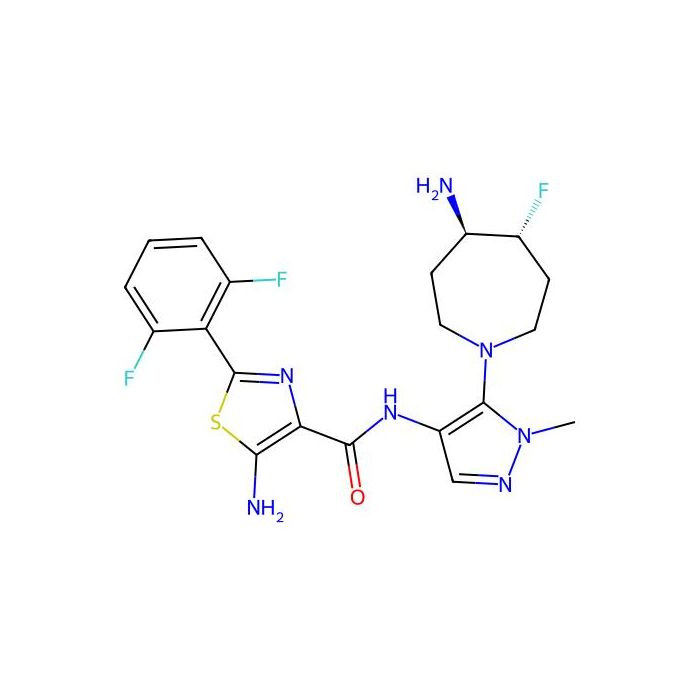
GDC-0339 is a potent, orally bioavailable and well tolerated pan-Pim kinase inhibitor, with K i s of 0.03 nM, 0.1 nM and 0.02 nM for Pim1 , Pim2 and Pim3 , respectively. GDC-0339 is discovered as a potential treatment of multiple myeloma
In Vitro
GDC-0339 is cytostatic, with an IC 50 of 0.1 μM for MM.1S cells. GDC-0339 treatment reveals a constellation of Pim downstream signaling events consistent with inhibition of Pim kinases. MCE has not independently confirmed the accuracy of these methods. They are for reference only. Cell Viability AssayCell Line: MM.1S cells Concentration: Incubation Time: 3 days Result: Inhibited cell viability. Western Blot AnalysisCell Line: MM.1S cells Concentration: 0.01 μM, 0.03 μM, 0.09 μM,0.27 μM, 0.83 μM, 2.5 μM Incubation Time: 4 hours Result: Induced a constellation of Pim downstream signaling events consistent with inhibition of Pim kinases.
In Vivo
GDC-0339 (1-300 mg/kg; p.o; daily; for 21 days) is efficacious in RPMI8226 and MM.1S human multiple myeloma xenograft mouse models. GDC-0339 has a half-life of t1/2=0.9 h. MCE has not independently confirmed the accuracy of these methods. They are for reference only. Animal Model: Female C.B-17 SCID mice, RPMI8226 human multiple myeloma xenograft mouse modelDosage: 1mg/kg, 10 mg/kg, 50 mg/kg, 100 mg/kg, 200 mg/kg, 300 mg/kg Administration: Oral administration; once daily; for 21 days Result: Showed dose-dependent tumor growth inhibition.
GDC-0339 is a potent, orally bioavailable and well tolerated pan-Pim kinase inhibitor, with K i s of 0.03 nM, 0.1 nM and 0.02 nM for Pim1 , Pim2 and Pim3 , respectively. GDC-0339 is discovered as a potential treatment of multiple myeloma.
Conditions de stockage de stockage
Store at -80°C
Expédié en
Dry ice packs + Cold packs
Ce produit nécessite l'expédition en chaîne froide. Les services terrestres et autres services économiques ne sont pas disponibles.
Certificats (CoA, COO, BSE/TSE et tableau d'analyse)
C of A & Other Certificates(BSE/TSE, COO):
Analytical Chart:
Calculateurs de solution
Molarity Calculator
Determine the necessary mass, volume, or concentration for preparing a solution.
Dilution Calculator
Determine the dilution needed to prepare a stock solution.
Reconstitution Calculator
Avis
Avis des clients
Application Protocols
Item-specific facts (from Product Data)
No validated application protocols are provided for this product.
General protocols for small-molecule tool compounds (not item-specific)
Stock preparation: Dissolve to 10–50 mM in anhydrous DMSO. Vortex and sonicate as needed. Record exact concentration by weight-in-volume or by quantitative NMR if precise dosing is required.
Biochemical assay dosing: Dilute serially in assay buffer to desired concentrations, ensuring final DMSO ≤0.1–1% v/v depending on assay tolerance. Include vehicle controls matched for DMSO content.
Cell-based assays: Pre-warm media, add compound stocks dropwise with mixing to avoid local precipitation. Typical exposure 1–72 h depending on endpoint. Monitor for cytotoxicity of vehicle.
Stability checks: After dilution into buffer/media, verify absence of precipitation (light scattering, A620) and confirm concentration by LC–MS or UV if chromophore allows.
Data integrity: Run replicates (n≥3), include positive/negative controls, and perform counterscreens to identify fluorescence/absorbance interference or colloidal aggregation.
Biological Roles
Item-specific facts (from Product Data)
No target class, pathway, or mechanism information is provided for GDC-0339.
General notes on small-molecule tool compounds (not item-specific; no clinical claims)
Bioactive discovery compounds are commonly investigated for modulation of enzymatic pathways (e.g., kinases, proteases), receptor signaling (GPCRs, nuclear receptors), or protein–protein interactions. Without target data, treat GDC-0339 as a generic chemical probe candidate.
Before deployment in biological systems, characterize:
Potency and selectivity in biochemical panels (e.g., enzyme profiling, receptor binding).
Off-target liabilities (CEREP/SafetyScreen panels), redox activity, and assay interference (PAINS filters are a preliminary screen but require experimental confirmation).
ADME considerations affect observed biology: solubility at assay pH, membrane permeability, efflux susceptibility, and stability in culture media (serum protein binding, adsorption to plastics).
For in vivo exploratory research (if permitted within institutional guidelines), collect fundamental PK (clearance, Vd, half-life) and exposure–response data; ensure all animal work follows ethical approvals. Note: No in vivo suitability is implied by this listing.
Important
Because target specificity and biological function are Not specified for this item; refer to CoA/Spec Sheet and primary literature before assigning a biological role.
Buffer Applications
Not typically applicable
GDC-0339 is a hydrophobic small molecule rather than a buffering agent. It does not define a pH range or buffering capacity.
General guidance for use in buffers (not item-specific)
When dosing into aqueous buffers for biochemical or cell assays, prepare concentrated DMSO stocks and dilute into the buffer to the desired final concentration, maintaining final DMSO ≤0.1–0.5% v/v to limit solvent effects.
If the compound is ionizable (unknown here), pH can significantly impact solubility. Evaluate solubility in commonly used assay buffers (e.g., PBS pH 7.4, HEPES pH 7.4) with and without surfactant (0.01% Tween-20) to mitigate aggregation.
Filter sterilize aqueous working solutions through 0.22 µm PVDF or PES if sterility is required. Validate compound recovery from filters to avoid adsorption losses.
Green Alternatives
Context
GDC-0339 is a bioactive small molecule used at low concentrations; the main environmental impact usually arises from solvent choice during dissolution, purification, and cleaning.
Greener solvent considerations (general, not item-specific)
Prefer water where feasible, with minimal DMSO co-solvent. When organic solvents are required, consider:
2-Methyltetrahydrofuran (2-MeTHF) vs. THF (renewable feedstock, better safety profile).
Ethyl acetate or IPA vs. dichloromethane/chloroform for extractions and cleaning.
Acetonitrile or ethanol vs. DMF/NMP when assay compatibility allows (lower reproductive toxicity vs. NMP; check solvency).
Minimize volumes in HTS by using high-concentration DMSO stocks (e.g., 50–100 mM) and robotic low-volume dispensing to reduce solvent waste.
Small comparison (literature-based, general)
DMSO: excellent solvency, fully miscible with water, low volatility; downside—facilitates dermal absorption, not readily biodegradable.
EtOAc/IPA: greener for workups/cleaning vs. chlorinated solvents; ensure compatibility with compound stability.
Operational tips
Implement closed-loop solvent delivery and distillation/recovery where permitted.
Segregate halogenated from non-halogenated waste; adopt microscale assay formats to minimize solvent and compound consumption.
Pharmaceutical Uses
Not applicable for this catalog entry
No pharmacopeial status, excipient role, or manufacturing use is provided. GDC-0339 is offered strictly for research use only (as stated in Product Data). No therapeutic or clinical claims are made or implied.
General formulation context (not item-specific)
For pre-formulation research, solubility enhancement strategies include co-solvents (DMSO, PEG 400), cyclodextrin inclusion, amorphous dispersions, or pH adjustment for ionizable compounds. These approaches are research-only and must be validated for the specific compound.
If investigating solid-state properties (polymorph, salt or cocrystal screening), first obtain definitive structural and ionization information (not provided here) and adhere to controlled temperature/humidity due to the -80°C storage recommendation indicating potential instability at higher temperatures.
Physical Properties
Item-specific facts (from Product Data)
Appearance: Not specified for this item; refer to CoA/Spec Sheet.
Literature/computed values
No literature physical constants are provided here. Retrieve experimentally determined values from the CoA/SDS or peer-reviewed sources using CAS 1428569-85-0 or CID 73603034.
General chemistry guidance (not item-specific)
Small-molecule screening compounds like GDC-0339 are frequently supplied as off-white to yellow solids with limited aqueous solubility and good solubility in polar aprotic solvents such as DMSO or DMF. Verify actual solubility empirically.
If logP/logD and pKa are unknown, perform a tiered solubility screen (water, PBS pH 7.4, MeOH, ACN, DMSO) at 1–10 mg/mL to inform stock preparation.
For chromatographic characterization prior to use: record HPLC/UPLC retention (C18, 5–95% ACN/H2O + 0.1% formic acid), LC–MS (ESI±), and verify purity/identity by MS and, where possible, 1H NMR.
Melting point, decomposition behavior, hygroscopicity, and polymorphism can impact handling and formulation. If melting/decomposition is near ambient, prefer cold handling and rapid weighing.
Important
Any specific numeric properties (mp, bp, density, solubility limits, logP, pKa, refractive index) are Not specified for this item; refer to CoA/Spec Sheet.
Quality and Grades
Item-specific facts (from Product Data)
Grade/Purity: Not specified for this item; refer to CoA/Spec Sheet.
How to interpret grade for small-molecule research compounds (general guidance)
Discovery/tool compounds are typically provided at research grade with HPLC purity often ≥95% and identity verified by MS/1H NMR. Actual acceptance criteria should be confirmed on the CoA for the specific lot received.
If UV-Vis absorbance specifications, residual solvent limits, water content (Karl Fischer), or inorganic residue are critical for your application (e.g., biophysics, HTS, crystallography), verify on the CoA. In absence of provided specs here, they are Not specified for this item; refer to CoA/Spec Sheet.
Batch-to-batch consistency: For screening campaigns, lock to a single lot where possible. Record lot number and CoA purity in your ELN.
Impurities: Trace synthetic impurities or residual salts can affect assay readouts (fluorescence/aggregation). Consider orthogonal purity checks (qNMR, UPLC-UV at multiple wavelengths, HRMS) when data reproducibility is essential.
Stabilizers: None are stated in the Product Data. If stabilizers or counterions are present, they should be listed on the CoA/SDS; otherwise assume none and confirm experimentally.
Reaction and Applications
Item-specific facts (from Product Data)
Manufacturer Applications: Not provided in the dataset.
General applications for a small-molecule research compound (not item-specific)
Biochemical and cell-based assays: Employed as a putative tool compound in target validation, SAR exploration, and phenotypic screening. Use serial dilutions (e.g., 10 mM DMSO stock to 10-point, 1:3 series) to generate dose–response curves.
Physicochemical profiling: Determine solubility, permeability (PAMPA/Caco-2), microsomal stability, protein binding, and metabolic soft spots (LC–MS/MS). These data inform usage conditions and storage.
Structural biology: If solubility permits, can be co-crystallized or soaked into protein crystals; alternatively, evaluate by cryo-EM ligand binding or NMR CSP experiments. Ensure purity and monodispersity to avoid precipitation.
Analytical controls: Serve as a positive/negative control in orthogonal assay formats to test assay robustness and artifacts (e.g., redox cycling, aggregation). Run detergent controls (0.01–0.05% Triton X-100) and colloidal aggregator counterscreens.
Not typically applicable
This item is not generally used as a reagent or catalyst in synthetic organic transformations; see “Synthetic Utility” for notes on why general-purpose reaction chemistry is not applicable without structural information.
Reaction Conditions
Not applicable
No chemical reactions or transformations are specified for this product. It is supplied as a research compound for use in assays and analytical studies, not as a reagent or catalyst.
General note (not item-specific)
If you intend to derivatize or formulate the compound, establish its stability profile first (thermal, oxidative, photolytic, pH). Absent structural data, do not assume stability under acidic/basic conditions, high temperatures, or strong light. Conduct small-scale stress tests and monitor by UPLC–MS.
Safety and Handling
Item-specific facts (from Product Data)
Storage conditions: Store at -80°C.
Shipping: Dry ice packs + Cold packs.
GHS/Signal word/H-statements/Pictograms: Not specified for this item; refer to SDS.
General safety guidance (not item-specific; defer to SDS)
Handle inside a certified chemical fume hood or ventilated enclosure. Avoid inhalation of dusts/aerosols and contact with skin/eyes.
Recommended PPE: lab coat, safety glasses or face shield, and appropriate chemical-resistant gloves (e.g., nitrile). Change gloves frequently when handling DMSO solutions as DMSO can enhance dermal absorption.
Avoid incompatible operations until compatibility is known. Typical incompatibilities for drug-like organics include strong oxidizers, strong acids/bases, and reactive acylating/alkylating agents. Segregate from foodstuffs and non-hazardous materials.
Special risks: Bioactive small molecules can exhibit potent activity at very low doses. Minimize exposure, weigh in a glovebox or balance enclosure, and use single-use weigh boats. When making concentrated DMSO stocks, cap securely and label potency.
First aid (summary; consult SDS):
Inhalation: move to fresh air; seek medical attention if symptoms occur.
Skin/eye contact: rinse with water for ≥15 min; remove contaminated clothing; seek medical attention if irritation persists.
Ingestion: rinse mouth; do not induce vomiting; seek medical attention.
Spill/cleanup: Avoid dust, absorb solutions with inert material, place in appropriate waste. Decontaminate surfaces with solvent followed by detergent water.
Solvent Selection
Item-specific facts (from Product Data)
No solubility profile provided. All numeric solubility values are Not specified for this item; refer to CoA/Spec Sheet.
General guidance for dissolving drug-like small molecules (not item-specific)
Primary stock solvent: DMSO is typically preferred due to broad solvency across heteroaromatic, amide, urea, and sulfonamide scaffolds and compatibility with biological assays at ≤0.1–1% v/v.
Secondary solvents: DMF, NMP, acetone, acetonitrile, methanol, and ethanol can assist; for aqueous work, use co-solvent systems (e.g., DMSO/H2O or ACN/H2O) or adjust pH if the compound is ionizable (pKa-dependent—measure experimentally).
Attempt 10 mg/mL in dry DMSO with vortex/sonication.
If insoluble, warm gently (≤40°C) and/or try DMF.
For aqueous buffers, prepare concentrated DMSO stock (e.g., 10–50 mM) and dilute into buffer keeping final DMSO ≤0.5%.
Filter (0.22 µm PTFE) if particulate persists; avoid cellulose filters with strong organic solvents.
Avoid adsorptive losses by using low-bind polypropylene vials for micromolar stocks.
When to choose alternatives
For spectroscopic assays sensitive to DMSO, consider ACN or MeOH, validating stability and background absorbance/fluorescence.
Storage and Reconstitution
Item-specific facts (from Product Data)
Storage: Store at -80°C.
Shipping: Dry ice packs + Cold packs.
General handling and reconstitution (not item-specific)
Upon receipt: Keep frozen. Allow the sealed container to equilibrate to room temperature before opening to prevent condensation ingress.
Aliquoting: If supplied as a solid, subdivide into single-use portions under dry air or nitrogen to minimize freeze–thaw and moisture uptake. If supplied as a DMSO solution, maintain at -80°C and aliquot into low-bind tubes.
Stock solution preparation: Prepare 10–50 mM stocks in anhydrous DMSO unless solubility dictates otherwise. Filter through 0.22 µm PTFE if particulates remain. Label vials with concentration, solvent, date, and lot.
Stability: In absence of compound-specific data, limit thaw cycles to one and avoid prolonged exposure to ambient light and temperature. Store working aliquots at -20°C (short term, days) and master stocks at -80°C (long term, months), monitoring by LC–MS for degradation.
Aqueous working solutions: Prepare fresh on the day of use. Discard after experiment unless stability has been validated.
Documentation: Because detailed specifications are Not specified for this item; refer to CoA/Spec Sheet and SDS for lot-specific stability, purity, and any special precautions.
Structure and Identity
Item-specific facts (from Product Data)
Product name: GDC-0339 (SKU: G654676)
CAS: 1428569-85-0
PubChem CID: 73603034
InChIKey: Not specified for this item; refer to CoA/Spec Sheet.
SMILES: Not specified for this item; refer to CoA/Spec Sheet.
Molecular formula: Not specified for this item; refer to CoA/Spec Sheet.
Molecular weight: Not specified for this item; refer to CoA/Spec Sheet.
General chemistry notes
GDC- prefixes commonly denote small-molecule research tool compounds originating from Genentech/industry discovery programs. Absent structural data here, treat as an unknown small-molecule solid with potential heteroatoms (typical of kinase or signaling inhibitors), but do not assume functional groups without the CoA/SDS.
2D structure description: Not available in the provided data. Consult the CoA/SDS or structural databases (using CAS or CID) for ring systems, heteroatom content, stereochemistry, and functional-group mapping before planning analytical or formulation work.
Synthetic Utility
Not typically applicable
GDC-0339 is a finished small-molecule tool compound rather than a general synthetic building block. Without structural information, it is not appropriate to propose named reactions or derivatizations.
General guidance (not item-specific)
If analog synthesis or SAR expansion is desired, retrieve the published structure (via CAS 1428569-85-0 or CID 73603034) and plan retrosynthetic disconnections around the core scaffold (e.g., heteroaromatic coupling nodes, amide/urea formations). Standard tactics may include cross-couplings (Suzuki–Miyaura, Buchwald–Hartwig), nucleophilic aromatic substitution, or heterocycle constructions; however, these are contingent on the actual structure and functional group tolerance.
For bioconjugation or probe development, determine whether the molecule presents a vector (e.g., solvent-exposed position) amenable to installing linkers or reporter tags without abolishing activity—this requires structural and SAR knowledge not provided here.
Target Specificity
Item-specific facts (from Product Data)
Target/epitope/biomarker: Not specified for this item; refer to CoA/Spec Sheet.
Species reactivity/clone/isotype: Not applicable (small molecule, not an antibody or biologic).
General guidance (not item-specific)
If a biological target is known from external literature, confirm by independent assays (biochemical IC50/Ki, cellular EC50, counterscreens for off-targets). Cross-validate with orthogonal readouts to rule out assay interference.
Foire aux questions
How should this product be stored?
Store at ?80 °C. Ultra-low temperature storage is required to maintain the specified shelf life.
How is this product shipped?
This product ships frozen with dry ice and cold packs. Unpack on arrival and transfer it to the storage condition stated above; handle dry ice with insulated gloves in a ventilated area.
What are the CAS number, molecular formula and molecular weight?
The CAS Number is 1428569-85-0, the molecular formula is C20H22F3N7OS, and the molecular weight is 465.50 g/mol.
What documentation is provided?
Available product documentation, including Certificates of Analysis (COA), Safety Data Sheets (SDS), and specification sheets, is shown in the product document area. Document availability and access follow the current site policy.
Nous utilisons des cookies pour garantir le bon fonctionnement du site et, lorsque cela est autorisé, pour améliorer votre expérience. Vous pouvez gérer vos préférences à tout moment dans les Paramètres. Pour en savoir plus, consultez notre Politique relative aux cookies.
Souhaitez-vous que nous vous envoyions un message lorsque des réductions seront disponibles?
Me rappeler plus tard
Merci ! Veuillez vérifier votre boîte de réception e-mail pour confirmer.
Products are supplied to verified businesses, institutions, and qualified professionals for research and development use only. Not for use in humans, animals, diagnosis, or therapy.