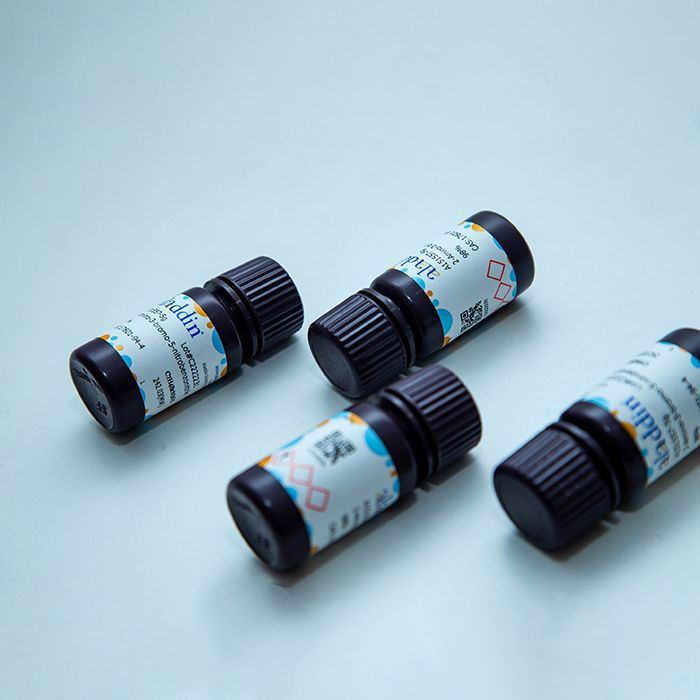
GL0388 is a Bax activator that results in Bax insertion into mitochondrial membrane. GL0388 shows antiproliferative activities against various cancer cells, with IC 50 s of 0.299-1.57 μM. GL0388 activates Bax and induce Bax-mediated apoptosis . GL0388 sup
Appearance:Solid
IC50& Target:Bax
In Vitro:GL0388 (0.1-10 μM; 72 h) inhibits the cell proliferation of MDA-MB-231 and MCF-7 breast cancer cell lines, with IC 50 s of 0.96 μM and 0.52 μM, respectively. GL0388 (0.01-100 μM) inhibits the cell proliferation in 60 human tumor cell lines, with GI5
In Vivo:GL0388 (10-20mg/kg for i.p.; 15mg/kg for i.t.; once daily for 10 days) dose-dependently suppresses the growth of MDA-MB-231 tumors in mice. MCE has not independently confirmed the accuracy of these methods. They are for reference only. Animal Model
Biological Activity:GL0388 is a Bax activator that results in Bax insertion into mitochondrial membrane. GL0388 shows antiproliferative activities against various cancer cells, with IC 50 s of 0.299-1.57 μM. GL0388 activates Bax and induce Bax-mediated apoptosis . GL0388 sup
Spécifications
Spécifications et pureté
≥98%
Conditions de stockage de stockage
Store at -20°C
Expédié en
Ice chest + Ice pads
Ce produit nécessite l'expédition en chaîne froide. Les services terrestres et autres services économiques ne sont pas disponibles.
Type d'action
ACTIVATOR
Pureté
≥98%
Noms et identifiants
Poids moléculaire
332.37
Données avancées
Certificats (CoA, COO, BSE/TSE et tableau d'analyse)
C of A & Other Certificates(BSE/TSE, COO):
Analytical Chart:
Calculateurs de solution
Molarity Calculator
Determine the necessary mass, volume, or concentration for preparing a solution.
Dilution Calculator
Determine the dilution needed to prepare a stock solution.
Reconstitution Calculator
Avis
Avis des clients
Application Protocols
No item-specific, tested application protocols are provided for GL0388.
General, assay-agnostic workflow for small-molecule screening
Stock preparation: Dissolve in anhydrous DMSO at 10–50 mM. Vortex, sonicate briefly if needed. Filter through 0.2 µm PTFE only if compatible and not adsorptive.
Aliquoting: Dispense single-use aliquots (e.g., 10–50 µL) in inert, low-bind tubes or assay plates; minimize headspace and overlay with inert gas if stability is a concern.
Storage: −20°C (per Product Data). Avoid repeated freeze–thaw. Keep desiccated and protected from light.
Plate setup: For 384-well assays, typical addition is 0.1–1% final DMSO. Include vehicle controls (matching DMSO) and positive/negative controls as relevant.
Data QC: Monitor precipitation or turbidity after dilution; confirm concentration by UV (if chromophore present) or LC–MS where feasible.
Important
All details above are general guidance for small-molecule library members and not item-specific specifications. For any validated application, consult the product’s CoA/Spec Sheet or perform in-house qualification.
Biological Roles
Item-specific biological roles, targets, or pathways
Not specified for this item; refer to CoA/Spec Sheet or screening documentation.
General guidance for users
Until the structure and/or target annotations for GL0388 are disclosed, treat it as an uncharacterized small molecule. Assign no presumed mechanism of action.
If biological activity is observed in your assays, perform orthogonal confirmation and counter-screens to exclude artifacts (fluorescence interference, colloidal aggregation, membrane disruption).
For chemoproteomics or phenotypic screening follow-up, consider synthesizing tagged analogs only after structural disclosure and IP review.
Compliance
This product is for research use only and is not intended for human or veterinary use. Do not make biological or therapeutic inferences without adequate validation and safety data.
Buffer Applications
This product is a small-molecule library member, not a buffering reagent. No buffering capacity, pKa data, or recommended buffer recipes are provided.
Item-specific buffer parameters: Not specified for this item; refer to CoA/Spec Sheet.
Practical note: If GL0388 must be used in aqueous systems, prepare a DMSO (or suitable organic) stock and dilute into the assay buffer of choice (e.g., PBS, HEPES) while keeping final organic co-solvent within your assay’s tolerance.
For pH-dependent studies, determine compound ionization empirically (UV–vis or potentiometric titration) once the structure is available; otherwise, bracket assays across pH 6.5–8.0 to detect pH sensitivity.
Green Alternatives
With no structure or solvent needs disclosed for GL0388, greener choices focus on handling and solvent selection during stock preparation and assays.
Greener solvent considerations (general)
Prefer ethanol, isopropanol, or water/co-solvent systems over DMF/NMP where solubility permits.
Use DMSO judiciously: while not classed as a green solvent, it offers low volatility and good safety profile relative to DMF/NMP in bioassays.
Avoid chlorinated solvents for routine stock prep. If required for analytics (e.g., chloroform for NMR), keep volumes minimal and ensure proper waste segregation.
Ethanol: Renewable, lower toxicity; limited solubility for very hydrophobic compounds; higher vapor pressure.
2-MeTHF/CPME: Greener ethers for synthetic work; typically not used for bioassay stocks but useful for purification or formulation studies if structure later dictates.
Operational greener practices
Miniaturize assays (384/1536-well) to reduce solvent use.
Implement acoustic dispensing to lower DMSO volumes and plastic waste.
Cold-chain efficiency: Consolidate shipments and reuse qualified gel packs to reduce environmental impact.
Item-specific note
No process or reagent-specific green substitutions can be recommended for GL0388 beyond the general guidance above because detailed chemistry is Not specified for this item; refer to CoA/Spec Sheet.
Pharmaceutical Uses
No excipient role, compendial status, or formulation use is provided for GL0388.
Item-specific pharmacopeial status: Not specified for this item; refer to CoA/Spec Sheet.
This product is intended strictly for research use only (non-clinical). It is not manufactured to GMP and is not intended for human or veterinary administration.
Guidance for formulation scientists (general, research-only)
If biological testing requires in vivo research models, ensure procurement of appropriate quality grade and full disclosure of structure, impurity profile, and stability prior to any formulation feasibility work.
For in vitro studies, typical solvent vehicles include DMSO stock diluted into buffer or culture medium; confirm vehicle tolerability for your system and avoid precipitation/phase separation.
Compliance reminder
No medical or clinical claims are made. Any translation toward development use requires separate sourcing and documentation.
Physical Properties
Item-specific physical data
Appearance: Not specified for this item; refer to CoA/Spec Sheet.
Molecular weight: Not specified for this item; refer to CoA/Spec Sheet.
Molecular formula: Not specified for this item; refer to CoA/Spec Sheet.
Melting point: Not specified for this item; refer to CoA/Spec Sheet.
Boiling point: Not specified for this item; refer to CoA/Spec Sheet.
Density: Not specified for this item; refer to CoA/Spec Sheet.
Solubility: Not specified for this item; refer to CoA/Spec Sheet.
LogP, pKa, refractive index, UV cut-off: Not specified for this item; refer to CoA/Spec Sheet.
Practical guidance when properties are undisclosed (general)
Initial solubility screen: Try DMSO at 10–50 mM; if insoluble, warm gently (≤40°C) and sonicate. If still insoluble, evaluate DMF, NMP, ethanol, isopropanol, or aqueous buffers with co-solvent and surfactant (e.g., 0.01–0.05% Tween-80) compatible with your assay.
Aqueous handling: Prepare a concentrated DMSO stock (e.g., 10 mM) and dilute into buffer; keep final DMSO ≤0.5–1% v/v for most biochemical assays (verify assay tolerance).
Solid vs. oil: If the item arrives as an oil, quantify by weight/volume after gentle warming and mix thoroughly before aliquoting.
Light and air sensitivity: In absence of data, treat as potentially light- and air-sensitive; minimize exposure to light, moisture, and elevated temperature.
Important
Do not treat any of the above as specifications. For authoritative item-specific values, consult the current CoA/Specification Sheet and SDS.
Quality and Grades
Item-specific quality information
Grade/Purity: Not specified for this item; refer to CoA/Spec Sheet.
How to interpret unspecified grades in screening compounds (general guidance)
Screening/library compounds are commonly provided at research grade with identity confirmation (e.g., LC–MS and/or 1H NMR) and an assay-ready purity threshold (often ≥90% by HPLC/LC–MS). Purity thresholds and analytical methods vary—always consult the item’s CoA.
If a stabilizer, salt form, or counterion is used, it should be disclosed on the CoA. No stabilizer information is provided here for GL0388.
What to request/verify for your workflow
Identity confirmation: LC–MS (exact mass and retention time) and/or NMR.
Purity: Chromatographic purity (% area, method details including wavelength(s) and gradient). Note that UV cutoffs and chromophores affect purity by UV.
Form: Solid vs. oil, free base vs. salt/hydrate/solvate; water content by Karl Fischer if relevant.
Residual solvents/metals: If your assay or downstream synthesis is sensitive, request residual solvent profile and elemental analysis as needed.
Batch traceability: Verify lot number and ensure the CoA corresponds to your received lot.
Implications for use
For quantitative biology or medicinal chemistry, impurities may influence potency or selectivity. Consider repurification if purity is below your internal threshold.
For HTS, confirm plate compatibility (e.g., DMSO stocks) and analytical recheck post-solubilization to rule out degradation.
Note
Where specific values are required, they are Not specified for this item; refer to CoA/Spec Sheet.
Reaction and Applications
Intended use context
GL0388 is listed under a small-molecule/compound library. In the absence of structural disclosure, its primary application is expected to be in discovery workflows such as biochemical or cell-based screening, target deconvolution, and SAR hypothesis generation.
Research applications (general; non-clinical)
High-throughput screening (HTS): Prepare DMSO stocks (e.g., 10 mM) and dispense into assay plates with acoustic or pin tools. Validate compound integrity by LC–MS before and after screening.
Hit validation: Retest across concentration ranges (10-point, half-log dilutions). Use orthogonal assay formats to rule out assay interference (fluorescence quenching, redox activity, aggregation).
Counter-screening: Evaluate activity in PAINS/REOS filters and test for colloidal aggregation (detergent-supplemented assay, dynamic light scattering) and redox cycling (e.g., HRP/Amplex assays) as appropriate.
Chemical biology: If a target is identified, perform thermal shift (DSF), CETSA, or SPR for binding confirmation; use chemoproteomic pull-downs if a handle or derivative can be prepared.
Practical tips when structure is unknown
Plate hygiene: Use fresh, low-water DMSO; limit freeze–thaw cycles by aliquoting. Track plate age and humidity.
Interference control: Include redox and fluorescence interference controls; monitor turbidity at 620–700 nm for aggregation.
Data integrity: Where possible, confirm identity/purity for the received lot via in-house LC–MS/NMR.
Item-specific statement
Named reactions or synthetic roles for GL0388 are not discussed because the structure and functional groups are Not specified for this item; refer to CoA/Spec Sheet.
Reaction Conditions
Item-specific reaction conditions, catalysts, and yields
Not specified for this item; refer to CoA/Spec Sheet.
Context
Because the structure and functional groups of GL0388 are undisclosed, no reliable guidance can be provided on its reactivity, stability under acidic/basic conditions, or compatibility with catalysts.
Practical advice for handling in experiments
If GL0388 is to be used only as a test article (not as a reagent), avoid exposing it to harsh conditions; prepare stocks in appropriate solvents (see Solvent Selection) and keep temperatures low to moderate during handling (room temperature or chilled).
For analytical method development (LC–MS/UPLC): Pilot gradients with water/acetonitrile (0.1% formic acid) and water/methanol systems; test both ESI+ and ESI−. Adjust based on observed retention and ionization.
Note
For any chemical transformations or stability studies, obtain the compound’s structure and review literature precedents before proceeding.
Safety and Handling
Item-specific hazard data
Signal word: Not specified for this item; refer to SDS.
H-statements: Not specified for this item; refer to SDS.
GHS classification/pictograms: Not specified for this item; refer to SDS.
General laboratory precautions for an undisclosed small molecule
Assume potential acute toxicity, skin/eye irritation, and environmental hazard until SDS is reviewed.
Engineering controls: Work in a chemical fume hood; avoid aerosolization and dust formation.
PPE: Lab coat, safety goggles, and appropriate chemically resistant gloves (e.g., nitrile). For weighing dusty solids, consider a particulate respirator as per institutional SOPs.
Handling: Avoid inhalation, ingestion, and skin contact. Use dedicated tools to prevent cross-contamination in screening collections.
Incompatibilities: Unknown; as a precaution, segregate from strong oxidizers/reductants, strong acids/bases, and ignition sources. Avoid contact with reactive metals until compatibility is confirmed.
First aid overview (seek medical attention; follow SDS):
Inhalation: Move to fresh air; monitor breathing.
Skin: Remove contaminated clothing; wash with soap and water.
Eyes: Rinse cautiously with water for several minutes; remove contact lenses if present and easy to do.
Ingestion: Rinse mouth; do not induce vomiting unless directed by medical personnel.
Spill response: Contain with inert absorbent, avoid dust, collect into a suitable container for disposal per local regulations.
Waste: Dispose of as organic laboratory waste according to institutional and regulatory requirements.
Authoritative source
Always defer to the current SDS for GL0388 (SKU: G659418) for definitive hazard, first-aid, firefighting, and transport information.
Solvent Selection
Because no structure or solubility data are provided for GL0388, select solvents empirically while maintaining assay compatibility.
General solvent strategy for small-molecule library members
Primary stock solvent: DMSO is the default due to broad solubilizing power and assay compatibility. Start at 10–50 mM.
Secondary options: DMF or NMP (strong polar aprotics) for stubbornly insoluble compounds—ensure assay tolerance; consider ethanol or isopropanol for less polar organics.
Aqueous delivery: Dilute DMSO stocks into buffer (e.g., PBS, HEPES) to a final DMSO of 0.1–1% v/v. Add non-ionic surfactant (0.01–0.05% Tween-80 or Pluronic F-68) if precipitation occurs and your assay permits.
For biophysical assays (SPR/ITC): Minimize cosolvent (<1% DMSO) and match DMSO in sample and reference to eliminate refractive index mismatch.
Polarity/miscibility considerations (general)
Unknown polarity: Trial a short solubility panel: water, buffer (pH 7.4), DMSO, DMF, ethanol, isopropanol, acetonitrile, CPME/MTBE (for hydrophobic liquids). Record visible solubility and stability over 24 h.
Light/air sensitivity: Prepare under low light; cap quickly; consider inert gas overlay if instability is suspected.
Comparison notes (general)
DMSO vs DMF: DMSO is less volatile and more biocompatible; DMF may dissolve some aromatics better but is less favored in cell assays.
MeCN vs EtOH: MeCN offers low viscosity and UV transparency but weaker solvating power for very hydrophobic compounds.
Item-specific statement
Solubility, dielectric constant, and partition data: Not specified for this item; refer to CoA/Spec Sheet.
Storage and Reconstitution
Item-specific storage and shipping
Storage conditions: Store at −20°C (from Product Data).
General best practices for small-molecule library compounds
Upon receipt: Allow the sealed container to equilibrate to room temperature before opening to prevent condensation. Inspect for leaks or crystallization.
Reconstitution: If supplied as a solid, prepare a concentrated DMSO stock (e.g., 10–50 mM). If supplied as an oil or viscous solid, warm gently (≤40°C) and vortex to homogenize before aliquoting.
Aliquoting: Prepare single-use aliquots to avoid freeze–thaw cycles. Use low-bind, chemically resistant vials; minimize headspace and consider inert gas overlay (argon or nitrogen) for air-sensitive compounds.
Light/moisture protection: Store in amber containers or wrap in foil; include desiccant in secondary containment.
Stability monitoring: Periodically recheck by LC–MS/UPLC to confirm integrity after storage; record freeze–thaw events and plate age in HTS settings.
Unspecified parameters
Appearance, exact solvent compatibility, hygroscopicity, and stability limits: Not specified for this item; refer to CoA/Spec Sheet.
Use limitations
For research use only. Not for human or veterinary use. Follow institutional SOPs and consult the SDS for detailed handling guidance.
Structure and Identity
Brief description: GL0388 (SKU: G659418) is listed in Aladdin Scientific's small-molecule/compound library category. Structural identifiers have not been disclosed for this catalog entry.
Item-specific facts (from Product Data)
SKU: G659418
Product Name: GL0388
CAS: G659418 (catalog placeholder; not a standard CAS)
Storage: Store at −20°C
Shipped in: Ice chest + Ice pads
Category: 全部 / 可售 / 小分子和化合物库
Research use: For research use only
Structure and identifiers
Molecular formula: Not specified for this item; refer to CoA/Spec Sheet.
Molecular weight: Not specified for this item; refer to CoA/Spec Sheet.
SMILES: Not specified for this item; refer to CoA/Spec Sheet.
InChIKey: Not specified for this item; refer to CoA/Spec Sheet.
Structural features
Functional groups, ring systems, stereochemistry: Not specified for this item; refer to CoA/Spec Sheet.
Notes for users
This entry appears to be a library code (GL0388). If you require explicit structure, registration identifiers, or elemental composition, please request the current CoA/Specification Sheet or structure disclosure under your screening agreement.
Without structure, downstream choices (solvent, assay format, detection wavelength) should be established empirically (see Solvent Selection and Application Protocols).
Synthetic Utility
Item-specific synthetic roles, functional groups, and reactivity
Not specified for this item; refer to CoA/Spec Sheet.
General note
Without structural information (functional groups, oxidation state, substitution patterns), meaningful discussion of named reactions, protecting-group strategies, or retrosynthetic disconnections for GL0388 is not possible.
Recommendations
If the compound is to be derivatized for SAR or probe development, request structure disclosure and analytical data. Once available, planning might include:
Installation of reporter handles (alkyne/azide/biotin) if vectors are present.
Late-stage diversification using cross-coupling or C–H functionalization if aromatic/heteroaromatic motifs exist.
Salt screening if ionizable centers are present to improve solubility for assays.
Until then, treat GL0388 strictly as a finished small-molecule screening entity rather than a synthetic building block.
Target Specificity
This section is applicable to biologics (antibodies, proteins) or annotated chemical probes with known targets. For GL0388, no target, selectivity profile, or binding data are provided.
Target(s): Not specified for this item; refer to CoA/Spec Sheet.
Selectivity/off-targets: Not specified for this item; refer to CoA/Spec Sheet.
Guidance
If screening identifies activity, develop a target deconvolution plan (e.g., CRISPR knock-out validation, affinity capture, CETSA, SPR) and build a selectivity panel relevant to the putative mechanism.
Confirm that observed effects are not due to nonspecific mechanisms (aggregation, membrane perturbation, redox cycling, metal chelation).
Foire aux questions
What is the purity of this product?
This product is supplied at ≥98% purity (chemical assay). Lot-specific values are stated on the Certificate of Analysis.
How should this product be stored?
Store at ?20 °C. Freezer storage is required to maintain the specified shelf life.
How is this product shipped?
This product ships in an insulated container with ice pads. Unpack on arrival and transfer it to the storage condition stated above.
What are the CAS number, molecular formula and molecular weight?
The CAS Number is G659418, the molecular formula is C21H17FN2O, and the molecular weight is 332.37 g/mol.
What documentation is provided?
Available product documentation, including Certificates of Analysis (COA), Safety Data Sheets (SDS), and specification sheets, is shown in the product document area. Document availability and access follow the current site policy.
Nous utilisons des cookies pour garantir le bon fonctionnement du site et, lorsque cela est autorisé, pour améliorer votre expérience. Vous pouvez gérer vos préférences à tout moment dans les Paramètres. Pour en savoir plus, consultez notre Politique relative aux cookies.
Souhaitez-vous que nous vous envoyions un message lorsque des réductions seront disponibles?
Me rappeler plus tard
Merci ! Veuillez vérifier votre boîte de réception e-mail pour confirmer.
Products are supplied to verified businesses, institutions, and qualified professionals for research and development use only. Not for use in humans, animals, diagnosis, or therapy.