QUALITÉ & PURETÉMoligand™?Moligand™ — Aladdin's line of ligands and bioactive small molecules. Use for receptor, pathway, and binding studies needing defined small-molecule tools.≥98%(HPLC)
Moligand™, ≥98%(HPLC) Moligand™ pour les flux de travail chromatographiques et analytiques sensibles nécessitant une interférence de ligne de base minimale.
🌡
Stockage & expédition
Store at -20°C Expédition Ice chest + Ice pads. Consultez le COA spécifique au lot pour les spécifications exactes.
📋
Documents qualité
SDS, COA, fiche technique et fiche de spécifications disponibles au téléchargement. COA spécifique au lot accessible via la recherche par numéro de lot.
📚
Preuve documentaire
Cité dans 0 publications à comité de lecture couvrant la chromatographie, la synthèse organique et les réactions de couplage croisé.
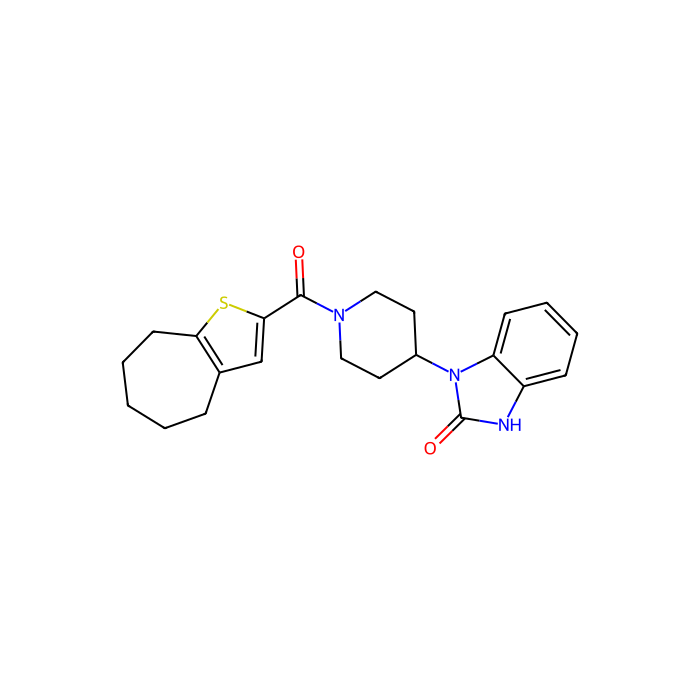
Potent and selective TRPC3/6 activator (EC50= 80 and 440 nM for TRPC3 and 6, respectively). Exhibits no activity at TRPV4, TRPA1, M1, M4, CaV1.2, hERG, NaV1.5, or CXCR5 receptors at concentrations <10 μmol/L. Induces TRPC3/6-currents in HEK293 cells trans
Conditions de stockage de stockage
Store at -20°C
Expédié en
Ice chest + Ice pads
Ce produit nécessite l'expédition en chaîne froide. Les services terrestres et autres services économiques ne sont pas disponibles.
This compound belongs to the class of organic compounds known as cycloheptathiophenes. These are polycyclic compounds containing a thiophene ring fused to a 7 member carbocyclic moiety. Thiophene is 5-membered ring consisting of four carbon atoms and one sulfur atom.
External Descriptors
Not available
1. Djoumbou Feunang Y, Eisner R, Knox C, Chepelev L, Hastings J, Owen G, Fahy E, Steinbeck C, Subramanian S, Bolton E, Greiner R, and Wishart DS. ClassyFire: Automated Chemical Classification With A Comprehensive, Computable Taxonomy. Journal of Cheminformatics, 2016, 8:61.
Certificats (CoA, COO, BSE/TSE et tableau d'analyse)
C of A & Other Certificates(BSE/TSE, COO):
Analytical Chart:
Propriétés chimiques et physiques
Solubilité
Solvent:DMSO, Max Conc. mg/mL: 39.55, Max Conc. mM: 100; Solvent:ethanol, Max Conc. mg/mL: 39.55, Max Conc. mM: 100
Poids moléculaire
395.500 g/mol
XLogP3
4.200
Hydrogen Bond Donor Count
1
Hydrogen Bond Acceptor Count
3
Rotatable Bond Count
2
Exact Mass
395.167 Da
Monoisotopic Mass
395.167 Da
Topological Polar Surface Area
80.900 Ų
Heavy Atom Count
28
Formal Charge
0
Complexity
607.000
Isotope Atom Count
0
Defined Atom Stereocenter Count
0
Undefined Atom Stereocenter Count
0
Defined Bond Stereocenter Count
0
Undefined Bond Stereocenter Count
0
The total count of all stereochemical bonds
0
Covalently-Bonded Unit Count
1
Calculateurs de solution
Molarity Calculator
Determine the necessary mass, volume, or concentration for preparing a solution.
Dilution Calculator
Determine the dilution needed to prepare a stock solution.
Reconstitution Calculator
Avis
Avis des clients
Application Protocols
No item-specific validated application protocols are provided for this product. The following general procedures are offered as non-binding guidance for small-molecule screening compounds.
DMSO stock preparation:
Warm compound to ambient temperature. Accurately weigh to prepare a 10–50 mM stock in anhydrous DMSO. Vortex until fully dissolved. If needed, sonicate briefly or warm to ≤37°C.
Aliquot into low-bind microtubes (e.g., 10–50 µL) to minimize freeze–thaw cycles. Store at −20°C.
Plate setup for biochemical assays:
Thaw an aliquot on ice, vortex, quick-spin. Perform serial dilutions in DMSO to create an intermediate plate, then transfer to assay buffer to achieve final 0.1–1% DMSO.
Include vehicle controls, positive controls (target-dependent), and counter-assay wells.
Solubility and stability checks:
After diluting into assay buffer, inspect for turbidity/precipitation. If present, increase DMSO slightly within assay tolerance or use staged dilution.
Verify stability by LC–MS at the end of the assay window.
Data quality:
Run in technical triplicates; include at least 8-point concentration–response series for curve-fitting. Monitor Hill slopes and exclude curves evidencing artifacts.
Refer to your laboratory SOPs and the SDS/CoA for any item-specific requirements.
Biological Roles
Item-specific biological target(s), mechanism, and pathways are not provided in the product data.
General context for small-molecule ligands (not item-specific):
Screening ligands are used to modulate or probe protein function (enzymes, receptors, transporters) in biochemical and cellular systems. They can reveal pathway dependencies, validate targets, and help map phenotypic effects to molecular interactions.
Orthogonal biophysical methods (e.g., DSF, SPR, MST, NMR ligand-observe) provide evidence of direct binding and can distinguish true interactions from assay artifacts.
In cell systems, concentration–response experiments with proper vehicle controls, counterscreens (e.g., cytotoxicity, reporter interference), and time-course studies help assign on-target versus off-target effects.
Chemoproteomics and thermal proteome profiling can be deployed to explore proteome-wide binding when the nominal target is unknown.
Notes and limitations:
No claims are made regarding endogenous biological roles, therapeutic relevance, or clinical utility for this item. It is supplied strictly for research use.
For any biological interpretation, couple activity readouts with confirmatory orthogonal assays and, where possible, structure verification and purity checks for the specific lot in use.
Buffer Applications
This product is a small organic ligand candidate and is not a buffering reagent. Therefore, classical buffer formulation guidance (pH ranges, buffer capacity, recipes) does not apply.
Practical notes for assay buffers (general, not item-specific):
Maintain a consistent, validated buffer system (e.g., HEPES, PBS, Tris) compatible with the biological assay and the expected solubility profile of the compound. Include 0.1–1% DMSO to preserve solubility when diluting from DMSO stocks.
If precipitation is observed on dilution, consider modest ionic strength adjustments, addition of 0.01–0.05% nonionic surfactant, or staged dilution via an intermediate organic content (e.g., 10–20% ethanol or ACN) that is subsequently reduced to final assay conditions.
For precise buffer recipes and pH control, refer to your assay SOPs; this item does not itself provide buffering capacity.
Green Alternatives
For this Moligand screening compound, the principal environmental considerations arise from solvent use during stock preparation, assay dilution, and any analytical or preparative handling. Where feasible, substitute toward greener solvents and workflows without compromising data integrity.
General green substitutions (not item-specific):
Stock/dilution solvents: While DMSO is often necessary for high-concentration stocks, consider staged dilutions into ethanol or aqueous buffer to minimize final DMSO in assays.
Chromatography: Favor water/ethanol or water/acetonitrile over water/methanol where ACN availability and waste treatment are optimized; use low-solvent gradient methods and shorter columns to reduce solvent consumption.
Workup/extraction (if applicable): Replace chlorinated solvents with ethyl acetate or MTBE where compatible. For solid-phase cleanups, use aqueous-compatible methods to reduce organic solvent volumes.
Balanced trade-offs:
DMSO vs ethanol:
DMSO: higher solvency, widely accepted in HTS; potential biological effects at >1% v/v.
Ethanol: greener and volatile; lower solvency for hydrophobic chemotypes and may perturb some assays at >1–2%.
ACN vs MeOH in LC:
ACN: often sharper peaks/shorter runs (less solvent overall).
MeOH: renewable routes available; higher viscosity can increase backpressure/energy use.
Operational tips:
Miniaturize assay volumes (uHTS) to reduce solvent and compound usage.
Consolidate shipments on cold chain to lower packaging waste and carbon footprint.
Pharmaceutical Uses
No pharmacopeial status or excipient/formulation role is provided for this item, and it is labeled for research use only.
General considerations for small-molecule ligands in pre-formulation research (not item-specific and not for human/clinical use):
Solubility screening: Determine pH-dependent solubility and potential salt forms (if ionizable) to support in vitro dosing solutions for nonclinical research.
Stability studies: Assess chemical stability in common vehicles (e.g., DMSO, ethanol, PEG400, aqueous buffers) and under light/temperature stress.
Compatibility: Evaluate adsorption to plastics (especially at low nM–µM concentrations) and choose low-binding labware when necessary.
Important limitations:
This product is not intended for therapeutic, diagnostic, or clinical applications. No claims are made regarding safety, efficacy, or dosage. Any formulation-related discussion is limited to laboratory research contexts only.
Physical Properties
The following item-specific physicochemical parameters are not included in the product data and should be confirmed from the CoA/Spec Sheet for the shipped batch:
Molecular Weight: Not specified for this item; refer to CoA/Spec Sheet.
Molecular Formula: Not specified for this item; refer to CoA/Spec Sheet.
Appearance: Not specified for this item; refer to CoA/Spec Sheet.
Melting point (literature or computed): Not specified for this item; refer to CoA/Spec Sheet.
Boiling point (literature): Not applicable/unknown for a defined solid compound; refer to CoA/Spec Sheet if relevant.
Density: Not specified for this item; refer to CoA/Spec Sheet.
Refractive index: Not applicable for solids; if liquid, refer to CoA/Spec Sheet.
pKa/logP/logD: Not specified for this item; consult literature or compute from the structure when available.
Solubility: Not specified. As a practical starting point for screening compounds, prepare a concentrated DMSO stock (e.g., 10–50 mM) and test aqueous dilution behavior with cosolvents/surfactants as needed.
General guidance (not item-specific):
Many drug-like small molecules show good solubility in DMSO (≥10 mM) but may precipitate upon >100-fold dilution into purely aqueous buffers; include 0.1–1% DMSO in assay buffers to maintain solubility.
If the compound is weakly basic/acidic, pH adjustment toward the ionized form can improve aqueous solubility for preparative work; confirm chemical stability across pH before use.
Quality and Grades
Grade/Purity: Moligand™ (as provided). Moligand denotes inclusion in a research-oriented small-molecule/ligand library intended for discovery workflows (e.g., screening, tool compound exploration). It emphasizes suitability for biochemical and cell-based assays rather than analytical reference-standard status.
What Moligand™ generally implies (general guidance, not item-specific specs):
Intended use: research screening, target validation, and SAR exploration.
Documentation: CoA/Spec Sheet typically includes structural identifiers, purity by LC/UPLC, and batch/lot information. Request the latest CoA for your lot.
Analytical expectations: Compounds in screening libraries are commonly assessed by LC–MS, and sometimes by 1H NMR for identity; UV trace and purity thresholds vary by supplier and lot. No specific purity threshold is stated for this item—refer to CoA/Spec Sheet.
What is not specified for this item:
Exact purity value and method: Not specified for this item; refer to CoA/Spec Sheet.
Residual solvents, water content (KF), inorganic/metal content, and stabilizers: Not specified for this item; refer to CoA/Spec Sheet.
Recommendations:
Verify identity/purity upon receipt if you require analytical-grade certainty (e.g., LC–MS check against expected m/z).
For screening campaigns, aliquot and track freeze–thaw cycles to maintain data quality.
Reaction and Applications
This product is supplied as a Moligand screening compound, primarily intended for discovery and assay applications rather than as a synthetic reagent.
Research and discovery uses (general, non-item-specific):
Biochemical and biophysical assays: evaluate binding or modulation of protein targets (e.g., enzyme inhibition, receptor interactions) using formats such as enzyme kinetics, fluorescence polarization, thermal shift (DSF), SPR, or MST.
Cell-based assays: probe pathway engagement and phenotypic outcomes with careful control of DMSO concentration and exposure times.
SAR and profiling: use orthogonal assays to validate activity and exclude assay artifacts (fluorescence interference, redox cycling, aggregation). Employ counter-screens and detergent controls when needed.
Orthogonal confirmation: leverage LC–MS to confirm intracellular exposure in cell assays and to monitor stability/metabolism in microsomes or S9 if ADME liabilities are in scope.
Not typically applicable:
Named synthetic reactions: Without a disclosed structure/functional groups, this item is not presented for use as a building block or reagent. If you intend to derivatize it, obtain full structural information and assess compatibility with the desired transformations (e.g., cross-coupling, amide formation) after confirming available handles.
Reaction Conditions
No item-specific reaction conditions are applicable because this product is provided as a screening ligand for use in biological/biophysical assays rather than as a reagent.
General laboratory practices relevant to handling in solution (not item-specific):
Stock preparation: Dissolve in anhydrous DMSO to 10–50 mM; vortex and gently warm (≤37°C) if necessary. Avoid prolonged heating.
Filtration: If particulate persists after dissolution, pass through a 0.22 µm PTFE filter to ensure clarity before assay or analytical injection.
Stability checks: Perform a quick LC–MS time-course (0, 4, 24 h) in the intended assay buffer with 0.1–1% DMSO at room temperature or 37°C to confirm chemical stability and absence of degradation/adsorption.
Light/oxidation sensitivity: If chromophoric or redox-active moieties are suspected, protect solutions from light and air (nitrogen overlay) during extended incubations.
If you intend to use the molecule as a reactant in synthesis, first obtain the complete structural information and consult the literature for conditions specific to its functional groups.
Safety and Handling
Item-specific hazard data were not provided.
GHS Classification: Not specified for this item; refer to SDS.
Signal Word / H-Statements / Pictograms: Not specified for this item; refer to SDS.
General laboratory safety (non-item-specific; defer to the official SDS for authoritative guidance):
Handle in a chemical fume hood with appropriate PPE: lab coat, safety glasses, and suitable gloves (e.g., nitrile). Avoid inhalation of dust/aerosols and skin contact.
Avoid ingestion and contact with eyes. Wash thoroughly after handling. Do not pipette by mouth.
Incompatibilities: Unknown without structure; as a precaution, avoid strong oxidizers/reducers and reactive bases/acids until compatibility is confirmed.
First aid (general): In case of skin/eye contact, rinse with water for at least 15 minutes and seek medical attention if irritation persists. If inhaled, move to fresh air. If swallowed, rinse mouth—do not induce vomiting; seek medical attention.
Spill response: Absorb small spills with inert material (e.g., vermiculite) and collect in a suitable container for disposal. Prevent release to drains.
Waste: Dispose of as organic chemical waste per institutional and local regulations.
Storage and transport (from product data):
Storage: Store at −20°C.
Shipping: Ice chest + ice pads.
Protect from moisture and, if colored/UV-absorbing, from light until characterization confirms photostability.
Solvent Selection
Given the absence of a disclosed structure, solvent selection should follow best practices for small-molecule screening compounds.
Primary stock solvent: DMSO is the default for HTS/assay stocks due to broad solvating power and aqueous miscibility at low percentages.
Typical stock concentration: 10–50 mM in DMSO (general practice). Confirm solubility visually and analytically (UV/UPLC) and adjust as needed.
Assay dilution: Maintain 0.1–1% (v/v) DMSO in assay buffers to prevent precipitation; include a solvent-matched vehicle control.
Cosolvents for preparative work: DMF, acetonitrile, methanol, ethanol—select based on compatibility with your assay or synthesis step. Water-miscible alcohols can aid in staged dilutions.
Aqueous buffer compatibility: Without ionization data, empirically screen pH 6.5–8.0 for biochemical assays; include mild surfactants (e.g., 0.01–0.05% Tween-20) only if compatible with the biology.
Practical guidance:
Perform a mini-solubility screen: prepare 10 mM DMSO stock, then dilute 1:100 into several assay buffers and inspect for turbidity over 1–2 hours at room temperature and at 37°C.
For analytical injections, use ACN/H2O (0.1% FA or NH4OAc as needed) to assess retention and solubility on LC–MS.
Comparison snapshot (general):
DMSO: highest solvency; potential biological effects at >1%.
DMF: strong solvency; less favored biologically, hygroscopic.
ACN: good for analytics; limited for compound storage.
MeOH/EtOH: greener, but limited for hydrophobic chemotypes.
Storage and Reconstitution
From product data:
Storage Conditions: Store at −20°C.
Shipped In: Ice chest + ice pads.
General best practices for small-molecule screening compounds (not item-specific):
Upon receipt: Allow the sealed container to equilibrate to room temperature before opening to prevent condensation. If supplied as a solid, promptly reseal under dry atmosphere after sub-sampling.
Reconstitution: Prepare concentrated DMSO stocks (e.g., 10–50 mM). Vortex to dissolve fully; gentle warming (≤37°C) may aid dissolution. Document exact concentration gravimetrically or by quantitative NMR/UV when required.
Aliquoting: Divide into single-use aliquots (10–50 µL) in low-bind tubes or 96/384-well source plates. Minimize headspace and freeze at −20°C or lower (−80°C for long-term).
Freeze–thaw: Avoid repeated cycles; discard aliquots after first thaw where critical. Track thaw counts in LIMS.
Light and moisture: Store protected from light and humidity. Use desiccants for solid storage and ensure anhydrous DMSO for solutions.
Stability: Item-specific solution/solid stability is Not specified for this item; refer to CoA/Spec Sheet. Verify by periodic LC–MS/UPLC if stored >3 months.
For any uncertainties regarding solubility, stability, or handling, consult the SDS and the batch-specific CoA/Spec Sheet.
Structure and Identity
A Moligand small-molecule screening compound supplied for research use in discovery workflows.
SKU: G288131
Product Name: GSK 1702934A
CAS: 924377-85-5
PubChem CID: 16376051
Category: Small molecules and compound libraries (Moligand collection)
Item-specific identifiers (as provided):
Molecular Formula: Not specified for this item; refer to CoA/Spec Sheet.
Molecular Weight: Not specified for this item; refer to CoA/Spec Sheet.
SMILES: Not specified for this item; refer to CoA/Spec Sheet.
InChIKey: 17772 (as provided)
Structural features:
Not specified in the product data. Without a structure, detailed functional groups, ring systems, stereochemistry, and 2D description cannot be summarized. Consult the CoA/Spec Sheet or the referenced CID for structural depiction.
Notes for users:
For cheminformatics registration or HTS plate mapping, retrieve the canonical SMILES/InChI from the CoA/Spec Sheet or trusted databases before ELN entry.
If you will perform analytical verification (LC–MS/NMR), request the latest batch CoA to confirm exact molecular formula and isotope pattern expectations.
Synthetic Utility
The compound is supplied as a finished Moligand screening molecule rather than as a synthetic building block. Without disclosed functional groups or structure, specific reactivity and transformation options cannot be described.
General guidance if derivatization is contemplated (not item-specific):
Confirm complete structural information (SMILES/InChI, functional groups, stereochemistry) and analytical data (LC–MS, NMR) from the CoA or original literature before planning any transformations.
Identify potential synthetic handles (e.g., aryl halides for cross-coupling, amines/acids for amide couplings, nitriles/aldehydes for further elaboration) and assess chemoselectivity risks.
Map protecting-group strategy if multiple nucleophiles/electrophiles are present; assess stability toward acids/bases, oxidants/reductants, and hydrogenation conditions.
If preparing analogs for SAR, design routes that allow late-stage diversification (e.g., SNAr, Buchwald–Hartwig, Minisci, or SuFEx) to maximize library efficiency.
Limitations:
No item-specific synthetic pathways, yields, or reaction conditions are provided here; consult primary literature or develop de novo routes once the structure is confirmed.
Target Specificity
Item-specific biological target(s), binding constants, selectivity panel results, and mechanism of action are not provided for this product.
Target/Pathway: Not specified for this item; refer to CoA/Spec Sheet or primary literature.
Affinity/IC50/Ki: Not specified for this item; refer to CoA/Spec Sheet.
Selectivity profile: Not specified for this item; refer to CoA/Spec Sheet.
Guidance (general, not item-specific):
Use orthogonal assays (biochemical + biophysical + cellular) to establish target engagement and selectivity.
Include counterscreens against common off-targets or assay-interference mechanisms (e.g., aggregation, redox activity, fluorescence quenching/inner-filter effects) when interpreting activity.
Confirm purity and identity of the specific lot used to avoid conflating impurities with apparent activity.
Foire aux questions
How is this product shipped?
This product ships in an insulated container with ice pads. Unpack on arrival and transfer it to the storage condition stated above.
What are the CAS number, molecular formula and molecular weight?
The CAS Number is 924377-85-5, the molecular formula is C22H25N3O2S, and the molecular weight is 395.52 g/mol. InChIKey AXWRAIIIBRLXBP-UHFFFAOYSA-N.
How should this product be stored?
Store at ?20 °C. Freezer storage is required to maintain the specified shelf life.
What is the purity of this product, and how is it determined?
This product is supplied at ≥98% purity, determined by HPLC. Lot-specific values are stated on the Certificate of Analysis.
What is Moligand??
Moligand? is one of Aladdin Scientific's premium product lines, formulated for high-purity applications across multiple workflows. Compared to standard grades in the same workflow, Moligand? products typically offer tighter specifications, more rigorous QC, and stronger lot-to-lot consistency.
What documentation is provided?
Available product documentation, including Certificates of Analysis (COA), Safety Data Sheets (SDS), and specification sheets, is shown in the product document area. Document availability and access follow the current site policy.
Besoin d'aide pour choisir la qualité ?
Notre guide de sélection des qualités couvre la pureté, le statut du stabilisant et l'adéquation à l'application pour toutes les variantes de notre catalogue.
Nous utilisons des cookies pour garantir le bon fonctionnement du site et, lorsque cela est autorisé, pour améliorer votre expérience. Vous pouvez gérer vos préférences à tout moment dans les Paramètres. Pour en savoir plus, consultez notre Politique relative aux cookies.
Souhaitez-vous que nous vous envoyions un message lorsque des réductions seront disponibles?
Me rappeler plus tard
Merci ! Veuillez vérifier votre boîte de réception e-mail pour confirmer.
Products are supplied to verified businesses, institutions, and qualified professionals for research and development use only. Not for use in humans, animals, diagnosis, or therapy.