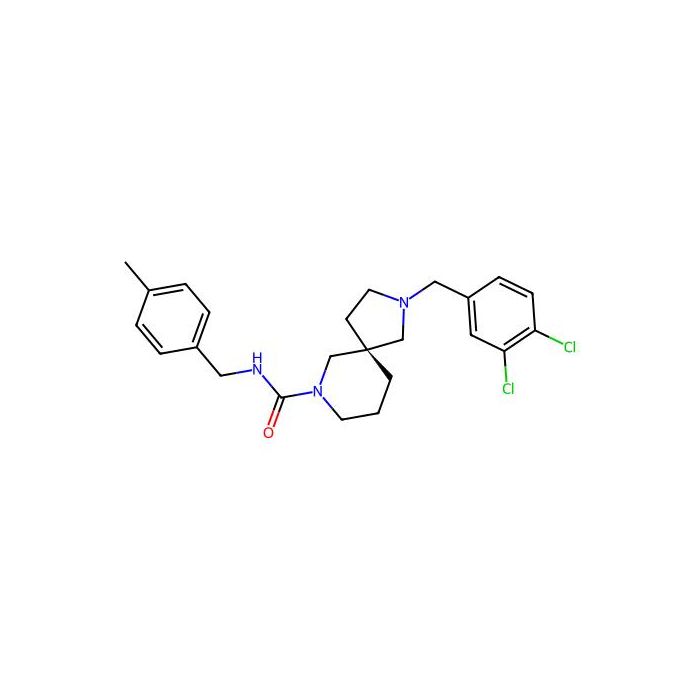
GSK2850163 is a novel inhibitor of inositol-requiring enzyme-1 alpha ( IRE1α ) which can inhibit IRE1α kinase activity and RNase activity with IC 50 s of 20 and 200 nM, respectively.
In Vitro
GSK2850163 is a novel inhibitor of inositol-requiring enzyme-1 alpha (IRE1α) which can inhibit IRE1α kinase activity and RNase activity with IC 50 s of 20 and 200 nM, respectively. The increased autophosphorylation of IRE1α could be reduced in a dose-dependent manner by GSK2850163. Increasing concentrations of GSK2850163 are capable of reducing the increased XBP 1 transcriptional activity. Two additional kinases are weakly inhibited by GSK2850163: Ron (IC 50 =4.4 μM) and FGFR1 V561M (IC 50 =17 μM). MCE has not independently confirmed the accuracy of these methods. They are for reference only.
GSK2850163 is a novel inhibitor of inositol-requiring enzyme-1 alpha ( IRE1α ) which can inhibit IRE1α kinase activity and RNase activity with IC 50 s of 20 and 200 nM, respectively.
Conditions de stockage de stockage
Store at -80°C
Expédié en
Dry ice packs + Cold packs
Ce produit nécessite l'expédition en chaîne froide. Les services terrestres et autres services économiques ne sont pas disponibles.
Certificats (CoA, COO, BSE/TSE et tableau d'analyse)
C of A & Other Certificates(BSE/TSE, COO):
Analytical Chart:
Calculateurs de solution
Molarity Calculator
Determine the necessary mass, volume, or concentration for preparing a solution.
Dilution Calculator
Determine the dilution needed to prepare a stock solution.
Reconstitution Calculator
Avis
Avis des clients
Application Protocols
No validated in-catalog application protocols are provided for this specific item. The following general procedures apply to small-molecule screening compounds.
Stock solution preparation (general)
Weigh compound quickly to minimize atmospheric exposure.
Prepare a 10 mM stock in DMSO (adjust if MW becomes available). Vortex/sonicate to dissolve; filter if needed (0.2 µm PTFE).
Aliquot into low-bind, amber tubes (e.g., 10–50 µL) to avoid repeated freeze–thaw.
Serial dilution for assays
Perform serial dilutions in DMSO or DMSO:buffer mixtures to achieve desired concentration ranges.
Maintain constant final DMSO % across conditions (commonly 0.1–0.5%).
Plate handling
Use polypropylene plates for compound storage; seal with foil/thermal seals to limit evaporation.
For acoustic dispensing, ensure solution homogeneity and track compound concentration and viscosity.
Analytical confirmation
Spot-check identity/purity via LC–MS prior to critical experiments. If standards are available, quantify concentration by qNMR or UV using an extinction coefficient (if known).
Biological Roles
Item-specific note: The Product Data do not specify a biological target, pathway, or mechanism for GSK2850163.
Item-specific (from Product Data)
Research use: For research use only (non-clinical, non-diagnostic).
General considerations for small-molecule probes (not item-specific)
Potential roles may include acting as an enzyme inhibitor/activator, receptor ligand, ion channel modulator, or pathway probe depending on structure and design intent.
When deploying an unannotated compound in biological systems:
Establish solubility/stability in the assay medium (pH, protein presence, redox environment).
Determine cytotoxicity windows independently (e.g., by CellTiter/Resazurin) before mechanistic readouts.
Evaluate off-target liabilities via selectivity panels if target specificity is proposed internally.
Data integrity
Couple biological results with analytical confirmation (LC–MS of working solutions) to ensure the active entity is the intended compound and concentration.
Record lot and preparation date, and monitor for degradation (e.g., hydrolysis, photolysis) across the assay period.
Buffer Applications
Not typically applicable: GSK2850163 is a small-molecule research compound rather than a buffering agent. It does not serve as a primary pH buffer component.
Practical notes (general)
When dosing into buffered media (e.g., PBS, HBSS, HEPES-buffered assay buffer), maintain consistent DMSO% and confirm that the compound does not precipitate upon dilution at the working pH.
If compound ionization is expected, buffer pH relative to the compound’s pKa (if known from literature) can influence solubility and apparent potency; adjust dosing strategy accordingly.
Green Alternatives
Context: As a research compound (not a process solvent or reagent), “green alternatives” are less about replacing the compound itself and more about choosing greener co-solvents and workflows during handling and analysis.
Solvent choices (general guidance)
Prefer water/DMSO minimal-use paradigms over chlorinated solvents for assay prep. Keep DMSO to the lowest feasible final %.
For analytical work, consider lower-toxicity eluents and buffered aqueous–acetonitrile over acetonitrile–methanol-heavy gradients where possible.
Micro-scale practices
Use miniaturized screening formats (384/1536-well) to reduce solvent consumption and waste per data point.
Employ sealed plates and acoustic dispensing to minimize volatile emissions and operator exposure.
Comparison (general)
DMSO vs. DMF: DMSO is generally preferred for worker safety and lower volatility; DMF should be avoided unless necessary.
ACN vs. MeOH for LC: ACN offers lower toxicity than MeOH exposure-wise but has supply sustainability considerations; balance based on lab policy.
Waste management
Segregate DMSO-containing aqueous waste for appropriate disposal; avoid disposing to drain. Consolidate organic waste streams to minimize container count and transport footprint.
Pharmaceutical Uses
No pharmaceutical or clinical use is claimed or supported for this catalog item.
Item-specific (from Product Data)
Research Use Note: For research use only. Not for human or veterinary use, diagnostic, or therapeutic applications.
General formulation context (not item-specific)
In preclinical research settings, small molecules may be formulated for in vitro or ex vivo studies (e.g., DMSO stocks diluted into buffer or media).
For in vivo exploratory research (outside the scope of this listing), typical vehicles include aqueous buffers with co-solvents/surfactants (e.g., PEG400, Captisol, Tween-80); any such use requires internal risk assessment, stability data, and appropriate approvals.
Documentation
No pharmacopeial monograph or excipient status is provided for this item. Batch-specific identity/purity and stability information should be taken from the CoA.
Physical Properties
Summary: Physical constants are not specified in the Product Data for this item. For assay planning, typical handling assumes an organic-soluble small molecule.
Item-specific (from Product Data)
Molecular weight: Not specified for this item; refer to CoA/Spec Sheet.
Molecular formula: Not specified for this item; refer to CoA/Spec Sheet.
Appearance: Not specified for this item; refer to CoA/Spec Sheet.
Literature/computed values (not item-specific)
Boiling point, melting point, density, pKa, logP/logD, refractive index: Not available here. If required, retrieve from structure (CID 73291790) via your preferred database and label as “literature”.
General chemistry knowledge (handling implications)
Small-molecule screening solids are commonly formulated as DMSO stock solutions (e.g., 10–50 mM) due to broad solubilizing power.
If the compound is weakly basic or acidic, solubility may improve with minimal acid/base modifiers (e.g., 0.1% formic acid or 0.1% NH4OH) in aqueous-organic mixtures; verify compound stability first.
Hygroscopic or polymorphic behavior can affect weigh-outs; if unknown, minimize ambient exposure and document any observed deliquescence or oiling-out upon warming.
Practical measurements to capture in-lab (recommended)
DMSO solubility at room temperature; precipitation threshold upon aqueous dilution.
UV–Vis profile (for assay interference screening) and aqueous pKa (if relevant to target engagement models).
LC–MS retention time and purity under your standard analytical method.
Quality and Grades
Quality statement: The Product Data do not specify a grade or purity for this item. For screening libraries, Aladdin Scientific emphasizes traceable identity and stability suitable for discovery research; verify batch-specific details on the CoA.
Item-specific (from Product Data)
Grade/Purity: Not specified for this item; refer to CoA/Spec Sheet.
What to expect (general guidance for small-molecule library compounds)
Identity confirmation commonly utilizes LC–MS (accurate mass), 1H NMR, and purity assessment by HPLC/UPLC (UV/ELSD/MS), typically reported as area% at a specified wavelength. Exact specifications vary by lot; consult CoA.
If salt form/solvate/hydrate is used, the CoA will indicate counterion/stoichiometry; account for this in molar stock preparation.
Stabilizers: none stated for this item. If present in a specific lot, it will be noted on the CoA.
Practical recommendations
For HTS/HCS, document lot number, purity method/wavelength, and measured purity to maintain data integrity.
If low-UV impurities are suspected (e.g., at 210–220 nm), confirm with orthogonal detection (CAD/ELSD/MS) when the assay is sensitive to impurities.
Reaction and Applications
Applicability note: GSK2850163 is offered as a research small molecule/compound library member, not as a synthetic reagent or catalyst. As such, classical “reaction applications” (e.g., Grignard, cross-coupling) are not typically relevant.
Item-specific (from Product Data)
Category: Small molecules and compound library (全部 / 可售 / 小分子和化合物库)
Research applications (general, non-clinical)
Use in biochemical or cell-based assays for exploratory target engagement, phenotypic screening, SAR hypothesis testing, or as a probe candidate where mechanism is known internally.
Suitable for plate-based HTS/fragment growth workflows when solubility/stability are confirmed.
Practical assay tips (general)
Prepare a fresh DMSO stock (e.g., 10 mM). Filter if particulate is observed (PTFE, 0.2 µm). Record exact concentration by weight-in or quantitative NMR if accuracy is critical.
Control the final DMSO percentage across all wells (commonly 0.1–0.5%) to avoid solvent-driven artifacts.
Include orthogonal counterscreens (e.g., detergent presence, redox activity, colloidal aggregation tests) to de-risk false positives.
For light- or air-sensitive chemotypes, use amber plates/tubes and minimize headspace; perform stability spot-checks by LC–MS after assay setup.
Not applicable here
Named synthetic transformations, catalytic cycles, or stoichiometric reagent roles are not typically applicable for this product.
Reaction Conditions
Not applicable in the classical sense: GSK2850163 is a research small molecule (final entity), not a reagent to run chemical reactions.
Practical handling conditions for stock preparation (general)
Dissolve in anhydrous DMSO to prepare a 10–50 mM stock (verify solubility). If undissolved, gently warm (≤40°C) and vortex/sonicate briefly.
Filter if necessary through 0.2 µm PTFE to remove particulates; avoid cellulose filters with strong organic solvents.
For aqueous assay dosing, pre-dilute to reduce precipitation risk and maintain constant DMSO across conditions.
Stability checks (general)
Assess short-term stability in DMSO at room temperature and 4°C; for long-term, store aliquots at −80°C (as per Product Data).
If the chemotype is unknown, assume potential light sensitivity; use amber vials and minimize freeze–thaw cycles.
Safety and Handling
Safety overview: No specific GHS details are provided in the Product Data. Treat as a research chemical of unknown hazard profile and follow institutional procedures.
Item-specific (from Product Data)
Signal word: Not specified for this item; refer to SDS.
H-statements: Not specified for this item; refer to SDS.
GHS classification/pictograms: Not specified for this item; refer to SDS.
Storage: Store at −80°C. Shipped on dry ice + cold packs.
General safety guidance (not item-specific; defer to SDS)
PPE: lab coat, nitrile gloves, safety glasses; handle powders/solutions in a certified chemical fume hood.
Avoid inhalation of dust/aerosols and skin contact. Prevent ingestion. Wash thoroughly after handling.
Incompatibilities are structure-dependent. As a precaution, segregate from strong oxidizers, strong acids/bases until specific compatibility is known.
First aid (summary): in case of exposure, rinse affected area with water; seek medical attention. Provide SDS to responders.
Waste: dispose of solutions and solids as hazardous organic chemical waste per local regulations.
Special risks for screening compounds
Some heteroaromatics or electrophiles may be reactive or light-sensitive. Protect from light if degradation is suspected.
DMSO solutions can enhance dermal absorption; avoid skin contact with solutions.
Solvent Selection
Guidance: Without a disclosed structure, solvent choice prioritizes robust solubilization and chemical stability for screening stocks.
Primary solvent for stocks
DMSO (anhydrous) is the default for discovery compounds due to high solvency across polar/nonpolar motifs and compatibility with most biological assays at low final DMSO fractions (≤0.5–1%).
DMF: strong solvent; use when DMSO is insufficient. Assess cytotoxicity in cell assays at very low final %.
Ethanol or isopropanol: suitable for some lipophilic compounds; evaporates readily for coating applications; watch for precipitation upon aqueous dilution.
Acetonitrile: miscible with water, useful for LC and some assay preparations.
Miscibility and dilution strategy
Prepare concentrated stocks (e.g., 10–50 mM in DMSO), then dilute into assay buffer to reach the desired final concentration while keeping total DMSO constant across wells.
To mitigate precipitation: pre-dilute DMSO stock into an intermediate of DMSO:buffer (e.g., 1:3) with surfactant (0.01–0.05% Tween-20) if compatible with assay.
EtOH: volatile, simpler removal; lower solvency for many heteroaromatics.
ACN: low viscosity; may denature proteins at modest %; good for analytical work.
Storage and Reconstitution
Item-specific storage
From Product Data
Storage Conditions: Store at −80°C.
Shipped In:Dry ice packs + Cold packs to maintain low temperature during transit.
Reconstitution (general guidance for small molecules)
Reconstitute in anhydrous DMSO to prepare concentrated stocks (e.g., 10–50 mM). If the molecular weight is later confirmed, calculate exact mass for desired molarity.
Gently warm (≤40°C) and sonicate if necessary to aid dissolution. Avoid prolonged heating.
Aliquoting and stability
Aliquot into small volumes (e.g., 10–50 µL) in amber, low-bind vials to minimize freeze–thaw cycles and light exposure.
Store aliquots at −80°C. For working stocks, short-term storage at −20°C may be acceptable; confirm by analytical stability checks.
Handling notes
Thaw on ice, mix thoroughly before use, and promptly return unused aliquots to −80°C.
Record preparation date/lot and monitor for precipitation or color change; if observed, re-verify by LC–MS.
Specifications
Appearance, purity, water/peroxide/metal limits, and exact solubility: Not specified for this item; refer to CoA/Spec Sheet.
Structure and Identity
Brief overview: GSK2850163 is cataloged as a research small molecule in our small-molecule/compound library collection. Structural identifiers are not provided in the Product Data for this SKU.
Item-specific (from Product Data)
Product name: GSK2850163 (SKU: G656144)
CAS: 2121989-91-9
PubChem CID: 73291790
Molecular formula: Not specified for this item; refer to CoA/Spec Sheet.
Molecular weight: Not specified for this item; refer to CoA/Spec Sheet.
SMILES: Not specified for this item; refer to CoA/Spec Sheet.
InChIKey: Not specified for this item; refer to CoA/Spec Sheet.
Structural features (general guidance; not item-specific without structure)
Without a provided structure, we cannot annotate ring systems, functional groups, or stereochemistry for this lot.
If available, please consult the Certificate of Analysis (CoA) or structure sheet to confirm: core scaffold class (e.g., heteroaromatic vs. aliphatic), ionizable centers, and stereocenters.
Practical tip
When working with screening compounds where the structure is not listed in the catalog entry, maintain linkage to internal structure files (SD/SMI) and record batch/lot to ensure traceability across biological assay data and cheminformatics workflows.
Synthetic Utility
Not a synthetic building block: This product is positioned as a screening/assay compound rather than a general-purpose reagent or synthon.
Item-specific (from Product Data)
No functional group, protecting group, or reagent role is specified.
General note
If internal programs consider derivatization (e.g., for SAR or probe development), obtain the structure and assess vector points for modification, liability motifs (e.g., anilides, Michael acceptors), and scalability. Otherwise, this catalog item is not intended as a starting material in routine synthesis workflows.
Target Specificity
Item-specific note: No target, pathway, or selectivity profile is provided in the Product Data for GSK2850163.
Item-specific (from Product Data)
Target, epitope, species reactivity, clone/isotype: Not applicable; this is a small molecule, not an antibody or protein reagent.
General guidance
If a target is proposed internally, document assay panel composition, mode of action (inhibitor/agonist/modulator), and cross-screening results to quantify selectivity.
Employ orthogonal readouts (biochemical and cellular) and artifact controls (aggregation, redox activity, assay interference) to support specificity claims.
Foire aux questions
How should this product be stored?
Store at ?80 °C. Ultra-low temperature storage is required to maintain the specified shelf life.
How is this product shipped?
This product ships frozen with dry ice and cold packs. Unpack on arrival and transfer it to the storage condition stated above; handle dry ice with insulated gloves in a ventilated area.
What are the CAS number, molecular formula and molecular weight?
The CAS Number is 2121989-91-9, the molecular formula is C24H29Cl2N3O, and the molecular weight is 446.41 g/mol.
What documentation is provided?
Available product documentation, including Certificates of Analysis (COA), Safety Data Sheets (SDS), and specification sheets, is shown in the product document area. Document availability and access follow the current site policy.
Nous utilisons des cookies pour garantir le bon fonctionnement du site et, lorsque cela est autorisé, pour améliorer votre expérience. Vous pouvez gérer vos préférences à tout moment dans les Paramètres. Pour en savoir plus, consultez notre Politique relative aux cookies.
Souhaitez-vous que nous vous envoyions un message lorsque des réductions seront disponibles?
Me rappeler plus tard
Merci ! Veuillez vérifier votre boîte de réception e-mail pour confirmer.
Products are supplied to verified businesses, institutions, and qualified professionals for research and development use only. Not for use in humans, animals, diagnosis, or therapy.