GSK690693 - Moligand™, 10mM in DMSO , Protein kinase C (PKC) inhibitor, CAS No.937174-76-0, Protein kinase C (PKC) inhibitor

CAS: 937174-76-0 Cat. No.: G409035 Formule: C21H27N7O3 Poids moléculaire: 425.48 Numéro CE: 804-554-1
DISPONIBLE À COMMANDE
QUALITÉ & PURETÉ Moligand™ ? Moligand™ — Aladdin's line of ligands and bioactive small molecules. Use for receptor, pathway, and binding studies needing defined small-molecule tools. 10mM in DMSO
Synonyms
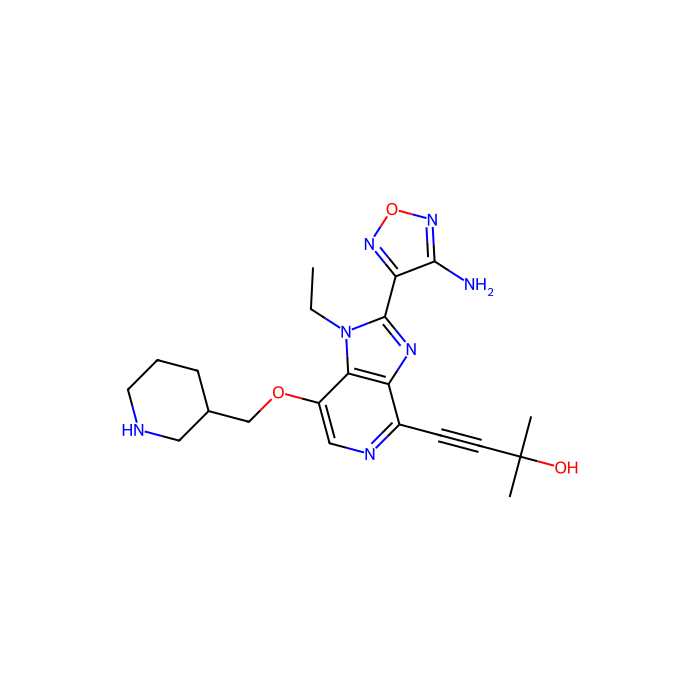
4-(2-(4-amino-1,2,5-oxadiazol-3-yl)-1-ethyl-7-((S)-piperidin-3-ylmethoxy)-1H-imidazo[4,5-c]pyridin-4-yl)-2-methylbut-3-yn-2-ol
Storage
Store at -80°C
Shipped In
Dry ice packs + Cold packs
★
Taille
Allemagne (EU)
USA*
Prix
Qté
1ml
G409035-1ml
—
2 En stock

160,44€

234,20€
Enregistrer 73,76 € (31.49%)
Enter a quantity for the sizes you want to add.

Vue d’ensemble

Information

GSK690693 is a pan-Akt inhibitor targetingAkt1/2/3withIC50of 2 nM/13 nM/9 nM in cell-free assays, also sensitive to the AGC kinase family: PKA, PrkX and PKC isozymes. GSK690693 also potently inhibitsAMPKandDAPK3from the CAMK family with IC50 of 50 nM and
In vitro

GSK690693 is very selective for the Akt isoforms versus the majority of kinases in other families. However, GSK690693 is less selective for members of the AGC kinase family including PKA, PrkX, and PKC isozymes with IC50 of 24 nM, 5 nM, and 2-21 nM, respectively. GSK690693 also potently inhibits AMPK and DAPK3 from the CAMK family with IC50 of 50 nM and 81 nM, respectively, and PAK4, 5, and 6 from the STE family with IC50 of 10 nM, 52 nM, and 6 nM, respectively. GSK690693 inhibits the phosphorylation of GSK3β in tumor cells with IC50 ranging from 43 nM to 150 nM. GSK690693 treatment leads to a dose-dependent increase in the nuclear accumulation of the transcription factor FOXO3A. GSK690693 potently inhibits the proliferation of T47D, ZR-75-1, BT474, HCC1954, MDA-MB-453, and LNCaP cells with IC50 of 72 nM, 79 nM, 86 nM, 119 nM, 975 nM, and 147 nM, respectively. GSK690693 treatment induces apoptosis at concentrations >100 nM in both LNCaP and BT474 cells. Consistent with the role of AKT in cell survival, GSK690693 induces apoptosis in sensitive ALL cell lines.

In vivo

A single administration of GSK690693 inhibits GSK3β phosphorylation in human breast carcinoma (BT474) xenografts in a dose- and time-dependent manner. Similarly, GSK690693 induces a reduction in phosphorylation of the Akt substrates, PRAS40, and FKHR/FKHRL1. GSK690693 also results in an acute increase in blood glucose, returning to baseline 8 to 10 hours after drug administration. Administration of GSK690693 induces reductions in phosphorylated Akt substrates in vivo, and potently inhibits the growth of human SKOV-3 ovarian, LNCaP prostate, and BT474 and HCC-1954 breast carcinoma xenografts, with maximal inhibition of 58% to 75% at the dose of 30 mg/kg/day. GSK690693 exhibits efficacy irrespective of the mechanism of Akt activation involved. GSK690693 is most effective in delaying tumor progression in Lck-MyrAkt2 mice expressing a membrane-bound, constitutively active form of Akt.
Cell Data

cell lines:Ba/F3 cells expressing wild-type or mutant human Kit, HMC1, HMC-1α155

Concentrations:Dissolved in DMSO, final concentrations ~30 μM

Incubation Time:72 hours

Powder Purity:≥98%
Spécifications

Synonymes
4-(2-(4-amino-1,2,5-oxadiazol-3-yl)-1-ethyl-7-((S)-piperidin-3-ylmethoxy)-1H-imidazo[4,5-c]pyridin-4-yl)-2-methylbut-3-yn-2-ol
Spécifications et pureté
Moligand™, 10mM in DMSO
Mécanismes biochimiques et physiologiques
GSK690693 is a pan-Akt inhibitor targeting Akt1/2/3 with IC50 of 2 nM/13 nM/9 nM in cell-free assays, also sensitive to the AGC kinase family: PKA, PrkX and PKC isozymes. GSK690693 also potently inhibits AMPK and DAPK3 from the CAMK family with IC50 of 50 nM and 81 nM, respectively. GSK690693 affects Unc-51-like autophagy activating kinase 1 (ULK1) activity, robustly inhibits STING-dependent IRF3 activation. Phase 1.
Conditions de stockage de stockage
Store at -80°C
Expédié en
Dry ice packs + Cold packs
Ce produit nécessite l'expédition en chaîne froide. Les services terrestres et autres services économiques ne sont pas disponibles.
Grade
Moligand™
Type d'action
INHIBITOR
Mécanisme d'action
Protein kinase C (PKC) inhibitor
Propriétés du produit
ALogP
0.3
Noms et identifiants
Isomères SMILES
CCN1C2=C(C(=NC=C2OC[C@H]3CCCNC3)C#CC(C)(C)O)N=C1C4=NON=C4N
WGK Allemagne
3
Poids moléculaire
425.48
Reaxys
15495142
Reaxys-RN_link_address
https://www.reaxys.com/reaxys/secured/hopinto.do?context=S&query=IDE.XRN=15495142&ln=

Données avancées

Cibles associées (humaines)
DCTPP1 Tchem dCTP pyrophosphatase 1 (1 Activities)
Activity TypeActivity Value -log(M)Mechanism of ActionActivity ReferencePublications (PubMed IDs)
PAK5 Tchem Serine/threonine-protein kinase PAK 5 (2 Activities)
Activity TypeActivity Value -log(M)Mechanism of ActionActivity ReferencePublications (PubMed IDs)
PRKX Tchem cAMP-dependent protein kinase catalytic subunit PRKX (3 Activities)
Activity TypeActivity Value -log(M)Mechanism of ActionActivity ReferencePublications (PubMed IDs)
PRKAR2A Tchem cAMP-dependent protein kinase type II-alpha regulatory subunit (1 Activities)
Activity TypeActivity Value -log(M)Mechanism of ActionActivity ReferencePublications (PubMed IDs)
PRKACB Tchem cAMP-dependent protein kinase catalytic subunit beta (1 Activities)
Activity TypeActivity Value -log(M)Mechanism of ActionActivity ReferencePublications (PubMed IDs)
PRKG1 Tchem cGMP-dependent protein kinase 1 (1 Activities)
Activity TypeActivity Value -log(M)Mechanism of ActionActivity ReferencePublications (PubMed IDs)
PRKG2 Tchem cGMP-dependent protein kinase 2 (1 Activities)
Activity TypeActivity Value -log(M)Mechanism of ActionActivity ReferencePublications (PubMed IDs)
PRKCD Tclin Protein kinase C delta type (1 Activities)
Activity TypeActivity Value -log(M)Mechanism of ActionActivity ReferencePublications (PubMed IDs)
PRKCB Tchem Protein kinase C beta type (1 Activities)
Activity TypeActivity Value -log(M)Mechanism of ActionActivity ReferencePublications (PubMed IDs)
PRKCE Tchem Protein kinase C epsilon type (2 Activities)
Activity TypeActivity Value -log(M)Mechanism of ActionActivity ReferencePublications (PubMed IDs)
PRKCH Tchem Protein kinase C eta type (2 Activities)
Activity TypeActivity Value -log(M)Mechanism of ActionActivity ReferencePublications (PubMed IDs)
AKT3 Tchem RAC-gamma serine/threonine-protein kinase (5 Activities)
Activity TypeActivity Value -log(M)Mechanism of ActionActivity ReferencePublications (PubMed IDs)
AKT2 Tchem RAC-beta serine/threonine-protein kinase (6 Activities)
Activity TypeActivity Value -log(M)Mechanism of ActionActivity ReferencePublications (PubMed IDs)
AKT1 Tchem RAC-alpha serine/threonine-protein kinase (10 Activities)
Activity TypeActivity Value -log(M)Mechanism of ActionActivity ReferencePublications (PubMed IDs)
PRKAG2 Tchem 5'-AMP-activated protein kinase subunit gamma-2 (1 Activities)
Activity TypeActivity Value -log(M)Mechanism of ActionActivity ReferencePublications (PubMed IDs)
PAK4 Tchem Serine/threonine-protein kinase PAK 4 (3 Activities)
Activity TypeActivity Value -log(M)Mechanism of ActionActivity ReferencePublications (PubMed IDs)
PAK6 Tchem Serine/threonine-protein kinase PAK 6 (3 Activities)
Activity TypeActivity Value -log(M)Mechanism of ActionActivity ReferencePublications (PubMed IDs)
PRKACA Tchem cAMP-dependent protein kinase catalytic subunit alpha (1 Activities)
Activity TypeActivity Value -log(M)Mechanism of ActionActivity ReferencePublications (PubMed IDs)
PRKCQ Tchem Protein kinase C theta type (4 Activities)
Activity TypeActivity Value -log(M)Mechanism of ActionActivity ReferencePublications (PubMed IDs)
Certificats (CoA, COO, BSE/TSE et tableau d'analyse)
C of A & Other Certificates(BSE/TSE, COO):
Analytical Chart:
Propriétés chimiques et physiques
SolubilitéSolubility (25°C) In vitro DMSO: 100 mg/mL (354.3 mM);    
Sécurité et dangers (GHS)
Signal
Danger
Mentions de danger

H301:Toxic if swallowed

WGK Allemagne
3
Reaxys
15495142
Reaxys-RN_link_address
https://www.reaxys.com/reaxys/secured/hopinto.do?context=S&query=IDE.XRN=15495142&ln=
Calculateurs de solution
Avis

Avis des clients

Besoin d'aide pour choisir la qualité ?

Notre guide de sélection des qualités couvre la pureté, le statut du stabilisant et l'adéquation à l'application pour toutes les variantes de notre catalogue.

Voir le guide des qualités Moligand™ →

Souhaitez-vous que nous vous envoyions un message lorsque des réductions seront disponibles?

Me rappeler plus tard

Merci ! Veuillez vérifier votre boîte de réception e-mail pour confirmer.

Oups ! Les notifications sont désactivées.