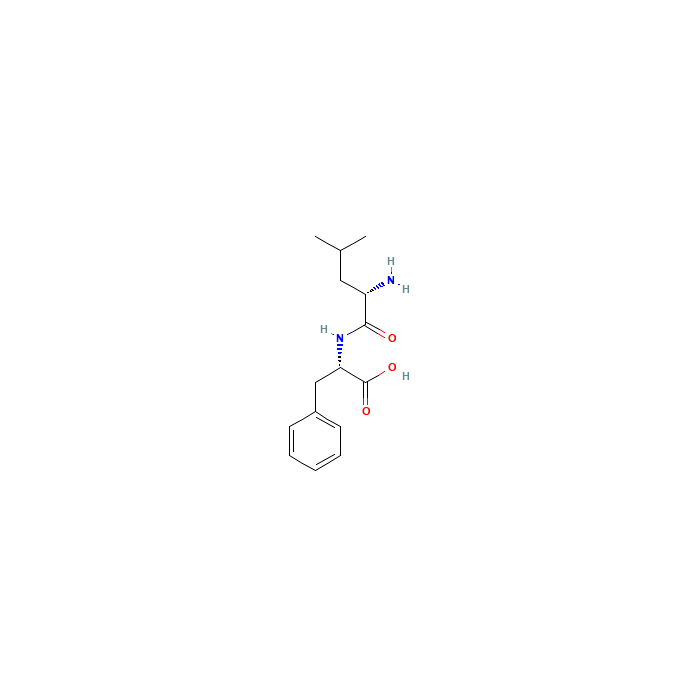
H-Leu-Phe-OH is a competitive inhibitor of both the peptidase and the esterase activities of carboxy peptidase Y.
Product description L-Leucyl-L-phenylalanine, a dipeptide, is an incomplete breakdown product of protein digestion or protein catabolism. Product Application ʟ-Leucyl-ʟ-phenylalanine can be used in biochemical and metabolomics research applications
This compound belongs to the class of organic compounds known as dipeptides. These are organic compounds containing a sequence of exactly two alpha-amino acids joined by a peptide bond.
External Descriptors
dipeptide
1. Djoumbou Feunang Y, Eisner R, Knox C, Chepelev L, Hastings J, Owen G, Fahy E, Steinbeck C, Subramanian S, Bolton E, Greiner R, and Wishart DS. ClassyFire: Automated Chemical Classification With A Comprehensive, Computable Taxonomy. Journal of Cheminformatics, 2016, 8:61.
Certificats (CoA, COO, BSE/TSE et tableau d'analyse)
C of A & Other Certificates(BSE/TSE, COO):
Analytical Chart:
Propriétés chimiques et physiques
Poids moléculaire
278.350 g/mol
XLogP3
-1.100
Hydrogen Bond Donor Count
3
Hydrogen Bond Acceptor Count
4
Rotatable Bond Count
7
Exact Mass
278.163 Da
Monoisotopic Mass
278.163 Da
Topological Polar Surface Area
92.400 Ų
Heavy Atom Count
20
Formal Charge
0
Complexity
325.000
Isotope Atom Count
0
Defined Atom Stereocenter Count
2
Undefined Atom Stereocenter Count
0
Defined Bond Stereocenter Count
0
Undefined Bond Stereocenter Count
0
The total count of all stereochemical bonds
0
Covalently-Bonded Unit Count
1
Calculateurs de solution
Molarity Calculator
Determine the necessary mass, volume, or concentration for preparing a solution.
Dilution Calculator
Determine the dilution needed to prepare a stock solution.
Reconstitution Calculator
Avis
Avis des clients
Application Protocols
Item-specific validated protocols: Not specified for this item; refer to CoA/Spec Sheet.
General example protocols (research-only; adapt to your system)
Enzyme kinetics (amino/dipeptidase): prepare 10–100 mM stock in buffer (pH 7.5–8.0) or DMSO; dilute to 0.1–5 mM in assay buffer. Incubate with enzyme at 25–37 °C; monitor product amino acids by HPLC-UV (214/257 nm) or LC–MS.
Transport uptake (cell-free vesicles): prepare radiolabeled/internal standard mixtures with H-Leu-Phe-OH (cold) at 10–500 µM; measure time-dependent uptake and fit to Michaelis–Menten or inhibition models.
RP-HPLC standard: inject 0.1–1.0 mg/mL in water/0.1% FA; typical retention on C18 with 5–30% ACN gradient over 10–20 min; detect at 214 and 257–258 nm.
Notes
Filter all assay solutions (0.22 µm) to remove particulates.
Keep DMSO content minimal in biological assays (≤1–2% v/v final).
Biological Roles
General biochemical context (literature; not a clinical claim)
Leu-Phe is a neutral, hydrophobic dipeptide that can be transported by proton-coupled oligopeptide transporters (e.g., PEPT1/PEPT2) in epithelial systems. It is a useful surrogate for studying peptide transport kinetics and competition in vitro.
It embodies key features of peptide substrates: a free N-terminal amine, a single peptide bond, and a free C-terminal carboxylate, enabling investigation of charge state and zwitterionic behavior around physiological pH.
In proteolysis studies, H-Leu-Phe-OH can serve as a minimal motif to probe aminopeptidase preferences for N-terminal leucine and dipeptidase recognition of hydrophobic residues.
Spectroscopic/biophysical considerations
The phenylalanine side chain provides an aromatic chromophore (UV absorbance ~257–258 nm, literature), enabling monitoring of uptake/cleavage by UV or HPLC-UV without additional labels.
Metabolic handling (in vitro context)
Dipeptidases can hydrolyze Leu-Phe to free L-leucine and L-phenylalanine; rates depend on enzyme source, pH, and ionic strength.
Note
Any biological use should be confined to laboratory research. No therapeutic or diagnostic use is implied.
Buffer Applications
Applicability
H-Leu-Phe-OH is not a buffering agent and is not used to control pH. Therefore, classical buffer recipes (e.g., phosphate, Tris, HEPES systems) do not apply directly.
Practical guidance for dissolution in buffers
Recommended media: phosphate-buffered saline (PBS), 10–50 mM phosphate or Tris buffers at pH 7.0–8.0 to enhance solubility while limiting racemization.
Procedure: wet the solid with a small volume of water or buffer, then bring to volume; gentle warming (≤30 °C) and vortexing/sonication can assist. Adjust pH carefully if needed.
Filtration: 0.22 µm sterile filtration for cell-free biochemical assays.
Concentration ranges: prepare 1–100 mM stocks depending on solubility and end-use; verify by weight and, if needed, UV at ~257–258 nm (phenylalanine band; literature).
Green Alternatives
Context
As a solid dipeptide, the principal green-chemistry considerations relate to solvent choice and coupling chemistry during derivatization or further peptide synthesis.
Greener solvent choices (literature guidance)
Prefer water or aqueous buffers when feasible for dissolution and assays.
For synthesis, replace DMF/NMP with greener alternatives where compatible: 2-MeTHF or Cyrene for some steps; ethanol/water for workups.
Peptide coupling choices
Use water-soluble carbodiimides (EDC) with green co-additives (OxymaPure) in aqueous/ethanol media when possible to reduce reliance on hazardous reagents and minimize racemization.
Comparison table (general)
Conventional: DMF or NMP; HATU/HBTU; dichloromethane for extractions.
Greener: aqueous buffer or EtOH/H2O; EDC/Oxyma or enzyme-catalyzed ligation; 2-MeTHF/EtOAc for extractions.
Trade-offs
Greener media may limit solubility or reaction rates for hydrophobic sequences; uronium reagents in greener solvents can have reduced efficiency. Optimize by temperature, concentration, and additive selection.
Pharmaceutical Uses
Role in pharma R&D (no therapeutic claims)
Analytical reference: can serve as a system suitability or retention time standard for peptide LC methods.
Transport studies: used in vitro to probe PEPT1/PEPT2 interactions during preclinical screening of peptide-like drug candidates.
Process development: model substrate for optimizing peptide crystallization/lyophilization and dissolution protocols.
Regulatory status and compendia
No specific pharmacopeial monograph is noted for H-Leu-Phe-OH (literature check recommended). If compendial compliance is required, verify against project specifications.
Formulation context
As a research excipient surrogate, it may be used to evaluate peptide excipient compatibility (buffers, antioxidants) under stress testing. Any use remains research-only.
Physical Properties
Item-specific properties
Appearance: Not specified for this item; refer to CoA/Spec Sheet.
Grade/purity: Not specified for this item; refer to CoA/Spec Sheet.
Literature/typical values for H-L-Leu-L-Phe (reference only; not item specifications)
Molecular weight: ~278.35 g/mol
Exact mass (monoisotopic): ~278.1630 Da
Elemental formula: C15H22N2O3
pKa (approx., at 25 °C):
α-CO2H (C-terminus) ~2.0–2.2
α-NH3+ (N-terminus) ~8.8–9.2
Side chains (Leu, Phe): non-ionizable in neutral range
Isoelectric point (calc., from terminal groups): pI ~5.6–5.7
LogP (XlogP3-AA, dipeptides typically): low-to-moderate; amphipathic with limited aqueous solubility that increases at basic pH (qualitative)
Solubility behavior: generally soluble in water at neutral-to-basic pH; increased solubility in aqueous buffers (pH ≥7) and polar organics (e.g., DMSO); limited in nonpolar solvents.
Optical rotation: dependent on concentration/solvent; positive for many L,L dipeptides (consult CoA for item-specific value).
Notes
Because dipeptide solid-state properties (mp, hydration) can vary with form (hydrate vs anhydrate, salt state), always consult the item’s CoA/Spec Sheet for definitive values.
Quality and Grades
Item-specific status
Grade/purity: Not specified for this item; refer to CoA/Spec Sheet.
Appearance: Not specified for this item; refer to CoA/Spec Sheet.
Interpreting peptide quality (general guidance)
Purity descriptors (e.g., ≥95% HPLC, ≥98%): indicate area-percent by RP-HPLC; relevant for biological assays and analytical standards.
Counterions/form: Free acid (–OH at C-terminus) and free amine at N-terminus are implied by the name H-Leu-Phe-OH; verify salt content and residual solvents on the CoA.
Identity confirmation: Typically by HRMS/ESI-MS and 1H/13C NMR (where applicable), and HPLC retention profile; optical rotation or chiral HPLC to confirm L,L stereochemistry.
Impurities to consider: truncation products, epimerization (D-at Cα), residual reagents (e.g., coupling agents), and water/solvent content. Actual limits are item-specific and must be checked on the CoA.
Stabilizers/additives
Not specified for this item; refer to CoA/Spec Sheet. Peptides are commonly supplied without stabilizers unless noted.
Reaction and Applications
Typical research applications (expanding on general peptide uses)
Enzymology: substrate or reference for aminopeptidases/dipeptidyl peptidases; kinetic standards for peptide transport (PEPT1/PEPT2) uptake studies (in vitro).
Analytical: HPLC/LC–MS retention and calibration standard for dipeptide separations; chiral method development (L,L vs D-containing isomers).
Model system: studies of peptide bond stability, cis/trans amide preferences, and hydrophobic interactions (Leu/Phe side chains).
Synthetic/chemical transformations
Elongation: serves as an N-terminal free dipeptide fragment for coupling to C-terminal activated esters/acid chlorides on-resin or in solution.
Derivatization: acylation of the N-terminus (e.g., Boc-/Cbz-/Ac-), esterification or amidation of the C-terminus to generate analogs or prodrugs (research).
Activation: C-terminus can be converted to active esters (e.g., NHS, pNP) for conjugation.
Practical tips
Minimize racemization at the C-terminus of Leu-Phe during further coupling by using uronium/phosphonium reagents (HATU, PyBOP) with HOAt/HOBt surrogates and base control (DIPEA ≤2–3 eq) at ≤25 °C.
For enzymatic assays, prepare fresh aqueous stocks and verify concentration by UV at 257–258 nm (phenylalanine aromatic band; use extinction from literature), or by quantitative NMR.
For transport studies, maintain physiological ionic strength and consider pH-dependent ionization (zwitterionic near neutral pH).
Reaction Conditions
General coupling conditions (literature; for extending H-Leu-Phe-OH)
To couple its C-terminus to an amine (solution phase): dissolve 1.0 eq H-Leu-Phe-OH in dry DMF (or greener alternative), add 1.1–1.2 eq HATU (or 1.2–1.5 eq EDC + 1.5 eq Oxyma), and 2.0–3.0 eq DIPEA at 0–25 °C for 1–3 h. Typical isolated yields for short fragments: 70–95% after purification (silica or prep RP-HPLC), depending on partner and conditions.
For N-terminal acylation: treat 1.0 eq with 1.1–1.5 eq acyl chloride/anhydride in aqueous-organic buffer (pH 8–9) or with activated esters; maintain temperature ≤25 °C to limit side reactions.
Racemization control
Use Oxyma/HOAt-type additives; avoid strong bases and prolonged reaction times. Keep pH mildly basic and temperature controlled. Pre-activate briefly, then add nucleophile.
Hydrolysis and stability
The peptide bond is stable near neutral pH; avoid extended exposure to pH <2 or >10 at elevated temperatures to prevent hydrolysis.
Workup/purification
Quench with dilute acid, extract (if appropriate), or precipitate into cold Et2O/acetone. For polar products, employ RP-HPLC (C18) with water–acetonitrile + 0.1% formic acid or TFA, monitoring at 214 and 257–258 nm.
Analytical controls
LC–MS to confirm mass (M+H)+ ~279 (literature). Chiral HPLC or optical rotation to verify stereochemistry.
Safety and Handling
GHS classification and hazards
Signal word: Not specified for this item; refer to SDS.
H-statements: Not specified for this item; refer to SDS.
Pictograms: Not specified for this item; refer to SDS.
General expectation: Small neutral dipeptides are commonly of low acute toxicity; nonetheless, handle as a laboratory chemical.
Precautions and PPE (good laboratory practice)
Wear suitable PPE: lab coat, safety glasses, and nitrile gloves.
Avoid dust generation and inhalation; handle powders in a fume hood or ventilated enclosure.
Avoid contact with skin and eyes; wash thoroughly after handling.
Incompatibilities and stability
Avoid strong oxidizers, strong acids/bases for extended periods (may cause hydrolysis or racemization under harsh conditions).
Hygroscopicity can vary; keep container tightly closed to minimize moisture uptake.
First aid (overview; defer to SDS)
Inhalation: move to fresh air; seek medical advice if symptoms persist.
Skin/eye contact: rinse with water for several minutes; remove contaminated clothing; seek medical attention if irritation continues.
Ingestion: rinse mouth; do not induce vomiting; seek medical advice.
Spill and disposal
Avoid dust; collect by gentle sweeping or HEPA vacuum. Dispose of in accordance with local regulations and the SDS.
Special risks
No peroxide formation or flammability concerns typical of organic solvents; principal risks are dust exposure and degradation under extreme pH/temperature.
Solvent Selection
Polarity and solubility profile (general for H-Leu-Phe-OH)
Amphipathic dipeptide: dissolves in water or aqueous buffers more readily at neutral to basic pH (deprotonated carboxylate). Limited solubility in purely nonpolar media.
Good solvents: water, PBS, Tris, phosphate buffers; DMSO can be used to prepare concentrated stocks when aqueous solubility is limiting; MeOH/H2O or EtOH/H2O mixtures as needed.
For bioassays/enzymology: dissolve directly in assay buffer; adjust pH to 7.4–8.0 to aid dissolution while minimizing racemization.
For synthetic use: use polar aprotic solvents (DMF, NMP) or aqueous-organic mixtures during coupling/fragment ligation.
Filtration through 0.22 µm PVDF/nylon can remove particulates before sensitive measurements (HPLC, enzymology).
Small comparison
Water vs DMSO: water offers native-like conditions but limited solubility at low pH; DMSO enables higher stock concentrations but may affect biological systems—keep final DMSO ≤1–2% v/v where relevant.
Storage and Reconstitution
Item-specific storage and shipping
Storage condition: Store at 2–8 °C (from Product Data).
Shipped: on wet ice (from Product Data).
Solid handling
Keep container tightly closed in a dry place. Protect from excessive heat and light. Allow vial to equilibrate to room temperature in a desiccator before opening to minimize condensation.
Reconstitution (general guidance)
Solvents: water or aqueous buffer (pH 7–8) preferred; DMSO may be used to prepare concentrated stocks when needed.
Procedure: add calculated volume to achieve desired concentration (e.g., 10–100 mM), gently vortex/sonicate. Adjust pH only as needed.
Sterile work: filter through 0.22 µm for sensitive biochemical applications.
Storage of solutions (general, non-binding guidance)
Prepare fresh when possible. For short-term (hours to days), store at 2–8 °C. For longer-term research storage, aliquot and freeze at ≤−20 °C to avoid repeated freeze–thaw; stability is matrix- and pH-dependent. Verify integrity by HPLC/LC–MS before critical use.
Research use note
For research use only. Not for human or veterinary use.
Structure and Identity
H-Leu-Phe-OH is the dipeptide H-L-leucyl-L-phenylalanine with a free N-terminus (H-) and a free C-terminal carboxylic acid (-OH).
Item-specific (from Product Data)
SKU: H332268
Product name: H-Leu-Phe-OH
CAS: 3063-05-6
PubChem CID: 6992310
InChIKey: 178736 (as provided; appears truncated — see literature note below)
Storage: 2–8 °C; shipped on wet ice
Research use: For research use only
Computed/literature identifiers and features (for reference; not item specifications)
Stereochemistry: two L-configured α-centers (at Leu and Phe residues)
Structural description (2D in words)
The molecule consists of an N-terminal α-amino group attached to the L-leucine α-carbon bearing an isobutyl side chain. The leucine carboxyl forms an amide bond to the α-amino of L-phenylalanine, whose side chain is benzyl. The C-terminus is a free carboxylic acid. Functional groups: primary amine (free N-terminus), secondary amide (peptide bond), carboxylic acid (C-terminus), hydrophobic side chains (isobutyl and phenyl).
Synthetic Utility
Functional groups and reactivity
Free N-terminus (primary amine): amenable to acylation (Ac-, Boc-, Cbz-), reductive amination (on protected derivatives), and coupling to activated esters.
Peptide bond (secondary amide): stable under neutral conditions; can be hydrolyzed by strong acid/base or proteases.
Free C-terminus (carboxylic acid): can be activated (e.g., NHS, pNP esters) or coupled via carbodiimides (EDC/DIC) or uronium reagents (HATU/COMU) to yield amides/extended peptides.
Named reactions/methods (peptide context)
Carbodiimide-mediated couplings (EDC/HOBt or OxymaPure), uronium/phosphonium couplings (HATU, HBTU, PyBOP), mixed anhydrides, and active esters.
Enzymatic ligation (protease-catalyzed) as greener alternatives in aqueous media.
Retrosynthetic value
Serves as a preassembled L,L dipeptide fragment in convergent synthesis of longer sequences, reducing coupling steps and minimizing cumulative epimerization risk.
Conjugation
C-terminal activation enables conjugation to amines on dyes, linkers, or surfaces; N-terminal modification allows installation of reporter groups or protective handles.
Target Specificity
This product is a small-molecule dipeptide, not an antibody, enzyme, or affinity reagent. No target specificity data (antigen, epitope, species reactivity, clone, isotype) apply.
Item-specific: Not applicable.
For biochemical studies, any protein/enzyme interactions (e.g., with peptidases or transporters) are assay-dependent and not inherent specificity of the product.
Foire aux questions
What is the purity of this product?
This product is supplied at ≥98% purity (chemical assay). Lot-specific values are stated on the Certificate of Analysis.
How should this product be stored?
Store at 2–8 °C. Refrigerated storage is required to maintain the specified shelf life.
How is this product shipped?
This product ships chilled on wet ice. Unpack on arrival and transfer it to the storage condition stated above.
What are the CAS number, molecular formula and molecular weight?
The CAS Number is 3063-05-6, the molecular formula is C15H22N2O3, and the molecular weight is 278.35 g/mol. InChIKey KFKWRHQBZQICHA-STQMWFEESA-N.
What documentation is provided?
Available product documentation, including Certificates of Analysis (COA), Safety Data Sheets (SDS), and specification sheets, is shown in the product document area. Document availability and access follow the current site policy.
Nous utilisons des cookies pour garantir le bon fonctionnement du site et, lorsque cela est autorisé, pour améliorer votre expérience. Vous pouvez gérer vos préférences à tout moment dans les Paramètres. Pour en savoir plus, consultez notre Politique relative aux cookies.
Souhaitez-vous que nous vous envoyions un message lorsque des réductions seront disponibles?
Me rappeler plus tard
Merci ! Veuillez vérifier votre boîte de réception e-mail pour confirmer.
Products are supplied to verified businesses, institutions, and qualified professionals for research and development use only. Not for use in humans, animals, diagnosis, or therapy.