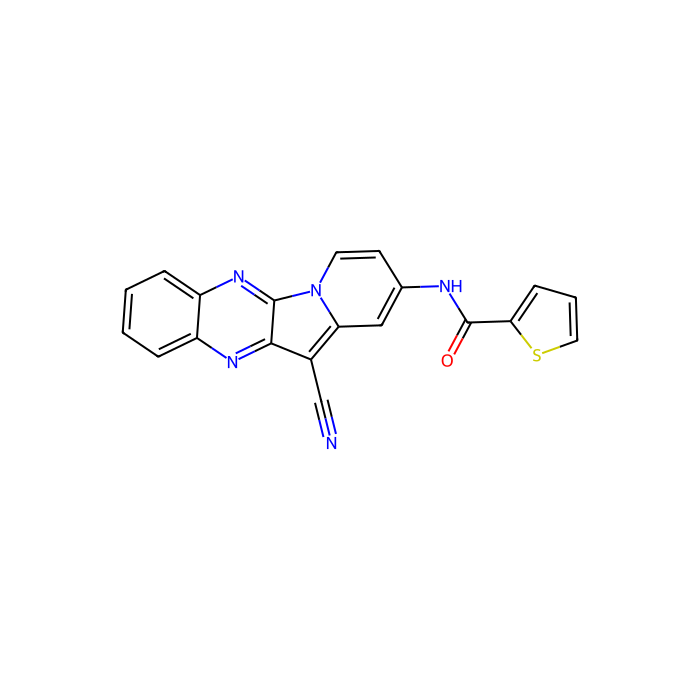
T-LAK-cell-originated protein kinase (TOPK) inhibitor; exhibits selectivity for TOPK over other MAPKK family members including ERK1, JNK1 and p38. Blocks proliferation of HCT116 colon cancer cells; suppresses tumor growth in a colon cancer xenograft model
Conditions de stockage de stockage
Store at -20°C
Expédié en
Ice chest + Ice pads
Ce produit nécessite l'expédition en chaîne froide. Les services terrestres et autres services économiques ne sont pas disponibles.
This compound belongs to the class of organic compounds known as quinoxalines. These are compounds containing a quinoxaline moiety, a bicyclic heterocycle made up of a benzene ring fused to a pyrazine ring.
External Descriptors
Not available
1. Djoumbou Feunang Y, Eisner R, Knox C, Chepelev L, Hastings J, Owen G, Fahy E, Steinbeck C, Subramanian S, Bolton E, Greiner R, and Wishart DS. ClassyFire: Automated Chemical Classification With A Comprehensive, Computable Taxonomy. Journal of Cheminformatics, 2016, 8:61.
Solvent:DMSO, Max Conc. mg/mL: 7.39, Max Conc. mM: 20
Poids moléculaire
369.400 g/mol
XLogP3
4.100
Hydrogen Bond Donor Count
1
Hydrogen Bond Acceptor Count
5
Rotatable Bond Count
2
Exact Mass
369.068 Da
Monoisotopic Mass
369.068 Da
Topological Polar Surface Area
111.000 Ų
Heavy Atom Count
27
Formal Charge
0
Complexity
635.000
Isotope Atom Count
0
Defined Atom Stereocenter Count
0
Undefined Atom Stereocenter Count
0
Defined Bond Stereocenter Count
0
Undefined Bond Stereocenter Count
0
The total count of all stereochemical bonds
0
Covalently-Bonded Unit Count
1
Calculateurs de solution
Molarity Calculator
Determine the necessary mass, volume, or concentration for preparing a solution.
Dilution Calculator
Determine the dilution needed to prepare a stock solution.
Reconstitution Calculator
Avis
Avis des clients
Application Protocols
No manufacturer-verified application protocols are provided for SKU H288486.
General starting points for small-molecule probes (not item-specific; validate experimentally):
Stock solution: Dissolve in anhydrous DMSO to 10–50 mM. Vortex/sonicate briefly; avoid prolonged heating. Filter if particulates persist and compound is non-adsorptive.
Cellular assays: Begin with dose–response series (e.g., 0.01–10 μM) with matched vehicle controls. Assess viability separately to decouple target effects from toxicity.
Biochemical enzyme assays: Determine IC50 by running 8–12 concentrations bracketing the expected potency; maintain constant DMSO. Evaluate time-dependence and reversibility.
Target engagement: Use DSF/CETSA or NanoBRET target engagement where applicable. Confirm on-target pathway modulation via Western blot or phospho-proteomics if relevant.
Stability checks: After dilution into assay buffer/medium, verify compound stability by LC–MS or UV over the assay timeframe.
Documentation:
Record lot number, preparation date, solvent system, and final vehicle percentage in all data. Archive raw data and analysis scripts.
For detailed, validated protocols, consult peer-reviewed literature associated with the CAS/CID and adapt to your assay platform.
Biological Roles
Item-specific biological target or mode-of-action information is not provided in the Product Data for SKU H288486. The product name may suggest a research application related to kinase biology; however, per Aladdin policy, target specificity cannot be asserted without explicit product documentation.
General context for small-molecule research probes (not item-specific):
Small molecules are frequently used to modulate enzyme activities (e.g., kinases, proteases, epigenetic modifiers) to dissect signaling pathways, validate targets, and study cellular phenotypes.
In cell biology studies, such probes can help determine pathway dependence, feedback regulation, and compensatory signaling via time-course and dose–response experiments.
In systems biology, integrating chemical perturbations with -omics readouts (transcriptomics, phosphoproteomics, metabolomics) provides causal insight not achievable by correlative measurements alone.
Practical guidance:
Establish on-target activity using orthogonal assays (biochemical IC50/Ki, cellular EC50/ED50) and confirm with genetic tools (siRNA/CRISPR KO/knockdown) to rule out off-target mechanisms.
Characterize time-dependence, reversibility, and washout behavior to understand pharmacodynamics in cell systems.
Evaluate cytotoxicity/viability independently (e.g., CellTiter-Glo, resazurin) to separate specific signaling effects from nonspecific toxicity.
Disclaimer:
No medical or clinical claims are made. This material is for laboratory research use only. Consult the CoA/SDS and primary literature linked to the CAS/CID for any target-related information relevant to your application.
Buffer Applications
This item is a small-molecule research compound and is not itself a buffering agent. Therefore, classical buffer system guidance (e.g., phosphate, Tris, HEPES pH ranges) is not directly applicable.
Practical notes for assay buffers (general; not item-specific):
Vehicle tolerance: Many cell-free and cellular assays tolerate ≤0.1–1% DMSO. Validate the highest tolerated percentage for your system.
Detergent use: Adding 0.01–0.05% non-ionic detergent (Tween-20, Triton X-100 alternatives) can mitigate compound aggregation and surface adsorption.
Protein binding: Include carrier protein (e.g., 0.1% BSA) where nonspecific adsorption to plastics is problematic, provided it does not interfere with readouts.
pH stability: If the compound contains ionizable groups (unknown here), maintain buffer pH to maximize stability and solubility; avoid extreme pH unless justified by stability studies.
For formulation of the compound into buffers, consult solubility/stability information on the CoA and confirm by analytical QC (e.g., UV/LC–MS) after dilution.
Green Alternatives
As a bioactive small molecule intended for research assays, the principal environmental considerations relate to solvent choice and waste minimization rather than replacement of the active itself.
Greener solvent strategies (general guidance):
Prefer DMSO and water-based buffers over chlorinated or high-toxicity solvents for stock preparation and dilutions, when chemically and biologically compatible.
Use minimal effective organic co-solvent. Evaluate PEG400, propylene glycol, or cyclodextrin vehicles for enhanced aqueous delivery in place of acetonitrile or DMF where feasible.
For chromatography/purification (if applicable), consider ethanol/water or isopropanol/water systems instead of acetonitrile where separation allows.
Comparison (general; not item-specific):
DMSO vs DMF: DMSO generally offers lower volatility and favorable safety profile; DMF entails higher regulatory concern. Choose DMSO when solubility allows.
Ethanol vs acetonitrile: Ethanol is more benign and renewable; however, acetonitrile offers lower viscosity and stronger elution—balance separation needs with EHS goals.
Operational Best Practices:
Scale experiments to minimize chemical usage while maintaining data quality.
Segregate halogenated from non-halogenated waste; adopt microplate formats to reduce solvent volumes.
Document and validate greener substitutions to ensure no impact on assay performance or compound stability.
Note: No item-specific degradants, stabilizers, or solvent constraints are provided for this SKU; verify compatibility with the SDS/CoA before implementing changes.
Pharmaceutical Uses
No pharmacopeial status, excipient role, or formulation specification is provided for SKU H288486. This product is sold strictly for research use only and is not intended for use in humans or for clinical applications.
General context (not item-specific):
Bioactive research compounds may be used in preclinical discovery workflows such as in vitro assays, ex vivo tissue studies, and mechanistic investigations. They are not manufactured to GMP or compendial standards unless explicitly stated.
If formulation-like studies are required (e.g., for in vivo research in model organisms), typical vehicles may include aqueous buffers with limited DMSO, PEG400, polysorbates, or cyclodextrin complexes—subject to compound compatibility and institutional approvals. Such uses must be justified by internal risk assessments, and the compound’s purity/stability must be verified.
Compliance notes:
This item carries a Research Use Only notice. It should not be used as an API, excipient, or for diagnostic purposes. For any translational or GLP/GMP needs, source material with appropriate regulatory documentation and quality systems.
Physical Properties
Only limited, item-specific physical property data are provided.
Item-specific data from Product Data:
Appearance: Not specified for this item; refer to CoA/Spec Sheet.
Molecular Weight: Not specified for this item; refer to CoA/Spec Sheet.
Common physicochemical parameters (literature/general guidance; NOT item-specific):
Many small-molecule research inhibitors are solids at ambient temperature with limited aqueous solubility and improved solubility in DMSO, DMF, or mixtures with co-solvents. Actual values (mp, logP, pKa, solubility) must be verified for this exact compound.
Do NOT treat the following as specifications for this SKU:
Melting point (mp): Not specified for this item; refer to CoA/Spec Sheet.
Boiling point (bp): Not applicable/Not specified for this item; refer to CoA/Spec Sheet.
Density: Not specified for this item; refer to CoA/Spec Sheet.
Solubility: Not specified for this item; refer to CoA/Spec Sheet.
LogP/logD: Not specified for this item; refer to CoA/Spec Sheet.
pKa: Not specified for this item; refer to CoA/Spec Sheet.
Refractive index: Not applicable for solids; Not specified for this item; refer to CoA/Spec Sheet.
Practical notes (general):
If the compound is hydrophobic, consider preparing concentrated stock solutions in anhydrous DMSO and diluting into assay buffers with attention to final DMSO percentage (commonly ≤0.5–1% v/v in biological assays). Always confirm compatibility and precipitation visually and by LC–MS or UV.
Quality and Grades
Item-specific grade and purity are not listed in the Product Data for SKU H288486.
Grade/Purity: Not specified for this item; refer to CoA/Spec Sheet.
Research Use: For research use only (as provided). Not for human or veterinary use, clinical diagnosis, or household purposes.
Guidance on typical grades (general, not item-specific):
Screening/Library grade: Suitable for discovery biology and primary screening; purity is often ≥90–95% by HPLC, but always confirm from the item’s CoA.
Analytical/Reference grade: Intended for quantitative studies; may include lot-specific assay, water, residual solvent, and impurity profiling.
Stabilizers: If a stabilizer or salt form is used, it will be declared on the CoA; stabilizers can affect mass balance and assay background.
What to check on the CoA/Spec Sheet for this item:
Lot-specific purity by HPLC/UPLC, identity confirmation (NMR, HRMS or LC–MS), water content (Karl Fischer) if applicable, residual solvents, and inorganic residue (if reported).
Fit-for-purpose recommendations:
For biochemical assays or cell-based work, verify purity and counter-screens for common assay interferences (e.g., PAINS, redox cycling, fluorescence). For quantitative work (KD/IC50, kinetic profiling), prefer lots with detailed analytical characterization and narrow impurity profiles.
Reaction and Applications
This product is categorized under small molecules/compound libraries and is generally used as a biochemical research tool rather than as a synthetic reagent.
Potential research applications (general; not item-specific claims):
Chemical biology: Probe studies to modulate and interrogate specific signaling enzymes or kinases in cell lysates or intact cells, enabling pathway mapping and phenotypic readouts.
Target engagement: Thermal shift assays (CETSA/DSF) or activity-based profiling to confirm on-target binding within cells or lysates.
Selectivity profiling: Broad kinase panels or proteomic chemoproteomics to benchmark target selectivity and off-target space.
Mechanistic studies: Time-dependent inhibition, reversibility assessment, and structure–activity relationship (SAR) expansion if used alongside analog series.
Assay considerations (general):
Vehicle control: Include matched DMSO controls across concentration series.
Adsorption: Hydrophobic ligands can adsorb to plastics; use low-binding plates/tubes and include detergent (e.g., 0.01–0.05% Tween-20) if compatible.
Redox/aggregation artifacts: Counter-screen for colloidal aggregation (e.g., with non-ionic detergent) and for fluorescence/quenching interference when using optical readouts.
Note: No manufacturer-provided application notes were supplied for this SKU. Users should design experiments based on their intended biological target and confirm compound identity and purity prior to data generation.
Reaction Conditions
No synthetic reaction conditions are provided for this item, and it is not positioned as a chemical reagent. For biological assay use, consider the following general (non-item-specific) handling and testing conditions:
Stock preparation: Prepare concentrated stock solutions in anhydrous DMSO (e.g., 10–50 mM), verifying complete dissolution. Aliquot to avoid freeze–thaw.
Working concentrations: In cellular or biochemical assays, small-molecule inhibitors are often tested over 10-point curves spanning ~0.001–30 μM (typical literature practice). Optimize range based on expected potency and solubility.
Incubation: Preincubation times of 10–60 min are common for reversible inhibitors; time-dependent inhibitors may require longer preincubation. Confirm equilibrium in your assay format.
Temperature: Run assays at recommended conditions for the biological system (e.g., 25–37°C). Maintain consistent temperature control to reduce variability.
Controls: Include vehicle controls (matching DMSO%), positive controls (reference inhibitor if available), and orthogonal assay formats to confirm mechanism.
Expected outcomes:
Not specified for this item; consult primary literature associated with the CAS/CID and validate in your hands. Always confirm that observed effects are reproducible and not due to aggregation, assay interference, or degradation.
Reminder: These are general literature-style practices and are not specifications for SKU H288486.
Safety and Handling
Authoritative safety data must be taken from the SDS specific to SKU H288486.
Item-specific hazard data from Product Data:
Signal Word: Not specified for this item; refer to SDS.
H-Statements: Not specified for this item; refer to SDS.
GHS Classification: Not specified for this item; refer to SDS.
GHS Pictograms: Not specified for this item; refer to SDS.
General laboratory precautions (not item-specific):
Use in a fume hood or well-ventilated area. Avoid inhalation of dust/aerosols and contact with skin/eyes. Wear appropriate PPE: lab coat, safety glasses, and suitable chemical-resistant gloves.
Avoid ingestion and environmental release. Handle with care when opening vials to prevent loss of material or exposure.
Incompatibilities and stability (general guidance):
Unknown for this specific item. As a precaution, keep away from strong oxidizers and acids/bases until compatibility is confirmed from the SDS. Minimize exposure to moisture, heat, and light if the molecule is potentially light- or hydrolysis-sensitive.
First-aid overview (general):
Skin/eye contact: Rinse with plenty of water for several minutes; remove contaminated clothing. Seek medical attention if irritation persists.
Inhalation: Move to fresh air; seek medical attention if symptoms occur.
Ingestion: Rinse mouth; seek medical attention. Do not induce vomiting unless directed by medical personnel.
Waste disposal:
Dispose of contents/container according to institutional hazardous waste procedures and local regulations. Defer to SDS for substance-specific disposal notes.
Solvent Selection
Item-specific solubility data are not provided. The guidance below is general for small-molecule research inhibitors and should be validated experimentally for this SKU.
Primary stock solvent (general): Anhydrous DMSO is commonly used to prepare 10–50 mM stocks for hydrophobic inhibitors. Confirm solubility visually and by analytical methods; avoid supersaturation.
Co-solvent strategies: If precipitation occurs upon dilution into aqueous buffers, consider adding a co-solvent (e.g., 0.1–1% DMSO or 5–20% PEG400), or use minimal amounts of ethanol/DMF when compatible with the assay. Cyclodextrin formulations can aid aqueous solubilization for very hydrophobic compounds.
pH effects: If the molecule has ionizable groups (unknown here), solubility may vary with pH. Prepare buffers accordingly and avoid extreme pH that could degrade sensitive functionalities (e.g., esters, sulfonamides).
Comparison notes (general):
DMSO vs ethanol: DMSO typically provides higher solubility for polar/hydrophobic mixed scaffolds; ethanol may be preferable where DMSO interferes with biology.
DMF vs DMSO: DMF can match solubility performance but is more hygroscopic/volatile and may be less biocompatible; use sparingly in biological systems.
Practical tips:
Warm gently (room temperature to 37°C) and vortex/sonicate to assist dissolution; avoid prolonged heating.
Filter stocks through PTFE (0.22 μm) if particulate persists and the compound is not adsorptive.
Record final solvent percentages in assays to control for vehicle effects.
Shipping: Shipped in ice chest with ice pads (cold-pack shipment).
Additional guidance (general; not item-specific):
Protect from moisture and light if the compound is potentially hygroscopic or photosensitive (status unknown here). Keep container tightly closed. Allow vial to equilibrate to room temperature in a desiccator before opening to avoid condensation.
Reconstitution: Not specified for this item; refer to CoA/Spec Sheet. Common practice for small-molecule probes is to dissolve in anhydrous DMSO to prepare a concentrated stock (e.g., 10–50 mM), verifying complete dissolution.
Aliquoting: Prepare single-use aliquots to minimize freeze–thaw cycles. Store aliquots at -20°C or below, in inert atmosphere (e.g., argon) if the compound is air/moisture sensitive (unknown here).
Freeze–thaw: Avoid repeated freeze–thaw. Thaw quickly at room temperature, use promptly, and return unused aliquots to storage.
Aqueous solutions: If aqueous dilutions are required, prepare immediately before use and discard after the experiment unless stability has been established analytically for your conditions.
Labeling and records:
Document lot number, concentration, solvent, and preparation date on each aliquot. Periodically re-check concentration and purity by LC–MS/HPLC if stored for extended periods.
For definitive handling, stability, and reconstitution instructions, rely on the lot-specific CoA and SDS for SKU H288486.
Structure and Identity
Brief overview: HI TOPK 032 is listed as a small-molecule research compound. Limited structure-identifying information is provided in the Product Data for this SKU.
SKU: H288486
Product Name: HI TOPK 032
CAS: 487020-03-1 (identifier provided; verify against CoA/SDS for final use)
PubChem CID: 1936439 (identifier provided)
InChIKey: 21399 (as provided; note that this does not conform to standard InChIKey length/format; consult CoA/SDS)
SMILES: Not specified for this item; refer to CoA/Spec Sheet.
Molecular Formula: Not specified for this item; refer to CoA/Spec Sheet.
Molecular Weight: Not specified for this item; refer to CoA/Spec Sheet.
Structural features (general context):
Item-specific 2D/3D structural details are not provided in the Product Data. If this compound corresponds to a named biochemical tool, its structure can typically be confirmed from the CAS or PubChem entry; users should rely on the Certificate of Analysis (CoA) and SDS for definitive identity data linked to this batch/SKU.
Describing the 2D structure in words:
Not possible from the provided data. No ring system, functional group, or stereochemical annotations are available in this listing. Professional users should verify the exact scaffold (e.g., heteroaromatic vs. diaryl core, presence of amide/urea/halogen substituents, etc.) directly from the CoA or authoritative databases keyed to the CAS/CID above.
Best practice:
Before critical experiments, confirm identity by matching CAS, exact mass, and spectral data (NMR/HRMS/LC–MS) with an authenticated reference.
Synthetic Utility
This SKU represents a bioactive small molecule intended as a research probe. It is not typically employed as a synthetic building block or reagent.
General comments (not item-specific):
Complex bioactive scaffolds can, in principle, be modified for SAR or conjugation (e.g., introducing linkers/handles for PROTACs, affinity probes, or fluorescent tags). Such derivatizations require knowledge of the exact structure and tolerance of the pharmacophore.
Without item-specific structural information (SMILES/functional groups), no reliable guidance can be offered regarding reactive handles (amines, phenols, halides, carboxylates) or their use in cross-couplings, amide couplings, or click chemistry.
Recommendations:
If derivatization is intended, obtain the detailed structure from the CoA/Spec Sheet or primary literature tied to the CAS/CID. Map exit vectors using docking or co-crystal structures (if available) and validate activity retention empirically.
For analytical tracking during syntheses, develop LC–MS methods that resolve parent and key impurities; confirm identity by NMR and HRMS.
Conclusion:
Treat this item as a finished research probe for biological evaluation rather than a general-purpose synthetic intermediate unless your program specifically targets scaffold modification with verified structural data.
Target Specificity
Item-specific target, epitope, or selectivity information is not provided for SKU H288486.
Per Aladdin policy:
Target identity, selectivity profiles, and potency values (e.g., KD, IC50) will only be stated when explicitly included in the Product Data for the item. This listing does not contain such details.
User guidance (general, not item-specific):
If a particular molecular target is intended (e.g., a specific kinase or enzyme), confirm with the CoA/Spec Sheet and primary literature corresponding to the CAS/CID before experimental use.
Establish target specificity using a combination of biochemical assays, cellular target engagement (e.g., CETSA, NanoBRET), and selectivity panels. Employ genetic validation (KO/knockdown) where possible.
Status for this item:
Not specified for this item; refer to CoA/Spec Sheet and SDS.
We use cookies to ensure the website functions properly and, where permitted, to improve your experience. You can manage your preferences at any time in Settings. Learn more in our Cookie Policy.
Shall we send you a message when we have discounts available?
Remind me later
Thank you! Please check your email inbox to confirm.
Products are supplied to verified businesses, institutions, and qualified professionals for research and development use only. Not for use in humans, animals, diagnosis, or therapy.

 E2628019