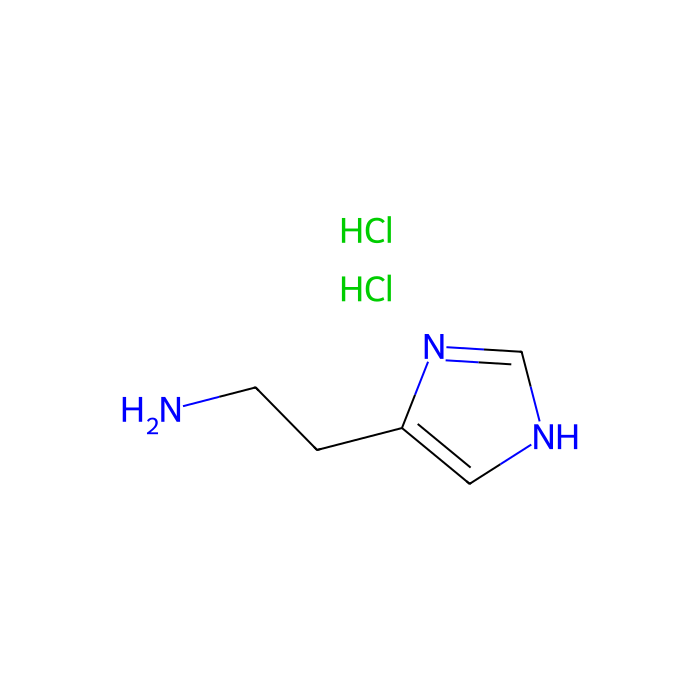
Histamine 2HCl - 10mM in DMSO , CAS No.56-92-8

CAS: 56-92-8 Cat. No.: H408357 Formule: C5H9N3·2HCl Poids moléculaire: 184.07 Beilstein Registry Number: 3624116 Numéro CE: 200-298-4 PubChem CID: 5818
DISPONIBLE À COMMANDE
GRADE & PURITY 10mM in DMSO
Synonyms
1H-Imidazole-5-ethanamine, hydrochloride (1:2)
Storage
Store at -80°C
Shipped In
Dry ice packs + Cold packs
★
Size
Allemagne (EU)
USA*
Price
Qty
1ml
H408357-1ml
—
1 En stock

27,68€

38,09€
Enregistrer 10,41 € (27.33%)
Enter a quantity for the sizes you want to add.
🧪
Why this grade

10mM in DMSO for sensitive chromatographic and analytical workflows requiring minimal baseline interference.

🌡

Storage & shipping

Store at -80°C Ships Dry ice packs + Cold packs Check lot-specific COA for exact specifications.

📋

Quality documents

SDS, COA, datasheet, and spec sheet available for download. Lot-specific COA accessible via lot number lookup.

📚

Literature proof

Cited in 23 peer-reviewed publications across chromatography, organic synthesis, and cross-coupling reactions.

Vue d’ensemble

Information

Histamine is an organic nitrogen compound, acts on target cells in mammalian brain via stimulation of Histamine 1/2.
In vitro

Histamine suppresses the generation of ROS through the Histaminetype-2 receptor (H2 receptor). Histamine inhibits the generation and release of reactive oxygen species (ROS) by monocytes/macrophages (MO) during respiratory burst. Histamine and interleukin-2 (IL-2) act synergistically to activate NK cell cytotoxicity (NKCC). Histamine combined with IL-2 might improve response rates and disease-free survival by protecting the cells of the immune system from oxidative stress and inducing natural endogenous immune cytotoxicity.

In vivo

Histamine treatment (0.5 mg/kg or 5.0 mg/kg, twice daily) protects against liver injury as evident by normal serum transaminase levels and significantly reduced liver pathology scores in a rat model with early alcohol-induced liver injury. The protective effect of histamine is blocked by Ranitidine (10 mg/kg), an H2 receptor antagonist, indicating that the histamine effect is predominantly mediated through the H2 receptor. Histamine (30 pg/rat, icv) increases both 3,4-dihydroxyphenylalanine accumulation and 3,4-dihydroxyphenylalanine acid concentrations in the nucleus accumbens in male rats, and this effect is not affect by H2 antagonist zolantidine, indicating that histamine stimulates mesolimbic DA neurons through an action at the H1 receptor. Histamine (0.5 mg/kg s.c.) reduces the liver tumour weight by 46% and subcutaneous tumour weight by 41% versus rats receiving subcutaneous saline injections. The anti-tumour effect observed by subcutaneous histamine injections is inhibited by Ranitidine (50 mg/kg s.c.) in rats sarcoma. Histamine (1000 mg/kg s.c.) displays acute tissue damage after 24 hours and indications of pathological inflammation at the injection sites at 5 days and 28 days in Sprague-Dawley rats. Histamine (1000 mg/kg s.c.) results in Cmax of 167 mM, tmax of 0.5 hour, t1/2 of 0.95 and AUC of 186 mmol-h/L in male Sprague-Dawley rats.
Cell Data

cell lines:Leukemia L1210 cell

Concentrations:

Incubation Time:

Powder Purity:≥99%

Specifications

Synonymes
1H-Imidazole-5-ethanamine, hydrochloride (1:2)
Spécifications et pureté
10mM in DMSO
Mécanismes biochimiques et physiologiques
Histamine is an organic nitrogen compound, acts on target cells in mammalian brain via stimulation of Histamine 1/2.
Conditions de stockage de stockage
Store at -80°C
Expédié en
Dry ice packs + Cold packs
Ce produit nécessite l'expédition en chaîne froide. Les services terrestres et autres services économiques ne sont pas disponibles.
Noms et identifiants
Isomères SMILES
C1=C(NC=N1)CCN.Cl.Cl
WGK Allemagne
2
RTECS
MS1575000
PubChem CID
5818
Poids moléculaire
184.07
Beilstein
3624116
Reaxy-Rn
3624116

Documentation

📋 Safety Data Sheet (SDS)

Comprehensive hazard, handling, storage, and regulatory compliance document.

Download SDS →

✅ Certificate of Analysis (COA)

Lot-specific quality data. Enter your lot number to retrieve the exact COA.

Look up COA →

📊 Datasheet

Quick-reference summary of product specifications and applications.

View datasheet →

🔬 Specification Sheet

Full quality attributes and acceptance criteria for this grade.

View spec sheet →

Advanced Data

Certificats (CoA, COO, BSE/TSE et tableau d'analyse)
C of A & Other Certificates(BSE/TSE, COO):
Analytical Chart:

Find and download the COA for your product by matching the lot number on the packaging.

1 results found

Lot NumberCertificate TypeDateArticle
K2222026Certificate of AnalysisAug 11, 2026 H408357
Propriétés chimiques et physiques
SolubilitéSolubility (25°C) In vitro DMSO: 52 mg/mL warmed with 50ºC Water: bath (187.46 mM); Water: Insoluble; Ethanol: Insoluble;
Point de fusion (°C)246°C
FAQ et articles
Paeonol: Physicochemical Features, Uses, and Key Points for Research Applications
Famotidine: Physicochemical Features, Mechanism of Action, and Key Points for Research Applications
GPCR/G Protein Signal Transduction Mechanisms and Disease Research
Evaluation of Blood-Brain Barrier Permeability: Tracer Extravasation, TEER Measurement, and Interpretation of In Vitro Model Results
Neuronal Signal Transduction Mechanisms and Disease Research
Skin Anti-Aging Mechanisms of Carnosine and Decarboxy Carnosine: Active Carbonyl Scavenging, Oxidative-Stress Buffering, and Inhibition of Collagen Glycation Cross-Linking
Probiotics, Prebiotics, and Postbiotics in Skin Care: Conceptual Distinctions, Mechanisms of Action, and Their Applications in the Care of Dry, Itchy, and Rough Skin
Gentiana Root Extract and Gentiopicroside: Chemical Composition, Antioxidant and Inflammation-Modulating Mechanisms, and Their Potential Effects on Skin Barrier Homeostasis
Skin-Soothing Mechanisms of Avenanthramides: From Natural Oat Defense Molecules to Inflammatory Signaling and Mast Cell Regulation
Citations of This Product
Calculateurs de solution
Avis

Avis des clients

Souhaitez-vous que nous vous envoyions un message lorsque des réductions seront disponibles?

Me rappeler plus tard

Merci ! Veuillez vérifier votre boîte de réception e-mail pour confirmer.

Oups ! Les notifications sont désactivées.