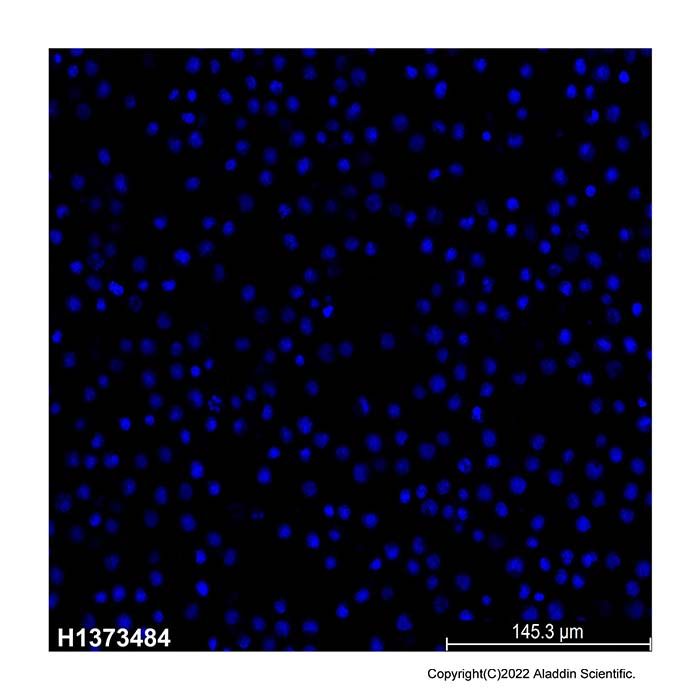
Hoechst 33258 is a blue to blue-green fluorescent live cell dye that can label DNA. Hoechst 33258 can specifically bind to the DNA groove (tending to bind to DNA rich in A/T at the same time), resulting in a significant increase in fluorescence intensity. Hoechst 33258 can pass through the cell membrane, causing changes in DNA structure, such as G2/M phase arrest. Hoechst 33258 can bind to live cells or fixed cells, and the fluorescence intensity increases with the increase of solution pH. As a DNA-specific probe, Hoechst 33258 can be used for detecting DNA content and analyzing cell cycle, etc. The excitation wavelength of Hoechst 33258 is 350-365 nm, and the emission wavelength is 460-490 nm.
The concentration of this product is 1.0 mg/mL. When used for nuclear staining, the recommended working concentration is 1-10 μg/mL.
Instruction for use
1.For fixed cells or tissues:
a. The cells were inoculated onto the culture plates/flasks and cultured until they reached the logarithmic growth phase. If cell fixation was required, the cells were fixed with 4% paraformaldehyde at room temperature for 10-15 minutes, then washed twice with PBS, each time for 5 minutes.
b. Add the Hoechst 33258 working solution and incubate at 37°C in the dark for 10-30 minutes.
c. Remove the Hoechst 33258 staining solution and wash the cells twice with PBS for 5 minutes each time.
2.For living cells or tissues:
a. Collect the cells, centrifuge at 1000 rpm for 5 minutes, and discard the supernatant.
b. Resuspend the cells in PBS, add the Hoechst 33258 working solution, and incubate at room temperature in the dark for 15-20 minutes.
c. Centrifuge at 1000 rpm for 5 minutes, discard the staining solution, wash twice with PBS for 5 minutes each time; then resuspend the cells in PBS.
d.Observe directly under a fluorescence microscope or under a fluorescence microscope after mounting. When cells undergo apoptosis, the nuclei of apoptotic cells will show dense and compact staining, or fragmented and dense staining.
Matters needing attention
1.Depending on the application of Hoechst 33258 staining solution, it is recommended to perform a titration before use to determine the optimal working concentration.
2.Fluorescent dyes all have the problem of quenching. It is recommended to complete the detection as soon as possible after staining. Live cells or tissues should be observed immediately after staining.
3.This product is only for professional scientific research use. It shall not be used for clinical diagnosis or treatment, nor for food or medicine. It shall not be stored in ordinary residences.
4.For your safety and health, please wear laboratory coats and disposable gloves during operation.

 ZJ25F1129346