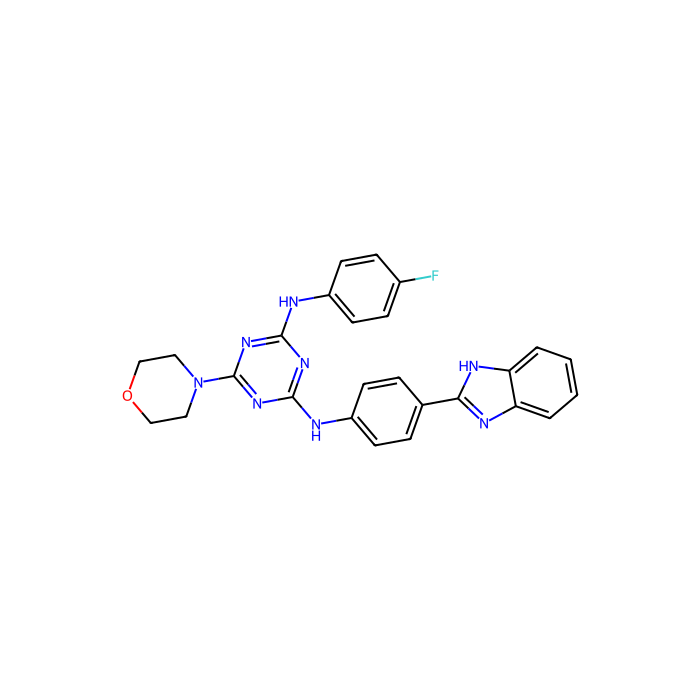
IITZ-01 is a potent autophagy inhibitor, enhancing autophagosome accumulation but inhibiting autophagosomal degradation by impairing lysosomal function.
IITZ-01 is a cell penetrant and potent autophagy inhibitor in numerous cancer cells including breast, lung, and colon cancer cells. It significantly elevates LC3-II and SQSTM1 protein levels in starvation-induced autophagy conditions. IITZ-01 accumulates within lysosomes causing liposomal deacidification, impairment of lysosomal maturation and inhibition of lysosomal degradation. Additionally, IITZ-01 induces apoptosis through the mitochondria-mediated pathway in TNBC cells MDA-MB-231 and MDA-MB-453, while sparing normal mammary epithelial MCF10A cell.
Conditions de stockage de stockage
Store at -20°C
Expédié en
Ice chest + Ice pads
Ce produit nécessite l'expédition en chaîne froide. Les services terrestres et autres services économiques ne sont pas disponibles.
This compound belongs to the class of organic compounds known as phenylbenzimidazoles. These are compounds containing a phenylbenzimidazole skeleton, which consists of a benzimidazole moiety where its imidazole ring is attached to a phenyl group.
External Descriptors
Not available
1. Djoumbou Feunang Y, Eisner R, Knox C, Chepelev L, Hastings J, Owen G, Fahy E, Steinbeck C, Subramanian S, Bolton E, Greiner R, and Wishart DS. ClassyFire: Automated Chemical Classification With A Comprehensive, Computable Taxonomy. Journal of Cheminformatics, 2016, 8:61.
Determine the necessary mass, volume, or concentration for preparing a solution.
Dilution Calculator
Determine the dilution needed to prepare a stock solution.
Reconstitution Calculator
Avis
Avis des clients
Application Protocols
Item-specific (from Product Data)
No tested applications or protocols (e.g., WB, IHC, IF, FC) are provided for this item.
General guidance (solution handling)
Stock solutions: Prepare under clean, dry conditions. Use amber vials if light sensitivity is unknown. Record solvent, concentration, and preparation date on the label.
Aliquoting: Dispense single-use aliquots to avoid repeated freeze–thaw cycles. Flush headspace with inert gas when feasible.
Verification: Confirm concentration by UV-Vis (if chromophore known) or quantitative NMR/LC–UV with internal standard.
Assay deployment (generic)
Conduct a small pilot to confirm solubility and lack of assay interference. Include vehicle controls matching the final co-solvent percentage.
Stability: Assess over the assay timeframe (e.g., 0–24 h at room temperature) by LC–MS to identify degradation or adsorption losses.
Documentation
Capture lot number, preparation details, and storage conditions in the ELN to ensure reproducibility.
Biological Roles
Item-specific (from Product Data)
No biological function, target, or pathway information is provided for IITZ-01.
General guidance (no clinical/medical claims)
If IITZ-01 is intended as a biochemical probe or tool compound in your work, verify its target, mechanism, and selectivity directly from primary literature and match to the exact CAS/structure to avoid confusion with similarly named analogs.
Establish baseline assay behavior: Determine intrinsic fluorescence/absorbance, redox activity (e.g., interference in reporter assays), and aggregation propensity (e.g., using detergent controls) before interpreting biological readouts.
Assess solubility and stability in assay buffers (pH 6–8, with/without serum proteins) and perform time-course analyses to detect degradation or adsorption to plastics.
Documentation
Maintain linkage between lot numbers and biological data to ensure traceability, especially if used in SAR or screening cascades.
Note
No biological roles are asserted by the supplier; IITZ-01 is provided strictly for research use only, and no therapeutic or clinical claims are made here.
Buffer Applications
IITZ-01 is not a buffer reagent; however, dissolution into buffers may be required for experimentation.
Item-specific (from Product Data)
No buffer-related specifications are provided.
Practical guidance (general)
Stock preparation: If soluble, prepare a concentrated DMSO stock (e.g., 10–100 mM), then dilute into the desired buffer (e.g., PBS pH 7.4, HEPES pH 7.4, Tris pH 7.5–8.0) with vigorous mixing. Maintain final organic co-solvent ≤0.5–1% where assay-compatible.
pH effects: For ionizable compounds, apparent solubility can increase at pH values where the compound is charged. If an acid, test pH 8–9; if a base, test pH 5–6, once pKa is known.
Additives: 0.01–0.05% nonionic surfactant (e.g., Tween-20) can mitigate aggregation/adhesion in some assays; verify that additives do not interfere with readouts.
Filtration: Use 0.2 µm PVDF or PES filters for aqueous systems; pre-wet filters with buffer containing the same % DMSO to minimize analyte loss.
Light sensitivity: If unknown, protect from light during preparation and storage (amber vials, foil wrap).
Quality control
Verify final concentration by UV-Vis (if chromophore present) or LC–MS/LC–UV.
Caveat
Because compound-specific pKa and solubility are not provided, perform small-scale scouting before committing to large assays.
Green Alternatives
Because IITZ-01’s structure and solvent requirements are unspecified, “greener” choices should focus on solvent selection, work-up, and waste minimization rather than on the molecule itself.
Item-specific (from Product Data)
No recommended solvents or processes are listed.
Greener solvent framework (general knowledge)
Prefer bio-based ethers and alcohols where feasible: 2-MeTHF or CPME instead of THF/diethyl ether; ethanol or IPA instead of methanol (toxicity-driven choice), subject to solubility and stability.
Replace chlorinated solvents when possible: Ethyl acetate or MeTHF can substitute for DCM in many extractions and crystallizations.
Aqueous/MeCN mobile phases: For LC analytics, optimize gradients to minimize solvent volume; reclaim acetonitrile via distillation where permitted.
Process considerations
Right-first-time dissolution: Determine minimal solvent volume to reduce waste; use small-scale screening plates.
Energy: Cold-chain is required (−20°C storage), but avoid unnecessary freeze–thaw cycles and maintain efficient freezer utilization.
Waste segregation: Separate halogenated from non-halogenated waste streams; label solutions containing IITZ-01 clearly for compliant disposal.
Comparison table (general)
DCM vs. EtOAc/CPME: Lower toxicity and environmental burden with EtOAc/CPME; may trade off dissolving power and evaporation rate.
THF vs. 2-MeTHF: 2-MeTHF less prone to peroxide formation and is bio-based; THF often offers broader solubility and higher polarity.
MeOH vs. EtOH/IPA: EtOH/IPA favored for lower toxicity; MeOH sometimes required for solubility/LC compatibility.
Caveat
Final solvent choices must be validated against IITZ-01’s actual solubility and stability profile (obtainable from CoA/SDS).
Pharmaceutical Uses
No pharmacopeial status or excipient role is provided for IITZ-01, and it is supplied strictly for research use only (non-clinical).
Item-specific (from Product Data)
Research Use Note: For research use only.
No references to USP/EP monographs, GMP status, or clinical/formulation uses.
General context (non-clinical)
Tool compounds are often used in discovery-stage assays, target validation, or method development. For any preclinical formulation studies (e.g., PK in animal models), researchers typically establish bespoke vehicle systems (e.g., PEG400/saline, Captisol, or lipid-based carriers) tailored to solubility and stability—these must be developed and justified independently, as this product includes no such guidance.
If IITZ-01 is evaluated in formulation research, document: vehicle composition, concentration limits, osmolality, pH, and stability over intended dosing intervals. Confirm absence of particulates by light obscuration or microscopy.
Compliance and safety
Do not use in humans or for diagnostic applications. Institutional and regulatory approvals are required for any animal use. Obtain and follow the SDS and internal safety reviews.
Traceability
Maintain full lot traceability and retain CoAs for any reported research findings. Consider secondary identity confirmation (NMR/LC–MS) before critical studies.
Physical Properties
Key physicochemical data are not provided for this catalog item; do not infer values without verification.
Item-specific (from Product Data)
Molecular weight: Not specified for this item; refer to CoA/Spec Sheet.
Molecular formula: Not specified for this item; refer to CoA/Spec Sheet.
Appearance: Not specified for this item; refer to CoA/Spec Sheet.
Literature/computed (general guidance)
Boiling point, melting point, density, refractive index, solubility, logP/logD, pKa, UV-Vis maxima: Not available from the provided data. Consult PubChem CID 134817273 and the lot-specific CoA/SDS for authoritative values.
If structure becomes available, calculate: cLogP, topological polar surface area (TPSA), and predicted pKa (if ionizable) using cheminformatics tools (e.g., ACD/Percepta, ChemAxon) to guide solvent selection and formulation.
Practical characterization workflow (general)
Melting range (if solid): Determine by DSC or capillary method to assess purity/phase behavior.
Solubility screening: Evaluate at small scale (1–2 mg) in DMSO, DMF, MeCN, MeOH, EtOH, IPA, acetone, ethyl acetate, toluene, water, and selected buffers (pH 2–10) to establish working concentrations.
UV-Vis: Acquire spectrum (200–400 nm) to estimate assay-compatible wavelengths; determine extinction coefficient if quantitative UV assays are planned.
Thermal stability: Use thermogravimetric analysis (TGA) or variable-temperature NMR if solid-state stability is uncertain.
Notes
Store at −20°C per Product Data; this implies stability benefits at low temperature but does not define physical state or hygroscopicity. Always defer to the item’s SDS and CoA.
Quality and Grades
Item-specific (from Product Data)
Grade/purity: Not specified for this item; refer to CoA/Spec Sheet.
Guidance on grades (general knowledge)
Analytical/Research grade: Typically suitable for most discovery biology/chemistry. Purity is often reported by HPLC/LC–MS; minor residual solvents or inorganic ash may be present.
HPLC grade solvents vs. compound purity: Note that “HPLC grade” refers to solvents, not solids. For small molecules, vendors commonly report purity by area% (HPLC/UPLC) and may include water/solvent content by KF/GC and residual metals by ICP-MS.
Bioactive/tool compounds: When used in screening/assay contexts, ≥95–98% (area) is often preferred to minimize off-target assay artifacts. Enantiomeric purity (ee) is relevant for chiral entities.
What to request/verify for IITZ-01
Lot-specific CoA with: assay method and purity (e.g., HPLC area%), identity confirmation (1H/13C NMR, HRMS), residual solvents (GC), water (KF), and, if applicable, chiral purity.
Spectral references: Provide NMR and MS spectra where available to expedite in-house QC.
Acceptance criteria: Align with your internal specifications for screening vs. in vivo precursor work (no clinical use). If UV cutoff or specific absorbance is critical (e.g., for photometric assays), request UV data.
Stabilizers/additives
Not specified for this item; refer to CoA/Spec Sheet. If stabilizers are present, confirm their assay compatibility and removal strategy during purification or formulation.
Reaction and Applications
Item-specific (from Product Data)
Manufacturer applications: Not provided in the listing.
General considerations
Without structural information, specific synthetic or transformation roles for IITZ-01 cannot be assigned. Treat it primarily as a research reagent/tool compound where the end use may be analytical characterization, assay development, or method validation.
Analytical method development: Use as an anonymous small-molecule standard to develop/validate LC–UV or LC–MS methods (e.g., retention time mapping, ionization behavior), after confirming stability and UV response.
Stability studies: Conduct forced-degradation screens (acid/base, oxidative, thermal, photolysis) to establish handling windows and to build degradation profiles for QA/QC.
Solid-form assessment: If supplied as a solid, explore polymorph/solvate forms by PXRD and DSC to understand variability across lots; this supports consistent assay performance.
Verification steps before deployment
Confirm identity and purity by orthogonal methods (HPLC/UPLC with PDA and MS; 1H/13C NMR). Archive spectra for traceability.
Establish stock solution preparation SOPs (solvent, concentration, light protection, container type) aligned with your assay constraints.
Limitations
In the absence of defined functional groups, do not assume compatibility with specific reaction families (e.g., cross-couplings, nucleophilic substitutions). If IITZ-01 is intended as a building block or intermediate in your program, obtain the full structure and reactivity profile from the CoA or primary literature.
Reaction Conditions
No reaction condition guidance can be provided without knowing IITZ-01’s functional groups and stability domain.
Item-specific (from Product Data)
None specified.
General recommendations (method-agnostic)
If IITZ-01 is to be subjected to chemical modification, run micro-scale scouting reactions with orthogonal conditions (acidic, basic, oxidative, reductive) and monitor by LC–MS.
Temperature: Begin at ambient (20–25°C) and escalate cautiously. Avoid prolonged heating until thermal stability is established (DSC/TGA or variable-temperature NMR).
Solvents: Choose based on established solubility; avoid strong protic/acidic/basic media until compatibility is known.
Atmosphere: If susceptibility to oxidation or hydrolysis is suspected, operate under inert gas (N2/Ar) and dry solvents.
Expected yields/timeframes
Not applicable—no literature precedents for this item are provided.
Workup/purification
Use quench strategies matched to the chemistry performed; employ flash chromatography with gradient systems validated by TLC/HPLC. Confirm product identity and purity by NMR and HRMS.
Caveat
Always confirm that any transformations are permitted under your intended use, recognizing that this product is supplied for research use only.
Safety and Handling
Safety information is limited in the Product Data; adopt conservative laboratory precautions and consult the SDS for your specific lot.
Item-specific (from Product Data)
Storage: Store at −20°C.
Shipping: Ice chest + ice pads (cold chain).
GHS classification, signal word, pictograms, H-statements: Not specified for this item; refer to SDS.
General laboratory precautions (general knowledge)
PPE: Wear lab coat, safety glasses, and appropriate chemically resistant gloves (e.g., nitrile). Use in a chemical fume hood to avoid inhalation of vapors or dusts.
Avoid contact with skin and eyes; do not ingest or inhale. Prevent aerosol generation when weighing/aliquoting powders.
Segregate from incompatible reagents until the functional groups are known (e.g., strong oxidizers/reducers, strong acids/bases). Do not assume air/moisture stability; keep containers tightly closed.
First-aid overview (general)
Skin/eye contact: Rinse with water for ≥15 minutes; remove contaminated clothing. Seek medical attention if irritation persists.
Inhalation: Move to fresh air; seek medical attention if symptoms occur.
Ingestion: Rinse mouth; do not induce vomiting unless directed by medical personnel.
Spill/incident response (general)
Small spills: Absorb with inert material (e.g., vermiculite). Avoid dust. Dispose per institutional hazardous waste procedures.
Fire: Use CO2, dry chemical, or foam; water spray for cooling. Combustion may produce CO/CO2 and unknown toxic fumes.
Documentation
Always reference the vendor SDS for definitive hazard classifications and incompatibilities once available.
Solvent Selection
With no structural or solubility data provided, solvent choice should be established empirically and documented for reproducibility.
Item-specific (from Product Data)
No solubility profile reported. Storage at −20°C suggests routine cold-chain handling but does not indicate solvent preferences.
General strategy (literature/general)
Initial screen (room temperature, ~1–2 mg each): DMSO, DMF, MeCN, MeOH, EtOH, IPA, acetone, ethyl acetate, dichloromethane, toluene, water, and phosphate-buffered saline (pH 7.4). Record qualitative solubility (clear, turbid, precipitated) at target concentrations (e.g., 1, 10, 50 mM in organics; 10–100 µM in aqueous).
Aqueous enablement: If water insoluble, prepare a concentrated DMSO stock (e.g., 10–100 mM) and dilute into buffer with vigorous mixing; keep final DMSO ≤0.5–1% for biochemical assays, if compatible.
pH leverage: If ionizable, solubility often improves by adjusting pH ±2 units around predicted pKa (once known). Conduct small-scale pH titrations.
Co-solvent systems: MeCN/H2O or MeOH/H2O with 0.1% acid/base can enhance LC compatibility and dissolution for analytics.
Practical notes
Filter stocks (0.2 µm PTFE for organic-rich; 0.2 µm PVDF/nylon for aqueous) to remove particulates.
Avoid prolonged heating to force dissolution unless thermal stability is known. Sonication can assist but monitor for degradation (HPLC).
Document solvent grade and water content; hygroscopic compounds can show variable apparent solubility.
Comparison (general)
DMSO: Broadest solvating power; potential assay interference at high %.
MeCN/MeOH: Good for LC and rapid drying; lower viscosity than DMSO.
Buffer-only: Preferable if intrinsic aqueous solubility allows; minimizes solvent effects.
Stabilizers, appearance, and formulation: Not specified for this item; refer to CoA/Spec Sheet.
General storage guidance (small molecules)
Container: Keep tightly closed in original amber vial or other light-protective container. Minimize headspace; consider inert gas blanket (N2/Ar) if air/moisture sensitivity is suspected.
Environment: Dry, clean freezer at −20°C. Avoid frost-free freezers that cycle temperatures.
Shelf life: Establish by periodic reanalysis (HPLC/LC–MS, NMR) of retained samples. Do not rely on assumed stability.
Reconstitution/stock preparation (general)
Equilibrate to room temperature before opening to prevent condensation. If a solid, quickly weigh the required amount; if an oil, use positive displacement pipettes.
Solvent choice: Start with DMSO or MeCN for high-concentration stocks if aqueous solubility is unknown. Filter through 0.2 µm if particulates are observed.
Aliquoting: Prepare single-use aliquots; store at −20°C or −80°C as appropriate. Avoid repeated freeze–thaw.
Light/moisture: Protect from light during preparation and storage; use desiccant if hygroscopicity is suspected.
Documentation
Record lot number, preparation date, solvent, and concentration on each aliquot. Refer to the lot-specific CoA/SDS for any additional handling instructions.
Structure and Identity
Brief overview: IITZ-01 is listed as a small-molecule research reagent, but key structural identifiers are not provided in the Product Data.
Item-specific (from Product Data)
Product name: IITZ-01 (SKU: I418558)
CAS: 1807988-47-1
PubChem CID: 134817273
InChIKey: 417141 (as provided; note: this appears atypical/truncated relative to standard 27-character InChIKeys)
SMILES: Not specified for this item; refer to CoA/Spec Sheet.
Molecular formula: Not specified for this item; refer to CoA/Spec Sheet.
Molecular weight: Not specified for this item; refer to CoA/Spec Sheet.
Literature/computed (general notes)
Without a validated SMILES or full InChIKey, computed descriptors (e.g., logP, TPSA) and structural features cannot be summarized.
If available, use the PubChem CID to retrieve a definitive IUPAC name, canonical SMILES, and structure depiction for project documentation. Cross-verify with the item’s CoA.
Structural features (general guidance)
In the absence of structural disclosure, treat IITZ-01 as an undifferentiated organic small molecule. Do not assume functional groups (e.g., amide, heteroaromatics) or stereochemistry.
For internal records, capture: batch/lot number, spectroscopic confirmation (1H/13C NMR, HRMS), and any vendor spectral references.
2D structure description
Not available from the provided data. Obtain the vendor structure file (SDF/Molfile) or generate from a validated SMILES, then annotate ring systems, heteroatoms, and any stereogenic centers (if present).
Synthetic Utility
Specific synthetic roles cannot be described without structural information.
Item-specific (from Product Data)
No functional groups, protecting groups, or reactive handles are specified for IITZ-01.
General guidance (if IITZ-01 were to be used as a building block)
Confirm functional groups by NMR/IR/MS and assess stability under common reaction conditions (acid/base, redox, heat). Establish whether sensitive motifs (e.g., nitroaryl, benzylic halide, enone) are present before planning transformations.
Map compatibility with typical reaction classes: cross-coupling (if aryl/vinyl halides/boronates are present), amide coupling (if amine/acid functionalities exist), or nucleophilic substitutions (if activated leaving groups are present). Do not assume reactivity in the absence of evidence.
Analytical control
Develop a validated HPLC/UPLC method with MS to monitor conversions and detect impurities/degradants.
Conclusion
Until the exact structure is confirmed (via CoA or primary literature tied to CAS 1807988-47-1), IITZ-01 should not be planned into synthetic sequences beyond exploratory characterization.
Target Specificity
Item-specific (from Product Data)
Target, pathway, species selectivity, and binding data: Not specified for this item; refer to literature/CoA if available.
Notes
No antibody/biologic attributes (clone, isotype, epitope) apply; this appears to be a small-molecule reagent.
If IITZ-01 is referenced as a tool compound in your program, ensure exact structural identity (CAS/SMILES) matches the literature source before attributing target specificity.
Nous utilisons des cookies pour garantir le bon fonctionnement du site et, lorsque cela est autorisé, pour améliorer votre expérience. Vous pouvez gérer vos préférences à tout moment dans les Paramètres. Pour en savoir plus, consultez notre Politique relative aux cookies.
Souhaitez-vous que nous vous envoyions un message lorsque des réductions seront disponibles?
Me rappeler plus tard
Merci ! Veuillez vérifier votre boîte de réception e-mail pour confirmer.
Products are supplied to verified businesses, institutions, and qualified professionals for research and development use only. Not for use in humans, animals, diagnosis, or therapy.

 I2221402