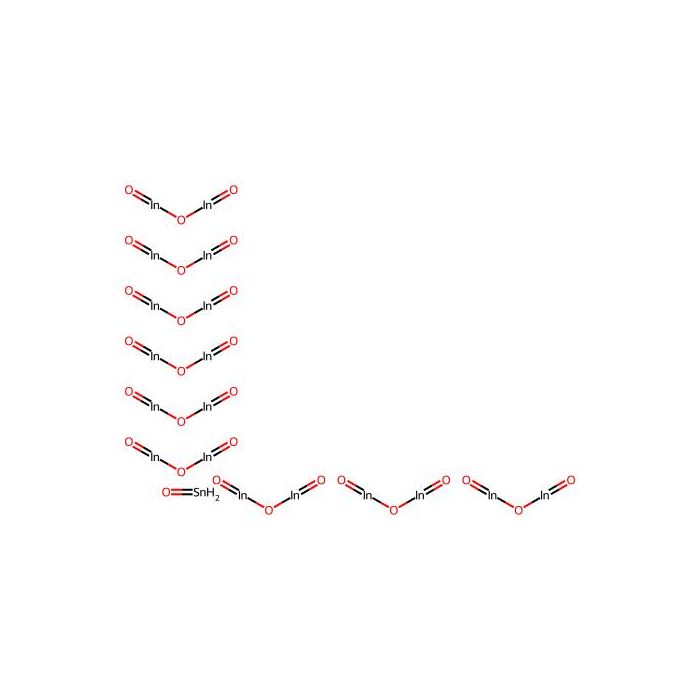
Indium tin oxide(ITO) - ≥99.5% metals basis, 20 wt. % in H2O , CAS No.50926-11-9

CAS: 50926-11-9 Cat. No.: I432794 Formule: In2O3/SnO2 Numéro CE: 610-589-1
DISPONIBLE À COMMANDE
QUALITÉ & PURETÉ ≥99.5% metals basis 20 wt. % in H2O
Synonyms
ITO
Storage
Room temperature
★
Taille
Allemagne (EU)
USA*
Prix
Qté
25g
I432794-25g
Sur commande · 8–12 semaines

525,76€

614,27€
Enregistrer 88,51 € (14.41%)
Enter a quantity for the sizes you want to add.

Vue d’ensemble

Application

Indium Tin oxide nanoparticles have been investigated for use in: transparent electrodes the formation of conductive paper and organic contaminants the formation of transparent conductive oxide films and magnetic nanocomposites electrochromic materials and in biomedical applications

Spécifications

Synonymes
ITO
Spécifications et pureté
≥99.5% metals basis, 20 wt. % in H2O
Conditions de stockage de stockage
Room temperature
Pureté
≥99.5% metals basis
Noms et identifiants
WGK Allemagne
3
Numéro ONU
1219
Groupe d'emballage
II

Données avancées

Certificats (CoA, COO, BSE/TSE et tableau d'analyse)
C of A & Other Certificates(BSE/TSE, COO):
Analytical Chart:
Propriétés chimiques et physiques
Point d'ébullition (°C)82 °C
Point de fusion (°C)1910 °C (lit.)
Sécurité et dangers (GHS)
Signal
Warning
Mentions de danger

H335:May cause respiratory irritation

H351:Suspected of causing cancer

Conseils de prudence

P201:Obtain special instructions before use.

P202:Do not handle until all safety precautions have been read and understood.

P261:Avoid breathing dust/fume/gas/mist/vapors/spray.

P271:Use only outdoors or in a well-ventilated area.

P281:Use personal protective equipment as required.

P304+P340:IF INHALED: Remove person to fresh air and keep comfortable for breathing.

P308+P311:IF exposed or concerned: Call a POISON CENTER/doctor/...

P403+P233:Store in a well-ventilated place. Keep container tightly closed.

WGK Allemagne
3
Classe
3
FAQ et articles
High-Refractive-Index vs Low-Refractive-Index Coating Materials: From AR/Waveguide Principles to a Formulation & Material-Selection Map (Including Product Category Tables A/B/C)
Post-Transition Metals and Their Salts: A Classification Guide from Definitions to Value-Chain Applications (Including Product Lists in Tables 1–4)
Light-Emitting Polymers (LEPs): A Practical Panorama - A Core PL/EL Mechanistic Framework, Material Family Map, and Structural “Design Knobs” (including Product Tables 1–4 and a selection guide)
Ceramic Materials Guide: Basic Definitions, Classification Framework, and Research-Task-Oriented Selection (with Product Navigation and Tables 1–4)
Self-Assembled Nanodielectrics (SANDs): Self-Assembled Nanodielectric Layers for Low-Voltage Thin-Film Transistors (with Product Selection Guide)
From ICMA to ICBA/ICTA: Structural Modulation and Device Performance of Indene-C60 Adduct Acceptors
How ZnO Nanoparticle Electron Transport Layers Reduce Dark Current in Organic Photodetectors: Mechanisms, Film Quality, and Material Selection
Signal Transduction Mechanism of Graphene Biosensors: From Molecular Recognition to Electrical/Optical Signal Readout and Materials Selection
Application of Conductive Carbon Black in Coatings: Selection Criteria, Dispersion Control, and Conductive Network Construction
Citations of This Product
Calculateurs de solution
Avis

Avis des clients

Souhaitez-vous que nous vous envoyions un message lorsque des réductions seront disponibles?

Me rappeler plus tard

Merci ! Veuillez vérifier votre boîte de réception e-mail pour confirmer.

Oups ! Les notifications sont désactivées.