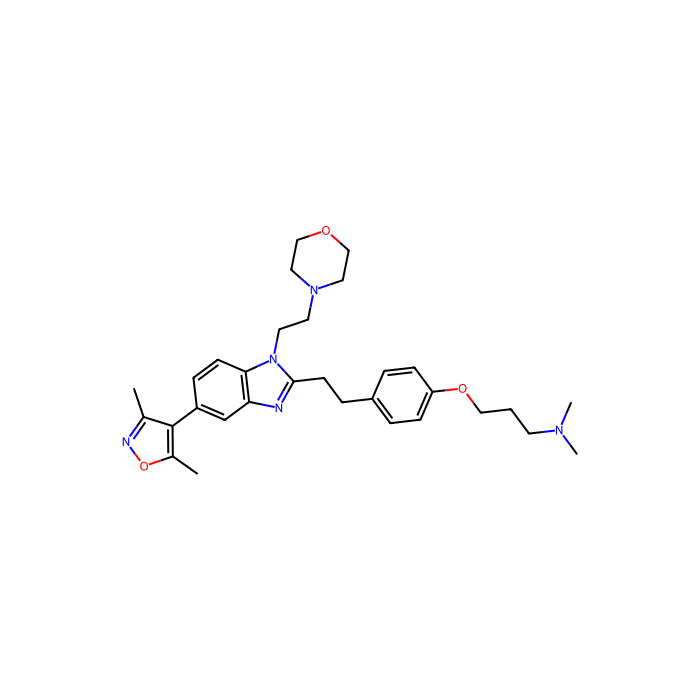
Dual CBP/p300 and BRD4 bromodomain inhibitor (IC50values are 0.65 and 1.5μM for CBP and BRD4 respectively). DownregulatesIL-6,IL-1βandIFN-βin macrophages.
Conditions de stockage de stockage
Store at 2-8°C
Expédié en
Wet ice
Ce produit nécessite l'expédition en chaîne froide. Les services terrestres et autres services économiques ne sont pas disponibles.
This compound belongs to the class of organic compounds known as benzimidazoles. These are organic compounds containing a benzene ring fused to an imidazole ring (five member ring containing a nitrogen atom, 4 carbon atoms, and two double bonds).
External Descriptors
Not available
1. Djoumbou Feunang Y, Eisner R, Knox C, Chepelev L, Hastings J, Owen G, Fahy E, Steinbeck C, Subramanian S, Bolton E, Greiner R, and Wishart DS. ClassyFire: Automated Chemical Classification With A Comprehensive, Computable Taxonomy. Journal of Cheminformatics, 2016, 8:61.
Certificats (CoA, COO, BSE/TSE et tableau d'analyse)
C of A & Other Certificates(BSE/TSE, COO):
Analytical Chart:
Propriétés chimiques et physiques
Solubilité
Solvent:1eq. HCl, Max Conc. mg/mL: 53.17, Max Conc. mM: 100; Solvent:DMSO, Max Conc. mg/mL: 26.58, Max Conc. mM: 50
Calculateurs de solution
Molarity Calculator
Determine the necessary mass, volume, or concentration for preparing a solution.
Dilution Calculator
Determine the dilution needed to prepare a stock solution.
Reconstitution Calculator
Avis
Avis des clients
Application Protocols
No validated application protocols (e.g., WB, IHC, IF, FC) are applicable; this product is a small-molecule research compound, not an antibody or assay kit. The manufacturer has not provided assay protocols for ISOX DUAL.
General preparation guidance (not item-specific):
Prepare a concentrated DMSO stock (e.g., 10–50 mM) as solubility permits. Aliquot to avoid repeated freeze–thaw.
Dilute into assay buffer or media with mixing, ensuring final DMSO content is compatible with your system. Inspect for precipitation or turbidity.
For HTS, dispense using acoustic or positive-displacement systems; include vehicle controls and, if relevant, detergent to mitigate aggregation artifacts.
Please refer to your internal SOPs or contact technical support with your specific use case for tailored guidance.
Biological Roles
Item-specific biological function, targets, or pathway involvement are not provided for ISOX DUAL. No biological role should be inferred from the product name.
General guidance for users evaluating small molecules (not item-specific):
If activity is observed in assays, confirm selectivity and on-target engagement using orthogonal biochemical methods (e.g., enzyme kinetics, CETSA/thermal shift, SPR) and cellular target validation (e.g., CRISPR knockdown/overexpression), as appropriate.
Assess pan-assay interference (PAINS) risks and colloidal aggregation using control experiments (detergent sensitivity, DLS) and redox/chelation screens where relevant (literature/general).
Characterize ADME-relevant properties (permeability, metabolic stability in liver microsomes/S9, plasma protein binding) early to contextualize potency.
Research-use limitation:
This product is for research use only. It is not intended for diagnostic, therapeutic, or human/animal consumption. No clinical or medical claims are made or implied.
Buffer Applications
This section is generally not applicable to discrete small-molecule library members. ISOX DUAL is not a buffering reagent, and no pKa or buffer capacity data are provided.
Practical note (general, not item-specific):
When preparing assay solutions, use established biological buffers (e.g., phosphate, HEPES, Tris) appropriate to your system. Dissolve the compound in a compatible co-solvent (often DMSO), then dilute into the buffer while monitoring final solvent content and solubility.
If the compound possesses ionizable groups (unknown here), the solution pH may influence solubility and stability; verify empirically.
Green Alternatives
This section is typically most relevant for solvents or bulk reagents where greener substitutions impact EHS footprint. ISOX DUAL is a small-molecule library member; there is no direct “green alternative” to the compound itself.
General considerations (not item-specific):
For solution preparation, prefer water or aqueous buffers when chemically and assay-compatible.
When organic stock solutions are required, use the minimum effective DMSO content and select co-solvents with safer profiles where possible (e.g., ethanol over DMF, if solubility allows).
Implement microscale handling, closed microplates, and proper waste segregation to minimize solvent use and exposure.
If chromatographic purification is performed in-house, consider greener mobile phases (e.g., EtOH/water or MeOH/water in place of ACN where performance permits) and adopt mass-directed purification to reduce waste (literature/general).
Because item-specific environmental metrics (e.g., life-cycle data, hazard category) are not provided, apply institutional green-chemistry guidelines to the associated workflows rather than to the compound identity itself.
Pharmaceutical Uses
No pharmacopeial status, excipient role, or manufacturing use is provided for this item. ISOX DUAL is supplied for research use only and is not intended for pharmaceutical formulation or clinical use.
General guidance (not item-specific):
If utilized as a research tool or probe in preclinical studies, ensure comprehensive analytical characterization (purity, identity, stability) and document the salt form and solvate/hydrate status, as these affect dose calculations.
Evaluate formulation feasibility (e.g., cosolvent systems, cyclodextrin inclusion, nanoemulsions) only within nonclinical research settings and institutional compliance frameworks.
No medical or therapeutic claims are made or implied for this product.
Physical Properties
Item-specific physical properties:
Appearance: Not specified for this item; refer to CoA/Spec Sheet.
Molecular Weight: Not specified for this item; refer to CoA/Spec Sheet.
Molecular Formula: Not specified for this item; refer to CoA/Spec Sheet.
Melting Point (MP): Not specified for this item; refer to CoA/Spec Sheet.
Boiling Point (BP): Not specified for this item; refer to CoA/Spec Sheet.
Density: Not specified for this item; refer to CoA/Spec Sheet.
Refractive Index: Not applicable/unknown; refer to CoA/Spec Sheet.
Solubility: Not specified for this item; refer to CoA/Spec Sheet.
logP/logD, pKa: Not specified for this item; refer to CoA/Spec Sheet.
General/literature guidance for small-molecule library members (not item-specific):
Many discovery compounds are amorphous to microcrystalline solids at ambient temperature; some may be oils.
Solubility screening typically starts with DMSO (100% or 50% v/v in water) and, if needed, co-solvents such as acetonitrile, ethanol, or DMF (literature/general). A brief sonication and gentle warming (≤40 °C) often aid dissolution.
Where ionizable functionality is present, pH-adjusted buffers (e.g., phosphate, citrate) can improve aqueous solubility (literature/general).
Important note:
Do not treat any of the above as product specifications. For validated numeric values and acceptance criteria, defer to the CoA/Spec Sheet supplied for this specific lot.
Quality and Grades
Item-specific grade/purity details:
Grade/Purity: Not specified for this item; refer to CoA/Spec Sheet.
How to interpret quality for small-molecule library members (general guidance):
Discovery/Screening compounds are typically supplied with identity confirmation (e.g., LC–MS and/or 1H NMR) and a reported purity by HPLC/UPLC (area %). Exact thresholds vary by supplier and intended use.
When UV transparency is relevant (e.g., for photophysical assays), some vendors provide a UV/Vis profile; otherwise, this is usually not controlled like solvent grades.
If salt form or solvate/hydrate state applies, it should be listed on the CoA; this affects calculated molecular weight and dosing.
For hit validation and in vitro assays, many labs require ≥95% HPLC purity and documented structure ID. For SAR or in vivo tool development, higher thresholds and full spectral packages (1H/13C NMR, HRMS) are common (literature/general).
Recommendations for this item:
Request the CoA/Spec Sheet for: purity method and result, salt/solvate form, water content (if available), and analytical identifiers (LC–MS, NMR). Verify lot-to-lot consistency if used in screening cascades.
If your application is chromatographic or photometric, validate background absorbance and potential fluorescence empirically, as such specifications are not provided here.
Reaction and Applications
Item-specific reactivity or application claims are not provided. Without structural information, detailed synthetic or mechanistic discussion is not appropriate.
General research applications for small-molecule library members (not item-specific):
High-throughput screening (HTS)/fragment or focused library screening: Evaluate as part of discovery campaigns against biochemical or cell-based assays.
Hit triage and orthogonal assays: If ISOX DUAL exhibits activity, follow up with orthogonal readouts to exclude assay interference (e.g., redox activity, aggregation, fluorescence), using controls such as detergent supplementation or dynamic light scattering (literature/general).
Physicochemical profiling: Measure solubility, stability (pH, oxidative, photolytic), logD, and permeability (PAMPA/MDCK) to assess developability.
Analytical confirmation: Reconfirm identity/purity post-dissolution by LC–MS to ensure no degradation or adduct formation.
Important caveat:
No target or mode-of-action information is provided for this item, and none should be inferred from the product name. All biological testing should be treated as exploratory and for research use only.
Reaction Conditions
No reaction conditions can be prescribed for ISOX DUAL because the structure and functional groups are not disclosed in the Product Data. As such, there are no item-specific recommendations for catalysts, temperatures, or solvents in synthetic transformations.
General, non-item-specific notes for handling small molecules in solution:
For solution preparation, dissolve in dry, oxygen-free solvents as needed for air/moisture-sensitive chemistries. Otherwise, standard analytical-grade solvents are typically sufficient for stock solution preparation.
Verify solution stability over time (bench-top vs refrigerated autosampler) by LC–MS to set appropriate holding times for assays.
If conducting biological assays, maintain DMSO ≤0.5–1% v/v final, unless your protocol supports higher levels.
Please consult the CoA/SDS or contact technical support with the structure if you require tailored guidance.
Safety and Handling
Item-specific safety data:
GHS Classification / Pictograms / Signal Word / H-Statements: Not specified for this item; refer to SDS.
Research Use: For research use only (as provided).
Storage Conditions: Store at 2–8 °C (as provided). Shipments are on wet ice.
General laboratory safety guidance (not item-specific; defer to SDS):
Handle in a chemical fume hood with appropriate PPE: lab coat, safety glasses, and chemically resistant gloves (e.g., nitrile). Avoid inhalation of dust/aerosols and skin/eye contact.
Assume unknown toxicity; minimize exposure via good hygiene practices. Do not eat, drink, or smoke when handling laboratory chemicals.
Avoid incompatible agents until confirmed by SDS/CoA; in the absence of data, segregate from strong oxidizers, strong acids/bases, and reducing agents as a precaution.
In case of skin/eye contact, rinse with water for ≥15 minutes; seek medical attention if irritation persists. If inhaled, move to fresh air; if ingested, rinse mouth and seek medical advice. Always follow site SOPs.
Spill response: contain with inert absorbent, prevent release to drains, and dispose of in accordance with local regulations. Decontaminate surfaces and ventilate area.
Stability considerations:
Maintain at 2–8 °C closed tightly, protected from light and moisture until use. Allow vials to equilibrate to room temperature before opening to minimize condensation.
Authoritative source: Always consult the Safety Data Sheet (SDS) for definitive hazard classification and first-aid measures.
Solvent Selection
Item-specific solubility data are not provided for ISOX DUAL. The following is general guidance for dissolving small-molecule screening compounds (not item-specific; verify empirically):
Primary stock solvent: DMSO is the default due to broad solvating power and compatibility with most biochemical and cell-based assays.
Secondary co-solvents: acetonitrile (MeCN), ethanol (EtOH), or DMF can be used to pre-wet before dilution into aqueous buffers if DMSO alone is insufficient.
Aqueous compatibility: After preparing a concentrated DMSO stock (e.g., 10–50 mM), dilute into assay buffer ensuring final DMSO ≤0.5–1% v/v for typical biochemical assays, or within cell-tolerated limits per protocol (literature/general).
pH strategies: If the compound is ionizable, modest pH adjustment (e.g., phosphate buffer pH 6–8) may improve solubility. Avoid extreme pH unless stability is established.
Physical aids: Gentle warming (≤40 °C), vortexing, and brief sonication can help. Filter (0.22 µm) if particulates persist and the compound is stable.
Quick comparison (general):
DMSO: strongest solvency; assay-compatible at low %; hygroscopic.
MeCN: volatile, mixes with water; less cytocompatible; good for LC.
EtOH: biocompatible at low %; limited solvency for highly lipophilic solids.
DMF: strong solvency; consider toxicity and assay interference.
Note: Because item-specific solubility is not specified, always perform a small-scale solubility and stability check before committing to screens.
Storage and Reconstitution
Item-specific instructions:
Storage Conditions: Store at 2–8 °C (provided). Protect from moisture and light. Keep container tightly closed.
Shipping: Shipped on wet ice (provided).
Reconstitution and handling (general guidance; not item-specific):
Before opening, allow the vial to equilibrate to room temperature to prevent condensation.
For initial dissolution, start with anhydrous DMSO to prepare a concentrated stock (e.g., 10–50 mM), adjusting based on observed solubility. If necessary, use co-solvents (MeCN, EtOH) or gentle warming (≤40 °C) and sonication.
After preparation, aliquot into low-bind microtubes to minimize adsorption and avoid repeated freeze–thaw cycles.
Recommended storage of DMSO stocks: −20 °C or −80 °C (dark), with headspace minimized; verify stability by periodic LC–MS. Aqueous working solutions are typically prepared fresh and used within the same day unless stability is demonstrated (literature/general).
Shelf-life and specifications:
No item-specific shelf-life, purity, or stability data are provided. Refer to the CoA/Spec Sheet for any available lot-specific guidance.
Always adhere to institutional SOPs and the SDS for definitive handling and disposal instructions.
Structure and Identity
Item-specific identifiers from Product Data:
Product Name: ISOX DUAL (SKU: I288673)
CAS: 1962928-22-8
PubChem CID: 121237857
InChIKey: 117633 (as provided; note this does not match the typical 27-character InChIKey format)
SMILES: Not specified for this item; refer to CoA/Spec Sheet.
Molecular Formula: Not specified for this item; refer to CoA/Spec Sheet.
Molecular Weight: Not specified for this item; refer to CoA/Spec Sheet.
Structural features (general notes):
The specific functional groups, ring systems, and stereochemistry are not provided in the Product Data. Without a valid SMILES/InChI, a definitive 2D/3D description cannot be given here.
Category indicates inclusion in a small-molecule library (小分子和化合物库), suggesting it is intended for screening and discovery workflows.
Guidance for users:
For authoritative structure representation (SMILES, InChI, InChIKey normalization), please consult the item’s CoA/Spec Sheet or vendor SDS. If you possess the structure, include it in ELNs/registration systems to enable proper inventory and safety controls.
If structural identity confirmation is required, typical analytical methods include 1H/13C NMR, HRMS/LC–MS, and, where applicable, HPLC purity profiling and elemental analysis (literature/general).
Synthetic Utility
Detailed synthetic utility cannot be described without a disclosed structure. Functional group reactivity, protecting-group strategies, and named-reaction participation are inherently structure-dependent and are not provided for ISOX DUAL.
General considerations (not item-specific):
If you possess the structure and intend to derivatize, map functional handles (e.g., aryl halides for cross-coupling, amines/acids for amide coupling) and identify potential liabilities (e.g., oxidizable heteroarenes, hydrolyzable esters).
Establish stability-indicating analytics to monitor transformations (LC–MS/UPLC-UV, possibly ELSD for nonchromophoric motifs).
For SAR exploration, consider parallel synthesis with microscale reaction screening and automated purification to accelerate cycle times.
Absent item-specific data, treat ISOX DUAL as an end-use screening compound rather than a building block.
Target Specificity
Not applicable. No antibody, protein, or biologic targeting information is provided, and this product is not supplied as an immunoreagent. There are no item-specific data on molecular targets, selectivity profiles, or binding constants.
If you discover activity in your assays, determine target specificity using appropriate follow-up studies (e.g., counterscreens against homologs, kinetic mechanism analysis, or target engagement assays).
We use cookies to ensure the website functions properly and, where permitted, to improve your experience. You can manage your preferences at any time in Settings. Learn more in our Cookie Policy.
Shall we send you a message when we have discounts available?
Remind me later
Thank you! Please check your email inbox to confirm.
Products are supplied to verified businesses, institutions, and qualified professionals for research and development use only. Not for use in humans, animals, diagnosis, or therapy.