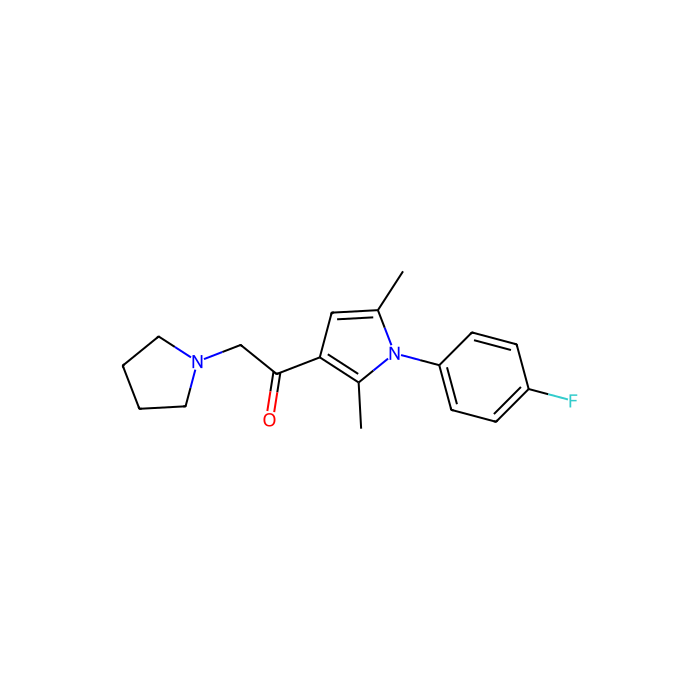
IU1 - Moligand™, ≥98%(HPLC) , Inhibitor of ubiquitin specific peptidase 14, CAS No.314245-33-5, Inhibitor of ubiquitin specific peptidase 14

CAS: 314245-33-5 Cat. No.: I169504 Formule: C18H21FN2O Poids moléculaire: 300.37 Numéro CE: 686-043-1
DISPONIBLE À COMMANDE
QUALITÉ & PURETÉ Moligand™ ? Moligand™ — Aladdin's line of ligands and bioactive small molecules. Use for receptor, pathway, and binding studies needing defined small-molecule tools. ≥98%(HPLC)
Synonyms
Usp14 inhibitor|1-(1-(4-fluorophenyl)-2,5-dimethyl-1H-pyrrol-3-yl)-2-(pyrrolidin-1-yl)ethanone|1-[1-(4-Fluorophenyl)-2,5-dimethyl-3-pyrrolyl]-2-(1-pyrrolidinyl)ethanone|1-(1-(4-fluorophenyl)-2,5-dimethyl-1H-pyrrol-3-yl)-2-(pyrrolidin-1-yl)ethan-1-one|1-[1-(4-fluorophenyl)-2,5-dimethylpyrrol-3-yl]-2-pyrrolidin-1-ylethanone|IU1|IU-1|1-[1-(4-Fluorophenyl)-2,5-dimethyl-1H-pyrrol-3-yl]-2-(1-pyrrolidinyl)ethanone|1-[1-(4-Fluoro-phenyl)-2,5-dimethyl-1H-pyrrol-3-yl]-2-pyrrolidin-1-yl-ethanone|1-[1-(4-FLUOROPHENYL)-2,5-DIMETHYLPYRROL-3-YL]-2-(PYRROLIDIN-1-YL)ETHANONE|1-[1-(4-fluorophenyl)-2,5-dimethyl-1H-pyrrol-3-yl]-2-(pyrrolidin-1-yl)ethan-1-one
Storage
Room temperature
Shipped In
Normal
★
Taille
Allemagne (EU)
USA*
Prix
Qté
5mg
I169504-5mg
—
3 En stock
84,08€
10mg
I169504-10mg
—
2 En stock
140,49€
25mg
I169504-25mg
—
1 En stock
249,82€
50mg
I169504-50mg
—
1 En stock
359,16€
100mg
I169504-100mg
—
1 En stock
562,21€
200mg
I169504-200mg
—
1 En stock
874,59€
Enter a quantity for the sizes you want to add.

Vue d’ensemble

IU1 est un inhibiteur spécial de Usp14 avec une IC50 de 4-5 μM.

Spécifications

Synonymes
Usp14 inhibitor | 1-(1-(4-fluorophenyl)-2,5-dimethyl-1H-pyrrol-3-yl)-2-(pyrrolidin-1-yl)ethanone | 1-[1-(4-Fluorophenyl)-2,5-dimethyl-3-pyrrolyl]-2-(1-pyrrolidinyl)ethanone | 1-(1-(4-fluorophenyl)-2,5-dimethyl-1H-pyrrol-3-yl)-2-(pyrrolidin-1-yl)ethan-1-one | 1-[1-(4-fluorophenyl)-2,5-dimethylpyrrol-3-yl]-2-pyrrolidin-1-ylethanone | IU1 | Afficher plus
Spécifications et pureté
Moligand™, ≥98%(HPLC)
Mécanismes biochimiques et physiologiques
Inhibiteur sélectif et réversible de Usp14 (IC 50 = 4 μM). Augmente la dégradation des substrats du protéasome. Réduit le taux d'élagage des chaînes d'ubiquitine liées à la cycline B ou à d'autres chaînes d'ubiquitine. Actif in vitro. IU1 est un inhibiteu
Conditions de stockage de stockage
Room temperature
Expédié en
Normal
Grade
Moligand™
Type d'action
INHIBITOR
Mécanisme d'action
Inhibitor of ubiquitin specific peptidase 14
Note
Dans la mesure du possible, les solutions doivent être préparées et utilisées le même jour. Toutefois, si vous devez préparer des solutions de base à l'avance, nous vous recommandons de les conserver sous forme d'aliquotes dans des flacons hermétiques à -20°C. Ces aliquotes sont généralement utilisables pendant un mois. En général, ces solutions peuvent être utilisées pendant un mois. Avant utilisation, et avant d'ouvrir le flacon, nous vous recommandons de laisser votre produit s'équilibrer à température ambiante pendant au moins 1 heure. Besoin de plus de conseils sur la solubilité, l'utilisation et la manipulation ? Veuillez consulter notre page de questions fréquemment posées (FAQ) pour plus de détails.
Pureté
≥98%(HPLC)
Noms et identifiants
Pubchem Sid
Pubchem Sid Url
https://pubchem.ncbi.nlm.nih.gov/substance/488191043
Sourires canoniques
CC1=CC(=C(N1C2=CC=C(C=C2)F)C)C(=O)CN3CCCC3
IUPAC Name
1-[1-(4-fluorophenyl)-2,5-dimethylpyrrol-3-yl]-2-pyrrolidin-1-ylethanone
InChIKey
JUWDSDKJBMFLHE-UHFFFAOYSA-N
INCHI
1S/C18H21FN2O/c1-13-11-17(18(22)12-20-9-3-4-10-20)14(2)21(13)16-7-5-15(19)6-8-16/h5-8,11H,3-4,9-10,12H2,1-2H3
Isomères SMILES
CC1=CC(=C(N1C2=CC=C(C=C2)F)C)C(=O)CN3CCCC3
WGK Allemagne
3
Poids moléculaire
300.37
Reaxy-Rn
21391902
Reaxys-RN_link_address
https://www.reaxys.com/reaxys/secured/hopinto.do?context=S&query=IDE.XRN=21391902&ln=

Données avancées

Taxonomic Classification

Taxonomy Tree

KingdomOrganic compounds
SuperclassOrganoheterocyclic compounds
ClassePyrroles
SubclassSubstituted pyrroles
Intermediate Tree Nodes Not available
Direct ParentPhenylpyrroles
Alternative Parents Aryl alkyl ketones  Fluorobenzenes  N-alkylpyrrolidines  Aryl fluorides  Vinylogous amides  Heteroaromatic compounds  Alpha-amino ketones  Trialkylamines  Azacyclic compounds  Organopnictogen compounds  Organofluorides  Organic oxides  Hydrocarbon derivatives  
Molecular FrameworkAromatic heteromonocyclic compounds
Substituents 1-phenylpyrrole - Aryl alkyl ketone - Aryl ketone - Fluorobenzene - Halobenzene - Aryl fluoride - Aryl halide - Monocyclic benzene moiety - N-alkylpyrrolidine - Benzenoid - Alpha-aminoketone - Heteroaromatic compound - Pyrrolidine - Vinylogous amide - Ketone - Tertiary amine - Tertiary aliphatic amine - Azacycle - Amine - Organooxygen compound - Organonitrogen compound - Organofluoride - Organohalogen compound - Hydrocarbon derivative - Organic oxide - Organopnictogen compound - Organic oxygen compound - Organic nitrogen compound - Aromatic heteromonocyclic compound
DescriptionThis compound belongs to the class of organic compounds known as phenylpyrroles. These are polycyclic aromatic compounds containing a benzene ring linked to a pyrrole ring through a CC or CN bond.
External Descriptors Not available
Structure 3D
Modèle de structure chimique interactif


Cibles associées (humaines)
USP14 Tchem Ubiquitin carboxyl-terminal hydrolase 14 (1 Activities)
Activity TypeActivity Value -log(M)Mechanism of ActionActivity ReferencePublications (PubMed IDs)
USP5 Tchem Ubiquitin carboxyl-terminal hydrolase 5 (172 Activities)
Activity TypeRelationActivity valueUnitsAction TypeJournalPubMed IddoiAssay Aladdin ID
TDP1 Tchem Tyrosyl-DNA phosphodiesterase 1 (345557 Activities)
Activity TypeRelationActivity valueUnitsAction TypeJournalPubMed IddoiAssay Aladdin ID
KDM4E Tchem Lysine-specific demethylase 4D-like (40243 Activities)
Activity TypeRelationActivity valueUnitsAction TypeJournalPubMed IddoiAssay Aladdin ID
USP14 Tchem Ubiquitin carboxyl-terminal hydrolase 14 (35 Activities)
Activity TypeRelationActivity valueUnitsAction TypeJournalPubMed IddoiAssay Aladdin ID
Cibles associées (non humaines)
Hdac6 Histone deacetylase 6 (222 Activities)
Activity TypeRelationActivity valueUnitsAction TypeJournalPubMed IddoiAssay Aladdin ID
Plasmodium falciparum (966862 Activities)
Activity TypeRelationActivity valueUnitsAction TypeJournalPubMed IddoiAssay Aladdin ID
rep Replicase polyprotein 1ab (378 Activities)
Activity TypeRelationActivity valueUnitsAction TypeJournalPubMed IddoiAssay Aladdin ID
TGR Thioredoxin glutathione reductase (28579 Activities)
Activity TypeRelationActivity valueUnitsAction TypeJournalPubMed IddoiAssay Aladdin ID
Mécanismes d'action
Certificats (CoA, COO, BSE/TSE et tableau d'analyse)
C of A & Other Certificates(BSE/TSE, COO):
Analytical Chart:

Find and download the COA for your product by matching the lot number on the packaging.

12 results found

Lot NumberCertificate TypeDateArticle
C23161016C23161016Certificate of AnalysisDec 10, 2025 I169504
C23161055C23161055Certificate of AnalysisDec 10, 2025 I169504
C23161171C23161171Certificate of AnalysisDec 10, 2025 I169504
C23161172C23161172Certificate of AnalysisDec 10, 2025 I169504
C23161173C23161173Certificate of AnalysisDec 10, 2025 I169504
C23161191C23161191Certificate of AnalysisDec 10, 2025 I169504
C2316821C2316821Certificate of AnalysisDec 10, 2025 I169504
C2316822C2316822Certificate of AnalysisDec 10, 2025 I169504
C2316823C2316823Certificate of AnalysisDec 10, 2025 I169504
C2316829C2316829Certificate of AnalysisDec 10, 2025 I169504
C2316830C2316830Certificate of AnalysisDec 10, 2025 I169504
C2316961C2316961Certificate of AnalysisDec 10, 2025 I169504
Propriétés chimiques et physiques
Poids moléculaire300.400 g/mol
XLogP33.500
Hydrogen Bond Donor Count0
Hydrogen Bond Acceptor Count3
Rotatable Bond Count4
Exact Mass300.164 Da
Monoisotopic Mass300.164 Da
Topological Polar Surface Area25.200 Ų
Heavy Atom Count22
Formal Charge0
Complexity389.000
Isotope Atom Count0
Defined Atom Stereocenter Count0
Undefined Atom Stereocenter Count0
Defined Bond Stereocenter Count0
Undefined Bond Stereocenter Count0
The total count of all stereochemical bonds0
Covalently-Bonded Unit Count1
Calculateurs de solution
Avis

Avis des clients

Application Protocols

Only product data may be used in this section. Tested application types, recommended dilutions, and step-by-step protocols are Not specified for this item; refer to CoA/Spec Sheet.

General best practices for small-molecule probe use (non-item-specific):

  • Prepare fresh dilution series in compatible assay buffer, maintaining a constant vehicle percentage across wells/samples.
  • Include positive and negative controls, vehicle controls, and—where feasible—orthogonal readouts to confirm on-target effects.
  • Document lot number, stock concentration, preparation date, and storage conditions for reproducibility.
  • For cell-based work, confirm solvent tolerance and assess cytotoxicity of the vehicle and probe across the tested range prior to mechanistic assays.
Biological Roles

Context (literature, non-item-specific): IU1 is widely referenced as a chemical probe used to study protein homeostasis pathways, particularly within the ubiquitin–proteasome system (UPS). Researchers employ such probes to modulate specific deubiquitinating enzymes (DUBs) associated with the 26S proteasome, thereby influencing the degradation of ubiquitinated substrates in biochemical and cellular models.

Relevance to biochemical research:

  • UPS modulation: Small-molecule DUB modulators are used to interrogate substrate processing, proteasome throughput, and turnover of short-lived regulatory proteins.
  • Mechanistic assays: Employed in enzyme activity assays, pulse–chase protein turnover experiments, proteomics workflows (e.g., ubiquitin remnant profiling), and reporter-based readouts of proteasome function.
  • Pathway mapping: Enables target/pathway validation by comparing effects across orthogonal assay systems and genetic perturbations (e.g., RNAi/CRISPR vs small-molecule treatment).

Important caveats:

  • Target specificity, affinity, and selectivity for any given DUB isoform and off-target profile are experiment- and batch-dependent and are Not specified for this item; consult the CoA and primary literature.
  • Cellular efficacy is influenced by permeability, efflux, binding to serum proteins, and metabolic stability; empirical titration and proper vehicle controls are essential.

Compliance note: For research use only. No clinical, diagnostic, or therapeutic claims are made or implied.

Buffer Applications

This item is a small-molecule probe rather than a buffering agent. Accordingly, it does not define or maintain pH in aqueous systems.

Practical considerations when introducing the probe into buffers (general guidance):

  • Vehicle: Prepare a concentrated DMSO stock and dilute into the desired buffer (e.g., HEPES, Tris, PBS) maintaining a constant final DMSO percentage across all conditions.
  • Surfactants/proteins: Low levels of nonionic surfactants (e.g., 0.01% Tween-20) or carrier proteins (e.g., 0.1% BSA) can reduce adsorption losses; validate that these additives do not interfere with the assay.
  • pH and ionic strength: Confirm compound stability across your intended pH/ionic strength window; some small molecules hydrolyze or precipitate outside narrow ranges.

Item-specific buffer compatibility, pKa, and solubility: Not specified for this item; refer to CoA/Spec Sheet.

Green Alternatives

Green chemistry considerations for this SKU primarily concern solvent use and assay format rather than replacing the probe itself.

  • Replace or minimize DMSO where compatible: Evaluate aqueous-compatible delivery systems (cyclodextrins, microemulsions) or lower-percentage DMSO dosing to reduce polar aprotic solvent usage. Validate target compatibility and adsorption effects.
  • Miniaturize screens: Use low-volume microplate formats (384/1536 wells) to reduce solvent and compound consumption.
  • Waste minimization: Consolidate waste streams for halogenated vs non-halogenated organics and avoid unnecessary serial dilutions.

Comparison of delivery options (general):

  • DMSO stock dosing: Simple, robust; generates polar aprotic waste; widely accepted in HTS.
  • Aqueous stock with solubilizers: Reduces DMSO but may introduce assay artifacts; requires pre-validation of excipients.
  • Solid dispensing (acoustic/pin tools): Minimizes solvent but requires specialized equipment and careful humidity control to prevent variability.

Note:

  • No greener “substitute compound” is relevant since IU1 is itself the intended active probe. Focus efforts on greener handling, solvent optimization, and right-sizing experiments to improve EHS footprint.
Pharmaceutical Uses

This product is supplied strictly for research use and is not intended for human or veterinary use, diagnostics, or as an excipient in commercial formulations.

General context (non-item-specific):

  • Chemical probes like IU1 are commonly used in discovery biology and preclinical research to explore target/pathway pharmacology in vitro and in cellular models. They are not manufactured or qualified to pharmacopeial excipient standards (e.g., USP/NF, Ph. Eur.).

Item-specific compliance and pharmacopeial status:

  • Pharmacopeial listing/status: Not specified for this item; refer to CoA/Spec Sheet.
  • Residual solvent and elemental impurity controls to ICH Q3 limits: Not specified for this item; refer to CoA/Spec Sheet.

Practical guidance:

  • If transitioning from research to regulated development, re-source or re-qualify material under appropriate GMP controls and generate full CMC documentation, including impurity profiles, stability studies, and release specifications.
Physical Properties

Item-specific physicochemical specifications are not provided in the Product Data for this SKU.

  • Appearance: Not specified for this item; refer to CoA/Spec Sheet.
  • Molecular weight: Not specified for this item; refer to CoA/Spec Sheet.
  • Melting point: Not specified for this item; refer to CoA/Spec Sheet.
  • Boiling point: Not applicable/rarely defined for research solids; Not specified for this item; refer to CoA/Spec Sheet.
  • Density: Not specified for this item; refer to CoA/Spec Sheet.
  • Solubility: Not specified for this item; refer to CoA/Spec Sheet. (General practice: prepare concentrated DMSO stocks for small-molecule probes; confirm actual solubility for this batch.)
  • LogP, pKa, refractive index, UV cutoff: Not specified for this item; refer to CoA/Spec Sheet.

General/literature guidance (non-item-specific):

  • Small-molecule screening probes are commonly handled as solid powders that dissolve in polar aprotic solvents (e.g., DMSO) to make 10–50 mM stocks, then diluted into assay buffers with final DMSO ≤1–2% v/v. Actual limits must be verified experimentally for each assay system.
  • Hygroscopicity and polymorphism can affect handling and apparent solubility; evaluate quickly upon receipt if your assay is sensitive to concentration accuracy.

Recommendation:

  • For quantitative work, obtain the batch CoA for purity, identity, and any available solubility/melting data, and verify solution stability under your specific buffer, pH, light, and temperature conditions.
Quality and Grades
  • Grade/Purity (as listed): Moligand™.

What Moligand™ generally implies (program-level, not item-specific):

  • A discovery-screening oriented small-molecule probe offering suitable purity and identity for biochemical and cellular research applications. Emphasis is on reliability for high-throughput screening (HTS), target validation, or mechanism-of-action studies rather than on ultra-trace analytical solvent standards.
  • Typical attributes of screening-grade small molecules include: validated identity (NMR/HRMS or LC–MS), purity suitable for biological screening (often ≥95% by HPLC/LC–UV), and documentation via CoA. Exact acceptance criteria are batch-dependent.

Item-specific notes for this SKU:

  • Itemized purity percentage, chromatographic profile, and residual solvent/elemental analyses are Not specified for this item; refer to CoA/Spec Sheet.
  • Stabilizers/inhibitors: Not specified for this item; refer to CoA/Spec Sheet.

Best practices for quality assurance:

  • Request and review the CoA before initiating critical experiments (e.g., potency benchmarking, SAR).
  • If your assays are UV-detection-based, evaluate the compound’s UV/Vis profile and assay interference risk (fluorescence, redox activity, aggregation) under your conditions.
  • For reproducibility across campaigns, archive aliquots of the received batch, record exact lot numbers, and confirm potency via an orthogonal assay when feasible.
Reaction and Applications

This product is a research probe and is not typically used as a synthetic reagent or reaction solvent.

Applications (research context):

  • Chemical biology studies: Employed as a small-molecule modulator in cell-free or cell-based assays to interrogate ubiquitin–proteasome system components and proteostasis pathways (literature, non-item-specific). Exact target engagement and potency should be verified from primary references and the batch CoA.
  • Screening workflows: Suitable for primary/secondary screening, counterscreens, and mechanistic follow-up as part of a focused library.

Not typically applicable:

  • It is not generally used in classical organic transformations (e.g., cross-coupling, oxidations, reductions) nor as a catalyst/ligand/solvent.

Good practices when using as a probe:

  • Establish vehicle controls and concentration–response curves; confirm lack of assay interference (fluorescence, redox activity, PAINS-like behavior) under your readout conditions.
  • Use orthogonal assays (biochemical vs. cellular) and, where possible, target engagement measurements (e.g., biophysical binding, activity assays) to corroborate phenotypes.
  • Confirm stability in assay buffer across the experiment duration (co-solvent %, pH, protein content, and temperature can affect stability and apparent potency).

Item-specific manufacturer application notes: Not specified for this item; refer to CoA/Spec Sheet.

Reaction Conditions

Not typically applicable. IU1 is provided as a research probe rather than a reagent for conducting chemical reactions.

General guidance for experimental use as a probe (non-item-specific):

  • Stock preparation: Commonly 10–20 mM in anhydrous DMSO; verify solubility with your batch. Prepare single-use aliquots to avoid repeated freeze–thaw and moisture uptake.
  • Working concentrations: Determine via concentration–response experiments; typical screening ranges span low nM to high µM depending on assay and target. Establish vehicle controls.
  • Incubation: Equilibration times in biochemical assays often range from minutes to an hour; cellular assays may require longer preincubation. Optimize for your system.

Item-specific guidance on concentration ranges, incubation times, or assay conditions: Not specified for this item; refer to CoA/Spec Sheet and primary literature.

Safety and Handling

Safety details are not specified in the Product Data for this item; defer to the Safety Data Sheet (SDS) for authoritative information.

  • GHS classification: Not specified for this item; refer to SDS.
  • Signal word / H-statements / Pictograms: Not specified for this item; refer to SDS.

General laboratory handling guidance (non-item-specific, best practice):

  • Personal protective equipment: lab coat, safety glasses, and suitable chemically resistant gloves (e.g., nitrile). Handle powders in a fume hood to minimize inhalation of dust/aerosol.
  • Avoid ingestion and skin/eye contact. Wash thoroughly after handling. Prevent environmental release.
  • Storage incompatibilities: keep away from strong oxidants and sources of ignition; avoid prolonged exposure to light and moisture unless stability is documented.
  • First aid (overview; consult SDS): rinse eyes/skin with water for ≥15 minutes upon contact; move to fresh air if inhaled; if ingested, seek medical attention—do not induce vomiting unless directed by medical personnel.
  • Spill response: gently collect solids while minimizing dust; for solutions, absorb with inert material. Dispose according to institutional and local regulations.
  • Waste: treat as organic laboratory chemical waste. Do not release to drains.

Note: This product is designated for research use only. Conduct risk assessment based on intended procedures (e.g., weighing fine powders, making DMSO stocks, aerosol-generating steps) and the SDS for the shipped batch.

Solvent Selection

Applicability: IU1 is supplied as a small-molecule probe; solvent choice primarily concerns preparation of stock solutions and assay dilutions rather than use as a reaction solvent.

General guidance for small-molecule probe handling (literature/practice; verify with your batch):

  • Preferred stock solvent: DMSO is commonly used due to broad solvency and biological compatibility at low percentages. Start with 10–20 mM stocks, adjusting based on observed solubility and assay needs.
  • Alternative solvents for intermediate handling: DMF, acetonitrile, ethanol. Confirm compatibility with assay components and targets.
  • Aqueous buffers: Most hydrophobic probes require co-solvent. Titrate DMSO content (e.g., final 0.1–1% v/v) and include a vehicle control.
  • Filtration: If particulates persist, pass through 0.2 µm PTFE/nylon filters. Avoid PVDF if adsorption is suspected.

Solubility/compatibility specifics for this item: Not specified for this item; refer to CoA/Spec Sheet.

Comparison notes (general):

  • DMSO vs DMF: DMSO offers better biocompatibility and lower volatility; DMF may improve solubility for certain heteroaromatics but has higher toxicity concerns.
  • ACN/Ethanol: Useful for intermediate dilution but can perturb protein assays at modest percentages; validate experimentally.

Practical tips:

  • Warm gently (ambient to 37 °C) and vortex/sonicate to aid dissolution; avoid prolonged heating.
  • Prepare single-use aliquots to limit freeze–thaw and moisture uptake.
  • Assess light sensitivity; wrap vials/plates in foil as precaution if stability is unknown.
Storage and Reconstitution

Storage (from Product Data for this SKU):

  • Storage conditions: Room temperature.
  • Shipped in: Normal conditions.

Additional item-specific details:

  • Appearance: Not specified for this item; refer to CoA/Spec Sheet.
  • Stabilizers/inert atmosphere/light protection: Not specified for this item; refer to CoA/Spec Sheet.

General guidance for small-molecule probes (non-item-specific):

  • Upon receipt, keep container tightly closed and protected from excessive humidity and light. If long-term storage is anticipated, consider desiccation and sub-ambient storage based on stability data.
  • Reconstitution: Prepare concentrated stock in anhydrous DMSO (or another validated solvent) using analytical balance and volumetric techniques. Mix thoroughly (vortex/brief sonication). If particulates remain, warm gently to ambient–37 °C and/or filter through 0.2 µm PTFE.
  • Aliquoting: Dispense single-use aliquots to minimize freeze–thaw; store aliquots in tightly sealed vials or plate wells. Record exact stock concentration and preparation date.
  • In-use stability: Validate stability in assay buffer at the intended temperature and time scale; discard solutions showing precipitation, discoloration, or potency drift.

Always consult the batch CoA and SDS for definitive storage and handling instructions specific to the lot you receive.

Structure and Identity

Brief overview: IU1 is a small-molecule research probe listed in our small-molecule and compound library category. Item-specific structural identifiers are not provided in the Product Data for this SKU.

  • SKU: I169504 (IU1)
  • CAS: 314245-33-5 (product listing)
  • InChIKey: Not specified for this item; refer to CoA/Spec Sheet. (Product Data lists an incomplete token; authoritative identifier not provided.)
  • SMILES: Not specified for this item; refer to CoA/Spec Sheet.
  • Molecular formula: Not specified for this item; refer to CoA/Spec Sheet.
  • Molecular weight: Not specified for this item; refer to CoA/Spec Sheet.

Structural features (general/literature context):

  • IU1 is widely referenced in the chemical biology literature as a small-molecule probe used in ubiquitin–proteasome system studies. Detailed structure and stereochemistry should be confirmed from primary literature or the item’s CoA prior to experimental design.
  • 2D description (general): compact, heteroatom-containing aromatic small molecule commonly formulated for screening in DMSO stocks; exact ring systems and functional group annotations are literature-defined and should be cross-checked against the batch CoA.

Notes:

  • For unambiguous identity (InChIKey, SMILES, formula), consult the batch-specific Certificate of Analysis (CoA) or request a specification sheet. Avoid relying on secondary sources when qualifying material for regulated or quantitative studies.
Synthetic Utility

IU1 is supplied as a finished small-molecule probe and is not typically employed as a synthetic reagent, catalyst, building block, or monomer in preparative chemistry.

When chemists might still consider synthetic context (general):

  • Reference standard: May serve as an analytical reference in method development (e.g., LC–MS/MS calibration) for studies involving proteostasis modulators.
  • SAR benchmarking: Used as an internal control in medicinal chemistry campaigns exploring structure–activity relationships (SAR) around related scaffolds; however, IU1 itself is not generally transformed further.

Not typically applicable:

  • Named-reaction participation, functional-group interconversion, or polymerization roles are not relevant for this probe in standard synthetic workflows.

Item-specific reactivity, functional groups, and derivatization handles: Not specified for this item; refer to CoA/Spec Sheet if derivatization is contemplated for target-ID workflows (e.g., affinity probes), and validate the structure from primary literature before planning chemistry.

Target Specificity

Only product data may be used in this section. Target specificity information (e.g., primary target, isoform selectivity, off-targets, binding constants) is Not specified for this item; refer to CoA/Spec Sheet.

Guidance:

  • Consult primary literature and the batch-specific CoA/SDS for any available target annotations, recommended controls, and counter-screens relevant to your research question.
  • Independently verify target engagement in your system using orthogonal methods (biochemical activity assays, biophysical binding, chemoproteomics), as probe behavior can be assay-context dependent.

Souhaitez-vous que nous vous envoyions un message lorsque des réductions seront disponibles?

Me rappeler plus tard

Merci ! Veuillez vérifier votre boîte de réception e-mail pour confirmer.

Oups ! Les notifications sont désactivées.