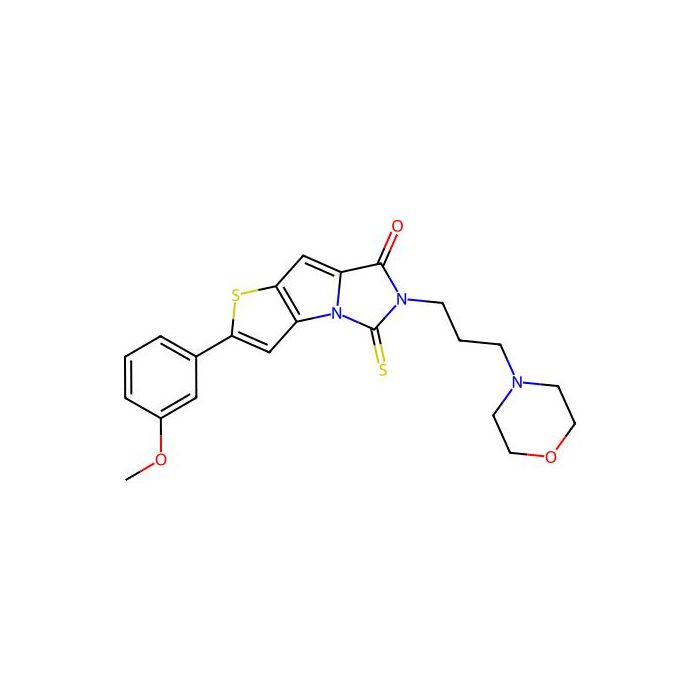
IW927 is a potent small molecule antagonist that blocks the binding of TNF-α to TNFRc1 with an IC 50 value of 50 nM and disrupts TNFα-induced IκB phosphorylation with an IC 50 value of 600 nM.
Form:Solid
Spécifications
Spécifications et pureté
≥99%
Mécanismes biochimiques et physiologiques
IW927 is a potent small molecule antagonist that blocks the binding of TNF-α to TNFRc1 with an IC 50 value of 50 nM and disrupts TNFα-induced IκB phosphorylation with an IC 50 value of 600 nM.
Conditions de stockage de stockage
Store at -20°C
Expédié en
Ice chest + Ice pads
Ce produit nécessite l'expédition en chaîne froide. Les services terrestres et autres services économiques ne sont pas disponibles.
Type d'action
ANTAGONIST
Pureté
≥99%
Noms et identifiants
Poids moléculaire
441.57
Données avancées
Certificats (CoA, COO, BSE/TSE et tableau d'analyse)
C of A & Other Certificates(BSE/TSE, COO):
Analytical Chart:
Calculateurs de solution
Molarity Calculator
Determine the necessary mass, volume, or concentration for preparing a solution.
Dilution Calculator
Determine the dilution needed to prepare a stock solution.
Reconstitution Calculator
Avis
Avis des clients
Application Protocols
Validated application protocols are not supplied in the Product Data for IW927.
Item-specific (from Product Data):
Tested applications and recommended conditions: Not specified for this item; refer to CoA/Spec Sheet or technical notes.
General protocols (not item-specific):
Stock preparation: Prepare 10–50 mM DMSO stocks under dry conditions. Mix by vortex/sonication; filter or centrifuge to clarify. Record exact concentration by weight-in/volume or qNMR if accuracy is critical.
Plate formatting: Dispense with calibrated acoustic or pin tools. Aim for final solvent ≤0.5–1% v/v in assay wells unless otherwise validated.
Stability check: Run LC–MS at T0 and after typical assay dwell times (e.g., 4–24 h at room temperature/37 °C) to confirm integrity.
Data integrity: Include vehicle controls and, when available, positive/negative control ligands to benchmark assay performance.
Note: Adapt conditions to your assay platform and institutional SOPs.
Biological Roles
Biological function, targets, and pathways for IW927 are not provided in the Product Data.
Item-specific (from Product Data):
Target/Mechanism: Not specified for this item; refer to CoA/Spec Sheet or technical notes.
General guidance (not item-specific):
For unannotated screening compounds, determine activity through unbiased phenotypic screens or targeted biochemical assays. Follow up with secondary/orthogonal assays to confirm specificity and potency.
Consider potential assay interference: inner-filter effects in fluorescence assays, redox cycling in peroxidase-coupled assays, and aggregate-based inhibition. Incorporate counter-screens and detergent controls.
Use chemoproteomics, CETSA/thermal shift, or affinity-based pull-down to explore target engagement if structural and reactivity features permit.
ADME flags to check early: aqueous solubility at assay pH, microsomal stability, plasma protein binding, and permeability (PAMPA/MDCK). These properties guide concentration selection and exposure windows.
Data stewardship:
Associate any emerging biological role with the exact batch/lot and analytical confirmation to ensure reproducibility across campaigns.
Note: No medical or clinical claims are made; this material is for research use only, consistent with the Product Data.
Buffer Applications
This product is not a defined buffering agent, and no acid/base properties are provided in the Product Data.
Item-specific (from Product Data):
pKa and buffering range: Not specified for this item; refer to CoA/Spec Sheet.
Practical note:
If used in biochemical assays, prepare it in assay-compatible buffers (e.g., HEPES, PBS, Tris) validated independently for pH stability and compound solubility. Confirm that the buffer components do not react with or precipitate the compound.
Recommendation:
Determine solubility and stability across the intended pH range separately from the assay to avoid confounding readouts.
Green Alternatives
In the absence of structure-specific handling requirements, greener practices focus on solvent choice, waste minimization, and energy-efficient workflows for small-molecule screening.
Item-specific (from Product Data):
No solvent/stability constraints disclosed.
Greener dissolution/handling (general guidance):
Prefer lower-toxicity, biodegradable solvents when compatible: replace DMF/NMP with 2-MeTHF, CPME, or bio-ethanol for synthesis; for analytics/assays, minimize DMSO volumes and consider aqueous co-solvent systems.
Use micro-scale operations (automation, low-dead-volume tips) to reduce waste in plate-based workflows.
Consolidate shipping and store at recommended temperature to limit cold-chain energy use; avoid unnecessary freeze–thaw cycles to reduce wastage.
Comparative solvent considerations (general):
DMSO vs. PEG-400 for difficult solutes: DMSO offers superior solvency and assay familiarity; PEG-400 can reduce volatility but may interfere with certain readouts.
MeCN vs. MeOH in LC: MeOH is generally less hazardous and lower cost but can alter selectivity and backpressure; choose based on method performance.
Documentation:
Track solvent volumes and waste streams in ELN/LIMS; implement greener alternatives where assay performance is maintained.
Note: These are general green-chemistry suggestions; evaluate compatibility with your specific assays and regulatory context.
Pharmaceutical Uses
No pharmacopeial status, excipient role, or manufacturing use is provided in the Product Data for IW927.
Item-specific (from Product Data):
Pharmaceutical/Excipient designation: Not specified for this item; refer to CoA/Spec Sheet.
General statement (not item-specific):
This product is supplied strictly for research use only and is not intended for human or veterinary use, clinical diagnosis, or as an active pharmaceutical ingredient (API) or excipient. Any formulation experiments should be confined to preclinical research contexts with appropriate controls and safety assessments.
Physical Properties
Core physicochemical data are not supplied in the Product Data for this item. Where specific values are needed, please consult the CoA/Spec Sheet for the shipped lot.
Item-specific (from Product Data):
Appearance: Not specified for this item; refer to CoA/Spec Sheet.
Commonly requested properties (for reference — literature/computational values are not available here without structure):
Melting point (literature): Not available; structure not provided.
Boiling point (literature): Not available; structure not provided.
Density (literature): Not available; structure not provided.
LogP/cLogP (computed): Not available; structure not provided.
pKa (literature/estimated): Not available; structure not provided.
Aqueous solubility (literature): Not available; structure not provided.
UV–Vis λmax (literature): Not available; structure not provided.
Practical notes (general guidance for screening compounds; not item-specific):
Initial dissolution is commonly attempted in anhydrous DMSO (e.g., 10–50 mM stocks). If precipitation occurs, consider co-solvents (DMF, MeOH) or gentle warming/sonication.
For analytical method setup, begin with LC–MS compatible eluents (e.g., 0.1% formic acid in water/MeCN) and scan 200–400 nm for UV response. Adjust method once structural chromophores are known.
Hygroscopicity, polymorphism, and solvate content can affect handling and assay reproducibility; verify on receipt via mass balance and purity trace.
Quality and Grades
Specific grade/purity information is not provided in the Product Data for this SKU.
Item-specific (from Product Data):
Grade/Purity: Not specified for this item; refer to CoA/Spec Sheet.
How to interpret grades (general, for small-molecule research compounds):
Screening/Library grade: Typically supplied at ≥90–95% purity by LC–UV; intended for HTS and medicinal chemistry triage. Minor isomers/solvents may be present; verify tolerances on CoA.
Analytical/Reference grade: Higher purity (often ≥98%), tight control of residual solvents/water, and full spectral data for quantitation and method validation.
Stabilizers: If present (e.g., acid scavengers, antioxidants), they will be disclosed on the CoA. Stabilizers can influence bioassay readouts and chromatography.
Recommendations:
Request the CoA for exact purity assay (HPLC/UPLC trace), residual solvents, water (KF), and identity data (NMR, MS) for your received lot.
For SAR or hit-confirmation work, consider re-purifying or re-baselining purity by orthogonal methods (e.g., qNMR) if the CoA purity is close to your acceptance threshold.
Document batch/lot numbers and analytical traces in ELN/LIMS to ensure reproducibility across campaigns.
Reaction and Applications
This product is cataloged as a small-molecule screening compound. Without a disclosed structure or functional groups, synthetic reaction guidance specific to this item cannot be provided.
Item-specific (from Product Data):
Manufacturer Applications: Not specified for this item; refer to CoA/Spec Sheet.
General applications for screening compounds (not item-specific):
Hit discovery/validation: Use as a test article in biochemical, biophysical, or phenotypic assays. Confirm identity/purity before SAR decisions.
Reference standard: Employ for LC–MS quantitation in ADME/DMPK once extinction coefficients or MS response factors are established.
Probe development starting point: If IP/structure is available, analog synthesis may follow; otherwise, focus on target deconvolution and orthogonal assay confirmation.
Practical tips:
Run orthogonal readouts (e.g., fluorescence vs. radiometric) to mitigate assay-interference risks (redox cycling, aggregation, PAINS-like behavior). Add detergent (e.g., 0.01% Triton X-100) where appropriate.
Assess chemical stability in assay media and storage solvent by time-course LC–MS to understand degradation pathways.
If derivatization is planned, obtain structural information and identify potential handles (halides, amines, acids) via supplier or independent characterization before attempting reactions.
Reaction Conditions
Specific reaction conditions are not applicable here because no structure or target transformations are provided for IW927.
Item-specific (from Product Data):
None.
General guidance (not item-specific):
If you plan to derivatize IW927 after structure disclosure, establish stability-indicating assays first (LC–MS time-course under acid/base/oxidant/reductant/thermal stress) to map tolerances.
Start with mild conditions and orthogonal chemistries (amide coupling, click reactions, SuFEx) before attempting harsher conditions.
Typical solvent/temperature windows and catalysts should be selected based on the revealed functional groups and desired transformations.
Note: Until structural data are obtained, treat as a finished test article rather than a synthetic intermediate.
Safety and Handling
Hazard classifications and pictograms are not provided in the Product Data. Always treat unknown small molecules as potentially hazardous and follow institutional safety procedures.
Item-specific (from Product Data):
GHS Classification: Not specified for this item; refer to SDS.
Signal Word / H-Statements / Pictograms: Not specified for this item; refer to SDS.
General laboratory precautions (not item-specific; defer to SDS for authoritative guidance):
PPE: Lab coat, safety glasses, and suitable chemical-resistant gloves (e.g., nitrile). Work in a certified fume hood to avoid inhalation exposure, especially during weighing and dissolution.
Avoid contact with skin/eyes and inhalation of dust or vapors. Prevent aerosol formation when making stock solutions.
Incompatibilities: Unknown without structure. As a precaution, segregate from strong oxidizers/reducers, strong acids/bases, and ignition sources until specific data are known.
First aid overview: In case of skin contact, wash with soap and water; eye contact, rinse cautiously with water for several minutes; inhalation, move to fresh air; ingestion, rinse mouth. Seek medical attention as per SDS.
Spill response: Contain solid with absorbent/HEPA vacuum (rated for fine powders). For solutions, absorb with inert material and dispose as hazardous chemical waste.
Waste: Dispose in accordance with local regulations; do not release to drains.
Note: Obtain and review the SDS for the current lot prior to use; SDS supersedes all general guidance.
Solvent Selection
With structure and solubility not specified, solvent selection should follow a stepwise, evidence-driven approach suitable for small-molecule screening compounds.
Item-specific (from Product Data):
No solubility/miscibility data provided; refer to CoA/Spec Sheet.
General strategy (not item-specific):
Primary stock solvent: Anhydrous DMSO is the default for HTS/biochemical assays due to broad solvency and biological compatibility at ≤1–2% v/v in assay wells.
Alternatives: DMF and NMP (higher solvency), MeOH/EtOH (protic), or acetone/AcCN (volatile) as needed. For very lipophilic compounds, consider co-solvent systems or surfactants compatible with your assay.
Compatibility: Verify assay tolerance to chosen solvent; many biochemical/cell assays limit DMSO to ≤0.5–1% v/v.
Solubility probing: Perform tiered solubility screens (visual check, Nephelometry, UV–Vis) across a mini-panel of solvents before plate formatting.
Practical tips:
Warm gently (≤40 °C) and sonicate to aid dissolution; avoid prolonged heating that may promote degradation.
Filter 0.2 µm or centrifuge stocks to remove particulates before dispensing to avoid pipetting artifacts.
For LC–MS analytics, prefer MeCN/H2O or MeOH/H2O systems buffered with volatile modifiers (FA/NH4OAc). Back-calculate injection solvent strength to prevent peak distortion.
Storage and Reconstitution
Follow the supplied storage guidance and use best practices to maintain compound integrity over its lifecycle.
Item-specific (from Product Data):
Storage Conditions: Store at -20°C.
Shipped In: Ice chest + Ice pads.
General storage advice (not item-specific):
Keep container tightly closed under dry, inert atmosphere if feasible. Protect from light until photostability is known.
Minimize freeze–thaw cycles by preparing single-use aliquots (solid or solution). For DMSO stocks, store at -20 °C; consider -80 °C for long-term storage and track stability by periodic LC–MS.
Allow vials to equilibrate to room temperature before opening to prevent condensation. If hygroscopicity is unknown, handle quickly in a low-humidity environment or glove box.
Reconstitution (general guidance):
Preferred solvent: DMSO is commonly used for screening stocks. Begin at 10 mM; adjust based on observed solubility. If insoluble, explore DMF/NMP or MeOH co-solvent, then dilute into assay buffer.
Verify concentration by UV–Vis (if chromophore known) or qNMR/gravimetry. Filter or centrifuge to remove particulates prior to use.
Documentation:
Record lot number, preparation date, solvent, and concentration on each aliquot and in ELN/LIMS. Consult the CoA/Spec Sheet for any lot-specific stability notes.
Structure and Identity
A small-molecule screening compound entry. Structural identifiers are not supplied in the Product Data for this catalog SKU.
Item-specific (from Product Data):
SKU: I649196
Product Name: IW927
CAS: 389142-48-7
InChIKey: Not specified for this item; refer to CoA/Spec Sheet.
SMILES: Not specified for this item; refer to CoA/Spec Sheet.
Molecular Formula: Not specified for this item; refer to CoA/Spec Sheet.
Molecular Weight: Not specified for this item; refer to CoA/Spec Sheet.
Structural features:
Specific functional groups, ring systems, or stereochemistry are not provided in the Product Data. Consult the CoA/Spec Sheet or SDS for structural depiction and identifiers.
Practical identity guidance (general):
For compounds listed by internal code names (e.g., “IW927”), identity is typically confirmed by a combination of NMR, LC–MS, and HRMS. Request these data as needed for method development and regulatory documentation.
If you maintain in-house libraries, map CAS 389142-48-7 to your ELN/LIMS with batch/lot-specific spectral files to ensure traceability.
2D structure (descriptive):
Not available in the provided Product Data. When received, confirm identity by comparing supplier spectra (1H/13C NMR, LC–MS retention time, purity trace) to your acceptance criteria prior to use in screening or reference standard workflows.
Synthetic Utility
Synthetic applications cannot be specified without the compound’s structure and functional groups.
Item-specific (from Product Data):
Functional groups/reactivity: Not specified for this item; refer to CoA/Spec Sheet.
General considerations (not item-specific):
If structural information becomes available, identify derivatization handles (e.g., aryl halides for cross-coupling, amines/acids for amide coupling, alcohols for esterification). Plan protecting-group strategies only after confirming stability.
For SAR expansion, route scouting should assess convergent vs. linear tactics, scalability, and robustness (e.g., Pd-catalyzed couplings, SNAr, reductive aminations) aligned with green-chemistry metrics where possible.
Maintain analytical orthogonality (LC–MS, qNMR, chiral SFC if applicable) to confirm both identity and enantiopurity across analog series.
Target Specificity
No target, binding epitope, or selectivity information is provided in the Product Data for this small molecule.
Item-specific (from Product Data):
Target/Pathway: Not specified for this item; refer to CoA/Spec Sheet.
General guidance (not item-specific):
Use orthogonal biochemical/biophysical assays (enzyme kinetics, SPR/ITC, DSF) and cellular target-engagement methods (e.g., CETSA) to profile specificity and off-targets.
Apply counter-screens against close homologs and unrelated pathways to identify promiscuity early.
Foire aux questions
What is the purity of this product?
This product is supplied at ≥99% purity (chemical assay). Lot-specific values are stated on the Certificate of Analysis.
How should this product be stored?
Store at ?20 °C. Freezer storage is required to maintain the specified shelf life.
How is this product shipped?
This product ships in an insulated container with ice pads. Unpack on arrival and transfer it to the storage condition stated above.
What are the CAS number, molecular formula and molecular weight?
The CAS Number is 389142-48-7, the molecular formula is C22H23N3O3S2, and the molecular weight is 441.57 g/mol.
What documentation is provided?
Available product documentation, including Certificates of Analysis (COA), Safety Data Sheets (SDS), and specification sheets, is shown in the product document area. Document availability and access follow the current site policy.
Nous utilisons des cookies pour garantir le bon fonctionnement du site et, lorsque cela est autorisé, pour améliorer votre expérience. Vous pouvez gérer vos préférences à tout moment dans les Paramètres. Pour en savoir plus, consultez notre Politique relative aux cookies.
Souhaitez-vous que nous vous envoyions un message lorsque des réductions seront disponibles?
Me rappeler plus tard
Merci ! Veuillez vérifier votre boîte de réception e-mail pour confirmer.
Products are supplied to verified businesses, institutions, and qualified professionals for research and development use only. Not for use in humans, animals, diagnosis, or therapy.