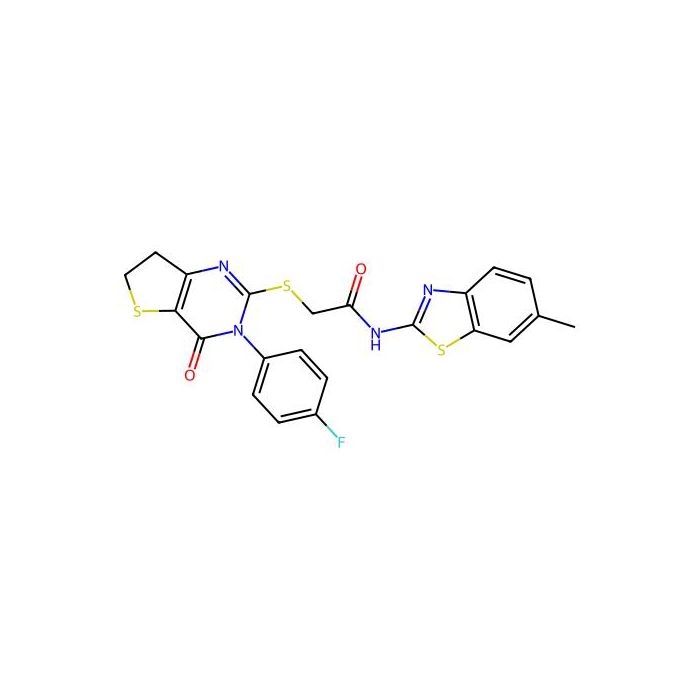
IWP-3 - Moligand™,≥98% , CAS No.687561-60-0

CAS: 687561-60-0 Cat. No.: I647349 Formule: C22H17FN4O2S3 Poids moléculaire: 484.59 Numéro CE: 804-109-1 PubChem CID: 2155389
DISPONIBLE À COMMANDE
QUALITÉ & PURETÉ Moligand™ ? Moligand™ — Aladdin's line of ligands and bioactive small molecules. Use for receptor, pathway, and binding studies needing defined small-molecule tools. ≥98%
Synonyms
IWP 3;IWP3|2-[[3-(4-fluorophenyl)-4-oxo-6,7-dihydrothieno[3,2-d]pyrimidin-2-yl]sulfanyl]-N-(6-methyl-1,3-benzothiazol-2-yl)acetamide|N-(6-Methylbenzo[d]thiazol-2-yl)-2-(3-(4-fluorophenyl)-4-oxo-3,4,6,7-tetrahydrothieno[3,2-d]pyrimidin-2-ylthio)acetamide|2-[[3-(4-Fluorophenyl)-3,4,6,7-tetrahydro-4-oxothieno[3,2-d]pyrimidin-2-yl]thio]-N-(6-methyl-2-benzothiazolyl)-acetamide|2-((3-(4-fluorophenyl)-4-oxo-3,4,6,7-tetrahydrothieno[3,2-d]pyrimidin-2-yl)thio)-N-(6-methylbenzo[d]thiazol-2-yl)acetamide|IWP-3
Storage
Store at -20°C
Shipped In
Ice chest + Ice pads
★
Taille
Allemagne (EU)
USA*
Prix
Qté
1mg
I647349-1mg
Sur commande · 8–12 semaines
34,62€
5mg
I647349-5mg
Sur commande · 8–12 semaines
69,33€
25mg
I647349-25mg
Sur commande · 8–12 semaines
277,59€
Enter a quantity for the sizes you want to add.

Vue d’ensemble

IWP-3 is an potent inhibitor of Wnt production with an IC 50 of 40 nM. IWP-3 inhibits Porcupine (Porcn) function thereby blocking palmitoylation of Wnt proteins. IWP-3 inhibits CK1γ3 and CK1ε only moderately and does not inhibit CK1α.

Form:Solid

Spécifications

Synonymes
IWP 3;IWP3 | 2-[[3-(4-fluorophenyl)-4-oxo-6,7-dihydrothieno[3,2-d]pyrimidin-2-yl]sulfanyl]-N-(6-methyl-1,3-benzothiazol-2-yl)acetamide | N-(6-Methylbenzo[d]thiazol-2-yl)-2-(3-(4-fluorophenyl)-4-oxo-3,4,6,7-tetrahydrothieno[3,2-d]pyrimidin-2-ylthio)acetamide | 2-[[3-(4-Fluorophenyl)-3,4,6,7-tetrahydro-4-oxothieno[3,2-d]pyrimidin-2-yl]thio] Afficher plus
Spécifications et pureté
Moligand™,≥98%
Mécanismes biochimiques et physiologiques
IWP-3 is an potent inhibitor of Wnt production with an IC 50 of 40 nM. IWP-3 inhibits Porcupine (Porcn) function thereby blocking palmitoylation of Wnt proteins. IWP-3 inhibits CK1γ3 and CK1ε only moderately and does not inhibit CK1α.
Conditions de stockage de stockage
Store at -20°C
Expédié en
Ice chest + Ice pads
Ce produit nécessite l'expédition en chaîne froide. Les services terrestres et autres services économiques ne sont pas disponibles.
Grade
Moligand™
Type d'action
INHIBITOR
Pureté
≥98%
Noms et identifiants
SMILES
CC1=CC2=C(C=C1)N=C(S2)NC(=O)CSC3=NC4=C(C(=O)N3C5=CC=C(C=C5)F)SCC4
IUPAC Name
2-[[3-(4-fluorophenyl)-4-oxo-6,7-dihydrothieno[3,2-d]pyrimidin-2-yl]sulfanyl]-N-(6-methyl-1,3-benzothiazol-2-yl)acetamide
InChIKey
XVMHQSDMKWQNBK-UHFFFAOYSA-N
InChI
1S/C22H17FN4O2S3/c1-12-2-7-15-17(10-12)32-21(24-15)26-18(28)11-31-22-25-16-8-9-30-19(16)20(29)27(22)14-5-3-13(23)4-6-14/h2-7,10H,8-9,11H2,1H3,(H,24,26,28)
Isomères SMILES
CC1=CC2=C(C=C1)N=C(S2)NC(=O)CSC3=NC4=C(C(=O)N3C5=CC=C(C=C5)F)SCC4
WGK Allemagne
3
PubChem CID
2155389
Poids moléculaire
484.59

Données avancées

Taxonomic Classification

Taxonomy Tree

KingdomOrganic compounds
SuperclassOrganoheterocyclic compounds
ClasseThienopyrimidines
SubclassNot available
Intermediate Tree Nodes Not available
Direct ParentThienopyrimidines
Alternative Parents Benzothiazoles  N-arylamides  Pyrimidones  Alkylarylthioethers  Fluorobenzenes  Aryl fluorides  Thiazoles  Heteroaromatic compounds  Secondary carboxylic acid amides  Lactams  Sulfenyl compounds  Azacyclic compounds  Carbonyl compounds  Hydrocarbon derivatives  Organic oxides  Organofluorides  Organopnictogen compounds  
Molecular FrameworkAromatic heteropolycyclic compounds
Substituents 1,3-benzothiazole - Thienopyrimidine - Aryl thioether - N-arylamide - Fluorobenzene - Halobenzene - Pyrimidone - Alkylarylthioether - Aryl fluoride - Aryl halide - Monocyclic benzene moiety - Pyrimidine - Benzenoid - Thiazole - Heteroaromatic compound - Azole - Secondary carboxylic acid amide - Carboxamide group - Lactam - Azacycle - Sulfenyl compound - Thioether - Carboxylic acid derivative - Hydrocarbon derivative - Organohalogen compound - Organopnictogen compound - Organic oxygen compound - Organofluoride - Organonitrogen compound - Carbonyl group - Organic nitrogen compound - Organooxygen compound - Organosulfur compound - Organic oxide - Aromatic heteropolycyclic compound
DescriptionThis compound belongs to the class of organic compounds known as thienopyrimidines. These are heterocyclic compounds containing a thiophene ring fused to a pyrimidine ring. Thiophene is 5-membered ring consisting of four carbon atoms and one sulfur atom. Pyrimidine is a 6-membered ring consisting of four carbon atoms and two nitrogen centers at the 1- and 3- ring positions.
External Descriptors Not available
Structure 3D
Modèle de structure chimique interactif


Cibles associées (humaines)
CSNK1D Tchem Casein kinase I delta (4546 Activities)
Activity TypeRelationActivity valueUnitsAction TypeJournalPubMed IddoiAssay Aladdin ID
CSNK1E Tclin Casein kinase I epsilon (1412 Activities)
Activity TypeRelationActivity valueUnitsAction TypeJournalPubMed IddoiAssay Aladdin ID
CAPAN-1 (772 Activities)
Activity TypeRelationActivity valueUnitsAction TypeJournalPubMed IddoiAssay Aladdin ID
HT-29 (80576 Activities)
Activity TypeRelationActivity valueUnitsAction TypeJournalPubMed IddoiAssay Aladdin ID
PANC-1 (6144 Activities)
Activity TypeRelationActivity valueUnitsAction TypeJournalPubMed IddoiAssay Aladdin ID
MIA PaCa-2 (5949 Activities)
Activity TypeRelationActivity valueUnitsAction TypeJournalPubMed IddoiAssay Aladdin ID
HEK293 (82097 Activities)
Activity TypeRelationActivity valueUnitsAction TypeJournalPubMed IddoiAssay Aladdin ID
SW-620 (52400 Activities)
Activity TypeRelationActivity valueUnitsAction TypeJournalPubMed IddoiAssay Aladdin ID
CSNK1G3 Tchem Casein kinase I isoform gamma-3 (2408 Activities)
Activity TypeRelationActivity valueUnitsAction TypeJournalPubMed IddoiAssay Aladdin ID
PORCN Tchem Probable protein-cysteine N-palmitoyltransferase porcupine (135 Activities)
Activity TypeRelationActivity valueUnitsAction TypeJournalPubMed IddoiAssay Aladdin ID
Cibles associées (non humaines)
Danio rerio (3092 Activities)
Activity TypeRelationActivity valueUnitsAction TypeJournalPubMed IddoiAssay Aladdin ID
CSNK1A1 Casein kinase I isoform alpha (80 Activities)
Activity TypeRelationActivity valueUnitsAction TypeJournalPubMed IddoiAssay Aladdin ID
Mécanismes d'action
Certificats (CoA, COO, BSE/TSE et tableau d'analyse)
C of A & Other Certificates(BSE/TSE, COO):
Analytical Chart:

Find and download the COA for your product by matching the lot number on the packaging.

3 results found

Lot NumberCertificate TypeDateArticle
I2608677I2608677Certificate of AnalysisApr 02, 2026 I647349
I2608678I2608678Certificate of AnalysisApr 02, 2026 I647349
I2608679I2608679Certificate of AnalysisApr 02, 2026 I647349
Propriétés chimiques et physiques
SolubilitéDMSO : 25 mg/mL (51.59 mM; ultrasonic and warming and heat to 60°C)
Poids moléculaire484.6
XLogP34.900
Hydrogen Bond Donor Count1
Hydrogen Bond Acceptor Count8
Rotatable Bond Count5
Exact Mass484.05 Da
Monoisotopic Mass484.05 Da
Topological Polar Surface Area154.000 Ų
Heavy Atom Count32
Formal Charge0
Complexity830.000
Isotope Atom Count0
Defined Atom Stereocenter Count0
Undefined Atom Stereocenter Count0
Defined Bond Stereocenter Count0
Undefined Bond Stereocenter Count0
The total count of all stereochemical bonds0
Covalently-Bonded Unit Count1
Sécurité et dangers (GHS)
Pictogramme(s)
Signal
Warning
Mentions de danger

H302:Harmful if swallowed

Conseils de prudence

P264:Wash hands [and …] thoroughly after handling.

P270:Do not eat, drink or smoke when using this product.

P330:Rinse mouth.

P501:Dispose of contents/container to an approved waste disposal plant.

P301+P317:IF SWALLOWED: Get medical help.

WGK Allemagne
3
RIDADR
NONHforallmodesoftransport
FAQ et articles
Calculateurs de solution
Avis

Avis des clients

Application Protocols

Tested/validated application details (e.g., WB, IHC, IF, FC), recommended dilutions, and positive controls are not applicable to this small-molecule product and are not specified for this item.

General use guidance (non-item-specific; for planning only):

  • Prepare concentrated DMSO stock (e.g., 10 mM). Perform serial dilutions into assay media to reach desired final concentrations while keeping DMSO within assay tolerance.
  • Include vehicle controls and, where possible, a mechanistic counter-screen. Document lot numbers and preparation details for reproducibility.

For any item-specific protocols, refer to the CoA/Spec Sheet.

Biological Roles

Research context (literature/general knowledge; non-clinical):

  • IWP-3 is widely cited as a small-molecule modulator used to study the Wnt signaling axis. In the literature, members of the IWP series function as inhibitors of Wnt ligand production by targeting the membrane-bound O-acyltransferase PORCN, the enzyme responsible for palmitoleoylation required for Wnt secretion and activity.
  • By attenuating Wnt secretion, IWP-3 is used as a chemical probe to evaluate Wnt-dependent processes in cultured cells and certain model organisms. Readouts include TCF/LEF reporter activity, β-catenin stabilization, expression of Wnt target genes, and phenotypic endpoints (literature reports).

Experimental considerations (practice):

  • Typical working concentrations in cell assays are in the low micromolar range; actual potency and cytotoxicity can vary with cell type, serum, and assay conditions (literature/practice). Always perform dose–response curves and include vehicle controls.
  • Timing: Pre-treatment windows of 1–24 h are commonly explored to achieve steady-state effects on Wnt secretion before measuring downstream responses (literature).
  • Orthogonal validation: Combine with genetic perturbation (e.g., PORCN knockdown) or alternative chemical probes to confirm pathway-specific effects and mitigate off-target concerns.

Caveats:

  • Potency and selectivity are assay-dependent. Use appropriate counter-screens (e.g., unrelated reporters) to control for general transcriptional or cytotoxic effects.
  • No medical or diagnostic use is intended or implied. For research use only (per product data).
Buffer Applications

This product is not a buffering agent and is not used to prepare classical pH buffer systems. For laboratory use, it is typically dissolved in DMSO and then diluted into biological buffers (e.g., PBS, HBSS, or culture media) immediately before use. If precipitation occurs upon dilution, consider using low percentages of DMSO and gentle mixing, or include carrier protein/surfactant compatible with your assay.

Green Alternatives

As a specialized bioactive research tool, IWP-3 is selected for biological performance rather than process chemistry. “Greener” selection typically addresses solvent systems and handling rather than replacement of the active itself.

Greener handling suggestions (general, not item-specific):

  • Use minimal DMSO volumes and prepare concentrated master stocks to reduce solvent use.
  • Employ aqueous-compatible delivery strategies (e.g., serial dilution just-in-time) to minimize organic solvent in assays.
  • Consolidate shipments and store efficiently at –20 °C to reduce cold-chain footprint.

Comparison of solvent choices (general):

  • DMSO: Widely accepted for biological assays; consider recycling/segregated waste streams.
  • Ethanol: Potentially greener but often provides insufficient solubility for this class of hydrophobic ligands.

Replacement of IWP-3 with a “greener” active is generally not meaningful because biological selectivity and potency, not environmental metrics, drive tool-compound choice. Instead, optimize solvent and waste practices around its use.

Pharmaceutical Uses

This product is supplied strictly for research use only and is not intended for human or veterinary applications.

Typical roles in pharmaceutical research settings (non-clinical, literature/general):

  • Reference tool compound for target/pathway modulation in discovery biology and assay development.
  • Positive control in Wnt-pathway–focused high-content or reporter assays.
  • Benchmark ligand for method development in ADME or bioanalytical assays (e.g., LC–MS/MS method qualification), when appropriate.

Regulatory/excipients:

  • Not an approved excipient and not compendial. No GMP certification is implied. Any cGMP or clinical manufacturing applications are out of scope.

Item-specific pharmacopeial status, residual solvent limits, or elemental impurity profiles: Not specified for this item; refer to CoA/Spec Sheet.

Physical Properties

Item-specific specifications (this product):

  • Appearance: Not specified for this item; refer to CoA/Spec Sheet.
  • Molecular Weight: Not specified for this item; refer to CoA/Spec Sheet.

Literature/general properties for IWP-class tool compounds (for planning only; confirm experimentally):

  • State: Typically isolated as an off-white to light solid (literature, class-level observation).
  • Solubility: Readily soluble in DMSO; sparingly soluble in aqueous buffers without cosolvent; limited solubility in ethanol/methanol may be observed (literature/practice).
  • Partitioning: Moderately lipophilic behavior is common for this class, often requiring cosolvent or carrier protein for aqueous delivery (literature, class-level).
  • Stability: DMSO stock solutions are usually stable for months at –20 °C when protected from moisture and repeated freeze–thaw (general practice; verify on CoA/SDS).

Notes for users:

  • For analytical work, LC–MS compatible diluents (DMSO → acetonitrile/water with 0.1% formic acid) are commonly used to evaluate purity and stability (general practice).
  • Do not treat the above as specifications. For regulated or quantitative applications, confirm actual values on the item’s CoA/Spec Sheet and SDS.
Quality and Grades
  • Grade/Purity: Moligand™

What Moligand™ generally implies (program-level context; not item-specific guarantees):

  • Curated portfolio of bioactive ligands and screening compounds suitable for chemical biology, target validation, and phenotypic studies.
  • Emphasis on structural identity and purity confirmation appropriate for research screening collections (e.g., orthogonal ID methods such as LC–MS/NMR are commonly used in the field). Exact test methods, purity %, residual solvents, and elemental limits for this lot are Not specified for this item; refer to CoA/Spec Sheet.

How to leverage this grade in practice:

  • Use for in vitro and cell-based assays where reliable identity and chromatography-grade purity are important to interpret SAR and pathway outcomes.
  • Record lot numbers and retain CoA/SDS in ELN for reproducibility.
  • For quantitative pharmacology, consider additional in-house QC (e.g., potency benchmarking against literature reference data) since bioactivity can be assay- and cell-line-dependent.

Stabilizers, inhibitors, and additives:

  • Any stabilizer or additive content is Not specified for this item; refer to CoA/Spec Sheet.

Compliance notes:

  • For research use only (per product data). Not for drug, household, or diagnostic use.
Reaction and Applications

This product is a bioactive small-molecule tool compound and is not typically used as a synthetic reagent or catalyst.

Applicable research applications (literature/general practice; non-clinical):

  • Chemical biology: Utilized to modulate signaling pathways in cell culture and select organism models to probe pathway dependence and downstream transcriptional responses.
  • Phenotypic screening: Employed as a reference/positive control in pathway-focused phenotypic assays.
  • Target/pathway validation: Short-term, reversible perturbation to complement genetic methods (e.g., RNAi/CRISPR) for orthogonal validation.

Not applicable to this item:

  • Named organic reactions (e.g., cross-coupling, Grignard) and synthetic transformation workflows do not typically involve this compound. For such needs, consult building blocks or reagents in our catalog.
Reaction Conditions

Not typically applicable. IWP-3 is used as a bioactive probe rather than as a reagent in chemical transformations, so standard reaction parameters (solvent, temperature, catalysts, yields) are not relevant.

Assay preparation conditions (general practice, for context only):

  • Stock preparation: Dissolve in anhydrous DMSO to prepare 10–50 mM master stocks; vortex and, if necessary, gently warm to aid dissolution. Filter through 0.22 µm PTFE if particulate remains.
  • Working solutions: Dilute into pre-warmed culture media or assay buffer immediately before use; maintain final DMSO at levels tolerated by the assay (often ≤0.1–0.5% v/v). Mix thoroughly to avoid local supersaturation.
  • Stability on bench: Minimize time of dilute solutions at room temperature; prepare fresh for critical assays.

Item-specific reaction or assay performance parameters are Not specified for this item; refer to CoA/Spec Sheet and SDS.

Safety and Handling

GHS classification, signal word, H-statements, and pictograms: Not specified for this item; refer to SDS.

General laboratory safety guidance for small-molecule research tools (non-item-specific; follow institutional SOPs):

  • PPE: Wear lab coat, safety glasses, and appropriate chemical-resistant gloves. Avoid inhalation of dust/aerosols. Handle solids in a fume hood.
  • Handling: Prepare concentrated stocks in dry, anhydrous DMSO. Minimize exposure to ambient moisture. Use dedicated, clean tools to prevent cross-contamination of screening libraries.
  • Incompatibilities: Avoid strong oxidizers and strong acids/bases during storage and handling. Do not mix with unknown reagents.
  • First aid (overview; consult SDS for details): On skin contact, wash with soap and water. If in eyes, rinse cautiously with water for several minutes and seek medical attention if irritation persists. If inhaled, move to fresh air. If ingested, rinse mouth and seek medical advice.
  • Spill/accident response: For small spills, absorb with inert material and collect for disposal. Prevent release to drains. Dispose according to local regulations.
  • Special risks: Bioactive tool compounds may have potent cellular effects at low micromolar or submicromolar levels. Avoid exposure and environmental release. Defer to the SDS for authoritative hazard information.

Storage and transport:

  • Storage: Store at –20 °C (per product data). Keep container tightly closed, desiccated, and protected from prolonged light.
  • Shipment: Shipped on ice packs in an insulated container (per product data).
Solvent Selection

Use-case: dissolution and delivery of a hydrophobic bioactive tool compound into biochemical or cell-based assays.

  • Primary stock solvent (practice/literature):
    • DMSO: Preferred for high-concentration stocks (e.g., 10–50 mM), excellent solubilizing power and inertness in most assays.
  • Secondary solvents/co-solvents (practice):
    • DMF: Alternative to DMSO for some analytical workflows.
    • Ethanol or methanol: Limited solubility may be achievable; assess assay tolerance.
  • Aqueous delivery:
    • Prepare DMSO stocks, then dilute into aqueous buffer immediately before use; maintain final DMSO typically ≤0.1–0.5% v/v in sensitive cell assays (literature/practice). Use surfactant (e.g., 0.01% Pluronic) or carrier protein (0.1% BSA) if precipitation is observed.
  • Compatibility:
    • Avoid prolonged standing of dilute aqueous solutions; adsorption to plastics/glass can reduce apparent potency. Use low-bind plastics or silanized glass.

Small comparison (guidance):

  • DMSO vs DMF: DMSO generally offers better biocompatibility and is more commonly accepted in cell assays; DMF may be useful for certain analytics but can be more cytotoxic at similar v/v.
  • Aqueous buffers: Poor direct solubility is typical; rely on cosolvent strategies.

Item-specific solubility, logP, or pKa values: Not specified for this item; refer to CoA/Spec Sheet.

Storage and Reconstitution

Storage conditions (item-specific):

  • Store at –20 °C (per product data). Shipments are made with ice packs in an insulated container to maintain a cold chain.

General handling and reconstitution (practice; verify with CoA/SDS for your lot):

  • Equilibrate the sealed container to room temperature before opening to avoid moisture condensation on the solid.
  • Reconstitution: Prepare concentrated stocks in anhydrous DMSO (e.g., 10–50 mM). Vortex thoroughly; brief sonication or gentle warming (≤37 °C) may assist dissolution. If needed, clarify by 0.22 µm PTFE filtration.
  • Aliquoting: Dispense single-use aliquots to minimize freeze–thaw cycles and headspace moisture ingress. Store aliquots at –20 °C in tightly sealed, chemically compatible vials (e.g., amber glass or fluoropolymer-lined caps) and, if applicable, protected from prolonged light.
  • Working solutions: Dilute DMSO stock into assay buffer or culture medium immediately before use. Avoid extended storage of aqueous dilutions; prepare fresh to minimize precipitation and potency drift.
  • Stability: Long-term stability, hygroscopicity, and light sensitivity are Not specified for this item; refer to CoA/Spec Sheet. As a precaution, limit freeze–thaw events and exposure to ambient humidity.

Disposal: Collect unused material and DMSO solutions as organic hazardous waste in accordance with institutional and local regulations.

Structure and Identity

IWP-3 is a bioactive small molecule commonly used as a research tool compound in chemical biology and pathway studies.

  • SKU: I647349
  • Product Name: IWP-3
  • CAS: 687561-60-0
  • CID: 2155389
  • InChIKey (as provided): 428352
  • SMILES: Not specified for this item; refer to CoA/Spec Sheet.
  • Molecular Formula: Not specified for this item; refer to CoA/Spec Sheet.
  • Molecular Weight: Not specified for this item; refer to CoA/Spec Sheet.
  • Grade/Purity: Moligand™

Structural features (general/literature description):

  • IWP-3 belongs to the “IWP” (Inhibitors of Wnt Production) chemotype class used in Wnt signaling studies (literature).
  • Typical members of this class are heteroaromatic amide/urea-like small molecules with multiple H-bond acceptors/donors and moderate aromatic content (literature, general description for the class; not item-specific).

2D structure (verbal, literature/class-level):

  • A compact, polyaromatic/heteroatom-containing scaffold with an amide-like linker connecting two ring systems is characteristic for IWP-family molecules; functional groups enable target engagement via H-bonding and π–π contacts (literature, class description).
Synthetic Utility

IWP-3 is a finalized bioactive small molecule and is not typically employed as a synthetic intermediate, catalyst, or reagent in organic synthesis.

When is this section relevant?

  • If performing SAR or analog synthesis, IWP-3 can serve as a structural reference standard for analytical comparison (e.g., LC–MS retention, NMR benchmarking) and as a biological comparator in potency assays.

For synthetic building blocks or reagents to execute named transformations (e.g., amide couplings, cross-couplings, heterocycle formation), please consult the appropriate categories in our catalog. This item’s principal value is as a research tool compound, not as a synthetic handle.

Target Specificity

This section is typically applicable to biologics/antibodies. For small-molecule tool compounds like IWP-3, detailed target-binding specificity and selectivity panels are reported in the literature but are not specified for this item. Refer to primary literature and the item’s CoA/Spec Sheet for any available selectivity information.

Foire aux questions

How is this product shipped?
This product ships in an insulated container with ice pads. Unpack on arrival and transfer it to the storage condition stated above.
What are the CAS number, molecular formula and molecular weight?
The CAS Number is 687561-60-0, the molecular formula is C22H17FN4O2S3, and the molecular weight is 484.59 g/mol. InChIKey XVMHQSDMKWQNBK-UHFFFAOYSA-N.
What is the purity of this product?
This product is supplied at ≥98% purity (chemical assay). Lot-specific values are stated on the Certificate of Analysis.
What is Moligand??
Moligand? is one of Aladdin Scientific's premium product lines, formulated for high-purity applications across multiple workflows. Compared to standard grades in the same workflow, Moligand? products typically offer tighter specifications, more rigorous QC, and stronger lot-to-lot consistency.
How should this product be stored?
Store at ?20 °C. Freezer storage is required to maintain the specified shelf life.
What documentation is provided?
Available product documentation, including Certificates of Analysis (COA), Safety Data Sheets (SDS), and specification sheets, is shown in the product document area. Document availability and access follow the current site policy.

Besoin d'aide pour choisir la qualité ?

Notre guide de sélection des qualités couvre la pureté, le statut du stabilisant et l'adéquation à l'application pour toutes les variantes de notre catalogue.

Voir le guide des qualités Moligand™ →

Souhaitez-vous que nous vous envoyions un message lorsque des réductions seront disponibles?

Me rappeler plus tard

Merci ! Veuillez vérifier votre boîte de réception e-mail pour confirmer.

Oups ! Les notifications sont désactivées.