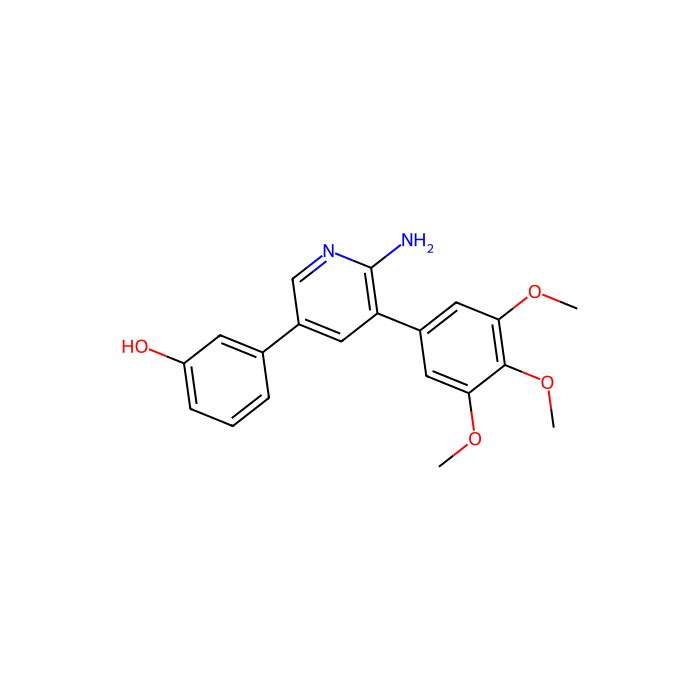
Potent and selective inhibitor of type I bone morphogenic protein (BMP) receptors (IC50values are 1.1, 1.8, 6.4, 34.4, 220, 302 and 321 nM for ALK2, ALK1, ALK6, ALK3, ActRIIA, ALK4 and ALK5 respectively). Reduces BMP4-induced Smad1/5/8 phosphorylationin vitro(IC50= 100 nM) and induces dorsalization of zebrafish embryos.
Conditions de stockage de stockage
Store at -20°C,Argon charged
Expédié en
Ice chest + Ice pads
Ce produit nécessite l'expédition en chaîne froide. Les services terrestres et autres services économiques ne sont pas disponibles.
This compound belongs to the class of organic compounds known as phenylpyridines. These are polycyclic aromatic compounds containing a benzene ring linked to a pyridine ring through a CC or CN bond.
External Descriptors
Not available
1. Djoumbou Feunang Y, Eisner R, Knox C, Chepelev L, Hastings J, Owen G, Fahy E, Steinbeck C, Subramanian S, Bolton E, Greiner R, and Wishart DS. ClassyFire: Automated Chemical Classification With A Comprehensive, Computable Taxonomy. Journal of Cheminformatics, 2016, 8:61.
Determine the necessary mass, volume, or concentration for preparing a solution.
Dilution Calculator
Determine the dilution needed to prepare a stock solution.
Reconstitution Calculator
Avis
Avis des clients
Application Protocols
Item-specific (Product Data)
Validated applications, recommended dilutions, and positive controls: Not specified for this item.
General usage examples (non-validated; for planning only)
Biochemical assays: prepare a 10–50 mM DMSO stock; perform serial 3-fold dilutions to bracket expected potency; keep final DMSO ≤0.5% v/v.
Cell-based assays: pre-warm media, add compound last to minimize precipitation; include vehicle controls and a cytotoxicity counter-assay.
Target engagement: consider thermal shift (CETSA/DSF) or NanoBRET approaches to confirm binding in cells; adjust exposure time and temperature according to cell line and assay sensitivity.
Data integrity: check compound interference (autofluorescence/absorbance/redox) using assay-specific counter-screens.
Biological Roles
Item-specific (Product Data)
No biological/target specificity is specified for this item.
Literature/general (for the named small-molecule tool K 02288)
In the literature, K 02288 is described as a research probe used to study bone morphogenetic protein (BMP) signaling within the TGF-β superfamily by targeting specific serine/threonine kinase receptors (reference class; verify details on the current CoA/SDS for this catalog item before attributing target specificity to this SKU).
Research uses typically include probing phosphorylation cascades, SMAD pathway modulation, and differentiation/lineage readouts in developmental biology models (literature, general; not a claim for this specific lot).
Good practice
Confirm target engagement with orthogonal assays (e.g., biochemical kinase paneling, cellular phospho-protein measurements) and incorporate negative controls/structural analogs where feasible.
Report SKU, lot number, and final DMSO concentration in publications to ensure reproducibility.
Buffer Applications
Not typically applicable
This product is a small-molecule probe, not a buffering agent. It does not form conventional buffer systems.
Practical assay buffer guidance (general)
Prepare concentrated DMSO stocks and dilute into biological buffers (e.g., HEPES, Tris, PBS) keeping final DMSO constant across treatments.
Include carrier protein (e.g., 0.1% BSA) or nonionic surfactant (e.g., 0.01–0.05% Tween-20 or Pluronic F-68) to mitigate adsorption and precipitation, as compatible with the assay.
Filter sterilize working solutions when used in cell-based assays; avoid repeated freeze–thaw of aqueous working solutions.
Green Alternatives
Context
As a bioactive probe, this item is not a process solvent or commodity reagent; green-chemistry substitution is typically not applicable to the molecule itself.
Greener handling and workflow (general recommendations)
Minimize DMSO volumes by preparing higher-concentration master stocks and aliquoting to reduce waste.
Use microscale assay formats (384/1536-well) to decrease solvent consumption.
Prefer aqueous assay buffers with minimal organic co-solvent where compatibility allows; validate solubility and activity.
For analytical work, select less hazardous mobile phases (e.g., water–acetonitrile with volatile modifiers) instead of chlorinated solvents.
Implement closed-container weighing and inert-gas manifolds to reduce emissions and maintain material stability, decreasing re-synthesis and waste.
End-of-life
Consolidate DMSO/organic waste streams for proper disposal; avoid drain disposal. Rinse containers with minimal solvent before waste collection.
Pharmaceutical Uses
Scope limitation
For research use only. Not for human or veterinary use. No clinical or therapeutic claims are made for this product.
In preclinical research settings, small-molecule probes are sometimes formulated in vehicles such as aqueous buffers with defined percentages of DMSO, PEG-400, and/or cyclodextrins to improve solubility and exposure in model systems. Such information is assay- and study-specific and is not provided for this item.
Compliance note
This listing does not indicate any pharmacopeial status (USP/EP/JP) or GMP suitability. If formulation development is planned for non-clinical studies, request full analytical data and impurity profiles for risk assessment.
Physical Properties
Item-specific (Product Data)
Appearance: Not specified for this item; refer to CoA/Spec Sheet.
Molecular Weight: Not specified for this item; refer to CoA/Spec Sheet.
Any other specifications (mp/bp/density/solubility/refractive index/logP/pKa): Not specified for this item; refer to CoA/Spec Sheet.
Literature/general expectations for small-molecule kinase probes
Physical state: typically solid powders (often off-white to yellow), sparingly soluble in water, readily soluble in polar aprotic organics such as DMSO and DMF (literature, general).
Solubility handling: prepare concentrated DMSO stocks (e.g., 10–50 mM) then dilute into assay buffers containing carrier protein or surfactant to limit precipitation (general guidance).
Hygroscopicity/photosensitivity: many heteroaromatic probes are light- and air-sensitive to varying degrees; protect from light and moisture during weighing and storage (general guidance).
Practical tips (general)
If the item’s solubility is unknown, perform a small-scale solubility screen (DMSO, DMF, MeOH, acetonitrile, phosphate buffer with 0.01–0.05% Tween-20) and verify clarity after 1–2 h at room temperature.
Record pH drift upon dilution from DMSO into aqueous media to anticipate precipitation near neutral pH.
Quality and Grades
Item-specific (Product Data)
Grade/Purity: Not specified for this item; refer to CoA/Spec Sheet.
Research Use: For research use only (not for human or veterinary use).
Guidance on interpreting grade (general)
For small-molecule bioactive probes, vendors often provide HPLC purity (area %) and identity by MS/1H NMR. If grade is unspecified, request the latest CoA including:
HPLC method, wavelength(s), and purity percentage.
Residual solvent levels and water content (e.g., KF), if applicable.
Identity confirmation (MS, HRMS, NMR) and batch number.
Low-UV-absorbing impurities and residual metals can confound biochemical assays; if using in photometric or cellular assays, prefer materials with high HPLC purity and provide pre-dilution filtration when feasible.
Stabilizers
No stabilizers are listed for this item. If stabilizers are required for your application (e.g., antioxidants), evaluate assay compatibility first.
Documentation
Always match internal records to SKU K287246 and the specific lot/cohort to ensure traceability in publications and QA reviews.
Reaction and Applications
Item-specific (Product Data)
Manufacturer Applications: Not specified for this item; no additional application text provided.
Applicability to synthetic chemistry
This product is offered as a bioactive small-molecule research tool rather than a general-purpose reagent or building block. It is not typically employed as a stoichiometric reagent, catalyst, or synthetic intermediate in routine organic synthesis.
Research applications (literature/general)
Small-molecule probes in this class are commonly used to interrogate kinase-driven signaling pathways in biochemical enzyme assays, cell-based pathway readouts, and target engagement studies (e.g., NanoBRET/thermal shift) — literature, general.
Practical assay notes (general)
Use serial dilutions from a concentrated DMSO stock to generate dose-response curves; include vehicle controls and, where applicable, orthogonal readouts (biochemistry vs. cell phenotype) to confirm on-target effects.
For photometric assays, evaluate compound intrinsic absorbance/fluorescence to mitigate assay interference (perform counter-screens).
Consider adsorption to plastics at low nM concentrations; use low-binding tubes/plates.
Reaction Conditions
Not directly applicable
This product is not supplied as a reagent for promoting chemical reactions; therefore, standard reaction conditions (catalysts, temperatures, yields) are not applicable.
General handling conditions for assay preparation (non-reaction)
Dissolution: room temperature in dry DMSO with gentle vortexing/sonication.
Working concentrations: commonly nM–µM in biochemical/cellular assays (set by assay design; validate solubility and absence of aggregation by controls such as detergent tests or light scattering).
Stability checks: evaluate by LC–MS after storage cycles and after 24–48 h in assay buffer at intended temperature to ensure no significant degradation (general best practice).
Safety and Handling
Item-specific (Product Data)
GHS Classification / Signal Word / H-Statements / Pictograms: Not specified for this item; refer to SDS.
Storage: Store at −20 °C, argon charged (Product Data). Shipped in ice chest with ice pads.
General laboratory precautions (not item-specific; defer to SDS for authoritative details)
Wear appropriate PPE: lab coat, safety glasses, and chemical-resistant gloves (e.g., nitrile). Work in a chemical fume hood when weighing or dissolving.
Avoid inhalation of dust or aerosols and prevent skin/eye contact. Wash thoroughly after handling.
Incompatibilities: strong oxidizers and strong acids/bases may cause decomposition for many heteroaromatic organics (general). Keep away from ignition sources when using organic solvents.
First-aid overview (general): in case of skin/eye contact, rinse with water for at least 15 minutes and seek medical attention. If inhaled, move to fresh air; if ingested, do not induce vomiting and seek medical care. Provide SDS to responders.
Waste: collect solutions and solids as organic hazardous waste according to institutional and local regulations.
Special notes
Argon blanket suggests sensitivity to air/moisture; minimize headspace oxygen exposure and reseal under inert gas after each use.
Solvent Selection
Item-specific (Product Data)
No solvent recommendations are specified for this item; refer to CoA/Spec Sheet.
Literature/general guidance for small-molecule kinase probes
Primary stock solvent: DMSO is typically preferred due to strong solubilizing power and assay compatibility at ≤0.1–0.5% v/v in final wells.
Alternative solvents (for method development): DMF, acetonitrile, or methanol can aid LC method prep; aqueous buffers may require co-solvent systems and surfactants (e.g., 0.01–0.05% Tween-20) to prevent precipitation.
Dielectric/polarity context: DMSO (ε ≈ 47) and DMF (ε ≈ 37) support dissolution of heteroaromatic scaffolds; acetonitrile offers volatility for LC and sample cleanup (literature, general values).
Practical selection tips
For biochemical assays: prepare 10–50 mM DMSO stock, dilute into assay buffer while vortexing; maintain constant final DMSO % across controls.
For LC–MS: dissolve in acetonitrile/water (50:50) with 0.1% formic acid as needed; filter through 0.2 µm PTFE/nylon.
For solid dispensing: pre-temper vials to ambient before opening to prevent moisture condensation; re-purge headspace with argon after aliquoting.
Storage and Reconstitution
Item-specific (Product Data)
Storage Conditions: Store at −20 °C, argon charged.
Shipping: Ice chest + ice pads.
General best practices (applicable to small-molecule probes; not item-specific specifications)
Protect from light and moisture. Allow vial to equilibrate to room temperature before opening to avoid condensation. Minimize time at ambient atmosphere; re-purge with argon or nitrogen after use.
Reconstitution: dissolve in dry DMSO to prepare a concentrated stock (e.g., 10–50 mM). Mix gently (vortex/brief sonication) until fully dissolved. If particles persist, warm mildly (≤37 °C) and re-mix; do not overheat.
Aliquoting: dispense single-use aliquots in inert, low-bind microtubes to avoid repeated freeze–thaw. Store aliquots at −20 °C (or below) under inert gas.
Stability monitoring: periodically verify integrity by HPLC/LC–MS, especially after 6–12 months or multiple thaw cycles.
Aqueous working solutions: prepare fresh on the day of use; if storage is necessary, keep at 2–8 °C protected from light and test for precipitation/degradation prior to use.
Label all aliquots with SKU K287246, lot, concentration, solvent, and date for traceability.
Structure and Identity
Item-specific (Product Data)
Product Name: K 02288 (SKU: K287246)
CAS: 1431985-92-0
InChIKey: 45799 (as provided; note this is shorter than a standard InChIKey)
SMILES: Not specified for this item; refer to CoA/Spec Sheet.
Molecular Formula: Not specified for this item; refer to CoA/Spec Sheet.
Molecular Weight: Not specified for this item; refer to CoA/Spec Sheet.
Literature/general information
K 02288 is widely cited as a small-molecule research probe used in kinase-signaling studies (literature). Exact structural identifiers (standard InChIKey, SMILES, formula, MW) should be verified against the current CoA/SDS for this catalog item before use in regulated or quantitative work.
Structural description (general)
For small-molecule kinase probes, structures commonly feature polycyclic heteroaromatics (e.g., quinoline, pyridine) and H-bonding motifs for ATP-pocket engagement (literature, general). Without a confirmed structure for this specific lot, do not rely on generic depictions.
Best practice
Confirm identity via vendor CoA (NMR/MS/HRMS/HPLC) prior to critical assays.
If performing analytical verification, consider LC–MS with positive ESI and a short reverse-phase gradient to confirm retention time and mass (general guidance).
Synthetic Utility
Applicability
This catalog item is intended as a bioactive research probe. It is not typically leveraged as a synthetic intermediate, ligand, or catalyst in routine organic synthesis.
General synthetic perspective (not item-specific)
Heteroaromatic kinase inhibitors, as a class, often contain multiple ring systems and heteroatoms that can complicate further derivatization due to chemoselectivity and stability constraints. If analog synthesis is intended, route scouting usually involves cross-couplings (Suzuki/Negishi/Buchwald–Hartwig), heteroaryl C–N/C–C bond formations, and late-stage functionalization strategies.
For analytical characterization of analogs, establish orthogonal purity assessments (HPLC at multiple wavelengths, qNMR) and stress-testing (acid/base/oxidative) to map degradation liabilities.
Recommendation
If your use case requires a derivatizable scaffold, consider ordering identified intermediates or building blocks rather than the final probe molecule.
Target Specificity
Item-specific (Product Data)
Target, epitope, clone/isotype, or species reactivity: Not specified for this item.
Note
While the literature discusses target preferences for compounds referred to as K 02288, this catalog entry does not provide target specificity. Users should verify the target profile for their lot via independent assays or request available characterization data.
Nous utilisons des cookies pour garantir le bon fonctionnement du site et, lorsque cela est autorisé, pour améliorer votre expérience. Vous pouvez gérer vos préférences à tout moment dans les Paramètres. Pour en savoir plus, consultez notre Politique relative aux cookies.
Souhaitez-vous que nous vous envoyions un message lorsque des réductions seront disponibles?
Me rappeler plus tard
Merci ! Veuillez vérifier votre boîte de réception e-mail pour confirmer.
Products are supplied to verified businesses, institutions, and qualified professionals for research and development use only. Not for use in humans, animals, diagnosis, or therapy.

 C2214339