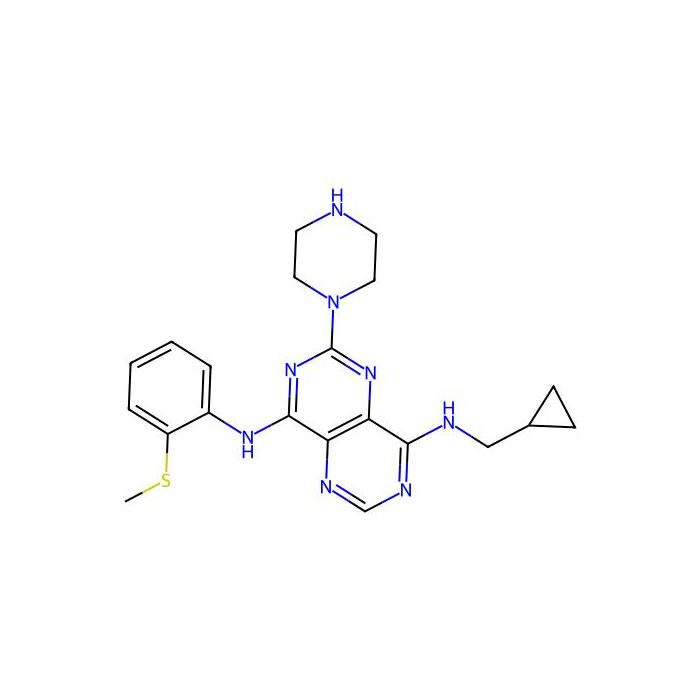
Khk-IN-1 , CAS No.1303469-70-6

CAS: 1303469-70-6 Cat. No.: K669262 Formule: C21H26N8S Poids moléculaire: 422.6 PubChem CID: 53348216
DISPONIBLE À COMMANDE
Synonyms
KHK-IN-1|KHK-IN-8|N~8~-(Cyclopropylmethyl)-N~4~-[2-(Methylsulfanyl)phenyl]-2-(Piperazin-1-Yl)pyrimido[5,4-D]pyrimidine-4,8-Diamine|N8-(Cyclopropylmethyl)-N4-[2-(methylthio)phenyl]-2-(1-piperazinyl)-pyrimido[5,4-d]pyrimidine-4,8-diamine|8-N-(cyclopropylmethyl)-4-N-(2-methylsulfanylphenyl)-2-piperazin-1-ylpyrimido[5,4-d]pyrimidine-4,8-diamine
Storage
Room temperature
★
Taille
Allemagne (EU)
USA*
Prix
Qté
1mg
K669262-1mg
Sur commande · 8–12 semaines

496,26€

744,43€
Enregistrer 248,17 € (33.34%)
5mg
K669262-5mg
Sur commande · 8–12 semaines

1 735,39€

2 603,13€
Enregistrer 867,74 € (33.33%)
Enter a quantity for the sizes you want to add.

Spécifications

Synonymes
KHK-IN-1 | KHK-IN-8 | N~8~-(Cyclopropylmethyl)-N~4~-[2-(Methylsulfanyl)phenyl]-2-(Piperazin-1-Yl)pyrimido[5,4-D]pyrimidine-4,8-Diamine | N8-(Cyclopropylmethyl)-N4-[2-(methylthio)phenyl]-2-(1-piperazinyl)-pyrimido[5,4-d]pyrimidine-4,8-diamine | 8-N-(cyclopropylmethyl)-4-N-(2-methylsulfanylphenyl)-2-piperazin-1-ylpyrimido[5,4-d]pyrimidine-4 Afficher plus
Conditions de stockage de stockage
Room temperature
Type d'action
INHIBITOR
Propriétés du produit
ALogP
3.2
Noms et identifiants
Sourires canoniques
CSC1=CC=CC=C1NC2=NC(=NC3=C2N=CN=C3NCC4CC4)N5CCNCC5
IUPAC Name
8-N-(cyclopropylmethyl)-4-N-(2-methylsulfanylphenyl)-2-piperazin-1-ylpyrimido[5,4-d]pyrimidine-4,8-diamine
InChIKey
HFLMLZKGLUEWBU-UHFFFAOYSA-N
INCHI
1S/C21H26N8S/c1-30-16-5-3-2-4-15(16)26-20-17-18(19(25-13-24-17)23-12-14-6-7-14)27-21(28-20)29-10-8-22-9-11-29/h2-5,13-14,22H,6-12H2,1H3,(H,23,24,25)(H,26,27,28)
Isomères SMILES
CSC1=CC=CC=C1NC2=NC(=NC3=C2N=CN=C3NCC4CC4)N5CCNCC5
PubChem CID
53348216
Poids moléculaire
422.6

Données avancées

Taxonomic Classification

Taxonomy Tree

KingdomOrganic compounds
SuperclassOrganoheterocyclic compounds
ClasseDiazinanes
SubclassPiperazines
Intermediate Tree Nodes Not available
Direct ParentN-arylpiperazines
Alternative Parents Thiophenol ethers  Dialkylarylamines  Aniline and substituted anilines  Aminopyrimidines and derivatives  Alkylarylthioethers  Imidolactams  Heteroaromatic compounds  Sulfenyl compounds  Dialkylamines  Azacyclic compounds  Hydrocarbon derivatives  
Molecular FrameworkAromatic heteropolycyclic compounds
Substituents N-arylpiperazine - Aryl thioether - Aniline or substituted anilines - Dialkylarylamine - Thiophenol ether - Aminopyrimidine - Alkylarylthioether - Monocyclic benzene moiety - Pyrimidine - Imidolactam - Benzenoid - Heteroaromatic compound - Secondary aliphatic amine - Azacycle - Secondary amine - Thioether - Sulfenyl compound - Organonitrogen compound - Organosulfur compound - Organic nitrogen compound - Hydrocarbon derivative - Amine - Aromatic heteropolycyclic compound
DescriptionThis compound belongs to the class of organic compounds known as n-arylpiperazines. These are organic compounds containing a piperazine ring where the nitrogen ring atom carries an aryl group.
External Descriptors Not available
Structure 3D
Modèle de structure chimique interactif


Cibles associées (humaines)
KHK Tchem Ketohexokinase (3 Activities)
Activity TypeActivity Value -log(M)Mechanism of ActionActivity ReferencePublications (PubMed IDs)
ABL1 Tclin Tyrosine-protein kinase ABL (18331 Activities)
Activity TypeRelationActivity valueUnitsAction TypeJournalPubMed IddoiAssay Aladdin ID
EGFR Tclin Epidermal growth factor receptor erbB1 (33727 Activities)
Activity TypeRelationActivity valueUnitsAction TypeJournalPubMed IddoiAssay Aladdin ID
INSR Tclin Insulin receptor (5558 Activities)
Activity TypeRelationActivity valueUnitsAction TypeJournalPubMed IddoiAssay Aladdin ID
PDGFRB Tclin Platelet-derived growth factor receptor beta (5195 Activities)
Activity TypeRelationActivity valueUnitsAction TypeJournalPubMed IddoiAssay Aladdin ID
DAPK3 Tchem Death-associated protein kinase 3 (2108 Activities)
Activity TypeRelationActivity valueUnitsAction TypeJournalPubMed IddoiAssay Aladdin ID
GSK3B Tclin Glycogen synthase kinase-3 beta (11785 Activities)
Activity TypeRelationActivity valueUnitsAction TypeJournalPubMed IddoiAssay Aladdin ID
PRKAB1 Tchem AMP-activated protein kinase, beta-1 subunit (56 Activities)
Activity TypeRelationActivity valueUnitsAction TypeJournalPubMed IddoiAssay Aladdin ID
PRKAG1 Tchem AMP-activated protein kinase, gamma-1 subunit (254 Activities)
Activity TypeRelationActivity valueUnitsAction TypeJournalPubMed IddoiAssay Aladdin ID
CSNK1D Tchem Casein kinase I delta (4546 Activities)
Activity TypeRelationActivity valueUnitsAction TypeJournalPubMed IddoiAssay Aladdin ID
SRC Tclin Tyrosine-protein kinase SRC (10310 Activities)
Activity TypeRelationActivity valueUnitsAction TypeJournalPubMed IddoiAssay Aladdin ID
CHEK2 Tchem Serine/threonine-protein kinase Chk2 (4015 Activities)
Activity TypeRelationActivity valueUnitsAction TypeJournalPubMed IddoiAssay Aladdin ID
ROCK1 Tclin Rho-associated protein kinase 1 (4723 Activities)
Activity TypeRelationActivity valueUnitsAction TypeJournalPubMed IddoiAssay Aladdin ID
JAK2 Tclin Tyrosine-protein kinase JAK2 (12915 Activities)
Activity TypeRelationActivity valueUnitsAction TypeJournalPubMed IddoiAssay Aladdin ID
MAPK13 Tchem MAP kinase p38 delta (2605 Activities)
Activity TypeRelationActivity valueUnitsAction TypeJournalPubMed IddoiAssay Aladdin ID
PRKAA1 Tclin AMP-activated protein kinase, alpha-1 subunit (2493 Activities)
Activity TypeRelationActivity valueUnitsAction TypeJournalPubMed IddoiAssay Aladdin ID
CYP2D6 Tclin Cytochrome P450 2D6 (33882 Activities)
Activity TypeRelationActivity valueUnitsAction TypeJournalPubMed IddoiAssay Aladdin ID
NTRK1 Tclin Nerve growth factor receptor Trk-A (7922 Activities)
Activity TypeRelationActivity valueUnitsAction TypeJournalPubMed IddoiAssay Aladdin ID
PAK3 Tchem Serine/threonine-protein kinase PAK 3 (1514 Activities)
Activity TypeRelationActivity valueUnitsAction TypeJournalPubMed IddoiAssay Aladdin ID
PRKACA Tchem cAMP-dependent protein kinase alpha-catalytic subunit (3475 Activities)
Activity TypeRelationActivity valueUnitsAction TypeJournalPubMed IddoiAssay Aladdin ID
CAMK2A Tchem CaM kinase II alpha (1938 Activities)
Activity TypeRelationActivity valueUnitsAction TypeJournalPubMed IddoiAssay Aladdin ID
CYP1A2 Tchem Cytochrome P450 1A2 (26471 Activities)
Activity TypeRelationActivity valueUnitsAction TypeJournalPubMed IddoiAssay Aladdin ID
PRKCQ Tchem Protein kinase C theta (3319 Activities)
Activity TypeRelationActivity valueUnitsAction TypeJournalPubMed IddoiAssay Aladdin ID
AKT1 Tchem Serine/threonine-protein kinase AKT (9192 Activities)
Activity TypeRelationActivity valueUnitsAction TypeJournalPubMed IddoiAssay Aladdin ID
RPS6KA3 Tchem Ribosomal protein S6 kinase alpha 3 (4284 Activities)
Activity TypeRelationActivity valueUnitsAction TypeJournalPubMed IddoiAssay Aladdin ID
CYP2C9 Tchem Cytochrome P450 2C9 (32119 Activities)
Activity TypeRelationActivity valueUnitsAction TypeJournalPubMed IddoiAssay Aladdin ID
CYP2C19 Tchem Cytochrome P450 2C19 (29246 Activities)
Activity TypeRelationActivity valueUnitsAction TypeJournalPubMed IddoiAssay Aladdin ID
CHEK1 Tchem Serine/threonine-protein kinase Chk1 (6846 Activities)
Activity TypeRelationActivity valueUnitsAction TypeJournalPubMed IddoiAssay Aladdin ID
CYP3A4 Tclin Cytochrome P450 3A4 (53859 Activities)
Activity TypeRelationActivity valueUnitsAction TypeJournalPubMed IddoiAssay Aladdin ID
IRAK4 Tchem Interleukin-1 receptor-associated kinase 4 (5917 Activities)
Activity TypeRelationActivity valueUnitsAction TypeJournalPubMed IddoiAssay Aladdin ID
AURKA Tchem Serine/threonine-protein kinase Aurora-A (10240 Activities)
Activity TypeRelationActivity valueUnitsAction TypeJournalPubMed IddoiAssay Aladdin ID
NEK2 Tchem Serine/threonine-protein kinase NEK2 (3514 Activities)
Activity TypeRelationActivity valueUnitsAction TypeJournalPubMed IddoiAssay Aladdin ID
EPHB1 Tchem Ephrin type-B receptor 1 (840 Activities)
Activity TypeRelationActivity valueUnitsAction TypeJournalPubMed IddoiAssay Aladdin ID
CAMK1D Tchem CaM kinase I delta (2141 Activities)
Activity TypeRelationActivity valueUnitsAction TypeJournalPubMed IddoiAssay Aladdin ID
PIM2 Tchem Serine/threonine-protein kinase PIM2 (5873 Activities)
Activity TypeRelationActivity valueUnitsAction TypeJournalPubMed IddoiAssay Aladdin ID
Caco-2 (12174 Activities)
Activity TypeRelationActivity valueUnitsAction TypeJournalPubMed IddoiAssay Aladdin ID
PLK3 Tchem Serine/threonine-protein kinase PLK3 (1916 Activities)
Activity TypeRelationActivity valueUnitsAction TypeJournalPubMed IddoiAssay Aladdin ID
ACVR1B Tchem Activin receptor type-1B (1131 Activities)
Activity TypeRelationActivity valueUnitsAction TypeJournalPubMed IddoiAssay Aladdin ID
STK26 Tchem Serine/threonine-protein kinase MST4 (1915 Activities)
Activity TypeRelationActivity valueUnitsAction TypeJournalPubMed IddoiAssay Aladdin ID
Liver microsomes (16955 Activities)
Activity TypeRelationActivity valueUnitsAction TypeJournalPubMed IddoiAssay Aladdin ID
KHK Tchem Ketohexokinase (328 Activities)
Activity TypeRelationActivity valueUnitsAction TypeJournalPubMed IddoiAssay Aladdin ID
CDK1 Tchem Cyclin-dependent kinase 1/cyclin B1 (1887 Activities)
Activity TypeRelationActivity valueUnitsAction TypeJournalPubMed IddoiAssay Aladdin ID
Cibles associées (non humaines)
Hdac6 Histone deacetylase 6 (222 Activities)
Activity TypeRelationActivity valueUnitsAction TypeJournalPubMed IddoiAssay Aladdin ID
Rattus norvegicus (775804 Activities)
Activity TypeRelationActivity valueUnitsAction TypeJournalPubMed IddoiAssay Aladdin ID
rep Replicase polyprotein 1ab (378 Activities)
Activity TypeRelationActivity valueUnitsAction TypeJournalPubMed IddoiAssay Aladdin ID
Mécanismes d'action
Certificats (CoA, COO, BSE/TSE et tableau d'analyse)
C of A & Other Certificates(BSE/TSE, COO):
Analytical Chart:
Propriétés chimiques et physiques
Poids moléculaire422.600 g/mol
XLogP33.200
Hydrogen Bond Donor Count3
Hydrogen Bond Acceptor Count9
Rotatable Bond Count7
Exact Mass422.2 Da
Monoisotopic Mass422.2 Da
Topological Polar Surface Area116.000 Ų
Heavy Atom Count30
Formal Charge0
Complexity543.000
Isotope Atom Count0
Defined Atom Stereocenter Count0
Undefined Atom Stereocenter Count0
Defined Bond Stereocenter Count0
Undefined Bond Stereocenter Count0
The total count of all stereochemical bonds0
Covalently-Bonded Unit Count1
Calculateurs de solution
Avis

Avis des clients

Application Protocols

Item-specific (from Product Data)

  • No tested applications, recommended concentrations, or protocols are provided for this SKU.

General usage examples (literature/practice; not item-specific)

  • Enzyme inhibition IC50 assay: Prepare a 10 mM DMSO stock. Perform 10-point half-log serial dilutions. Incubate with recombinant KHK (fixed concentration), ATP, Mg2+, and fructose in HEPES buffer at 25–30°C. Initiate reaction with ATP, monitor phosphate release via Malachite Green at 620–650 nm. Fit data to a 4-parameter logistic model to obtain IC50.
  • Cellular target engagement: Treat cultured hepatocyte-derived cells with compound dilutions (e.g., 0.1–30 µM) for 1–2 h. Perform CETSA or NanoBRET target-engagement readouts per instrument vendor protocols. Maintain constant DMSO across treatments.
  • Solubility/stability check: Verify clarity post-dilution, and confirm compound integrity pre/post assay by LC-MS.

Notes

  • These are generic protocol outlines provided for context. Optimize conditions for your system and consult the SDS/CoA for handling details.
Biological Roles

General/literature context (not item-specific claims)

  • Khk-IN-1 is described in the literature as an inhibitor of ketohexokinase (KHK, also called fructokinase), the enzyme catalyzing ATP-dependent phosphorylation of fructose to fructose-1-phosphate. KHK operates prominently in liver, kidney, and intestine, channeling fructose into glycolytic and lipogenic pathways.
  • KHK isoforms: Two splice variants, KHK-A and KHK-C, display tissue-specific expression and kinetic differences (literature). Some inhibitors demonstrate isoform selectivity, which can be important for dissecting biology; verify any selectivity for this item from primary sources or the CoA if provided.
  • Research utilities: Chemical inhibition allows interrogation of fructose uptake/metabolism, ATP depletion dynamics, and regulation of downstream enzymes (aldolase B, triokinase). Perturbations can be monitored via targeted metabolomics, NADH-coupled kinase assays, or phosphate-release assays.
  • Off-target considerations: Kinase-directed scaffolds may interact with other ATP-binding proteins at higher concentrations. Profiling via broad panel assays (e.g., DiscoverX/kinome scans) is a common practice to contextualize specificity (general guidance).

Item-specific data

  • No potency (IC50/Ki), isoform selectivity, permeability, or cellular activity values are provided in the Product Data. Consult literature tied to the CAS (1303469-70-6) or the CoA for definitive performance characteristics.
Buffer Applications

Applicability

  • Khk-IN-1 is not a buffering agent. This section pertains only to preparing assay-compatible solutions containing the compound.

General preparation guidance (literature/practice)

  • Stock solutions: Dissolve in anhydrous DMSO to a convenient concentration (e.g., 10–50 mM), then dilute into assay buffer immediately before use to achieve the target final concentration with ≤1% DMSO.
  • Typical assay buffers: HEPES (25–50 mM, pH 7.2–7.6) or Tris (25–50 mM, pH 7.4–8.0) containing 1–5 mM Mg2+ and 0.1 mg/mL BSA are common for kinase-coupled enzymology (general guidance). Maintain ionic strength with 100–150 mM NaCl when needed.
  • Additives: 0.01% Tween-20 can mitigate nonspecific adsorption and compound aggregation in microplates (literature, general). Avoid high detergent levels that may denature proteins or affect readouts.
  • Stability checks: After dilution, inspect for precipitation. Prepare fresh working solutions and minimize time at ambient temperature to limit hydrolysis/oxidation risks.

Item-specific notes

  • No item-specific solubility limits, pKa, or stability in buffer are provided; determine empirically for your application and consult the CoA/SDS.
Green Alternatives

Context

  • As a specialized screening compound, Khk-IN-1 has no direct “green substitute” serving the same mechanistic role. However, greener choices concern the solvents and auxiliaries used with it.

Greener solvent choices (general guidance)

  • Prefer water-based buffers with minimal DMSO where solubility allows.
  • When organic co-solvent is needed, consider ethanol or 2-propanol as more benign alternatives to DMF/NMP when compatible with solubility and assay performance.
  • For extractions/workups, replace chlorinated solvents with ethyl acetate or methyl tert-butyl ether where feasible.

Comparison (general)

  • DMSO vs DMF/NMP: DMSO offers favorable EHS profile and biodegradability relative to DMF/NMP.
  • Ethanol vs acetonitrile: Ethanol is safer and renewable but may have stronger effects on some enzymes/receptor systems.

Operational tips

  • Use high-concentration stocks to minimize total solvent introduced to assays.
  • Employ microscale assays to reduce chemical footprint and waste.
  • Implement solvent recycling and proper waste segregation to lower environmental impact.

Item-specific data

  • No item-specific green chemistry metrics (E-factor, life-cycle, atom economy) are available for this SKU.
Pharmaceutical Uses

Applicability

  • This product is supplied strictly for research use only (per Product Data). It is not intended for human or veterinary use, diagnostics, or as an active pharmaceutical ingredient.

General formulation context (non-clinical)

  • In preclinical research settings, small-molecule tool compounds may be formulated for in vitro/ex vivo studies or exploratory in vivo work. Typical vehicles include aqueous buffers with limited DMSO, or cosolvent systems such as PEG400/saline or Captisol when higher solubility is required (literature, general). Such information is provided here purely as background and does not constitute a recommended use for this item.

Regulatory/compendial status

  • No pharmacopeial monograph or excipient designation is implied or provided for Khk-IN-1. Any cGMP-related attributes are Not specified for this item; refer to CoA/Spec Sheet if relevant.

Item-specific constraints

  • No dosage forms, excipient compatibility data, or stability-indicating methods are provided in the Product Data. Any formulation experiments should be performed under appropriate institutional approvals and are outside the scope of this catalog listing.
Physical Properties

Item-specific (from Product Data)

  • Appearance: Not specified for this item; refer to CoA/Spec Sheet.
  • Density: Not specified for this item; refer to CoA/Spec Sheet.
  • Melting point: Not specified for this item; refer to CoA/Spec Sheet.
  • Boiling point: Not specified for this item; refer to CoA/Spec Sheet.
  • Solubility (water/organics): Not specified for this item; refer to CoA/Spec Sheet.
  • LogP/logD, pKa, refractive index, UV cutoff: Not specified for this item; refer to CoA/Spec Sheet.

General/literature guidance (non-spec)

  • Bioactive screening compounds like Khk-IN-1 are commonly supplied as solids with good solubility in polar aprotic solvents such as DMSO and DMF; aqueous solubility often requires co-solvent or salt forms (literature, general).
  • For assay preparation, a typical practice is to make a DMSO stock (e.g., 10–50 mM) and dilute into assay buffer to ≤1% DMSO final to minimize solvent effects (literature practice; not item-specific).
  • Hygroscopicity and polymorphism can impact measured melting points and solubility. Verify these parameters for the specific lot from the CoA.

Notes

  • Do not extrapolate general values as specifications. For experimental planning, determine actual solubility and stability in your chosen medium by small-scale pretests and consult the SDS/CoA for definitive physico-chemical data.
Quality and Grades

Item-specific (from Product Data)

  • Grade/Purity: Not specified for this item; refer to CoA/Spec Sheet.

General guidance on research chemical grades

  • Research-grade small molecules intended for screening are typically supplied at high purity (often ≥95% by HPLC), with identity confirmed by NMR and/or MS. Exact acceptance criteria (purity threshold, residual solvent limits, water content, and chromatographic methods) should be taken from the CoA for this SKU.
  • UV/LC suitability: If your application is LC-MS or HPLC-based quantitation, ensure low UV background and documented residual solvent profile. "HPLC grade" refers to solvents; for solids, seek HPLC purity data and chromatograms.
  • Batch-to-batch consistency: Screen compounds can exhibit polymorphism or variable solvation; CoA will note form (free base/salt), counterions, and water content where relevant.
  • Stabilizers: Not specified for this item; refer to CoA/Spec Sheet. If provided, note implications for bioassays (e.g., BHT or acid stabilizers can interfere at low micromolar levels).

Recommendations

  • Request CoA prior to critical experiments; verify identity (CAS/CID), purity, analytical methods, and any salt/solvate form. Record batch/lot numbers for reproducibility.
Reaction and Applications

Applicability to this compound type

  • Khk-IN-1 is supplied as a bioactive small molecule for research screening rather than as a general-purpose synthetic reagent. As such, preparative chemical reactions using this compound as a substrate or catalyst are not typical.

Research applications (general/literature)

  • Enzyme inhibition studies: Used to probe ketohexokinase (KHK) function in cell-free enzymology and cellular models. Endpoints may include ATP consumption, fructose-1-phosphate formation, and downstream metabolic flux changes (literature context). No item-specific potency data are provided here.
  • Chemical biology: Tool compound for validating target engagement via CETSA, DARTS, or activity-based assays; suitable for SAR benchmarking when used alongside structural analogs (general practice).
  • Analytical use: May serve as a reference or positive control for method development in LC-MS quantification in biochemical assays once purity/identity are confirmed.

Notes

  • For any use in chemical synthesis (e.g., derivatization), confirm functional groups and stability from the structure. Without SMILES/structure in Product Data, do not assume reactivity or protective group compatibility.
Reaction Conditions

Applicability

  • As a research inhibitor standard, Khk-IN-1 is not generally used as a reagent in chemical transformations; therefore, no canonical “reaction conditions” apply.

Assay conditions (general/literature, non-spec)

  • Enzymatic inhibition: Incubations commonly proceed at 25–37°C in buffered aqueous media (HEPES or Tris, pH ~7.4) with Mg2+ present for ATP-dependent enzymes. Preincubation of inhibitor with enzyme for 5–30 minutes may be employed to approach steady-state inhibition where binding kinetics are slow (general practice).
  • Concentration ranges: Screening often spans 0.1 nM to 100 µM to map potency curves; maintain constant solvent (e.g., 0.5–1% DMSO) across conditions.
  • Detection: Measure fructose-1-phosphate formation, inorganic phosphate release (Malachite Green), or ATP consumption (luciferase-based) as readouts. Validate linear range and ensure no assay interference.

Chemical stability checks (general)

  • Verify compound integrity under assay temperature and light exposure by LC-MS before/after incubation. Include vehicle controls to assess solvent effects.

Item-specific data

  • No item-specific optimal temperatures, times, or kinetic parameters are provided in Product Data; consult primary literature for CAS 1303469-70-6 or generate empirical data.
Safety and Handling

Item-specific (from Product Data)

  • GHS Classification: Not specified for this item; refer to SDS.
  • Signal Word: Not specified for this item; refer to SDS.
  • Hazard (H-) Statements: Not specified for this item; refer to SDS.
  • Pictograms: Not specified for this item; refer to SDS.
  • Storage Conditions: Room temperature (as provided). Evaluate need for desiccation/inert atmosphere based on CoA/SDS.

General laboratory safety (defer to SDS for authority)

  • PPE: lab coat, nitrile gloves, safety glasses; handle powders in a fume hood to avoid inhalation.
  • Avoid: ingestion, inhalation of dust/aerosols, and skin/eye contact. Wash thoroughly after handling.
  • Incompatibilities: strong oxidizers and strong acids/bases may cause degradation for many organic inhibitors; verify specific incompatibilities in SDS.
  • First aid (overview): in case of contact, rinse with water for several minutes; remove contaminated clothing. If inhaled, move to fresh air. Seek medical attention as needed. Follow institutional protocols.
  • Spill/accidental release: avoid dust generation; absorb/collect using inert material; dispose per local regulations.
  • Waste: treat as organic laboratory chemical waste; incinerate in approved facility where permitted.

Special risks/notes (general)

  • Some kinase inhibitors may be light- or moisture-sensitive; minimize exposure to light/humidity during weighing and solution prep. Confirm stability and any quench/decomposition pathways in SDS/CoA.
Solvent Selection

Item-specific (from Product Data)

  • No item-specific solubility profile was provided. Refer to CoA/Spec Sheet and perform a small solubility screen before scale-up.

General/literature guidance for small-molecule inhibitors

  • Primary stock solvent: DMSO is commonly used due to broad solubilizing power and assay compatibility up to ~0.5–1% v/v in many enzymatic assays (literature, general). DMF or NMP may be alternatives when DMSO solubility is limited.
  • Aqueous use: For biological assays, prepare concentrated DMSO stock solutions (e.g., 10 mM) and dilute into buffered media (HEPES, PBS) while keeping final DMSO ≤1%. Consider adding 0.01% non-ionic surfactant (e.g., Tween-20) to mitigate compound aggregation (literature, general).
  • Solvent polarity/miscibility: DMSO (highly polar, miscible with water/organics) vs. acetonitrile, methanol, or buffered saline for dilution steps. Avoid strong acids/bases unless stability is documented.
  • Solubility testing: Conduct a tiered test (1 mg in 1 mL) across DMSO, DMF, methanol, acetonitrile, and buffer (pH 7.4) to identify workable vehicles. Inspect for precipitation after dilution.

Quick comparison (general)

  • DMSO: maximal solubility; potential assay interference at high %.
  • DMF/NMP: strong solvation; higher toxicity; harder to remove.
  • Aqueous buffer: best biological relevance; solubility often limited without co-solvent.
Storage and Reconstitution

Item-specific (from Product Data)

  • Storage Conditions: Room temperature.
  • Shipped In: Not specified for this item; refer to CoA/Spec Sheet.
  • Appearance: Not specified for this item; refer to CoA/Spec Sheet.

General best practices (non-spec)

  • Store tightly closed in original container, protected from excessive humidity and light. If hygroscopic or light-sensitive (verify on CoA/SDS), consider using desiccant and amber containment.
  • Reconstitution: For bioassays, dissolve accurately weighed material in anhydrous DMSO to prepare a concentrated stock (e.g., 10–50 mM). Vortex and, if needed, sonicate briefly. Filter through 0.22 µm PTFE only if particulate persists and if compatible.
  • Aliquoting: Prepare single-use aliquots to avoid repeated freeze–thaw of solutions; store DMSO stocks at −20 to −80°C in tightly sealed vials to limit moisture ingress (general guidance). Label with concentration, date, and lot.
  • Stability: Solution stability can vary; assess by periodic LC-MS/HPLC. Discard if significant degradation is observed or if precipitation occurs upon dilution.

Compliance

  • For research use only. Follow institutional chemical hygiene policies and consult the SDS for definitive storage, stability, and handling instructions.
Structure and Identity

Item-specific (from Product Data)

  • Product Name: Khk-IN-1 (SKU: K669262)
  • CAS: 1303469-70-6
  • CID: 53348216
  • InChIKey: 120125 (as provided)
  • SMILES: Not specified for this item; refer to CoA/Spec Sheet.
  • Molecular Formula: Not specified for this item; refer to CoA/Spec Sheet.
  • Molecular Weight: Not specified for this item; refer to CoA/Spec Sheet.

General/literature context

  • Khk-IN-1 is known in the chemical biology literature as a small-molecule inhibitor targeting ketohexokinase (KHK), an ATP-dependent kinase involved in fructose phosphorylation. Exact structure, stereochemistry, and substituent pattern should be confirmed from primary literature or the CoA.
  • Expected functional features (literature, general): typical KHK inhibitors contain heteroaromatic scaffolds with hydrogen-bond donors/acceptors positioned to engage the ATP-binding region and/or the fructose-binding pocket; many are designed to be polar enough for enzyme engagement yet retain DMSO solubility for screening.

2D structural description (general)

  • Without a provided SMILES or structure, a definitive 2D description cannot be given for this catalog lot. Obtain the structure drawing from the CoA/Spec Sheet or authoritative databases (cross-reference the CAS and CID above).
Synthetic Utility

Applicability

  • Khk-IN-1 is a designated bioactive small molecule and is not typically employed as a building block or reagent in organic synthesis.

General considerations (if derivatization is desired)

  • Without a provided structure/SMILES, specific functional group reactivity cannot be described. If the scaffold includes heteroaromatics, amides, or ureas (common in kinase-targeted chemotypes), late-stage diversification could, in principle, involve N-alkylation/acylation, Suzuki/Chan–Lam couplings, or amide bond modifications. Verify functionality and protection strategies from a verified structural source before attempting derivatization.
  • Stability: Many drug-like scaffolds are stable under neutral to mildly basic conditions but may degrade under strong acid/base, oxidants, or prolonged heating. Conduct micro-scale tests and monitor by LC-MS.

Recommendation

  • For SAR or probe development, source or synthesize analogs based on the confirmed structure rather than modifying a finished research standard, to maintain analytical traceability and purity control.
Target Specificity

Item-specific (from Product Data)

  • No target, isoform selectivity, or binding data are provided for this SKU.

General/literature context

  • Khk-IN-1 is described in publications as a selective inhibitor of ketohexokinase (KHK), potentially with isoform selectivity between KHK-A and KHK-C. However, specificity, off-target profiles, and potency values must be confirmed from peer-reviewed sources corresponding to CAS 1303469-70-6 or from the CoA.

Recommendations

  • If target specificity is critical, perform or request profiling across a kinase/ATP-binding protein panel, and confirm IC50/Ki under matched assay conditions. Evaluate counterscreens for common assay interferences (fluorescence quenching, redox cycling, aggregation). Document lot and conditions for reproducibility.

Souhaitez-vous que nous vous envoyions un message lorsque des réductions seront disponibles?

Me rappeler plus tard

Merci ! Veuillez vérifier votre boîte de réception e-mail pour confirmer.

Oups ! Les notifications sont désactivées.