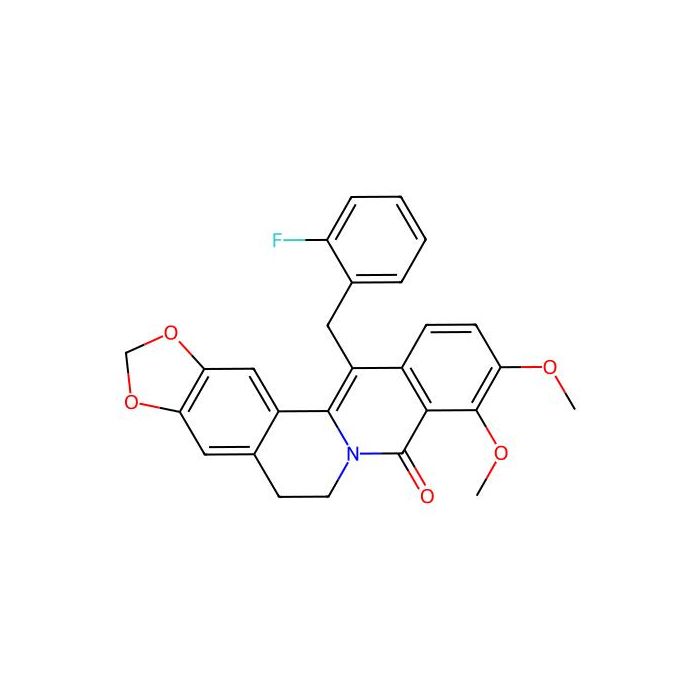
KRN5, a derivative of KRN2, is an oral active Nuclear factor of activated T cells 5 (NFAT5) suppressor, with an IC 50 of 750 nM. KRN5 has potential to treat NFAT5-mediated Chronic Arthritis
In Vitro
KRN5 is less toxic than BBR as determined by a cytotoxicity assay, hERG K+ channel assay, cytochrome inhibition assay, and liver microsomal metabolic stability test, which makes it a potential drug candidate. KRN5 at a concentration of 1 μM inhibits the expressions of NFAT5, IL-6,MCP-1, and GM-CSF,which are NFAT5 target molecules, in RAW264.7 macrophages stimulated with LPS. MCE has not independently confirmed the accuracy of these methods. They are for reference only.
In Vivo
Oral feeding of KRN5 (15 mg/kg and 60 mg/kg) every other day for 3 weeks from day 21 dose-dependently mitigates arthritis severity . The concentration of serum anti-type II collagen IgG also significantly decreases in the sera of KRN5-treated mice. TNF-α and IL-6 production by LPS-stimulated splenocytes are significantly lower in KRN5-treated CIA mice than in vehicle-treated mice . MCE has not independently confirmed the accuracy of these methods. They are for reference only. Animal Model: 8-week-old DBA/1Jmice immunized with bovine type II collagen . Dosage: 15 mg/kg and 60 mg/kg. Administration: Orally on alternate days (every other day) for 3 weeks. Result: Dose-dependently mitigated arthritis severity.
Form:Solid
IC50& Target:IC50: 750 nM (NFAT5)
Spécifications
Spécifications et pureté
≥98%
Mécanismes biochimiques et physiologiques
KRN5, a derivative of KRN2, is an oral active Nuclear factor of activated T cells 5 (NFAT5) suppressor, with an IC 50 of 750 nM. KRN5 has potential to treat NFAT5-mediated Chronic Arthritis.
Conditions de stockage de stockage
Store at -20°C
Expédié en
Ice chest + Ice pads
Ce produit nécessite l'expédition en chaîne froide. Les services terrestres et autres services économiques ne sont pas disponibles.
Certificats (CoA, COO, BSE/TSE et tableau d'analyse)
C of A & Other Certificates(BSE/TSE, COO):
Analytical Chart:
Propriétés chimiques et physiques
Solubilité
DMSO : 5 mg/mL (10.88 mM; ultrasonic and warming and heat to 80°C)
Calculateurs de solution
Molarity Calculator
Determine the necessary mass, volume, or concentration for preparing a solution.
Dilution Calculator
Determine the dilution needed to prepare a stock solution.
Reconstitution Calculator
Avis
Avis des clients
Application Protocols
No tested applications are specified for this item. The following is a general example protocol for using small molecules in cell-based assays (for research use only):
Example: Preparing stocks and performing a dose–response assay (general)
Reconstitution: Dissolve compound in anhydrous DMSO to 10 mM. Vortex and sonicate if needed. Record exact concentration gravimetrically or by UV if chromophore known.
Aliquoting: Dispense single-use aliquots (10–50 µL) in low-bind tubes; store at −20°C.
Plate setup: Seed cells and allow to attach/recover per cell-line SOP. Prepare a 1:3 or 1:2 serial dilution across the desired range (e.g., 10 µM to 5 nM) in assay medium, keeping final DMSO constant (≤0.1–0.5%). Include vehicle and positive controls.
Dosing: Add compounds using calibrated liquid handlers or pintools. Mix gently; avoid edge effects by using humidified incubators and plate seals.
Incubation: Typical exposure 4–72 h depending on assay biology.
Readout: Measure endpoint (viability, reporter, enzymatic activity) and calculate EC50/IC50 using a 4-parameter logistic fit.
Quality controls: Check precipitation visually, confirm on-plate concentration by LC–MS for critical studies, and include at least triplicate wells.
Adjust conditions according to your specific biological system and institutional SOPs.
Biological Roles
Item-specific biological function, mechanism of action, and targets for KRN5 are not provided in the product data.
General considerations for screening compounds (not item-specific)
Small molecules in discovery programs are used to modulate protein function (enzymes, receptors, ion channels) or cellular pathways. Without an assigned target, treat KRN5 as a chemical probe candidate requiring deconvolution.
Potential workflows include: phenotypic screening followed by target identification using chemoproteomics (affinity capture with immobilized or photoactivatable analogs), thermal shift assays (CETSA), or genetic interaction mapping (CRISPR modifier screens).
Evaluate selectivity early by counter-screens across close homologs and orthogonal assay formats to rule out assay artifacts (e.g., redox cycling, aggregation). Include controls for pan-assay interference (PAINS) and colloidal aggregation (detergent sensitivity, light scattering).
ADME-relevant attributes (permeability, microsomal stability, efflux liability) inform interpretation of cellular vs. biochemical potency; these are not provided here and should be determined experimentally if needed.
Note: All uses are for research only. Avoid inferring therapeutic relevance without rigorous target/efficacy/safety validation. Consult the CoA/Spec Sheet or authoritative databases (using CAS 1800465-47-7; CID 91820677) for any disclosed biological annotations.
Buffer Applications
KRN5 is a small organic compound and is not a buffering agent. No acid/base specifications (pKa, buffer range) are provided.
Practical notes for assay buffers (general)
Prepare a concentrated DMSO stock and dilute into your assay buffer (e.g., PBS, HEPES, Tris) to the desired final concentration, keeping DMSO typically ≤0.1–0.5% v/v depending on assay tolerance.
To mitigate precipitation upon dilution, add compound stock slowly with vigorous mixing, optionally with 0.01–0.05% nonionic surfactant (e.g., Tween-20/80) if compatible.
For biological assays, pre-equilibrate compound in buffer/media at experimental temperature to avoid solubility shifts.
If a buffering role is specifically required, select a dedicated buffer system (e.g., HEPES pH 7.2–7.6, MOPS pH 6.5–7.9, or Tris pH 7.0–9.0) and verify compound stability in that buffer by analytical LC or UV scans.
Green Alternatives
Because KRN5 is a library small molecule, green chemistry considerations center on solvent choices for stock and working solutions rather than synthetic use.
General greener solvent guidance (literature; not item-specific)
Replace or reduce DMF/NMP due to repro-tox concerns; prefer DMSO (readily biodegradable/tox profile better characterized) when biologically acceptable.
For certain applications, consider propylene glycol, PEG 300/400, or aqueous cyclodextrin formulations to reduce reliance on high-hazard aprotics. Validate assay compatibility and adsorption.
During preparative work, greener chromatographic solvents (e.g., EtOAc/MeOH/heptane systems) can reduce halogenated solvent use; this is relevant only if you are synthesizing or purifying related analogs.
Illustrative comparison (general)
DMSO: strong solvency, good EHS profile relative to DMF/NMP; may need low final % in bioassays.
Ethanol/i-PrOH: renewable feedstocks available; volatility can cause dosing drift in open plates.
Water + solubilizers (HP-β-CD, polysorbates): lowest EHS burden; limited by compound’s intrinsic solubility and potential assay interference.
Operational tips
Minimize solvent volumes via high-concentration stocks and acoustic or pintool dispensing.
Use sealed plates to curb evaporation of volatile green solvents (ethanol, i-PrOH).
Document solvent percentages in reports to facilitate greener method optimization across campaigns.
Pharmaceutical Uses
No pharmacopeial status, excipient role, or formulation use is provided for KRN5. This product is supplied strictly for research use only.
General research/manufacturing context (not item-specific)
Compounds like KRN5 can serve as analytical reference materials in method development, forced-degradation studies, or as internal/external standards within discovery programs (subject to availability of purity/identity data in the CoA).
If evaluated in pre-formulation research, typical vehicles might include DMSO, ethanol/PEG 400/saline mixtures, or cyclodextrin complexes; however, such use requires internal safety review and is outside routine catalog guidance.
No compendial monographs or GMP status are implied by this listing. Do not use in clinical, diagnostic, or veterinary applications.
Documentation
For any regulated use (e.g., GLP studies), request comprehensive documentation (CoA, SDS, residual solvents, elemental impurities) and perform independent qualification according to your QA system.
Physical Properties
Item-specific physical constants are not provided in the product data.
Appearance: Not specified for this item; refer to CoA/Spec Sheet.
Melting point (MP): Not specified for this item; refer to CoA/Spec Sheet.
Boiling point (BP): Not specified for this item; refer to CoA/Spec Sheet.
Density: Not specified for this item; refer to CoA/Spec Sheet.
Refractive index: Not specified for this item; refer to CoA/Spec Sheet.
Solubility: Not specified for this item; refer to CoA/Spec Sheet.
logP/logD, pKa: Not specified for this item; refer to CoA/Spec Sheet.
General guidance (literature/practice, not item-specific)
Small-molecule screening compounds are commonly soluble in DMSO at 10–50 mM. If precipitation occurs, warm gently (≤40°C) and vortex/sonicate briefly.
For aqueous work, incremental cosolvent addition (e.g., 0.1–1% DMSO, ethanol, or DMF) with surfactant (0.01–0.1% Tween-80) can improve dispersion; verify assay compatibility.
If salt/solvate form is unknown, check CoA/Spec Sheet to correctly calculate molarity. Hygroscopic or hydrate forms may alter apparent MW and solubility.
Prior to long assays, confirm stability by a quick analytical LC run of the working solution (look for degradation/adsorption losses). Use low-bind plastics for hydrophobic molecules.
Always rely on the batch CoA/Spec Sheet for item-specific specifications; values above are general best practices only.
Quality and Grades
Grade/Purity: Not specified for this item; refer to CoA/Spec Sheet.
Interpretation and expectations (general guidance for small-molecule libraries; not item-specific)
Screening compounds are typically supplied at high chemical purity (often ≥95% by area, LC-UV/MS) to support biological assays. Verify the exact purity method and threshold on the CoA (e.g., HPLC-UV at multiple wavelengths vs. ELSD/MS), as UV-only methods may miss nonchromophoric impurities.
Identity is commonly confirmed by LC–MS and/or 1H NMR; some suppliers also include HRMS. If your workflow requires chiral purity or residual solvent/metal analysis, request supporting documentation.
If a stabilizer, salt form, or counterion is present, it should be declared on the CoA; this affects molarity and solubility. None are specified here.
Best practices
For quantitative biology/chemistry, verify incoming quality by an orthogonal check (e.g., analytical LC using your method and a quick 1H NMR).
If using for HTS, consider plating with parallel post-dispense QC (UV/LC) to document on-plate concentration and stability.
If low-UV baseline noise is essential (e.g., HPLC method development), confirm “HPLC grade solvent” requirements pertain to your diluent; this compound’s grade is not specified.
Reaction and Applications
Manufacturer application specifics are not provided. KRN5 is categorized under small molecules/compound libraries; it is generally intended as a bioactive or screening compound rather than a stoichiometric reagent.
Potential research applications (general; not item-specific)
Target discovery and validation: Employ in phenotypic or target-based screens to probe pathway sensitivity. If a nominal target is known from external literature (check PubChem CID 91820677), validate by orthogonal assays (biochemical vs. cellular).
Chemical biology: Use as a tool compound to perturb signaling networks, followed by transcriptomic/proteomic readouts. Consider CETSA, DARTS, or thermal profiling to assess target engagement.
Structure–activity relationship (SAR): Use KRN5 as a reference in analog series to benchmark potency, solubility, or permeability metrics.
Analytical reference: Serve as a reference standard for LC–MS method development and stability-indicating assays in project work (not pharmacopeial).
Practical notes
Confirm chemical identity and purity (LC–MS, NMR) prior to critical experiments.
Prepare fresh assay dilutions to minimize degradation/adsorption, and include vehicle controls matched to the highest solvent percentage.
If photolability is suspected (aromatic systems), protect from light during handling; confirm with a quick photostability screen.
Reaction Conditions
No reaction conditions or chemical transformation guidance can be specified for KRN5 without a disclosed structure.
General handling conditions for solution preparation (laboratory practice)
Dissolution: Prepare concentrated DMSO stocks (e.g., 10–50 mM). If insoluble, gently warm (≤40°C) and sonicate. Avoid prolonged heating.
Filtration: If particulate remains, sterile-filter through 0.22 µm PTFE or PVDF (for cell-based assays when sterility is required).
Light/air sensitivity: Unknown for this item. As a precaution, minimize exposure to strong light and air; consider amber vials and inert headspace for long storage of solutions.
Stability checks: Verify by analytical LC after incubation at assay temperature and time (e.g., 4–24 h) to detect degradation.
If you intend to use KRN5 in chemical reactions (e.g., coupling to tags), consult the CoA/Spec Sheet for structure and then apply conditions appropriate to its functional groups (solvent, base, catalysts, temperature). Until structure is confirmed, avoid conditions that may cause uncontrolled decomposition (strong acids/bases, oxidants, or high temperatures).
Safety and Handling
Safety information in the product data is incomplete.
GHS classification, signal word, pictograms, H-statements: Not specified for this item; refer to SDS.
Research use: For research use only (not for human or veterinary use).
General laboratory precautions (professional guidance; defer to SDS)
Wear appropriate PPE: lab coat, safety glasses, and chemical-resistant gloves. Handle in a fume hood to avoid inhalation of dust/vapors/aerosols.
Avoid ingestion, inhalation, and skin/eye contact. Wash thoroughly after handling.
Prevent cross-contamination between screening plates by using clean tips and low-retention plastics; wipe spills with suitable solvent-compatible wipes and dispose per institutional policy.
In case of contact: rinse eyes/skin with water for at least 15 minutes; seek medical attention as per institutional SOPs.
Do not mix with strong oxidizers or reducers unless compatibility is known (general precaution for organic compounds). Keep away from ignition sources if volatile/flammable—status unknown; consult SDS.
Spill and disposal
Contain spills with inert absorbent; collect as hazardous organic waste. Dispose of contents/container in accordance with local regulations.
Always consult the product-specific SDS for authoritative hazard classification, first-aid, firefighting measures, accidental release, and exposure controls.
Solvent Selection
This product is listed as a small-molecule screening compound; solvent choice focuses on preparing concentrated stocks and assay-compatible working solutions.
Item-specific solubility data: Not specified for this item; refer to CoA/Spec Sheet.
General strategy (literature/practice)
Primary stock solvent: DMSO (typical 10–50 mM). Warm to 30–40°C and vortex/sonicate if needed. Filter (0.22 µm PTFE) if particulate persists.
Alternative polar aprotic: DMF or NMP (assay compatibility to be confirmed). For greener options, see Green Alternatives tab.
Aqueous use: Dilute DMSO stock into buffered media; keep final DMSO ≤0.1–0.5% v/v for sensitive cells/enzymes. Consider 0.01–0.1% nonionic surfactant to mitigate adsorption.
Volatile cosolvents: Ethanol or isopropanol may be acceptable up to 0.5–1% v/v in many biochemical assays; verify tolerance.
Comparison (general)
DMSO: excellent solvency, low volatility; may perturb membranes/enzymes at >0.5%.
DMF/NMP: strong solvency; potential cytotoxicity—use at very low final %.
Ethanol: good miscibility; higher volatility and potential for evaporation bias in plates.
Tips
Use low-bind tubes and tips to minimize loss of hydrophobic analytes.
Pre-rinse tips with concentrated stock to improve delivery accuracy at nL–µL volumes.
For analytical workflows, match diluent to mobile phase to reduce peak shape distortion.
Storage and Reconstitution
Manufacturer guidance (item-specific)
Storage conditions: Store at −20°C.
Shipped in: Ice chest + ice pads (cold chain).
Additional best practices (general; not item-specific)
Keep the container tightly closed under dry, inert conditions if possible. If the compound is moisture- or light-sensitive (unknown here), store in an amber, desiccated environment with desiccant and/or inert gas headspace.
Upon first use, prepare concentrated DMSO stocks (e.g., 10–50 mM), dispense into single-use aliquots, and return unused solid promptly to −20°C.
Avoid repeated freeze–thaw cycles; thaw aliquots on ice, use once, and discard remainder or refreeze once if stability permits (verify by LC).
For aqueous working solutions, prepare fresh on the day of use. If sterility is required, filter through 0.22 µm membranes compatible with the solvent system.
Label aliquots with lot number, concentration, solvent, and preparation date. Maintain a stability log and perform periodic QC (LC–MS or HPLC-UV) for long-term studies.
Specifications not provided in product data (consult CoA/SDS)
Appearance, purity grade, stabilizers, exact solubility, and photostability are not specified for this item; refer to CoA/Spec Sheet and SDS for definitive guidance.
Structure and Identity
Brief overview: KRN5 (SKU: K651942) is listed as a small-molecule library compound. Structural identifiers beyond CAS/CID are not provided in the product data.
Product name: KRN5
SKU: K651942
CAS: 1800465-47-7
PubChem CID: 91820677
Molecular formula: Not specified for this item; refer to CoA/Spec Sheet.
Molecular weight: Not specified for this item; refer to CoA/Spec Sheet.
SMILES: Not specified for this item; refer to CoA/Spec Sheet.
InChIKey: Not specified for this item; refer to CoA/Spec Sheet.
Synonyms: Not specified for this item; refer to CoA/Spec Sheet.
Structural features and 2D description
Item-specific functional groups, ring systems, and stereochemistry are not available in the provided data. If needed for cheminformatics or screening import, please obtain the structure file (SDF/MOL/SMILES) from the CoA/Spec Sheet or PubChem (CID above) and verify against the batch CoA.
For informatics workflows, we recommend confirming exact-connectivity (InChIKey) and any salt/solvate state (free base vs. HCl, hemihydrate, etc.) from the batch documentation to ensure correct stoichiometry in assay planning.
Synthetic Utility
KRN5 is presented as a finished small molecule for screening; no reactive handle or building-block role is specified in the product data.
General considerations (not item-specific)
Without a disclosed structure, it is not feasible to recommend specific transformations or named-reaction use. If your intent is derivatization (e.g., biotinylation, photoaffinity tagging), obtain the structure from the CoA/Spec Sheet or PubChem and assess functional-group compatibility (amines, phenols, halides, etc.) for coupling strategies.
For probe development, typical routes include installing linker handles via amide coupling (EDC/HATU), click chemistry (azide/alkyne), or SNAr/cross-coupling if aryl halides are present—contingent on the actual structure.
If chiral centers exist, plan for enantioselective synthesis or chiral resolution to match the bioactive enantiomer, verified by chiral HPLC and optical rotation.
Recommendation
Treat KRN5 primarily as an end-use research compound. For synthetic exploitation, first confirm exact connectivity and functional groups, then design routes using standard protecting-group and coupling strategies suitable for the identified motifs.
Target Specificity
Target, epitope, species reactivity, clone, and isotype are applicable to biological reagents (antibodies/proteins) and do not apply to a small-molecule compound.
Target/Mechanism: Not specified for this item; refer to literature or internal screening data if available.
Guidance (general, not item-specific)
Use orthogonal assays (biochemical vs. cellular) to confirm on-target activity.
Apply selectivity panels across close homologs and unrelated off-targets to assess specificity.
Consider chemoproteomic approaches or CETSA/TPP to support target engagement claims.
No item-specific target information is provided in the product data.
Nous utilisons des cookies pour garantir le bon fonctionnement du site et, lorsque cela est autorisé, pour améliorer votre expérience. Vous pouvez gérer vos préférences à tout moment dans les Paramètres. Pour en savoir plus, consultez notre Politique relative aux cookies.
Souhaitez-vous que nous vous envoyions un message lorsque des réductions seront disponibles?
Me rappeler plus tard
Merci ! Veuillez vérifier votre boîte de réception e-mail pour confirmer.
Products are supplied to verified businesses, institutions, and qualified professionals for research and development use only. Not for use in humans, animals, diagnosis, or therapy.