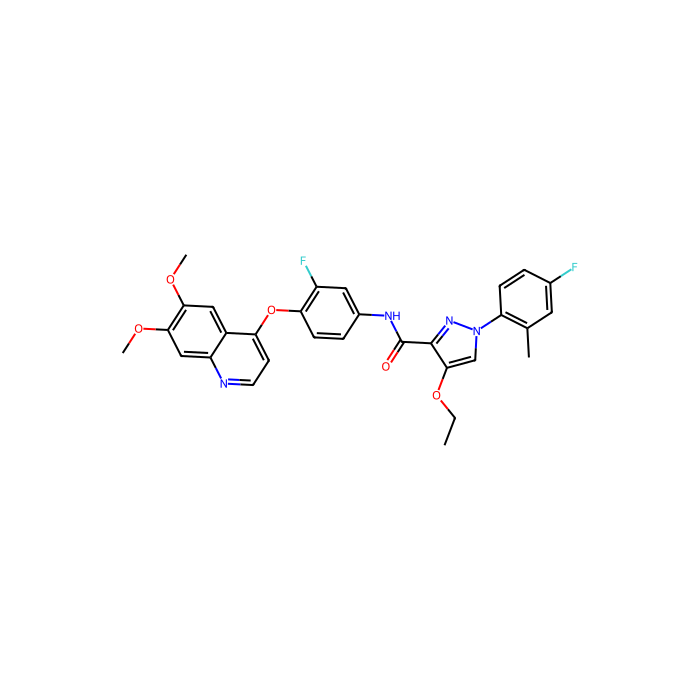
LDC1267 - Moligand™, ≥98% , Inhibitor of AXL receptor tyrosine kinase;Inhibitor of MER proto-oncogene; tyrosine kinase;Inhibitor of TYRO3 protein tyrosine kinase, CAS No.1361030-48-9, Inhibitor of AXL receptor tyrosine kinase;Inhibitor of MER proto-oncogene; tyrosine kinase;Inhibitor of TYRO3 protein tyrosine kinase

CAS: 1361030-48-9 Cat. No.: L413798 Formule: C30H26F2N4O5 Poids moléculaire: 560.55
DISPONIBLE À COMMANDE
QUALITÉ & PURETÉ Moligand™ ? Moligand™ — Aladdin's line of ligands and bioactive small molecules. Use for receptor, pathway, and binding studies needing defined small-molecule tools. ≥98%
Synonyms
N-[4-[(6,7-dimethoxy-4-quinolyl)oxy]-3-fluoro-phenyl]-4-ethoxy-1-(4-fluoro-2-methyl-phenyl)pyrazole-3-carboxamide
Storage
Store at -20°C
Shipped In
Ice chest + Ice pads
★
Taille
Allemagne (EU)
USA*
Prix
Qté
5mg
L413798-5mg
—
5 En stock
20,74€
25mg
L413798-25mg
—
4 En stock
69,33€
100mg
L413798-100mg
—
3 En stock
225,53€
250mg
L413798-250mg
—
2 En stock
494,52€
Enter a quantity for the sizes you want to add.

Vue d’ensemble

Information

LDC1267 LDC1267 is a highly selective TAM kinase inhibitor with IC50 of <5 nM, 8 nM, and 29 nM for Mer, Tyro3, and Axl, respectively. Displays lower activity against Met, Aurora B, Lck, Src, and CDK8.


Targets

Mer (Cell-free assay); Tyro3 (Cell-free assay); Axl (Cell-free assay) <5 nM; 8 nM; 29 nM


In vitro

LDC1267 moderately affects cell proliferation in 11 of 95 different cell lines with IC50 of >5μM. In NKG2D-activated NK cells, LDC1267 abolishes the inhibitory effects of Gas6 stimulation.


In vivo

In B16F10 melanoma-bearing mice, LDC1267 (20 mg/kg, i.p.) efficiently enhances anti-metastatic NK cell activity, and rejects tumor metastases without serious cytotoxicity.


Cell Research(from reference)

Cell lines:A panel of 93 cancer cell lines and two primary cells (x axis, IMR90 and human peripheral blood mononuclear cells) 

Concentrations:~30 μM 

Incubation Time:72 hours 

Spécifications

Synonymes
N-[4-[(6,7-dimethoxy-4-quinolyl)oxy]-3-fluoro-phenyl]-4-ethoxy-1-(4-fluoro-2-methyl-phenyl)pyrazole-3-carboxamide
Spécifications et pureté
Moligand™, ≥98%
Mécanismes biochimiques et physiologiques
LDC1267 is a highly selective TAM kinase inhibitor with IC50 of <5 nM, 8 nM, and 29 nM for Mer, Tyro3, and Axl, respectively. Displays lower activity against Met, Aurora B, Lck, Src, and CDK8.
Conditions de stockage de stockage
Store at -20°C
Expédié en
Ice chest + Ice pads
Ce produit nécessite l'expédition en chaîne froide. Les services terrestres et autres services économiques ne sont pas disponibles.
Grade
Moligand™
Type d'action
INHIBITOR
Mécanisme d'action
Inhibitor of AXL receptor tyrosine kinase;Inhibitor of MER proto-oncogene; tyrosine kinase;Inhibitor of TYRO3 protein tyrosine kinase
Pureté
≥98%
Product Line
L413798-5mg
Propriétés du produit
ALogP
6.213
hba_count
7
Nombre de HBD
1
Liaison rotative
9
Noms et identifiants
Pubchem Sid
Pubchem Sid Url
https://pubchem.ncbi.nlm.nih.gov/substance/488201781
SMILES
CCOC1=CN(N=C1C(=O)NC2=CC(=C(C=C2)OC3=C4C=C(C(=CC4=NC=C3)OC)OC)F)C5=C(C=C(C=C5)F)C
IUPAC Name
N-[4-(6,7-dimethoxyquinolin-4-yl)oxy-3-fluorophenyl]-4-ethoxy-1-(4-fluoro-2-methylphenyl)pyrazole-3-carboxamide
InChIKey
ISPBCAXOSOLFME-UHFFFAOYSA-N
InChI
1S/C30H26F2N4O5/c1-5-40-28-16-36(23-8-6-18(31)12-17(23)2)35-29(28)30(37)34-19-7-9-25(21(32)13-19)41-24-10-11-33-22-15-27(39-4)26(38-3)14-20(22)24/h6-16H,5H2,1-4H3,(H,34,37)
Isomères SMILES
CCOC1=CN(N=C1C(=O)NC2=CC(=C(C=C2)OC3=C4C=C(C(=CC4=NC=C3)OC)OC)F)C5=C(C=C(C=C5)F)C
Poids moléculaire
560.55
Reaxys
22371579
Reaxys-RN_link_address
https://www.reaxys.com/reaxys/secured/hopinto.do?context=S&query=IDE.XRN=22371579&ln=

Données avancées

Taxonomic Classification

Taxonomy Tree

KingdomOrganic compounds
SuperclassBenzenoids
ClasseBenzene and substituted derivatives
SubclassAnilides
Intermediate Tree Nodes Not available
Direct ParentAromatic anilides
Alternative Parents Phenylpyrazoles  Diarylethers  Quinolines and derivatives  Pyrazole-5-carboxamides  Phenoxy compounds  2-heteroaryl carboxamides  Anisoles  Toluenes  Alkyl aryl ethers  Fluorobenzenes  Pyridines and derivatives  Aryl fluorides  Heteroaromatic compounds  Secondary carboxylic acid amides  Azacyclic compounds  Hydrocarbon derivatives  Organic oxides  Organofluorides  Organonitrogen compounds  
Molecular FrameworkAromatic heteropolycyclic compounds
Substituents Aromatic anilide - Diaryl ether - Phenylpyrazole - Quinoline - 2-heteroaryl carboxamide - Phenoxy compound - Phenol ether - Pyrazole-5-carboxamide - Anisole - Halobenzene - Fluorobenzene - Alkyl aryl ether - Toluene - Pyridine - Aryl halide - Aryl fluoride - Heteroaromatic compound - Pyrazole - Azole - Secondary carboxylic acid amide - Carboxamide group - Azacycle - Organoheterocyclic compound - Carboxylic acid derivative - Ether - Organooxygen compound - Organic oxygen compound - Organic nitrogen compound - Hydrocarbon derivative - Organic oxide - Organonitrogen compound - Organofluoride - Organohalogen compound - Aromatic heteropolycyclic compound
DescriptionThis compound belongs to the class of organic compounds known as aromatic anilides. These are aromatic compounds containing an anilide group in which the carboxamide group is substituted with an aromatic group. They have the general structure RNC(=O)R', where R= benzene, and R = aryl group.
External Descriptors Not available
Structure 3D
Modèle de structure chimique interactif


Cibles associées (humaines)
TYRO3 Tchem Tyrosine-protein kinase receptor TYRO3 (1 Activities)
Activity TypeActivity Value -log(M)Mechanism of ActionActivity ReferencePublications (PubMed IDs)
MERTK Tchem Tyrosine-protein kinase Mer (1 Activities)
Activity TypeActivity Value -log(M)Mechanism of ActionActivity ReferencePublications (PubMed IDs)
AXL Tchem Tyrosine-protein kinase receptor UFO (2 Activities)
Activity TypeActivity Value -log(M)Mechanism of ActionActivity ReferencePublications (PubMed IDs)
ABL1 Tclin Tyrosine-protein kinase ABL (18331 Activities)
Activity TypeRelationActivity valueUnitsAction TypeJournalPubMed IddoiAssay Aladdin ID
PDGFRB Tclin Platelet-derived growth factor receptor beta (5195 Activities)
Activity TypeRelationActivity valueUnitsAction TypeJournalPubMed IddoiAssay Aladdin ID
KIT Tclin Stem cell growth factor receptor (10667 Activities)
Activity TypeRelationActivity valueUnitsAction TypeJournalPubMed IddoiAssay Aladdin ID
LCK Tclin Tyrosine-protein kinase LCK (9212 Activities)
Activity TypeRelationActivity valueUnitsAction TypeJournalPubMed IddoiAssay Aladdin ID
GSK3B Tclin Glycogen synthase kinase-3 beta (11785 Activities)
Activity TypeRelationActivity valueUnitsAction TypeJournalPubMed IddoiAssay Aladdin ID
CSNK1D Tchem Casein kinase I delta (4546 Activities)
Activity TypeRelationActivity valueUnitsAction TypeJournalPubMed IddoiAssay Aladdin ID
MAP2K5 Tchem Dual specificity mitogen-activated protein kinase kinase 5 (650 Activities)
Activity TypeRelationActivity valueUnitsAction TypeJournalPubMed IddoiAssay Aladdin ID
SRC Tclin Tyrosine-protein kinase SRC (10310 Activities)
Activity TypeRelationActivity valueUnitsAction TypeJournalPubMed IddoiAssay Aladdin ID
CHEK2 Tchem Serine/threonine-protein kinase Chk2 (4015 Activities)
Activity TypeRelationActivity valueUnitsAction TypeJournalPubMed IddoiAssay Aladdin ID
AURKB Tchem Serine/threonine-protein kinase Aurora-B (6805 Activities)
Activity TypeRelationActivity valueUnitsAction TypeJournalPubMed IddoiAssay Aladdin ID
MST1R Tchem Macrophage-stimulating protein receptor (2327 Activities)
Activity TypeRelationActivity valueUnitsAction TypeJournalPubMed IddoiAssay Aladdin ID
MET Tclin Hepatocyte growth factor receptor (10718 Activities)
Activity TypeRelationActivity valueUnitsAction TypeJournalPubMed IddoiAssay Aladdin ID
CDK2 Tchem Cyclin-dependent kinase 2 (9050 Activities)
Activity TypeRelationActivity valueUnitsAction TypeJournalPubMed IddoiAssay Aladdin ID
BLK Tchem Tyrosine-protein kinase BLK (2498 Activities)
Activity TypeRelationActivity valueUnitsAction TypeJournalPubMed IddoiAssay Aladdin ID
HCK Tclin Tyrosine-protein kinase HCK (2743 Activities)
Activity TypeRelationActivity valueUnitsAction TypeJournalPubMed IddoiAssay Aladdin ID
NTRK1 Tclin Nerve growth factor receptor Trk-A (7922 Activities)
Activity TypeRelationActivity valueUnitsAction TypeJournalPubMed IddoiAssay Aladdin ID
FLT3 Tclin Tyrosine-protein kinase receptor FLT3 (13481 Activities)
Activity TypeRelationActivity valueUnitsAction TypeJournalPubMed IddoiAssay Aladdin ID
CSF1R Tclin Macrophage colony stimulating factor receptor (5179 Activities)
Activity TypeRelationActivity valueUnitsAction TypeJournalPubMed IddoiAssay Aladdin ID
AURKA Tchem Serine/threonine-protein kinase Aurora-A (10240 Activities)
Activity TypeRelationActivity valueUnitsAction TypeJournalPubMed IddoiAssay Aladdin ID
AURKC Tchem Serine/threonine-protein kinase Aurora-C (1780 Activities)
Activity TypeRelationActivity valueUnitsAction TypeJournalPubMed IddoiAssay Aladdin ID
STK10 Tchem Serine/threonine-protein kinase 10 (2119 Activities)
Activity TypeRelationActivity valueUnitsAction TypeJournalPubMed IddoiAssay Aladdin ID
FER Tclin Tyrosine-protein kinase FER (2362 Activities)
Activity TypeRelationActivity valueUnitsAction TypeJournalPubMed IddoiAssay Aladdin ID
FRK Tchem Tyrosine-protein kinase FRK (2284 Activities)
Activity TypeRelationActivity valueUnitsAction TypeJournalPubMed IddoiAssay Aladdin ID
MAP4K5 Tchem Mitogen-activated protein kinase kinase kinase kinase 5 (1523 Activities)
Activity TypeRelationActivity valueUnitsAction TypeJournalPubMed IddoiAssay Aladdin ID
U2OS (164939 Activities)
Activity TypeRelationActivity valueUnitsAction TypeJournalPubMed IddoiAssay Aladdin ID
AXL Tchem Tyrosine-protein kinase receptor UFO (3469 Activities)
Activity TypeRelationActivity valueUnitsAction TypeJournalPubMed IddoiAssay Aladdin ID
TIE1 Tchem Tyrosine-protein kinase receptor Tie-1 (296 Activities)
Activity TypeRelationActivity valueUnitsAction TypeJournalPubMed IddoiAssay Aladdin ID
TYRO3 Tchem Tyrosine-protein kinase receptor TYRO3 (2906 Activities)
Activity TypeRelationActivity valueUnitsAction TypeJournalPubMed IddoiAssay Aladdin ID
DDR1 Tchem Epithelial discoidin domain-containing receptor 1 (1050 Activities)
Activity TypeRelationActivity valueUnitsAction TypeJournalPubMed IddoiAssay Aladdin ID
MERTK Tchem Proto-oncogene tyrosine-protein kinase MER (2687 Activities)
Activity TypeRelationActivity valueUnitsAction TypeJournalPubMed IddoiAssay Aladdin ID
ROS1 Tclin Proto-oncogene tyrosine-protein kinase ROS (2436 Activities)
Activity TypeRelationActivity valueUnitsAction TypeJournalPubMed IddoiAssay Aladdin ID
NTRK3 Tclin NT-3 growth factor receptor (2338 Activities)
Activity TypeRelationActivity valueUnitsAction TypeJournalPubMed IddoiAssay Aladdin ID
MUSK Tchem Muscle, skeletal receptor tyrosine protein kinase (1511 Activities)
Activity TypeRelationActivity valueUnitsAction TypeJournalPubMed IddoiAssay Aladdin ID
CDK8 Tchem Cell division protein kinase 8 (1536 Activities)
Activity TypeRelationActivity valueUnitsAction TypeJournalPubMed IddoiAssay Aladdin ID
CDK19 Tchem Cell division cycle 2-like protein kinase 6 (553 Activities)
Activity TypeRelationActivity valueUnitsAction TypeJournalPubMed IddoiAssay Aladdin ID
EPHB6 Tchem Ephrin type-B receptor 6 (487 Activities)
Activity TypeRelationActivity valueUnitsAction TypeJournalPubMed IddoiAssay Aladdin ID
HIPK4 Tchem Homeodomain-interacting protein kinase 4 (1718 Activities)
Activity TypeRelationActivity valueUnitsAction TypeJournalPubMed IddoiAssay Aladdin ID
BRD4 Tchem Bromodomain-containing protein 4 (13122 Activities)
Activity TypeRelationActivity valueUnitsAction TypeJournalPubMed IddoiAssay Aladdin ID
TRIM24 Tchem Transcription intermediary factor 1-alpha (2087 Activities)
Activity TypeRelationActivity valueUnitsAction TypeJournalPubMed IddoiAssay Aladdin ID
BRPF1 Tchem Peregrin (2217 Activities)
Activity TypeRelationActivity valueUnitsAction TypeJournalPubMed IddoiAssay Aladdin ID
HEK-293T (167025 Activities)
Activity TypeRelationActivity valueUnitsAction TypeJournalPubMed IddoiAssay Aladdin ID
Cibles associées (non humaines)
Mapk1 MAP kinase ERK2 (650 Activities)
Activity TypeRelationActivity valueUnitsAction TypeJournalPubMed IddoiAssay Aladdin ID
Hdac6 Histone deacetylase 6 (222 Activities)
Activity TypeRelationActivity valueUnitsAction TypeJournalPubMed IddoiAssay Aladdin ID
Fgfr3 Fibroblast growth factor receptor 3 (21 Activities)
Activity TypeRelationActivity valueUnitsAction TypeJournalPubMed IddoiAssay Aladdin ID
rep Replicase polyprotein 1ab (378 Activities)
Activity TypeRelationActivity valueUnitsAction TypeJournalPubMed IddoiAssay Aladdin ID
Mécanismes d'action
Certificats (CoA, COO, BSE/TSE et tableau d'analyse)
C of A & Other Certificates(BSE/TSE, COO):
Analytical Chart:

Find and download the COA for your product by matching the lot number on the packaging.

14 results found

Lot NumberCertificate TypeDateArticle
C2331533C2331533Certificate of AnalysisJan 20, 2026 L413798
C2331534C2331534Certificate of AnalysisJan 20, 2026 L413798
C2331535C2331535Certificate of AnalysisJan 20, 2026 L413798
C2331539C2331539Certificate of AnalysisJan 20, 2026 L413798
C2331619C2331619Certificate of AnalysisJan 20, 2026 L413798
C2331627C2331627Certificate of AnalysisJan 20, 2026 L413798
C2331632C2331632Certificate of AnalysisJan 20, 2026 L413798
C23081514C23081514Certificate of AnalysisDec 10, 2025 L413798
C23081516C23081516Certificate of AnalysisDec 10, 2025 L413798
C23081518C23081518Certificate of AnalysisDec 10, 2025 L413798
C23081528C23081528Certificate of AnalysisDec 10, 2025 L413798
C2331558C2331558Certificate of AnalysisDec 19, 2022 L413798
C2510007C2510007Certificate of AnalysisDec 19, 2022 L413798
C2508025C2508025Certificate of AnalysisNov 25, 2022 L413798
Propriétés chimiques et physiques
SolubilitéSolubility (25°C) In vitro DMSO: 100 mg/mL warmed with 50ºC Water: bath (178.39 mM); Ethanol: 2 mg/mL warmed with 50ºC Water: bath (3.56 mM); Water: Insoluble;
DMSO (mg/mL) Solubilité maximale100
DMSO (mM) Solubilité maximale178.396218
Eau (mg/mL) Solubilité maximale<1
Poids moléculaire560.5
XLogP35.700
Hydrogen Bond Donor Count1
Hydrogen Bond Acceptor Count9
Rotatable Bond Count9
Exact Mass560.187 Da
Monoisotopic Mass560.187 Da
Topological Polar Surface Area96.700 Ų
Heavy Atom Count41
Formal Charge0
Complexity860.000
Isotope Atom Count0
Defined Atom Stereocenter Count0
Undefined Atom Stereocenter Count0
Defined Bond Stereocenter Count0
Undefined Bond Stereocenter Count0
The total count of all stereochemical bonds0
Covalently-Bonded Unit Count1
Sécurité et dangers (GHS)
Reaxys
22371579
Reaxys-RN_link_address
https://www.reaxys.com/reaxys/secured/hopinto.do?context=S&query=IDE.XRN=22371579&ln=
Calculateurs de solution
Avis

Avis des clients

Application Protocols

No item-specific, validated application protocols are provided for this product.

General guidance (for research use only; adapt to your system and consult literature on LDC1267):

  • Biochemical enzyme assay (outline):
    • Prepare a DMSO stock (e.g., 10 mM). Perform a 10-point, 3-fold dilution series in assay buffer, maintaining constant DMSO across wells.
    • Incubate with enzyme and substrate under recommended conditions for the target class (e.g., kinase buffer, ATP concentration near Km).
    • Read activity via an appropriate endpoint (ADP formation, phospho-specific detection) and fit to determine IC50.
  • Cell-based assay (outline):
    • Treat cells with serial dilutions, keeping final DMSO ≤0.1–0.5% v/v.
    • Incubate for a time consistent with pathway modulation (e.g., 1–24 h). Assess readouts (phospho-protein levels, reporter assays, phenotypic markers).
    • Include vehicle controls and, when possible, an orthogonal chemotype control.

Note: These outlines are generic and must be tailored to the verified biological target and assay design. Always verify solubility and stability under your specific assay conditions.

Biological Roles

Context from the literature: LDC1267 is widely cited as a small-molecule kinase inhibitor probe. It has been reported as a tool compound for interrogating signaling pathways associated with specific receptor tyrosine kinases (e.g., entries connected to PubChem CID 56847486). No item-specific biological validation data are provided in this listing.

Use cases in chemical biology (general):

  • Pathway dissection: Applied in cell-based assays to modulate kinase activity and study downstream transcriptional or phenotypic outcomes. Rigorous target confirmation (e.g., biochemical IC50, cellular target occupancy) should be drawn from primary sources and replicated in the user’s system.
  • Dose selection: Typical workflows involve generating concentration–response curves across several logs of concentration with appropriate vehicle controls and orthogonal readouts to mitigate off-target interpretation.
  • Selectivity profiling: Kinome-wide panels (when available in the literature) can help identify potential off-target interactions and guide concentration ceilings for phenotypic work.

Best practices:

  • Validate compound identity and purity prior to biological deployment (LC–MS, NMR).
  • Use matched negative controls or alternative chemotypes to corroborate mechanism-dependent phenotypes.
  • Monitor compound stability in assay media (time-course LC–MS) to rule out degradation or adsorption to plastics.

Note: This product is for research use only. No claims are made regarding therapeutic, diagnostic, or clinical utility.

Buffer Applications

This product is not a buffering agent and is not used to control solution pH.

Practical notes for assay buffers (general):

  • Vehicle preparation: Dissolve LDC1267 in DMSO to make a concentrated stock, then dilute into the desired buffer (e.g., PBS, HEPES, Tris-based buffers, or complete cell culture media) with thorough mixing to avoid precipitation.
  • Final DMSO content: Keep ≤0.1–0.5% v/v for sensitive cell systems; confirm tolerance for your specific model.
  • Surfactants: A low level of non-ionic detergent (e.g., 0.01–0.05% Tween 20 or 0.01% Pluronic F-127) can mitigate nonspecific adsorption or aggregation in some biochemical assays, if compatible with the readout.

Item-specific buffer recipes or pH ranges: Not applicable. Refer instead to your assay’s buffer system and the literature on LDC1267 usage.

Green Alternatives

As a small-molecule research ligand, LDC1267 itself is the active material and not a process solvent or reagent that typically invites greener substitutes. However, greener considerations apply to the choice of dissolution and processing solvents around its use.

Greener handling considerations (general):

  • Prefer DMSO and ethanol over higher-toxicity dipolar aprotics (e.g., DMF, NMP) whenever solubility permits.
  • For analytical sample prep, acetonitrile–water mixtures are standard; consider methanol–water when chromatographic performance is acceptable, as MeOH has a more favorable environmental profile.
  • Minimize solvent volumes via high-concentration master stocks and microplate dispensing to reduce waste.

Illustrative comparison for solution preparation (general):

  • DMSO: High solvency, widespread acceptance in biological assays; moderate environmental impact; good stability of many ligands.
  • Ethanol: Greener and readily biodegradable; limited solvency for highly lipophilic scaffolds; may disrupt biological assays at higher v/v.
  • DMF/NMP: Strong solvents but reproductive-toxicity concerns and challenging waste profile; avoid unless necessary.

Waste management:

  • Segregate DMSO/organic solutions and contaminated disposables into appropriate organic waste streams; avoid drain disposal. Employ microscale work to reduce total solvent burden.
Pharmaceutical Uses

This product is supplied strictly for research use only and is not intended for human or veterinary use, clinical diagnostics, or as an excipient in commercial formulations.

Context (general information):

  • No pharmacopeial monograph (USP/EP/JP) is referenced for LDC1267.
  • In preclinical research settings, small-molecule tool compounds may be formulated for in vitro or exploratory in vivo studies (e.g., DMSO/PEG/saline vehicles). Such procedures are outside the scope of this listing and must comply with institutional and regulatory guidelines.

Formulation considerations for laboratory research (general, non-clinical):

  • Solubility screening: Evaluate cosolvents (DMSO, ethanol), solubilizers (Captisol, hydroxypropyl-β-cyclodextrin), or mixed vehicles (e.g., DMSO–PEG400–saline) as permissible in your research environment.
  • Stability: Assess compound stability in chosen vehicle over the relevant timescale (e.g., hours to days) via LC–MS.

Item-specific excipient role or compendial status: Not specified for this item; refer to CoA/Spec Sheet. No claims are made for clinical or manufacturing use.

Physical Properties

Only limited item-specific physico-chemical data are provided in this listing.

Item-specific specifications:

  • Appearance: Not specified for this item; refer to CoA/Spec Sheet.
  • Molecular weight (spec): Not specified for this item; refer to CoA/Spec Sheet.

Literature/general reference values for LDC1267 (context only; verify before use):

  • Typical state: solid small molecule (many kinase probes are crystalline or amorphous powders). Confirm with received lot.
  • Aqueous solubility: Often low for this class; DMSO stock solutions are commonly used in chemical biology (e.g., 10–50 mM). Exact solubility for this item is not specified; determine empirically.
  • LogP/logD: Kinase-directed scaffolds frequently display moderate-to-high lipophilicity; no item-specific value provided here.
  • Melting point, boiling point, density, refractive index, pKa: Not specified for this item; consult CoA/Spec Sheet or primary literature for LDC1267.

Practical notes (general):

  • If preparing DMSO stocks, filter-sterilize through PTFE/RC (0.22 µm) when sterility is required. Record concentration gravimetrically where possible.
  • Evaluate solubility in assay buffer with serial aqueous dilution from DMSO (final DMSO typically ≤0.1–0.5% v/v in cell-based assays) to avoid precipitation.
  • For analytical characterization, confirm identity/purity by LC–MS and 1H NMR against a trusted reference.
Quality and Grades
  • Grade/Purity: Moligand™

What Moligand™ signifies (general description):

  • A research-focused grade for small-molecule ligands and screening compounds intended for discovery chemistry, target validation, and assay development. Moligand™ offerings emphasize suitability for biochemical and cell-based studies rather than bulk synthetic use.

Implications for use:

  • Analytical characterization: Items in this category are typically accompanied by identity and purity verification (e.g., LC–MS, NMR, or HPLC traces) appropriate for screening work. For the present item, specific analytical metrics (purity %, residual solvent, water, metal content, UV cutoff) are Not specified for this item; refer to CoA/Spec Sheet.
  • UV transparency and LC compatibility: For HPLC/UPLC assay readouts, confirm background absorbance and impurity profiles using your instrument method; no item-specific UV cutoff is provided here.
  • Stabilizers: None are listed in the product data. If any stabilizer or counterion is present, it will appear on the CoA; otherwise assume neat compound only after verification.

Best practices:

  • Before biological assays, confirm purity and identity with your internal methods where feasible.
  • For cross-site reproducibility, retain aliquots of the received lot and document internal QC (LC–MS retention time, exact mass, purity by area %, water content if Karl Fischer is available).
Reaction and Applications

This compound is primarily utilized as a research ligand/probe in chemical biology rather than as a synthetic reagent. Consequently, conventional synthetic reaction families (e.g., cross-couplings, condensations) are not the typical use case for LDC1267 as a substrate or solvent.

Application contexts (general, literature-based):

  • Target engagement studies: Employed as a small-molecule inhibitor in biochemical enzyme assays and cell-based models to interrogate signaling pathways. Verify target and selectivity with primary references for LDC1267.
  • Phenotypic screening: Used to modulate pathway activity in cells, organoids, or primary cultures; effects should be benchmarked with dose–response and orthogonal readouts.
  • Chemical proteomics (where applicable): With appropriate derivatization (e.g., photoaffinity/handle-tagged analogs), related scaffolds can be used to profile target engagement. Such derivatization is beyond the scope of this item and requires bespoke synthesis.
  • Analytical controls: Serves as a positive control inhibitor in assay development and validation when aligned to its known target class (kinases, per literature context).

Practical tips:

  • Prepare concentrated DMSO stocks (e.g., 10–50 mM) and aliquot to avoid freeze–thaw.
  • Confirm absence of aggregation/artifacts using counterscreens (e.g., detergent sensitivity, redox reactivity tests) typical for small-molecule screening.
  • Document assay conditions (vehicle %, exposure time, cell density, protein source) to ensure reproducibility across campaigns.

Note: No item-specific application protocols or performance guarantees are provided; consult the literature on LDC1267 for target-specific guidance.

Reaction Conditions

Conventional synthetic reaction conditions are not typically applicable to the end-use of this product, which is supplied as a finalized research ligand rather than a reagent or substrate for chemical transformations.

General guidance related to use in assays (not synthetic reactions):

  • Stock preparation: Dissolve in anhydrous DMSO to a convenient concentration (e.g., 10–50 mM). Vortex and, if needed, sonicate briefly to aid dissolution. Filter-sterilize (0.22 µm PTFE/RC) when sterility is required.
  • Working solutions: Dilute stocks into assay media immediately prior to use, maintaining consistent final vehicle across controls and treated samples.
  • Stability checks: Verify short-term stability at room temperature and long-term stability at storage conditions by LC–MS.

If employing LDC1267 in any chemical transformation or conjugation chemistry:

  • Reaction conditions must be developed de novo based on the verified structure and functional groups of the specific lot. No item-specific reaction parameters, catalysts, or yields are provided here.

Item-specific reaction data: Not applicable/Not specified for this item; refer to CoA/Spec Sheet and primary literature if undertaking derivative synthesis.

Safety and Handling

Hazard classification for this specific item has not been provided in the listing.

Item-specific safety data:

  • GHS classification: Not specified for this item; refer to SDS.
  • Signal word / H-statements / pictograms: Not specified for this item; refer to SDS.

General laboratory handling guidance (not a substitute for the SDS):

  • PPE: Wear lab coat, safety glasses, and suitable gloves (e.g., nitrile). Handle powders in a fume hood to minimize inhalation exposure.
  • Avoid contact with skin, eyes, and clothing. Prevent dust formation and aerosolization; handle gently when weighing.
  • Incompatibilities: Avoid strong oxidants and strong acids/bases unless compatibility is confirmed. Keep away from ignition sources if using flammable solvents (DMSO solutions are not flammable per se, but co-solvents may be).
  • First aid (overview): In case of skin contact, wash with soap/water. Eye contact: rinse cautiously with water for several minutes; remove contact lenses if present and easy to do. Inhalation: move to fresh air. Ingestion: rinse mouth. Seek medical attention if symptoms occur.
  • Spill response: Avoid raising dust; collect mechanically or dampen and wipe. Dispose according to local regulations for laboratory chemicals.
  • Environmental precautions: Prevent release to drains. Collect waste solutions (e.g., DMSO stocks and assay residues) in designated organic waste streams.

Always consult the product’s SDS for authoritative and complete safety information.

Solvent Selection

This product is supplied as a solid small molecule (appearance not specified). For small-molecule ligands of this class, solvent choice is often driven by the need to achieve concentrated stock solutions and maintain assay compatibility.

General guidance (literature/experience-based):

  • Primary stock solvent: DMSO is typically preferred due to broad solvating ability and compatibility with biochemical and cell-based assays.
  • Co-solvent strategies: For working solutions, dilute DMSO stocks into aqueous assay buffers (e.g., PBS, HEPES, cell culture media) with vigorous mixing to minimize precipitation. Keep final DMSO at ≤0.1–0.5% v/v for sensitive cell systems; up to 1–2% v/v may be tolerated in some biochemical assays.
  • Alternative solvents for method development: DMF, 1-methyl-2-pyrrolidone (NMP), or ethanol can improve solubility for analytical injections or surface binding studies. Confirm compatibility with assay components and plastics.
  • Analytical dissolution: For LC–MS, a 50:50 acetonitrile:water (0.1% formic acid) diluent can aid peak shape after initial dissolution in DMSO.

Comparison (general):

  • DMSO: maximal solvency, ubiquitous in screening workflows.
  • Ethanol/MeOH: greener but may offer insufficient solubility and can perturb protein assays at comparable v/v.
  • NMP/DMF: potent but less biocompatible; reserve for analytical or chemical operations.

Item-specific solubility data: Not specified for this item; determine empirically and consult CoA/Spec Sheet if available.

Storage and Reconstitution

Item-specific conditions:

  • Storage: Store at -20°C (per product data).
  • Shipping: Shipped in ice chest with ice pads (per product data).
  • Appearance: Not specified for this item; refer to CoA/Spec Sheet.

Best practices (general):

  • Keep container tightly closed in a dry, inert atmosphere. Protect from light and ambient moisture. If available, store under desiccation or with desiccant and minimize headspace.
  • Upon receipt, allow the sealed container to equilibrate to room temperature before opening to avoid moisture condensation.

Reconstitution (general guidance for small-molecule ligands):

  • Dissolve in anhydrous DMSO to prepare a concentrated stock (e.g., 10–50 mM). Mix thoroughly; brief sonication may help. Record exact concentration.
  • Sterile work: If sterility is required, prepare solutions using sterile technique and pass through a 0.22 µm PTFE/RC filter.
  • Aliquoting: Dispense into single-use aliquots (amber vials or plates) to avoid repeated freeze–thaw cycles. Store aliquots at -20°C or below.
  • Stability: Assess stability of both solid and solution forms by LC–MS or HPLC at defined intervals. Item-specific stability data are Not specified for this item; refer to CoA/Spec Sheet.

Disposal: Dispose of unused solutions and contaminated materials as organic chemical waste in accordance with institutional and local regulations.

Structure and Identity

Brief summary: LDC1267 is a cataloged small‑molecule research ligand (Moligand grade) commonly referenced in the chemical biology literature as a kinase-targeted probe. Item-specific identifiers for structural confirmation are limited in this listing.

  • SKU: L413798
  • Product name: LDC1267
  • CAS: 1361030-48-9
  • PubChem CID: 56847486 (literature identifier)
  • InChIKey: Not specified for this item; refer to CoA/Spec Sheet. (See also PubChem under the listed CID for literature values.)
  • SMILES: Not specified for this item; refer to CoA/Spec Sheet.
  • Molecular formula: Not specified for this item; refer to CoA/Spec Sheet.
  • Molecular weight: Not specified for this item; refer to CoA/Spec Sheet.

Structural features (general, literature-based context):

  • LDC1267 is reported in the literature as a heteroaromatic, kinase-oriented small molecule with multiple hydrogen-bond acceptors and a largely aromatic scaffold typical of ATP-competitive inhibitors. Precise ring systems and substituent patterns should be verified against an authenticated structural reference (e.g., supplier CoA or PubChem for CID 56847486).

2D-structure description (general):

  • Flat, polyaromatic/heteroaromatic core consistent with hinge-binding motifs is typical for kinase-focused chemotypes; side chains often modulate solubility and target selectivity. For this specific item, please confirm the exact atom connectivity via the CoA/Spec Sheet before structural analyses or derivatization.
Synthetic Utility

LDC1267 is offered as a finished research ligand, not as a general synthetic building block. Consequently, its direct use in multi-step synthetic sequences is limited compared with standard reagents.

General considerations (where relevant):

  • Derivatization potential: If the scaffold contains handles amenable to modification (e.g., heteroaryl nitrogens, amide linkages, or peripheral aryl substituents), medicinal chemistry teams may design analogs, probes (photoaffinity/biotin), or linker-bearing derivatives. The presence and accessibility of such positions must be verified from the authenticated structure (consult CoA or literature for LDC1267).
  • Analytical standards: The compound can serve as a reference standard for method development (e.g., LC–MS/MS quantification in matrices) after establishing response factors and stability.
  • Retrosynthetic relevance: Any discussion of disconnections or named reactions would require the exact structure. Since item-specific connectivity is not provided here, users should consult primary literature for LDC1267 synthesis to plan analog campaigns.

Summary: Treat this product primarily as a tool compound for assays. If derivatization or conjugation is intended, confirm structural details and assess IP/usage rights before synthesis work.

Target Specificity

Target/antigen specificity data (antibody-style metadata such as antigen, clone, isotype, species reactivity) are not applicable to this small-molecule product.

Item-specific target data provided in this listing: None.

General literature context:

  • LDC1267 is discussed in the literature as a small-molecule inhibitor used to interrogate kinase signaling. Users should consult primary publications and databases (e.g., PubChem CID 56847486 and referenced articles) for quantitative target profiles (biochemical IC50/Ki, cellular potency) and selectivity panels.

Recommendation:

  • Before deploying in target-validation experiments, compile and review independent datasets (orthogonal assays, counter-screens) to establish concentration windows that reflect on-target activity while minimizing off-target effects in your biological system.

Souhaitez-vous que nous vous envoyions un message lorsque des réductions seront disponibles?

Me rappeler plus tard

Merci ! Veuillez vérifier votre boîte de réception e-mail pour confirmer.

Oups ! Les notifications sont désactivées.