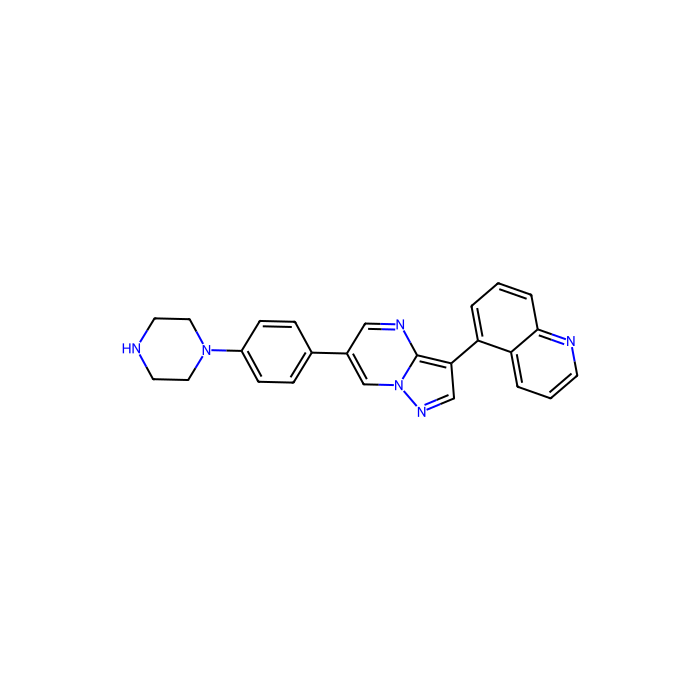
Potent ALK inhibitor (IC50values are 1.3, 2.4, 85.8, 2,133 and 9,276 nM for ALK2, ALK1, ALK3, ALK4 and ALK5, respectively). Exhibits selectivity for ALK2 over ALK4 and ALK5 in cellular assays. Inhibits heterotopic ossification in a mutant ALK2 mouse model
Conditions de stockage de stockage
Store at -20°C
Expédié en
Ice chest + Ice pads
Ce produit nécessite l'expédition en chaîne froide. Les services terrestres et autres services économiques ne sont pas disponibles.
This compound belongs to the class of organic compounds known as phenylpyrimidines. These are polycyclic aromatic compounds containing a benzene ring linked to a pyrimidine ring through a CC or CN bond. Pyrimidine is a 6-membered ring consisting of four carbon atoms and two nitrogen centers at the 1- and 3- ring positions.
External Descriptors
Not available
1. Djoumbou Feunang Y, Eisner R, Knox C, Chepelev L, Hastings J, Owen G, Fahy E, Steinbeck C, Subramanian S, Bolton E, Greiner R, and Wishart DS. ClassyFire: Automated Chemical Classification With A Comprehensive, Computable Taxonomy. Journal of Cheminformatics, 2016, 8:61.
Solvent:2eq.HCl, Max Conc. mg/mL: 20.32, Max Conc. mM: 50
Poids moléculaire
406.500 g/mol
XLogP3
3.300
Hydrogen Bond Donor Count
1
Hydrogen Bond Acceptor Count
5
Rotatable Bond Count
3
Exact Mass
406.191 Da
Monoisotopic Mass
406.191 Da
Topological Polar Surface Area
58.400 Ų
Heavy Atom Count
31
Formal Charge
0
Complexity
587.000
Isotope Atom Count
0
Defined Atom Stereocenter Count
0
Undefined Atom Stereocenter Count
0
Defined Bond Stereocenter Count
0
Undefined Bond Stereocenter Count
0
The total count of all stereochemical bonds
0
Covalently-Bonded Unit Count
1
Calculateurs de solution
Molarity Calculator
Determine the necessary mass, volume, or concentration for preparing a solution.
Dilution Calculator
Determine the dilution needed to prepare a stock solution.
Reconstitution Calculator
Avis
Avis des clients
Application Protocols
Item-specific (from Product Data)
Tested applications, recommended working concentrations, and assay protocols: Not specified for this item; refer to CoA/Spec Sheet.
General use examples (for guidance only; verify experimentally)
Cell-based assays: Prepare a 10 mM DMSO stock; perform serial dilutions to achieve desired final concentrations with a constant vehicle percentage (e.g., 0.1% DMSO). Include vehicle-only and positive/negative controls.
Biochemical assays: Validate solubility in assay buffer at the intended concentration; consider adding a small amount of non-ionic surfactant if acceptable for the readout.
Stability check: Analyze pre- and post-assay samples by LC–MS or UPLC to confirm exposure and rule out compound loss/adsorption.
Documentation
Record lot number, stock concentration, solvent, preparation date, and storage conditions with each experiment to ensure traceability.
Biological Roles
Item-specific (from Product Data)
No biological role/target information is specified for this item; refer to CoA/Spec Sheet.
Literature/general context (no medical/clinical claims)
LDN-212854 is frequently cited as a selective small-molecule modulator within the bone morphogenetic protein (BMP) signaling axis, often used to probe type I receptor-mediated SMAD signaling in cellular systems.
As a chemical biology tool, it serves to transiently and reversibly interrogate pathway function during developmental processes and lineage specification in vitro.
Researchers employ such probes to dissect receptor selectivity, feedback regulation, and crosstalk with TGF-β/Activin pathways using transcriptional reporters, phospho-protein assays, and phenotypic readouts.
Practical considerations
Verify assay window and off-target profiles in your specific cellular context; transporter expression, serum content, and protein binding can shift apparent potency.
Maintain consistent vehicle percentages, exposure times, and cell densities to ensure reproducibility across experiments.
Consider metabolic stability and efflux in long-term culture; periodic medium refresh or pulse-dosing may be required to maintain steady exposure.
Buffer Applications
Applicability
LDN 212854 is not a buffering agent and is not used to prepare buffer systems.
Practical handling in buffered systems (general guidance)
Stocks are typically made in DMSO and diluted into biological buffers or culture media immediately before use. Add compound last, under vigorous mixing, to minimize local supersaturation and precipitation.
Maintain consistent final organic cosolvent content (e.g., 0.05–0.2% DMSO) across control and treated samples.
If precipitation occurs upon dilution, slightly warm the buffer (e.g., 30–37 °C) and add slowly with mixing; consider using serum-containing media or cyclodextrin carriers if compatible with the assay.
Item-specific buffer data
Not specified for this item; refer to CoA/Spec Sheet for any lot-specific solubility notes.
Green Alternatives
Context
For bioactive probes such as LDN 212854, the principal environmental considerations arise from solvent selection, energy-intensive cold storage, and waste minimization rather than synthetic use.
Greener handling strategies (general guidance)
Prefer lower-toxicity solvents for working solutions when compatible with assay biology: ethanol/water blends can sometimes replace higher percentages of DMSO; validate for your system.
Minimize DMSO by preparing higher-concentration master stocks and diluting just-in-time to target media, keeping final DMSO ≤0.1–0.2% v/v when feasible.
Use microscale formats (96/384-well) and pre-aliquoted single-use vials to reduce waste and freeze–thaw cycles.
Consolidate cold storage: store aliquots at −20 °C as required, but avoid unnecessary ultra-low temperatures to reduce energy consumption while maintaining stability.
Comparison of solvent choices (general)
DMSO: Excellent solvency; moderate environmental impact; persistent in aqueous waste.
Ethanol: Renewable feedstock; lower toxicity; volatility can complicate dosing precision.
Aqueous buffers with solubilizing excipients (e.g., cyclodextrins, non-ionic surfactants): Potential to reduce organic solvent use; must be validated for compound compatibility and assay interference.
Waste management
Segregate halogenated and non-halogenated solvent waste streams; use adsorbent packs to capture trace organics from aqueous effluent where required by local regulations.
Pharmaceutical Uses
Applicability
This product is sold for research use only. No medical, clinical, or therapeutic uses are claimed or supported.
Formulation/processing context (general)
In pharmaceutical research settings, small-molecule chemical probes like LDN 212854 can be used as reference comparators or tool compounds during target validation, hit-to-lead studies, and mechanistic investigations.
Typical laboratory formulations include DMSO stocks for in vitro assays and ex vivo studies. Any in vivo formulation development lies outside the scope of this listing and requires specialized safety and PK data.
Compendial status
No pharmacopeial monograph is known for this research-only compound (verify as needed). Any regulatory or GMP application would require independent qualification and documentation.
Item-specific notes
Grade/purity and excipient content: Not specified for this item; refer to CoA/Spec Sheet.
Physical Properties
Item-specific (from Product Data)
Physical state/appearance: Not specified for this item; refer to CoA/Spec Sheet.
Molecular weight: Not specified for this item; refer to CoA/Spec Sheet.
Molecular formula: Not specified for this item; refer to CoA/Spec Sheet.
Melting point: Not specified for this item; refer to CoA/Spec Sheet.
Boiling point: Not applicable (decomposes; solid bioactive compounds are not typically distilled). Specific data not specified for this item; refer to CoA/Spec Sheet.
Solubility: Not specified for this item; refer to CoA/Spec Sheet.
LogP, pKa, refractive index, density: Not specified for this item; refer to CoA/Spec Sheet.
Literature/general guidance
Bioactive small molecules of this class are typically sparingly soluble in water and readily soluble in polar aprotic organic solvents such as DMSO and DMF; ethanol or methanol can be secondary choices. Verify solubility empirically for your lot.
For analytical characterization, reverse-phase HPLC with aqueous-organic gradients (e.g., water/acetonitrile + 0.1% formic acid) and MS detection is commonly employed.
Practical tips
Prepare small test dissolutions (e.g., 1–10 mg/mL) in dry, anhydrous DMSO to assess clarity and stability prior to making assay stocks.
If insolubility or slow dissolution is observed, gentle warming (≤40 °C) and sonication can be used; avoid prolonged heating to prevent degradation.
Record exact solvent, concentration, and any cosolvents used in assay documentation.
Quality and Grades
Item-specific (from Product Data)
Grade/purity: Not specified for this item; refer to CoA/Spec Sheet.
Appearance: Not specified for this item; refer to CoA/Spec Sheet.
How to interpret grade/purity for small-molecule probes (general guidance)
Reference/Screening grade: Typically intended for in vitro/in-cellulo research; purity is often assessed by HPLC/UPLC with UV or MS detection. Verify lot-specific purity and identity on the CoA.
Analytical reference standard quality emphasizes well-defined identity (NMR/LC–MS) and tight impurity control to reduce assay variability.
Low-UV solvent residues and stabilizers are uncommon for this class; if present, they will be listed on the CoA. Absence of such listing implies none specified for this item.
Practical recommendations
Request or download the lot-specific CoA before critical experiments. Confirm assay-relevant attributes (purity basis, residual solvents, water content, and counterion if applicable).
If using in quantitative studies, consider in-house verification by qNMR or LC–MS and establish a correction factor if purity <100%.
Record any stabilizers or salt forms if noted on your lot, as these can affect solubility and potency readouts.
Reaction and Applications
Applicability
This product is supplied as a bioactive small molecule for research screening and chemical biology. It is not typically used as a synthetic reagent or catalyst in preparative organic chemistry.
Item-specific (from Product Data)
Manufacturer applications: Not specified for this item; refer to CoA/Spec Sheet.
Literature/general research applications (no medical/clinical claims)
Employed as a chemical probe in studies interrogating BMP/TGF-β superfamily signaling in developmental biology, stem-cell differentiation, and pathway modulation assays.
Utilized in high-content screening and target-validation experiments to examine pathway-dependent transcriptional readouts.
Incorporated into structure–activity relationship (SAR) panels to benchmark selectivity and potency against related kinase receptors.
Practical usage tips
Prepare fresh or thawed aliquots immediately before use to minimize potency drift.
Include vehicle controls matched for DMSO/organic cosolvent content to isolate compound-specific effects.
Establish dose–response curves spanning at least one order of magnitude above and below expected activity; verify with orthogonal readouts where possible.
Reaction Conditions
Applicability
Not typically applicable. This product is not intended for use as a reagent in named organic reactions or catalytic processes.
Item-specific reaction data
Not specified for this item; refer to CoA/Spec Sheet.
General guidance for laboratory use
For solution preparation, common practice is dissolution in anhydrous DMSO at defined concentrations (e.g., 10 mM) and dilution into assay media immediately before use. Verify chemical stability under your assay temperature and light conditions.
Avoid prolonged exposure to strong acids/bases or oxidants that may degrade the compound.
Literature context
Any reported stability or degradation pathways should be confirmed from primary literature or by in-house stress testing (e.g., LC–MS after incubation at 37 °C in assay buffer for 24–48 h).
Safety and Handling
Item-specific (from Product Data)
GHS classification, signal word, hazard statements, pictograms: Not specified for this item; refer to SDS.
Storage: Store at −20 °C (per Product Data). Shipped on ice with ice pads.
General laboratory safety (defer to SDS for authoritative guidance)
PPE: Wear lab coat, safety glasses, and appropriate chemically resistant gloves. Handle powders in a fume hood to minimize inhalation exposure.
Avoid ingestion, inhalation of dust/aerosols, and skin/eye contact. Wash thoroughly after handling.
Incompatibilities (general): Strong oxidizers and strong acids/bases may degrade organic small molecules; keep away from moisture and light unless data indicate stability.
First aid (general): In case of contact, rinse affected area with water for at least 15 minutes; remove contaminated clothing. If inhaled, move to fresh air. Seek medical attention according to institutional protocols.
Spill response: Avoid dust generation. Collect using inert absorbent or HEPA-filtered vacuum. Dispose per institutional and local regulations.
Waste: Accumulate in compatible organic waste containers; label with contents and hazards.
Special considerations for bioactive probes
Treat as potentially potent and biologically active; minimize exposure and environmental release.
Prepare and open vials at room temperature to avoid condensation ingress; promptly recap and return to cold storage.
Solvent Selection
Item-specific (from Product Data)
No solvent recommendations are specified for this item; refer to CoA/Spec Sheet.
Literature/general guidance for dissolving bioactive small molecules like LDN 212854
Primary stock solvent: Anhydrous DMSO is commonly used to prepare concentrated stocks (e.g., 10–50 mM), owing to high solvating power and compatibility with biological assays at low final percentages.
Secondary options: DMF, ethanol, or methanol can be employed when DMSO is not suitable. Aqueous buffers typically require cosolvent and/or surfactant (e.g., ≤1% DMSO or 0.1–0.5% Tween-80) for clear solutions.
Aqueous compatibility: Most kinase-pathway inhibitors show poor intrinsic water solubility; gradual dilution of DMSO stocks into warmed buffer with vigorous mixing helps prevent precipitation.
Adsorption: To minimize loss to plastics, use low-binding tubes and add compound last to protein-containing media to leverage carrier effects (serum/albumin may increase apparent solubility).
Practical notes
Filter sterilization (0.22 μm PTFE) is preferred for cell-based work after dilution into medium if chemically stable.
Avoid repeated freeze–thaw of DMSO stocks; dispense single-use aliquots.
Comparison (general)
DMSO: Highest solvency; may affect cells above 0.1–0.5% v/v.
Ethanol: Volatile; tolerable in many assays up to ~0.5–1% v/v.
Aqueous buffer alone: Typically insufficient without cosolvent; risk of precipitation.
Storage and Reconstitution
Item-specific (from Product Data)
Storage condition: Store at −20 °C.
Shipping condition: Ice chest with ice pads.
Reconstitution and handling (general guidance; verify for your application)
Upon receipt, allow the sealed container to equilibrate to room temperature before opening to prevent moisture condensation.
Prepare concentrated stocks in anhydrous DMSO (common practice for bioactive small molecules). Typical lab stocks are 10–50 mM; adjust to your assay’s needs.
Aliquot into low-binding microtubes to create single-use portions; flush headspace with inert gas if long-term storage is anticipated.
Store aliquots at −20 °C or below, protected from light. Avoid repeated freeze–thaw cycles; discard aliquots showing precipitation, discoloration, or unexpected LC–MS/HPLC profiles.
For working solutions, dilute the DMSO stock into pre-warmed buffer or culture medium with vigorous mixing, maintaining constant final DMSO across controls and treatments.
Stability notes
Long-term stability, hygroscopicity, and light sensitivity: Not specified for this item; refer to CoA/Spec Sheet and SDS.
If assay timelines exceed 24–48 h, confirm stability under assay conditions by analytical testing.
Research use
For research use only. Not for human or veterinary use.
Structure and Identity
Item-specific (from Product Data)
Product name: LDN 212854 (SKU: L286865)
CAS: 1432597-26-6
PubChem CID: 60182388
InChIKey: 20225 (as provided)
SMILES: Not specified for this item; refer to CoA/Spec Sheet.
Molecular formula: Not specified for this item; refer to CoA/Spec Sheet.
Molecular weight: Not specified for this item; refer to CoA/Spec Sheet.
Literature/general notes (for context only)
LDN-212854 is described in the literature as a small-molecule BMP type I receptor pathway inhibitor used as a chemical probe in developmental and stem-cell biology studies. Detailed 2D structure and definitive identifiers should be verified from primary databases (e.g., PubChem, vendor CoA).
Typical structural features reported in the literature for this chemotype include heteroaromatic rings and H-bond acceptor/donor motifs consistent with kinase-binding scaffolds; consult primary references for exact functional groups.
Practical identity guidance
Always match CAS and supplier lot-specific CoA before use in regulated or data-critical work.
If preparing analytical reference solutions, confirm identity by orthogonal techniques (e.g., LC–MS exact mass, HPLC purity profile, NMR) using conditions suited to your laboratory.
Synthetic Utility
Applicability
LDN 212854 is provided as a finished bioactive small molecule, not as a building block or reagent. It is not typically employed as a substrate, catalyst, or ligand in synthetic transformations.
General chemistry perspective
While not generally used in synthesis, users may derivatize related scaffolds for SAR exploration. Any modification of this item would constitute custom chemistry beyond the intended catalog use.
Item-specific synthetic roles
Not specified for this item; refer to CoA/Spec Sheet.
Practical note
If you require intermediates or analog-friendly functional handles for medicinal chemistry programs, consider procuring precursor scaffolds or custom synthesis services rather than repurposing an assay-grade reference compound.
Target Specificity
Item-specific (from Product Data)
Target, selectivity profile, Ki/IC50 values, species reactivity, and off-target panel: Not specified for this item; refer to CoA/Spec Sheet.
Note
For research planning, consult primary literature and internal validation data to confirm selectivity in your assay context. This tab intentionally lists only product-specific information, which is not provided in this listing.
We use cookies to ensure the website functions properly and, where permitted, to improve your experience. You can manage your preferences at any time in Settings. Learn more in our Cookie Policy.
Shall we send you a message when we have discounts available?
Remind me later
Thank you! Please check your email inbox to confirm.
Products are supplied to verified businesses, institutions, and qualified professionals for research and development use only. Not for use in humans, animals, diagnosis, or therapy.

 K2221009