QUALITÉ & PURETÉMoligand™?Moligand™ — Aladdin's line of ligands and bioactive small molecules. Use for receptor, pathway, and binding studies needing defined small-molecule tools.≥99%
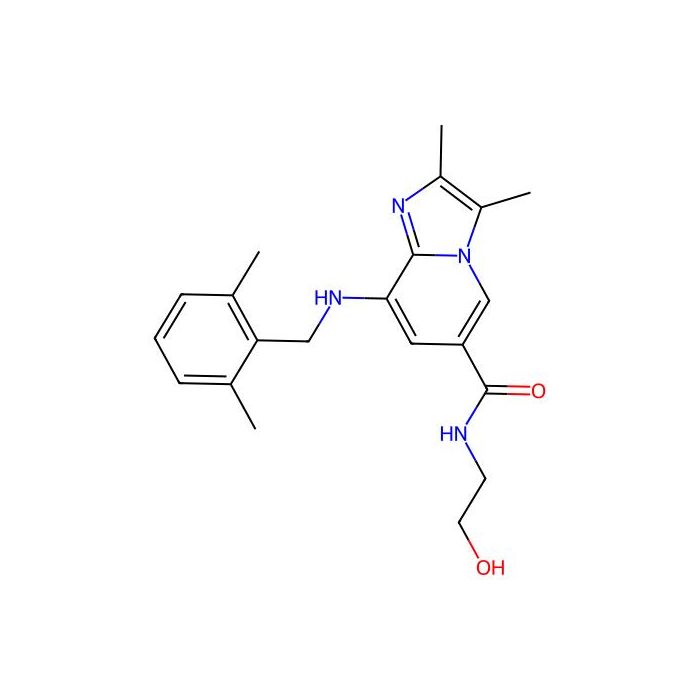
Linaprazan (AZD0865) inhibits gastric H+,K+-ATPase by K+-competitive binding. (IC50: 1.0 ± 0.2 μM)It is a acid-suppressing agents with rapid onset of action and potent acid inhibition.In vitro: Linaprazan can inhibit the final step in acid secretion. Linaprazanreduced porcine renal Na+,K+-ATPase activity by 9 ± 2%, demonstrating a high selectivity for H+,K+-ATPase.In vivo: The reference for animal administration is 0.5-1.0 mg/kg. The greater degree of acid suppression with the 75-mg dose of Linaprazan would translate to a healing rate of 89% at 4 weeks.
Linaprazan (AZD0865) inhibits gastric H+,K+-ATPase by K+-competitive binding. (IC50: 1.0 ± 0.2 μM)\nIt is a acid-suppressing agents with rapid onset of action and potent acid inhibition. \nIn vitro: Linaprazan can inhibit the final step in acid secretion
Conditions de stockage de stockage
Store at -20°C,Argon charged,Desiccated
Expédié en
Ice chest + Ice pads
Ce produit nécessite l'expédition en chaîne froide. Les services terrestres et autres services économiques ne sont pas disponibles.
Certificats (CoA, COO, BSE/TSE et tableau d'analyse)
C of A & Other Certificates(BSE/TSE, COO):
Analytical Chart:
Propriétés chimiques et physiques
Solubilité
DMSO : ≥ 35 mg/mL (95.51 mM)
Poids moléculaire
366.500 g/mol
XLogP3
3.400
Hydrogen Bond Donor Count
3
Hydrogen Bond Acceptor Count
4
Rotatable Bond Count
6
Exact Mass
366.206 Da
Monoisotopic Mass
366.206 Da
Topological Polar Surface Area
78.700 Ų
Heavy Atom Count
27
Formal Charge
0
Complexity
493.000
Isotope Atom Count
0
Defined Atom Stereocenter Count
0
Undefined Atom Stereocenter Count
0
Defined Bond Stereocenter Count
0
Undefined Bond Stereocenter Count
0
The total count of all stereochemical bonds
0
Covalently-Bonded Unit Count
1
Calculateurs de solution
Molarity Calculator
Determine the necessary mass, volume, or concentration for preparing a solution.
Dilution Calculator
Determine the dilution needed to prepare a stock solution.
Reconstitution Calculator
Avis
Avis des clients
Application Protocols
No manufacturer‑verified protocols are provided for this item. The following are general, field‑tested workflows for small‑molecule tools used in biochemical and cell‑based assays. Optimize for your system.
Stock preparation and handling:
Prepare a 10 mM stock in anhydrous DMSO. Aliquot (e.g., 50–200 µL) into amber vials and store at −20°C. Avoid repeated freeze–thaw; thaw only what is needed.
Biochemical ATPase assay (general outline):
Buffer: choose MES/MOPS/HEPES containing Mg2+ and K+ per assay design. Maintain pH appropriate for the ATPase prep.
Add compound by serial dilution to achieve a concentration range spanning at least three logs (e.g., 1 nM to 30 µM), keeping final DMSO ≤0.5% v/v.
Initiate with ATP; incubate at controlled temperature. Quantify activity via inorganic phosphate detection or coupled assays. Include vehicle controls and known reference inhibitor if available.
Cell‑based assay (general outline):
Prepare dosing solutions in complete media with ≤0.1–0.2% DMSO. Pre‑screen for cytotoxicity/vehicle tolerance.
Evaluate pathway modulation or reporter readouts after defined exposure periods; confirm compound stability in media over the assay window.
LC‑MS quantitation (general outline):
Extract samples with ACN or MeOH (protein precipitation). Analyze on RP‑LC with ESI‑MS; use an internal standard. Validate linearity, precision, and accuracy.
These are generic starting points; adhere to institutional SOPs and adjust for your enzyme source, cell line, and detection method.
Biological Roles
Role class (literature/general): Linaprazan is reported in the literature as a potassium‑competitive acid pump blocker (P‑CAB) designed to interact with the gastric H+/K+-ATPase, the membrane P‑type ATPase responsible for acid secretion in gastric parietal cells.
Mechanistic context (biochemistry, not medical claims):
P‑CABs typically bind to the luminal side of the H+/K+-ATPase and inhibit proton translocation by competing with K+. The inhibition is generally reversible and does not require acid activation (unlike benzimidazole‑type covalent proton pump inhibitors), enabling kinetic studies at defined pH and K+ concentrations.
In vitro, inhibition can be tracked via ATPase activity assays (Pi release), membrane potential readouts, or proton flux assays in vesicle or cell systems.
Pathway considerations:
Modulation of H+/K+-ATPase activity influences transmembrane proton gradients and intracellular pH homeostasis, with downstream effects on ion exchange and membrane transport.
Selectivity versus other P‑type ATPases (e.g., Na+/K+-ATPase, Ca2+-ATPase) is an important dimension of biochemical profiling to interpret on‑target versus off‑target effects.
Research utilities:
Serves as a reference tool for target validation, SAR benchmarking within the P‑CAB class, and assay development (e.g., optimization of pH, K+/Mg2+ levels, and membrane preparations).
Note: This information reflects general literature descriptions of the P‑CAB class. Item‑specific biological activity data (potency, selectivity, kinetics) are not provided in this listing; consult primary literature or generate in‑house data.
Buffer Applications
Linaprazan is not a buffering reagent and is not used to establish a defined pH range. However, buffer composition strongly impacts its handling and activity in biochemical assays.
Practical guidance (general):
Choose buffers that support H+/K+-ATPase assays (e.g., MES, MOPS, HEPES) with controlled pH (often mildly acidic to neutral, depending on the assay format) and include requisite ions (K+, Mg2+) for ATPase function.
Maintain a low final co‑solvent content (DMSO or ethanol typically ≤0.1–1% v/v) to avoid perturbing enzyme kinetics.
If precipitation occurs upon dilution into aqueous buffer, increase the dilution factor of the organic stock, add a small percentage of compatible co‑solvent, or incorporate solubilizers (e.g., HP‑β‑CD) after compatibility checks.
For vesicle or membrane preparations, add the compound last to pre‑equilibrated buffer to minimize adsorption and precipitation.
Because this compound is not a pH buffer, no pKa‑based recipes or buffering ranges are provided here. Refer to your assay protocol and validate compound stability at the chosen pH and ionic strength.
Green Alternatives
Because Linaprazan is used primarily as a research tool compound rather than a process solvent or reagent, “green alternatives” focus on solvent choices for dissolution, assay preparation, and workup.
Greener solvent choices for stocks and dilutions (general guidance):
Prefer ethanol or isopropanol over DMF/NMP when feasible; limit to concentrations that maintain solubility and assay performance.
Keep DMSO levels in working assays as low as practical (≤0.1–0.5% v/v where compatible) to reduce cytotoxicity and environmental load.
For extractions or cleanup, consider ethyl acetate or methyl tert‑butyl ether (MTBE) rather than chlorinated solvents when compatible with the compound’s polarity.
Small comparison (general; not item specifications):
| Use case | Greener option | Trade‑offs |
| --- | --- | --- |
| High‑concentration stock | Ethanol | May not reach mM‑level solubility; volatility affects dose accuracy |
| Maximum solubility | DMSO (benchmark) | Good lab safety, but not “green”; limit final % in assays |
| Sample cleanup | EtOAc, MTBE | Lower density, easier phase separation; may extract water |
| Aqueous enhancement | HP‑β‑cyclodextrin | Adds excipient to system; may affect biophysical readouts |
Operational tips:
Use minimal solvent volumes, employ closed vials to limit VOC emissions, and scale experiments appropriately.
Plan waste segregation to avoid halogenated solvent streams when possible.
Pharmaceutical Uses
No pharmacopeial grade or excipient role is specified for this item; it is supplied strictly for research use only (product data). The following points describe laboratory‑scale, non‑clinical uses relevant to pharmaceutical R&D without making therapeutic claims.
Typical R&D roles (general):
Analytical reference standard during method development (HPLC‑UV/LC‑MS), including specificity, linearity, and stability‑indicating separations.
Positive control or benchmark tool in biochemical assays targeting gastric H+/K+-ATPase for discovery screening and SAR comparison.
Preformulation investigations (research context): solubility profiling versus pH, co‑solvent, and cyclodextrin; salt‑form exploration; forced degradation studies to map stress liabilities (acid/base, oxidative, thermal, photolytic).
Formulation development (exploratory, non‑clinical):
Preparation of small‑scale solution or suspension vehicles suitable for in vitro work. Selection guided by solvent limits, compound solubility, and assay requirements.
Regulatory status: Not specified for this item; refer to CoA/Spec Sheet and SDS. No claims of compliance with USP/EP/JP monographs are made in this listing.
Researchers must ensure all uses remain within laboratory research scope and comply with institutional safety and regulatory policies.
Physical Properties
Item-specific physicochemical specifications (BP, MP, density, solubility limits, logP, pKa, refractive index) are not provided in the product data.
Item-specific values
Melting point: Not specified for this item; refer to CoA/Spec Sheet.
Boiling point: Not specified for this item; refer to CoA/Spec Sheet.
Density: Not specified for this item; refer to CoA/Spec Sheet.
UV/Vis characteristics: Not specified for this item; refer to CoA/Spec Sheet.
Water content, metal limits, residual solvents: Not specified for this item; refer to CoA/Spec Sheet.
General expectations for small, lipophilic screening compounds (literature/general guidance; not item specifications):
Many P‑CAB scaffolds are moderately to highly lipophilic with low intrinsic aqueous solubility at neutral pH, but dissolve readily in polar aprotic media such as DMSO or DMF.
Apparent solubility in water‑based assay buffers can often be improved by co‑solvents (≤1–2% DMSO v/v), pH adjustment (if basic/ionizable centers are present), or complexation (e.g., hydroxypropyl‑β‑cyclodextrin), subject to assay compatibility.
Thermal behavior is typically that of an organic crystalline solid; avoid overheating or extended exposure to elevated temperatures during weighing and solution prep.
Note: For experimental values and acceptance criteria that govern batch release, always consult the lot‑specific CoA/Spec Sheet supplied with the product.
Quality and Grades
Grade/Purity: Not specified for this item; refer to CoA/Spec Sheet.
Appearance: Not specified for this item; refer to CoA/Spec Sheet.
Research Use Note (product data): For research use only. Not for human or veterinary use, diagnostic procedures, or food applications.
How to interpret grade and documentation (guidance):
CoA/Spec Sheet (lot‑specific): Provides analytical acceptance criteria and results (e.g., identity confirmation, purity by HPLC/LC‑MS, residual solvents). When present, these define release specifications for the exact lot you receive and supersede general catalog statements.
Identity confirmation: For small molecules, identity is typically supported by MS and/or NMR; some lots may also include FT‑IR or elemental analysis (refer to CoA for your lot).
Purity reporting: Chromatographic purity (e.g., HPLC area%) is commonly used for screening compounds; threshold and method conditions vary—consult the CoA for details such as column, mobile phase, detection wavelength, and run time.
Stabilizers/additives: Not specified for this item; refer to CoA/Spec Sheet. If present, stabilizers will be disclosed on the CoA and may influence downstream assays.
Batch‑to‑batch consistency: Store under the recommended conditions (−20°C, protected from moisture/light) and minimize freeze–thaw to maintain consistency across experiments.
If you require a specific grade (e.g., ≥98% HPLC, LC‑MS qualified, salt form), contact Technical Support with your SKU and desired specifications.
Reaction and Applications
This product is primarily intended as a screening/assay compound rather than a synthetic reagent. No manufacturer reaction use is specified. The following outlines research applications relevant to small‑molecule tool compounds.
Biochemical applications (literature/general):
Evaluation in enzyme inhibition assays pertinent to gastric H+/K+-ATPase (P‑CAB class association in literature). Enables determination of potency, reversibility, and mechanism (e.g., K+-competitive behavior) under defined ionic conditions.
Off‑target profiling against related P‑type ATPases to assess selectivity (e.g., Na+/K+-ATPase), monitored by phosphate release or ATP hydrolysis assays.
Cellular applications:
Use in cell‑based models expressing the target ATPase or reporter systems to quantify pathway modulation. Control for DMSO vehicle and assay pH/ionic strength.
ADME/analytical studies:
Suitable as a reference compound for method development (LC‑MS, stability indicating HPLC), microsomal stability, and permeability assays (e.g., PAMPA, Caco‑2), following institutional SOPs.
Practical tips:
Prepare concentrated DMSO stocks (e.g., 10 mM) and store aliquots at −20°C to minimize freeze–thaw.
Filter or centrifuge working dilutions if haze/precipitation appears to avoid assay interference.
Confirm identity/purity by LC‑MS before critical experiments; monitor for degradation under assay conditions (temperature, light, pH).
Note: No named synthetic reactions are recommended for this item; treat it as a finished tool compound for discovery workflows.
Reaction Conditions
No synthetic reaction conditions are specified for this catalog item; it is intended for use as a characterized small‑molecule standard in assays and analytics. The following practical conditions pertain to solution preparation and analytical method setup (general guidance only):
Stock solution preparation:
Dissolve in anhydrous DMSO to 10–50 mM as solubility permits. Sonication and gentle warming (≤40°C) can expedite dissolution. Filter through a 0.22 µm PTFE membrane if particulate persists.
For ethanol stocks, expect lower solubility; cap tightly to limit evaporation and concentration drift.
Working solutions for biochemical assays:
Dilute stock into assay buffer to a final organic solvent content typically 0.1–1% v/v. Mix thoroughly to avoid localized supersaturation; prepare fresh before use when possible.
LC‑MS/HPLC method development (general):
Reversed‑phase C18 columns with water/acetonitrile (or methanol) mobile phases containing 0.1% formic acid or ammonium formate are commonly effective for small lipophilic analytes.
Start with linear gradients (5–95% organic, 10–20 min) and tune based on retention and peak shape. Monitor for carryover with needle wash and strong wash steps due to compound hydrophobicity.
Stability checks:
Assess freeze–thaw stability of DMSO aliquots and short‑term bench stability in the chosen buffer. Protect solutions from light and moisture.
These conditions are advisory and should be optimized for your specific assay or analytical platform.
Safety and Handling
Hazard classification (product data):
Signal word: Not specified for this item; refer to SDS.
H‑statements: Not specified for this item; refer to SDS.
GHS classification/pictograms: Not specified for this item; refer to SDS.
Storage and shipping (product data):
Store at −20°C in a tightly closed container. Shipments are provided in an ice chest with ice pads to preserve quality.
General laboratory precautions (good practice; defer to SDS for authoritative guidance):
Handle in a fume hood or well‑ventilated area. Avoid inhalation of dust, ingestion, and skin/eye contact.
Recommended PPE: lab coat, safety glasses, and suitable gloves (e.g., nitrile). Use dust control practices when weighing.
Avoid incompatible conditions typical for organic compounds: strong oxidizers, strong acids/bases (if instability is suspected), and prolonged exposure to heat, light, or moisture.
In case of contact: rinse skin with water and remove contaminated clothing; flush eyes with water for several minutes; if inhaled, move to fresh air. Seek medical attention per SDS instructions.
Spill/cleanup:
Avoid raising dust; collect mechanically and dispose of according to institutional and local regulations for organic laboratory chemicals.
Waste:
Dispose via approved organic waste streams. Do not release to drains.
Always consult the product SDS for definitive hazard statements, first‑aid measures, firefighting procedures, and regulatory information for your jurisdiction.
Solvent Selection
Linaprazan is supplied as a research small molecule; item‑specific solubility limits are not provided. The following guidance supports solution preparation for screening and assay work.
Primary stock solvents (general practice; verify compatibility with your assay):
DMSO: Preferred for high‑concentration stocks (e.g., 10–50 mM) due to broad solubilizing power for lipophilic heteroaromatics.
DMF or NMP: Alternatives when DMSO is undesirable; consider cytotoxicity and background in bioassays.
Ethanol (absolute) or isopropanol: Greener options for lower‑concentration stocks; may require warming/sonication.
Aqueous use:
Prepare a concentrated organic stock, then dilute into buffer to a final co‑solvent of 0.1–1% v/v (as permitted by the assay). Gentle vortexing and immediate use reduce precipitation.
If the molecule is basic/ionizable (literature for P‑CAB class suggests basic centers), limited acidification of buffer (e.g., to pH 5.5–6.5) can improve apparent solubility, subject to target stability.
Surfactants/solubilizers:
Nonionic surfactants (e.g., 0.01–0.1% Tween‑80) or complexants (e.g., 1–5% HP‑β‑CD) can reduce aggregation in biochemical assays; validate for target compatibility.
Comparison (general):
DMSO: Maximum solubility, excellent stability; may affect some enzyme kinetics above 1–2%.
Ethanol: Lower toxicity than DMF; volatility can alter concentrations—cap promptly.
Aqueous only: Typically limited by hydrophobicity; risk of precipitation on dilution.
Note: Determine actual solubility for your lot empirically. For definitive limits and salt form, consult the CoA/Spec Sheet.
Storage and Reconstitution
Storage conditions (product data): Store at −20°C.
Shipping (product data): Shipped in an ice chest with ice pads to maintain product integrity during transit.
Container considerations: Keep tightly sealed in original packaging. Use desiccant if available to limit moisture ingress. Protect from light to reduce risk of photodegradation.
Reconstitution (general guidance; not item‑specific specs):
For stock solutions, dissolve in dry DMSO to the desired concentration (e.g., 10–50 mM). Sonication and brief warming (≤40°C) may assist dissolution. Record exact concentration for traceability.
If preparing aqueous working solutions, add the DMSO stock to buffer slowly with vigorous mixing to minimize precipitation. Target a final co‑solvent level of 0.1–1% v/v as allowed by your assay.
Aliquoting and stability:
Aliquot stocks to single‑use volumes to avoid repeated freeze–thaw. Store aliquots at −20°C in amber vials. Avoid frost‑free freezers with auto‑defrost cycles.
Short‑term bench stability should be verified empirically; discard solutions showing precipitation or discoloration.
Documentation: Retain lot number and any accompanying CoA/Spec Sheet. Note preparation date, solvent, and concentration on each aliquot.
Note: If the product is supplied as a particular salt form or with stabilizers, this will be indicated on the CoA/Spec Sheet. Always defer to lot‑specific documentation where available.
Structure and Identity
Brief overview: Linaprazan (SKU: L648359) is a research‑use small molecule supplied for screening and chemical biology applications.
Item identifiers (product data)
CAS: 248919-64-4
SKU: L648359 (Aladdin Scientific)
Category: Small molecules and compound libraries (全部 / 可售 / 小分子和化合物库)
Storage directive: Store at −20°C (product data)
Shipped on: Ice chest + ice pads (product data)
External identifier (literature):
PubChem CID: 9951066 (literature/database)
Not specified for this item; refer to CoA/Spec Sheet.
Molecular formula: Not specified for this item; refer to CoA/Spec Sheet.
Molecular weight: Not specified for this item; refer to CoA/Spec Sheet.
SMILES: Not specified for this item; refer to CoA/Spec Sheet.
InChIKey: Not specified for this item; refer to CoA/Spec Sheet.
Structural features (general literature description without structural claims):
Reported in the literature as a small‑molecule potassium‑competitive acid pump blocker (P‑CAB) scaffold designed to interact with the gastric H+/K+-ATPase. Specific ring systems and stereochemistry are not provided for this item; consult the CoA/Spec Sheet or primary literature for definitive structure drawings.
2D structure (descriptive): Not provided in this listing. Users should consult a reliable structure database (e.g., PubChem CID above) or the product CoA for bond connectivity and functional group details.
Synthetic Utility
This product is offered as a finished small‑molecule tool compound rather than a synthetic building block; no manufacturer guidance is provided for using it as a reagent or intermediate.
When relevant in discovery chemistry (general):
It may serve as a reference scaffold for structure–activity relationship (SAR) comparisons, guiding design of analogs within the P‑CAB chemical space.
Derivatization strategies (general concepts): exploration of ring substitution patterns, basic center modulation (to tune pKa/solubility), and heteroatom isosteres to alter potency and selectivity. Such work requires access to the corresponding synthetic route and intermediates, which are not provided here.
Analytical leverage in synthesis workflows:
Use as a co‑injected standard during LC‑MS method development to benchmark retention behavior and ionization efficiency for series members.
Stability mapping under synthetic workup conditions (aqueous acid/base, extraction solvents) can inform protecting group and quench choices for related analog syntheses.
Because no structural details, functional group set, or reactivity data are specified in this listing, no named transformations or protective group strategies are proposed for this item. Consult primary literature for synthetic routes to the linaprazan scaffold if derivatization is intended.
Target Specificity
Primary target (literature/general): The gastric H+/K+-ATPase (proton pump), a P‑type ATPase responsible for acid secretion in gastric parietal cells.
Mode of interaction (literature for P‑CAB class): Potassium‑competitive and reversible inhibition affecting the luminal ion‑binding/translocation steps of the enzyme. Activity can be modulated by extracellular K+, pH, and membrane environment.
Selectivity considerations:
Profiling against related P‑type ATPases (e.g., Na+/K+-ATPase, Ca2+-ATPase) is recommended to quantify selectivity margins and off‑target risk in biochemical settings.
Species/cross‑reactivity:
The catalytic machinery of P‑type ATPases is conserved; however, quantitative potency can vary across species and assay formats. Empirical determination in the species/model of interest is advised.
Item-specific target data:
Not specified for this item; refer to CoA/Spec Sheet and primary literature for any quantitative metrics (e.g., IC50, Ki, kinetics).
This section summarizes general literature context for the class; it does not constitute a claim of specific potency or selectivity for the supplied lot.
Besoin d'aide pour choisir la qualité ?
Notre guide de sélection des qualités couvre la pureté, le statut du stabilisant et l'adéquation à l'application pour toutes les variantes de notre catalogue.
Nous utilisons des cookies pour garantir le bon fonctionnement du site et, lorsque cela est autorisé, pour améliorer votre expérience. Vous pouvez gérer vos préférences à tout moment dans les Paramètres. Pour en savoir plus, consultez notre Politique relative aux cookies.
Souhaitez-vous que nous vous envoyions un message lorsque des réductions seront disponibles?
Me rappeler plus tard
Merci ! Veuillez vérifier votre boîte de réception e-mail pour confirmer.
Products are supplied to verified businesses, institutions, and qualified professionals for research and development use only. Not for use in humans, animals, diagnosis, or therapy.