GRADE & PURITYAR?Analytical Reagent grade — high-purity chemicals meeting strict assay limits for lab analysis. Use when accuracy matters and trace impurities could skew results.≥99%
Alkali metal sulfate - Inorganic lithium salt - Inorganic oxide - Inorganic salt
Description
This compound belongs to the class of inorganic compounds known as alkali metal sulfates. These are inorganic compounds in which the largest oxoanion is sulfate, and in which the heaviest atom not in an oxoanion is an alkali metal.
External Descriptors
Not available
1. Djoumbou Feunang Y, Eisner R, Knox C, Chepelev L, Hastings J, Owen G, Fahy E, Steinbeck C, Subramanian S, Bolton E, Greiner R, and Wishart DS. ClassyFire: Automated Chemical Classification With A Comprehensive, Computable Taxonomy. Journal of Cheminformatics, 2016, 8:61.
Determine the necessary mass, volume, or concentration for preparing a solution.
Dilution Calculator
Determine the dilution needed to prepare a stock solution.
Reconstitution Calculator
Avis
Avis des clients
Application Protocols
No manufacturer-validated application protocols were provided for this item. The following are general literature-style procedure outlines; adapt to your system and verify experimentally.
Preparation of 1.00 M Li2SO4 (monohydrate) aqueous solution (literature/general)
Calculate required mass using MW for monohydrate (~127.96 g/mol, literature) or your lot-specific assay/LOD.
Dissolve in ~70% of final volume of DI water with stirring. Bring to volume, mix thoroughly, and filter (0.22–0.45 µm) if needed.
Store at room temperature; for sensitive assays, prepare fresh or verify conductivity/assay periodically.
Protein crystallization screen component (literature)
Prepare concentrated stocks (e.g., 2–3 M) and mix with buffered protein solutions to reach desired final concentrations (0.2–3.0 M).
Use vapor diffusion (hanging/sitting drop) with 1:1 to 1:3 protein:reservoir ratios as a starting point. Monitor for precipitation/crystal growth.
Precipitation of BaSO4 for sulfate test (literature)
Mix aqueous sample with an excess of soluble Ba2+ salt under stirring. Observe immediate formation of a dense white precipitate indicating sulfate presence. Filter, wash, and, if needed, ignite to constant mass for gravimetry.
Note
These outlines are not product-validated methods. Confirm compatibility and purity requirements from the CoA/Spec Sheet.
Biological Roles
General biochemical context (literature; non-clinical)
Lithium ion (Li+) is not an essential micronutrient but is known to interact with enzymes and signaling pathways in vitro, often by competing with Mg2+ in certain phosphotransfer reactions. Such effects are concentration-dependent and system-specific.
Sulfate (SO4²−) is a highly kosmotropic anion that influences protein solubility and stability through Hofmeister series effects. In aqueous solutions, sulfate tends to stabilize water structure and promote “salting out.”
Laboratory relevance
Protein crystallization: Lithium sulfate is frequently included in screening matrices for macromolecular crystallography where ionic strength and kosmotropic effects modulate nucleation and growth.
Ionic strength control: In enzymology or biophysical assays where a non-complexing background electrolyte is desired, lithium sulfate solutions can provide predictable conductivity and minimal specific binding relative to many multivalent salts.
Cautions
At high concentrations, lithium salts can perturb biological systems; design controls for ion-specific effects and osmolarity.
Avoid extrapolating in vitro observations to biological or clinical effects; this product is for research use only (per Product Data).
Note
No organism-specific metabolic roles are attributed to lithium sulfate; sulfate anion participates broadly in sulfur assimilation pathways in biology, but as inorganic sulfate it is generally inert under typical assay conditions without transport or activation.
Buffer Applications
Lithium sulfate monohydrate does not constitute a buffering system. However, it is valuable for adjusting ionic strength and as a precipitant in certain workflows.
Ionic strength adjustment (literature/general)
Use in conjunction with true buffers (e.g., Tris, HEPES, phosphate) to set ionic strength without introducing coordinating anions. Typical working concentrations in biochemical assays: 10–300 mM, depending on assay tolerance.
Protein crystallization/precipitation
Lithium sulfate is commonly employed as a precipitant in sparse-matrix screens. Practical concentration windows: 0.2–3.0 M (literature). Combine with buffers spanning pH 4–9 and additives (polyols/salts) to explore phase space.
Recipe hints (general)
Prepare a sterile-filtered stock (e.g., 2–3 M) in water; mix with buffered protein solutions to target final ionic strength. Confirm osmolarity for sensitive systems.
Account for the monohydrate when calculating molarity.
Not a buffer
pH control must be provided by a legitimate buffering agent. Sulfate has negligible buffering capacity in the physiological to alkaline range.
Green Alternatives
Context: Lithium sulfate monohydrate is an inorganic salt used chiefly in water-based systems. Greenness considerations revolve around solvent choice, cation/anion selection, and lifecycle.
Comparative options (literature/general)
Sodium sulfate (Na2SO4) or potassium sulfate (K2SO4): Similar sulfate chemistry with more abundant cations; may be greener from a resource perspective. However, Li+ can exhibit unique effects on solubility and crystallization.
Ammonium sulfate ((NH4)2SO4): Highly water-soluble, widely used in protein precipitation; volatile counterion facilitates removal by basification/evaporation but can affect pH.
Tradeoffs
Performance: Lithium salts can provide distinct ionic strength and Hofmeister effects beneficial for certain crystallizations and electrochemical studies; substituting Na+/K+ may alter outcomes.
Environmental aspect: Sulfate is generally low-toxicity and environmentally benign at modest concentrations, but lithium sourcing bears upstream environmental considerations. Waste minimization and recovery of aqueous salt streams improve sustainability.
Practical greener choices
Use water as the primary solvent wherever feasible.
Optimize ionic strength to the minimum effective concentration to reduce salt load in effluent.
For non-critical lithium-specific effects, consider Na2SO4 or K2SO4 to reduce reliance on lithium resources.
Small comparison (literature; qualitative)
Li2SO4·H2O: Strong salting-out, small cation radius, good conductivity in water.
Na2SO4/K2SO4: Often cheaper, abundant, lower supply-chain impact; different crystallization profiles.
(NH4)2SO4: Excellent protein precipitant; easier removal via volatility control.
Pharmaceutical Uses
No therapeutic or clinical claims are made for this product. The following relates solely to potential roles in formulation research and manufacturing (literature/general):
Excipient/formulation research
Osmotic/ionic-strength modifier in aqueous formulations or process streams where a non-coordinating anion is desirable.
Crystallization process aid for screening salt forms of drug substances or for protein crystallography in structural biology supporting drug discovery.
Processing utilities
Reference electrolyte for conductivity calibration or process monitoring in water systems.
Compendial status
Pharmacopoeial monographs may exist for lithium sulfate (anhydrous) in some compendia, but specific pharmacopeial grade or compliance for this monohydrate product is Not specified for this item; refer to CoA/Spec Sheet.
Extractables/leachables and trace impurities
For GMP-leaning research, assess trace metals and anion contaminants; item-specific impurity limits are Not specified for this item; refer to CoA/Spec Sheet.
Note
Use is limited to research laboratory work per Product Data (Research Use Only). Suitability for pharmaceutical manufacturing must be established independently.
Physical Properties
Item-specific physical properties
Appearance: Not specified for this item; refer to CoA/Spec Sheet.
Storage conditions (from Product Data): Room temperature
Shipping: Normal
Any other specifications (bp, mp, density, water/peroxide/metal limits, UV cutoff): Not specified for this item; refer to CoA/Spec Sheet.
Literature/reference properties for lithium sulfate monohydrate (not product specifications)
Hydration: Monohydrate; may dehydrate on heating to give anhydrous Li2SO4 before melting at high temperature (literature)
Solubility: Freely soluble in water; sparingly to poorly soluble in most nonpolar organic solvents (literature). Sulfate salts typically show endothermic dissolution with moderate temperature dependence.
Density: ca. 2.0–2.2 g/cm³ (monohydrate; literature ranges)
Refractive index: Not commonly reported for powders; N/A (literature)
pKa: Not applicable (salt of a strong acid and weakly Lewis-acidic cation) (literature)
Hygroscopicity: Generally stable; hydration state can shift with temperature/humidity (literature)
Practical implications (general)
Readily forms clear aqueous solutions useful for ionic-strength control and crystallization screens.
For precise physical constants required in method validation or regulatory filings, consult primary literature values and verify experimentally for your lab conditions.
Important
Do not treat literature values as product specifications. For lot-specific attributes, consult the CoA/Spec Sheet.
Quality and Grades
Item-specific grade
Grade/Purity: AR (from Product Data)
What AR grade typically implies (general)
AR = Analytical Reagent grade, typically suitable for most analytical and general laboratory applications where controlled impurity levels are important. AR-grade salts are commonly used for titrations, preparation of reference solutions, ionic-strength adjustments, and as components of analytical reagents.
While AR emphasizes chemical purity and low interfering contaminants, specific impurity cutoffs (e.g., metals, chloride, nitrate) vary by supplier and lot. For chromatography-specific needs (e.g., LC-UV backgrounds), consult UV cutoff and trace organic content, which are Not specified for this item; refer to CoA/Spec Sheet.
Stabilizers and additives
Stabilizers/anti-caking agents: Not specified for this item; refer to CoA/Spec Sheet.
Quality control considerations (general)
For quantitative work, verify lot-specific assay, moisture content (especially for hydrates), and relevant trace metals if they impact your method.
Hydration state matters: AR-grade monohydrate should be used on a mass-corrected basis when preparing solutions. Determine loss on drying (LOD) if high precision is required.
Documentation
Request and retain the CoA/Spec Sheet for your specific lot to document assay, moisture/LOD, trace-metal profile, and any test methods used.
Reaction and Applications
Analytical chemistry (literature/general)
Ionic strength standard: Prepare aqueous solutions for method development in electrochemistry and spectroscopy where a non-complexing supporting electrolyte is required.
Precipitation/metathesis: Source of Li+ or SO4²− for selective precipitation (e.g., formation of poorly soluble sulfates such as BaSO4 for sulfate tests) and ion-exchange studies.
Materials and electrochemistry (literature)
Supporting electrolyte in aqueous systems: Used in cyclic voltammetry or conductivity measurements, typically 0.1–1.0 M, where sulfate is relatively non-coordinating and lithium provides small-cation transport properties.
Polymer/gel electrolytes (academic studies): Occasionally employed in PEO or hydrogel matrices for ionic conductivity benchmarking, though specialty Li salts (e.g., LiTFSI) are more common.
Biochemistry and crystallography (literature)
Protein crystallization: Lithium sulfate is a widely used precipitant in sparse-matrix screens; concentrations often span 0.2–3.0 M depending on protein and additives. Lithium’s kosmotropic nature can enhance salting-out relative to alkali congeners.
Synthetic chemistry (literature/general)
Additive/electrolyte: Can serve as an inert electrolyte in aqueous-phase reactions (e.g., phase-transfer or micellar catalysis) to control ionic strength and activity coefficients.
Desiccation/processing: While not a primary drying agent, lithium sulfate can be used to adjust water activity in certain formulations.
Notes
No manufacturer-specific application notes were provided; the above are literature uses. Validate concentration ranges and compatibility for your system.
Reaction Conditions
The product is most often used as an aqueous electrolyte or precipitant rather than a stoichiometric reagent. The following parameters are general literature guidance and should be optimized experimentally.
Aqueous electrolyte use (literature)
Concentration: 0.1–1.0 M typical for electrochemistry (CV, EIS); higher concentrations possible for conductivity standards.
Solvent: Deionized water; degassing optional depending on redox system.
Temperature: Ambient (20–25 °C); conductivity and viscosity are temperature-dependent.
pH: Near-neutral unless adjusted by added acids/bases; sulfate is non-buffering.
Protein crystallization screens (literature)
Concentration: 0.2–3.0 M Li2SO4 in combination with buffer (pH 4–9) and additives.
Temperature: 4–20 °C common; lower temperatures may favor nucleation for some proteins.
Method: Vapor diffusion (sitting/hanging drop), microbatch, or dialysis; monitor for phase separation and crystal habit.
Metathesis/precipitation (literature)
Medium: Water; add counterion solution slowly under stirring.
Stoichiometry: Equimolar or slight excess to drive precipitation of target sulfate (e.g., with Ba2+).
Workup: Filtration of precipitate; wash with cold water to minimize loss.
Note
Values above are typical literature ranges and not product specifications. Validate with small-scale trials and consult the SDS for any safety constraints.
Safety and Handling
GHS/SDS status
Signal word, hazard statements, pictograms, and classification: Not specified for this item; refer to the product SDS for authoritative information.
General safety guidance for inorganic sulfate salts (literature/general)
Expected hazards: Low to moderate acute toxicity; may cause mild irritation to eyes, skin, and respiratory tract upon dust exposure. Avoid inhalation of powders and contact with eyes.
PPE: Wear lab coat, safety glasses, and appropriate gloves (e.g., nitrile). Use dust control (microbalance enclosure or fume hood) when weighing.
First aid (general): If inhaled—move to fresh air; if on skin—wash with soap and water; if in eyes—rinse cautiously with water for several minutes and remove contact lenses if present; if ingested—rinse mouth. Seek medical attention per SDS guidance.
Handling & incompatibilities (general)
Avoid generating dust; handle under local exhaust if possible.
Incompatible with strong reducing agents (may produce sulfides under extreme conditions), strong acids/bases can alter solution chemistry. Avoid contact with reactive metals in wet conditions.
Not an organic peroxide former; no flammability expected under normal conditions.
Spills & disposal (general)
Small spills: Avoid dust; sweep carefully and collect for disposal.
Disposal: Follow institutional and local regulations for inorganic salts; do not release large quantities to the environment.
Always consult the product SDS for definitive hazard classification and response measures.
Solvent Selection
This product is a solid inorganic salt, not a solvent. Solvent selection is therefore typically about choosing an appropriate medium to dissolve or suspend lithium sulfate monohydrate for your application.
General solvent behavior (literature)
Polarity: Highly polar/ionic; dissolves readily in water and aqueous buffers.
Miscibility: Forms clear solutions in water; limited solubility in alcohols (MeOH, EtOH) and negligible in aprotic nonpolar solvents (e.g., hexanes, toluene). Minimal solubility in most ethers and chlorinated solvents.
Practical choices
Aqueous media: Preferred for analytical solutions, crystallization screens, and electrochemistry (supporting electrolyte). Adjust pH with appropriate buffers if needed—note that sulfate does not buffer.
Mixed solvents: Water–alcohol mixtures can modulate ionic strength and protein solubility in crystallography or precipitation workflows.
Comparison (general guidance)
Versus Na2SO4/K2SO4: Lithium salt often affords higher molar ionic strength at a given mass due to lower formula weight and can interact differently with macromolecules/solvents (Hofmeister effects). Sodium and potassium sulfates may have different solubility or crystallization propensities.
Tips
Filter solutions (0.2–0.45 µm) to remove particulates before sensitive analyses.
Account for hydration water when preparing solutions (use MW for monohydrate or correct by LOD).
Storage and Reconstitution
Item-specific storage
Storage conditions: Room temperature (from Product Data)
Shipped: Normal (from Product Data)
General storage guidance (literature/general)
Keep tightly closed to minimize moisture exchange and contamination. Although a hydrate, prolonged exposure to very dry or very humid air may alter hydration state.
Store in a clean, dry area away from incompatible materials (strong acids/bases in bulk, strong reducing agents). Avoid generating dust.
Reconstitution/preparation
Dissolves readily in water. For accurate molarity, account for the monohydrate formula weight or determine loss on drying (LOD) if high precision is required.
Recommended to use deionized water; filter solutions (0.2–0.45 µm) for analytical or biochemical applications.
Stability of solutions (general)
Aqueous solutions are typically stable at ambient temperature for extended periods in clean containers. If microbial contamination is a concern, sterilize by filtration and/or add suitable biocides consistent with your application.
Notes
No item-specific limits on water content, trace metals, or other specifications are provided here; Not specified for this item; refer to CoA/Spec Sheet.
For research use only (from Product Data).
Structure and Identity
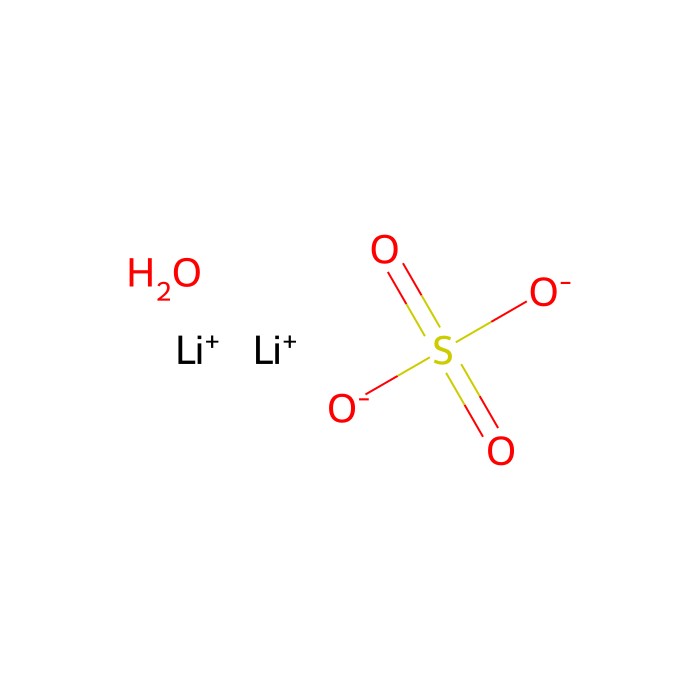
Brief description: Lithium sulfate monohydrate is an inorganic ionic salt consisting of two lithium cations, one sulfate dianion, and one water of crystallization.
Item-specific identifiers (from Product Data)
SKU: L110837
Product name: Lithium sulfate monohydrate
CAS: 10102-25-7
PubChem CID: 165815
InChIKey: 318606 (as provided)
SMILES: Not specified for this item; refer to CoA/Spec Sheet.
Molecular formula: Not specified for this item; refer to CoA/Spec Sheet.
Molecular weight: Not specified for this item; refer to CoA/Spec Sheet.
Literature identity data (for reference; not item specifications)
Common empirical formula (monohydrate): Li2SO4·H2O (literature)
Inorganic structural features: tetrahedral sulfate (SO4 2−) coordinated by two monovalent Li+ counterions; one lattice H2O per formula unit (literature)
2D structural description (literature)
The sulfate anion comprises a central sulfur atom double-bonded to four oxygen atoms in a tetrahedral geometry. Two lithium cations are present as discrete counterions and are typically coordinated to oxygens from sulfate and water in the crystal lattice. One water molecule per formula unit participates in coordination/hydrogen bonding within the lattice. No stereocenters or covalent rings; fully inorganic, ionic solid.
Notes
All item-specific identity fields not explicitly provided above should be confirmed against the product’s CoA/Spec Sheet prior to regulated use.
Synthetic Utility
Role as inorganic reagent (literature/general)
Source of sulfate: Employed in metathesis to generate insoluble sulfates (e.g., BaSO4), enabling anion exchange or analytical separations.
Source of lithium: Can participate in salt metathesis to furnish other lithium salts when treated with appropriate acids or anion donors (e.g., Li2SO4 + 2 HX → 2 LiX + H2SO4 in aqueous media), though more direct routes are often preferred.
Medium/electrolyte effects
As a supporting electrolyte, Li2SO4 can modulate ionic strength, activity coefficients, and double-layer structure, influencing reaction rates and selectivities in aqueous-phase catalysis and electroorganic reactions.
Crystallization/process chemistry
Useful for selective precipitation and salting-out of organics or proteins from aqueous solutions. Lithium’s small ionic radius can yield distinct crystal habits versus Na+/K+ counterparts, which can aid separations.
Advantages/constraints
Advantages: Inexpensive, water-compatible, relatively inert sulfate anion; AR grade suitable for many analytical tasks.
Constraints: Limited solubility in nonaqueous media; lithium content may be undesirable in battery-contaminant-sensitive workflows; hydrate state requires careful mass correction for stoichiometric preparations.
Note
For water-sensitive or strictly anhydrous synthesis, this monohydrate is not appropriate; consider anhydrous salts or dry-down protocols with verification (LOD/KF).
Target Specificity
This section is generally applicable to biological affinity reagents (e.g., antibodies, ligands). Lithium sulfate monohydrate is an inorganic salt and does not possess target specificity in the biomolecular recognition sense.
Item-specific data: None provided; not applicable.
Guidance: For macromolecular crystallography or biochemical assays, any “specificity” arises from ionic-strength and Hofmeister effects rather than selective binding to a biomolecular epitope.
We use cookies to ensure the website functions properly and, where permitted, to improve your experience. You can manage your preferences at any time in Settings. Learn more in our Cookie Policy.
Shall we send you a message when we have discounts available?
Remind me later
Thank you! Please check your email inbox to confirm.
Products are supplied to verified businesses, institutions, and qualified professionals for research and development use only. Not for use in humans, animals, diagnosis, or therapy.

 H2615512