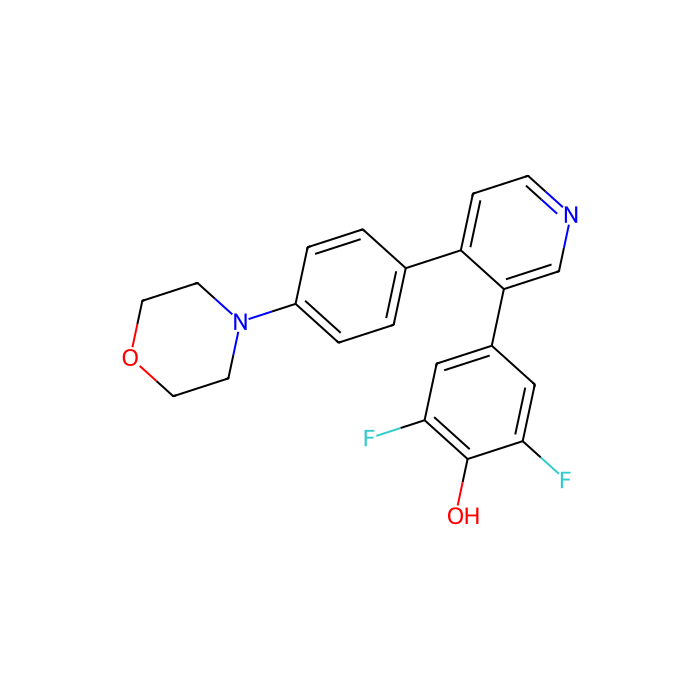
LJI308 is a potent pan-ribosomal S6 kinase (RSK) inhibitor, with IC50s of 6 nM, 4 nM, and 13 nM for RSK1, RSK2, and RSK3, respectively. LJI308 inhibits the phosphorylation of RSK (T359/S363) and YB-1 (S102) after irradiation, treatment with EGF, and in cells expressing a KRAS mutation
Spécifications
Spécifications et pureté
10mM in DMSO
Mécanismes biochimiques et physiologiques
Potent pan-ribosomal S6 protein kinase (RSK) inhibitor (IC50values are 4 to 13 nM). Displays selectivity for RSK isoforms over other kinases. Inhibits RSK-dependent Y-box binding protein 1 (YB-1) phosphorylationin vitro. Suppresses growth of triple negative breast cancer cell lines.
Conditions de stockage de stockage
Store at -80°C
Expédié en
Dry ice packs + Cold packs
Ce produit nécessite l'expédition en chaîne froide. Les services terrestres et autres services économiques ne sont pas disponibles.
This compound belongs to the class of organic compounds known as phenylmorpholines. These are aromatic compounds containing a morpholine ring and a benzene ring linked to each other through a CC or a CN bond.
External Descriptors
Not available
1. Djoumbou Feunang Y, Eisner R, Knox C, Chepelev L, Hastings J, Owen G, Fahy E, Steinbeck C, Subramanian S, Bolton E, Greiner R, and Wishart DS. ClassyFire: Automated Chemical Classification With A Comprehensive, Computable Taxonomy. Journal of Cheminformatics, 2016, 8:61.
Determine the necessary mass, volume, or concentration for preparing a solution.
Dilution Calculator
Determine the dilution needed to prepare a stock solution.
Reconstitution Calculator
Avis
Avis des clients
Application Protocols
The listing does not include tested-application protocols. The following is general guidance for handling small-molecule research probes; adapt to your assay and consult the CoA/SDS.
Stock preparation (general)
Equilibrate vial to room temperature in a desiccator before opening to prevent moisture condensation.
Dissolve in anhydrous DMSO to prepare a concentrated stock (e.g., 10–50 mM), verifying complete dissolution by visual inspection and, if needed, by analytical HPLC.
Aliquot into low-bind tubes or plate wells to avoid repeated freeze–thaw; flush headspace with inert gas if long-term storage is planned.
Working solution and dosing (general)
Dilute stock into assay buffer or cell culture medium to the desired concentration series, maintaining a constant final DMSO level (typically ≤0.1–0.5% v/v).
Include vehicle and positive-control inhibitors to benchmark responses; perform at least triplicate technical replicates.
Readouts (examples, general)
Biochemical kinase assays: measure substrate phosphorylation or ADP formation.
Cellular assays: monitor phospho-protein levels by Western blot/ELISA or reporter readouts.
Quality control
Confirm identity/purity for the received lot (LC–MS/HPLC) and check short-term stability in the chosen assay medium.
These steps are general best practices and are not item-specific performance claims.
Biological Roles
Scope
The following reflects general/literature context for LJI308 and related chemical probes; it is not item-specific potency or selectivity data. No medical or clinical claims are made.
Literature context
LJI308 has been reported as a small-molecule kinase pathway probe, often used to modulate MAPK/ERK-linked signaling cascades in cell biology studies (literature). Investigators employ such compounds to examine phosphorylation of downstream substrates and to dissect feedback mechanisms in growth and stress-response pathways.
Typical experimental end points include changes in phospho-protein markers by Western blot/ELISA, transcriptional readouts, or phenotypic outputs (proliferation, viability) under strictly controlled research conditions.
Good practice for biological use (general)
Validate the compound’s identity and purity for the received lot (LC–MS/HPLC).
Establish a vehicle control and, if available, a reference probe with a well-characterized profile.
Confirm target engagement using orthogonal assays (e.g., NanoBRET, CETSA) where relevant.
Evaluate concentration ranges that avoid overt cytotoxicity; perform vehicle-matched controls and time-course studies.
Item-specific
No biological activity data are provided in this listing. For batch-specific characterization and any internal testing notes, refer to the CoA/Spec Sheet.
Buffer Applications
Not typically applicable. LJI308 is a small-molecule research compound, not a buffering agent.
Practical note (general)
When preparing assay buffers that include LJI308 from a DMSO stock, ensure the final DMSO percentage is consistent across all conditions and that buffer components (salts, pH, proteins, detergents) do not precipitate the compound. Filter if compatible to remove particulates.
Green Alternatives
Not typically applicable. LJI308 is a discrete research compound, not a process solvent or reagent where greener substitutes are usually evaluated.
Practical sustainability guidance (general)
Minimize solvent volumes in stock preparation and assay setup; prefer aqueous-compatible methods where feasible.
Choose lower-toxicity, lower-VOC solvents for cleaning and analytics when compatible (e.g., ethanol or isopropanol over chlorinated solvents).
Consolidate shipments and store efficiently at -80°C to reduce cold-chain energy use. Employ aliquoting to minimize waste from degradation-related discards.
Pharmaceutical Uses
No excipient or pharmacopeial status is provided for this item, and it is sold strictly for research use only.
Item-specific (from Product Data)
Research Use Note: For research use only.
General context
Small-molecule probes like LJI308 are used in discovery research, target validation, and mechanism-of-action studies. They are not intended for human or veterinary use, diagnostic applications, or as active pharmaceutical ingredients. No GMP status or compendial monograph is indicated in this listing.
If translational formulation studies are contemplated (research stage only)
Determine solubility and stability in biorelevant media, evaluate excipient compatibility, and monitor degradation pathways. Such work must remain non-clinical unless supported by appropriate regulatory-grade material and documentation.
Physical Properties
Item-specific physical data are not provided in this listing.
Item-specific (from Product Data)
Appearance: Not specified for this item; refer to CoA/Spec Sheet.
Molecular Weight: Not specified for this item; refer to CoA/Spec Sheet.
Literature/computed properties (for context only; verify against CoA)
For small-molecule kinase probes such as LJI308, typical handling involves dissolution in DMSO to prepare concentrated stocks (e.g., 10–50 mM). Exact solubility limits, logP/logD, and pKa values must be confirmed from authoritative databases or experimental measurements for the specific batch.
Not available here (consult CoA/SDS or primary databases)
Melting point, boiling point, density, refractive index, UV–Vis absorption maxima, aqueous and organic solvent solubility, partition coefficients, and pKa: Not specified for this item; refer to CoA/Spec Sheet.
Practical notes (general)
If the compound is hydrophobic (common for kinase probes), expect higher solubility in polar aprotic organics (DMSO, DMF, NMP) than in water; aqueous working solutions typically require cosolvent or surfactant. Always verify with small-scale solubility tests and analytical confirmation (clarity, absence of precipitate, consistent potency in assay controls).
Quality and Grades
Item-specific (from Product Data)
Grade/Purity: Not specified for this item; refer to CoA/Spec Sheet.
Category Path: 全部 / 可售 / 小分子和化合物库
Research Use Note: For research use only.
Interpretation and expectations (general guidance)
Library/Screening compounds are typically supplied at research grade with batch-specific purity verified by HPLC/UPLC and identity confirmed by LC–MS and/or NMR. When purity/grade are not stated on the catalog page, the lot-specific CoA governs acceptance criteria (e.g., HPLC area% purity, residual solvents, water content).
If your application is sensitive (e.g., biochemical potency measurements, cell-based phospho-protein assays), request or review:
Analytical methods and chromatograms (HPLC/UPLC trace, purity definition).
LC–MS (m/z, adduct form) and, when available, HRMS.
NMR (1H/13C) for structural confirmation and impurity assessment.
Stability indicating data for storage at -80°C and in DMSO at working concentration.
Stabilizers/Salts
Any stabilizer, counterion (if provided as a salt), or residual solvent should be disclosed on the CoA. None are specified in this listing; verify per lot.
Documentation
Use the CoA and Spec Sheet as the authoritative source for assay setup and QC thresholds; do not substitute literature values for lot-specific quality data.
Reaction and Applications
This compound is supplied as a research small molecule and is not typically used as a synthetic reagent. Therefore, classical reaction applications (e.g., coupling, catalysis) are not generally applicable.
Item-specific (from Product Data)
Manufacturer Applications: Not specified in this listing.
Research applications (literature/general for LJI308)
LJI308 is described in the literature as a chemical probe for intracellular kinase signaling studies. Typical uses include:
Biochemical kinase assays to assess ATP-competitive inhibition and rank-order potency versus related kinases (literature context).
Cell-based pathway interrogation (e.g., monitoring phosphorylation changes in downstream substrates by Western blot or ELISA; literature context).
Target engagement assays (e.g., CETSA, NanoBRET, or pull-down) to confirm on-target binding in cells (general practice).
Data quality considerations:
Include vehicle controls (DMSO), positive control inhibitors, and concentration-response testing to derive IC50/EC50 with appropriate curve fits.
Use orthogonal readouts (biochemical and cellular) to confirm mechanism consistency.
Note
Specific potencies, selectivity panels, and off-target profiles are not provided in this listing and should be obtained from primary literature and the product’s CoA/Spec Sheet.
Reaction Conditions
Not applicable in the classical synthetic sense, as LJI308 is not used as a reagent or catalyst.
Assay preparation conditions (general guidance for small-molecule probes)
Stock solutions: Commonly 10–50 mM in anhydrous DMSO (verify solubility for this item).
Working concentrations: Titration across a broad range (e.g., 0.001–30 µM) with consistent vehicle control is standard in biochemical and cellular assays.
Dilution media: Assay buffer or culture medium supplemented as needed (e.g., serum, BSA) while maintaining low final DMSO (typically ≤0.1–0.5% v/v).
Incubation: Time and temperature are assay-dependent; many kinase pathway assays use 30 min to several hours at 37°C for cellular systems.
Verification
Confirm absence of precipitation after dilution; verify stability over the assay period by re-reading control potency over time or by LC–MS spot checks.
All values above are general literature/practice and not specifications for this item.
Safety and Handling
Safety information is limited in this listing; consult the product SDS for authoritative guidance.
Item-specific (from Product Data)
GHS Classification: Not specified for this item; refer to SDS.
Signal Word / H-Statements / Pictograms: Not specified for this item; refer to SDS.
Storage Conditions: Store at -80°C.
Shipping: Dry ice packs + Cold packs.
General laboratory precautions (non-item-specific)
Handle in a chemical fume hood; avoid inhalation, ingestion, and skin/eye contact.
Wear appropriate PPE: lab coat, safety glasses, and chemically resistant gloves (e.g., nitrile). Change gloves frequently when handling DMSO stocks due to skin absorption risks of dissolved compounds.
Prevent cross-contamination of screening libraries by using dedicated tips/tubes and by minimizing freeze–thaw cycles of stock plates/aliquots.
Incompatibilities and stability (general)
Avoid exposure to moisture, heat, and light unless stability is documented. Many heteroaromatic probes can show hydrolytic or oxidative liabilities; store desiccated and protected from light.
First-aid overview (general)
Skin/eye contact: Rinse with water for ≥15 minutes; remove contaminated clothing. Inhalation: move to fresh air; seek medical attention if symptoms persist. Ingestion: rinse mouth; seek medical attention. Always follow your institution’s EHS procedures.
Waste disposal
Dispose according to local regulations for organic laboratory chemicals; collect DMSO solutions and assay waste in designated halogenated/non-halogenated containers as appropriate.
Solvent Selection
This product is a small-molecule library entry rather than a bulk solvent; solvent selection pertains to preparing stock and working solutions.
Item-specific (from Product Data)
No solubility or solvent recommendations are specified for this item; refer to CoA/Spec Sheet.
General guidance (literature/practice for kinase-probe-like small molecules)
Primary stock solvent: DMSO is commonly used due to broad solvating power and assay compatibility. Prepare concentrated stocks (e.g., 10–50 mM) after verifying solubility.
Aqueous dilution: Dilute DMSO stocks into assay buffer or media, keeping final DMSO typically ≤0.1–0.5% v/v to minimize vehicle effects (optimize per assay).
Alternative solvents for method development: DMF, NMP, ethanol, or acetonitrile; confirm compatibility with biological assays and plastics. For analytical methods, acetonitrile/water or methanol/water with formic acid or ammonium salts are common mobile phases.
Practical tips
Warm gently (room temperature) and vortex/sonicate to aid dissolution; avoid heating above ambient unless stability is verified.
Filter working solutions (0.22 µm) when compatible to remove particulates prior to cell-based or biochemical assays.
Confirm absence of precipitation after dilution by visual inspection and by consistent dose–response in controls.
Storage and Reconstitution
Item-specific (from Product Data)
Storage Conditions: Store at -80°C.
Shipped In: Dry ice packs + Cold packs.
General best practices for this compound class
Keep container tightly closed in a dry, inert atmosphere; use desiccant and protect from light.
Upon first receipt, allow the sealed vial to equilibrate to room temperature in a desiccator before opening to avoid moisture condensation.
Prepare anhydrous DMSO stock solutions (after confirming solubility), aliquot into small volumes, and store aliquots at -80°C to minimize freeze–thaw. Avoid repeated cycles.
For short-term working use, -20°C storage of DMSO aliquots may be acceptable if stability is verified; long-term storage should remain at -80°C per item-specific guidance.
Reconstitution notes
If insoluble at room temperature, gently vortex/sonicate; avoid heating unless stability data support it. Do not use strong base or acid unless solubility/stability are confirmed for this specific compound.
Record preparation date, solvent, concentration, and lot number on aliquots; periodically reassess potency and purity (e.g., HPLC) for aging stocks.
Expiry
Follow the CoA/Spec Sheet for recommended retest/expiry dating. In absence of item-specific data, implement internal requalification intervals (e.g., every 3–6 months for frozen DMSO stocks).
Structure and Identity
Overview: LJI308 is listed in our small-molecule/compound library. Limited structure data are provided in this listing; consult the CoA/Spec Sheet for definitive identity data.
Item-specific (from Product Data)
Product Name: LJI308
CAS: 1627709-94-7
PubChem CID: 118704762
InChIKey: 447623 (as provided; note this is non-standard length—verify on CoA/SDS)
SMILES: Not specified for this item; refer to CoA/Spec Sheet.
Molecular Formula: Not specified for this item; refer to CoA/Spec Sheet.
Molecular Weight: Not specified for this item; refer to CoA/Spec Sheet.
Structural features (general/literature context)
LJI308 is described in the literature as a heteroaromatic small-molecule kinase probe. Exact ring systems, functional groups, and stereochemical elements should be confirmed against a primary structural source (CoA, SDS, or PubChem entry for CID 118704762).
2D structure description (general guidance)
Without a provided SMILES or structure image in this listing, a text description cannot be definitively stated. Users should retrieve the structure from the cited CAS or CID and verify heteroatom patterning, ring count, and potential H-bond donors/acceptors before method development.
Identity verification tips (general)
Cross-verify CAS and CID against vendor CoA and analytical data (1H/13C NMR, LC–MS, HRMS, HPLC purity, melting point). Ensure batch-specific identifiers match your incoming lot.
Synthetic Utility
Not typically applicable. LJI308 is a finished small-molecule probe supplied for biological and screening experiments rather than as a building block or reagent.
General note
If analog synthesis or SAR exploration is planned, consult the primary literature/patents associated with LJI308 for retrosynthetic disconnections, key bond-forming steps, and protecting-group strategies. Without item-specific structural details in this listing, synthetic commentary would be speculative; use the CAS (1627709-94-7) and CID (118704762) to retrieve definitive structures and reported synthetic routes.
Target Specificity
Only item-specific data may be listed here.
Item-specific (from Product Data)
Target, epitope, clone/isotype, or species reactivity: Not applicable/not specified for this small-molecule item.
Note
Any target selectivity or potency profile for LJI308 should be sourced from the primary literature and the lot-specific CoA/Spec Sheet. This catalog entry does not provide such data.
Foire aux questions
How should this product be stored?
Store at ?80 °C. Ultra-low temperature storage is required to maintain the specified shelf life.
How is this product shipped?
This product ships frozen with dry ice and cold packs. Unpack on arrival and transfer it to the storage condition stated above; handle dry ice with insulated gloves in a ventilated area.
What are the CAS number, molecular formula and molecular weight?
The CAS Number is 1627709-94-7, the molecular formula is C21H18F2N2O2, and the molecular weight is 368.38 g/mol. InChIKey YUYJEQHNWKQNBT-UHFFFAOYSA-N.
What documentation is provided?
Available product documentation, including Certificates of Analysis (COA), Safety Data Sheets (SDS), and specification sheets, is shown in the product document area. Document availability and access follow the current site policy.
Nous utilisons des cookies pour garantir le bon fonctionnement du site et, lorsque cela est autorisé, pour améliorer votre expérience. Vous pouvez gérer vos préférences à tout moment dans les Paramètres. Pour en savoir plus, consultez notre Politique relative aux cookies.
Souhaitez-vous que nous vous envoyions un message lorsque des réductions seront disponibles?
Me rappeler plus tard
Merci ! Veuillez vérifier votre boîte de réception e-mail pour confirmer.
Products are supplied to verified businesses, institutions, and qualified professionals for research and development use only. Not for use in humans, animals, diagnosis, or therapy.