
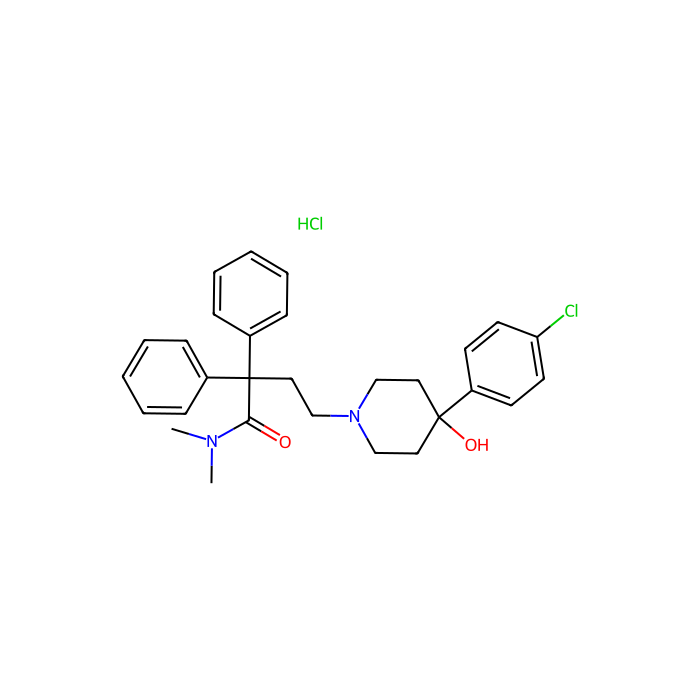
Loperamide HCl - 10mM in DMSO , Mu opioid receptor agonist, CAS No.34552-83-5, Mu opioid receptor agonist
En stock
SKU
L408678
δ-opioid receptor Selective Inhibitors | Agonists | Antagonists
δ-opioid receptor Selective Inhibitors | Agonists | Antagonists
Information
Loperamide HCl (ADL 2-1294) is a selectiveμ-opioid receptoragonist opioid withKiof 3.3 nM, 15-fold and 350-fold selective over the δ subtype and the κ subtype of the opioid receptor, used against diarrhea resulting from gastroenteritis or inflammatory bow
In vitro
Loperamide exhibits potent affinity and selectivity for the cloned micro (Ki = 3 nM) compared with the delta (Ki = 48 nM) and kappa (Ki = 1156 nM) human opioid receptors. Loperamide potently stimulates [35S]guanosine-5\'-O-(3-thio)triphosphate binding with EC50 of 56 nM, and inhibits forskolin-stimulated cAMP accumulation (IC50 = 25 nM) in Chinese hamster ovary cells transfected with the human mu opioid receptor. Loperamide potently inhibits late-phase formalin-induced flinching after intrapaw injection (A50 = 6 mg). Loperamide is a strong inhibitor of CES2, with a K(i) of 1.5 muM, but it only weakly inhibits CES1A1 (IC50 = 0.44 mM). Loperamide reversibly blocks rises in [Ca2+]i evoked by high [K+] in a concentration-dependent manner, with an IC50 of 0.9 mM. Loperamide (0.1-50 mM) produces a concentration-dependent reduction of the peak IBa with an IC50 value of 2.5 mM and, at the highest concentration tested, could fully block IBa in the absence of any other pharmacological agent. Loperamide also attenuates NMDA-evoked currents recorded at a membrane potential of -60 mV, with an IC50 of 73 mM.
In vivo
Loperamide, an opioid agonist unable to cross the blood-brain barrier, inhibits both thermal and mechanical hyperalgesia when s.c. injected, locally over the tibial tumoral mass (7.5-75 mg) or distantly, under the fur of the neck (4 mg/kg) in mice.
Cell Data
cell lines:
Concentrations:
Incubation Time:
Powder Purity:≥99%
| CAS | 34552-83-5 |
|---|---|
| Concentration | 10mM in DMSO |
| Synonymes | ADL 2-1294 | 4-(4-chlorophenyl)-4-hydroxy-N,N-dimethyl-α,α-diphenyl-1-piperidinebutanamide, hydrochloride (1:1) |
| Spécifications et pureté | 10mM in DMSO |
| Conditions de stockage de stockage | Store at -80°C |
| Expédié en | Dry ice packs + Cold packs |
| Product Description | Information Loperamide HCl (ADL 2-1294) is a selectiveμ-opioid receptoragonist opioid withKiof 3.3 nM, 15-fold and 350-fold selective over the δ subtype and the κ subtype of the opioid receptor, used against diarrhea resulting from gastroenteritis or inflammatory bow Loperamide exhibits potent affinity and selectivity for the cloned micro (Ki = 3 nM) compared with the delta (Ki = 48 nM) and kappa (Ki = 1156 nM) human opioid receptors. Loperamide potently stimulates [35S]guanosine-5\'-O-(3-thio)triphosphate binding with EC50 of 56 nM, and inhibits forskolin-stimulated cAMP accumulation (IC50 = 25 nM) in Chinese hamster ovary cells transfected with the human mu opioid receptor. Loperamide potently inhibits late-phase formalin-induced flinching after intrapaw injection (A50 = 6 mg). Loperamide is a strong inhibitor of CES2, with a K(i) of 1.5 muM, but it only weakly inhibits CES1A1 (IC50 = 0.44 mM). Loperamide reversibly blocks rises in [Ca2+]i evoked by high [K+] in a concentration-dependent manner, with an IC50 of 0.9 mM. Loperamide (0.1-50 mM) produces a concentration-dependent reduction of the peak IBa with an IC50 value of 2.5 mM and, at the highest concentration tested, could fully block IBa in the absence of any other pharmacological agent. Loperamide also attenuates NMDA-evoked currents recorded at a membrane potential of -60 mV, with an IC50 of 73 mM. In vivo Loperamide, an opioid agonist unable to cross the blood-brain barrier, inhibits both thermal and mechanical hyperalgesia when s.c. injected, locally over the tibial tumoral mass (7.5-75 mg) or distantly, under the fur of the neck (4 mg/kg) in mice. cell lines: Concentrations: Incubation Time: Powder Purity:≥99% |
| Solubilité | Solubility (25°C) In vitro DMSO: 82 mg/mL (199.08 mM); Water: 82 mg/mL (199.08 mM); Ethanol: 82 mg/mL (199.08 mM); |
| Numéro CE | 252-082-4 |
| Formule moléculaire | C29H33ClN2O2·HCl |