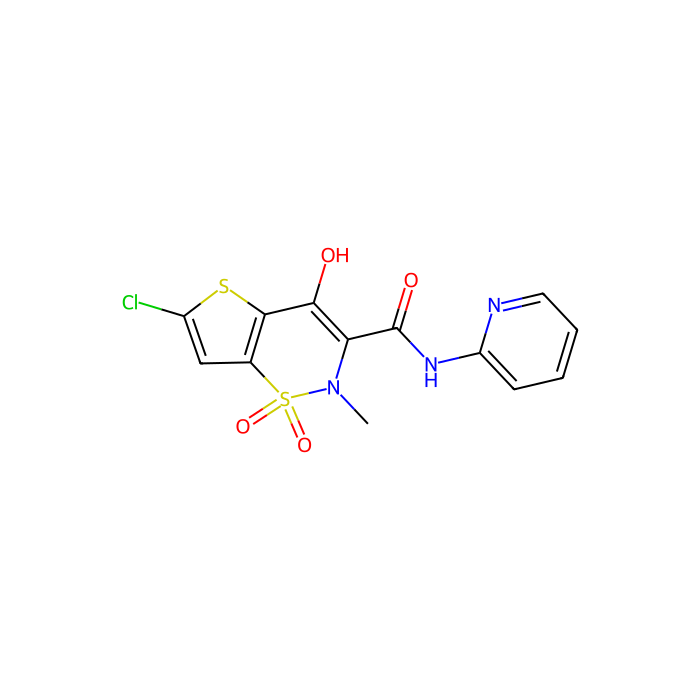
Lornoxicam is a cyclooxygenase inhibitor. Structurally similar to Tenoxicam. An anti-inflammatory and an analgesic. Lornoxicam is an inhibitor of Cox-1 and Cox-2.Potent COX-1 and COX-2 inhibitor (IC 50 = 5 and 8 nM for COX-1 and COX-2, respectively). Inhi
Conditions de stockage de stockage
Store at -80°C
Expédié en
Dry ice packs + Cold packs
Ce produit nécessite l'expédition en chaîne froide. Les services terrestres et autres services économiques ne sont pas disponibles.
This compound belongs to the class of organic compounds known as alpha amino acids and derivatives. These are amino acids in which the amino group is attached to the carbon atom immediately adjacent to the carboxylate group (alpha carbon), or a derivative thereof.
1. Djoumbou Feunang Y, Eisner R, Knox C, Chepelev L, Hastings J, Owen G, Fahy E, Steinbeck C, Subramanian S, Bolton E, Greiner R, and Wishart DS. ClassyFire: Automated Chemical Classification With A Comprehensive, Computable Taxonomy. Journal of Cheminformatics, 2016, 8:61.
Determine the necessary mass, volume, or concentration for preparing a solution.
Dilution Calculator
Determine the dilution needed to prepare a stock solution.
Reconstitution Calculator
Avis
Avis des clients
Application Protocols
Item-specific, validated application protocols are not provided for this product. The following are general, literature-informed procedures suitable for research use. Adjust to your laboratory’s SOPs.
Preparation of 10 mM DMSO stock:
Allow vial to equilibrate to ambient temperature in a desiccator and protect from light.
Accurately weigh compound (e.g., 3.72 mg for 1 mL at 10 mM if using literature MW ~371.8 g/mol; correct for CoA assay).
Add anhydrous DMSO to volume; vortex and sonicate as needed until fully dissolved.
Aliquot into amber microtubes; store at −20 to −80 °C, minimizing freeze–thaw.
Dilution for biochemical/cellular assays:
Add DMSO stock to pre-warmed buffer/media under vigorous mixing.
Keep final DMSO at or below assay tolerance (commonly 0.1–0.5%).
Verify absence of precipitate by visual inspection and, if necessary, 0.22 µm filtration.
HPLC reference solution (example):
Prepare a primary stock in DMSO or MeOH (e.g., 1.0 mg/mL).
Dilute into mobile phase to desired calibration levels; record exact purity-corrected concentration.
Store working solutions refrigerated and protected from light; verify short-term stability before sequence runs.
Note: These are general guidelines. No specific assay validations or performance claims are made for this item.
Biological Roles
Context from literature (informational; not an item specification and no clinical claims):
Pharmacological class: oxicam family small molecule with activity reported against cyclooxygenase enzymes (COX-1/COX-2), leading to modulation of prostaglandin biosynthesis in research systems.
Mechanistic hallmarks: binds within the COX active site; the enolic acidic functionality and heteroaromatic rings contribute to chelation/H-bonding and pi-stacking interactions characteristic of oxicams.
Physicochemical determinants: moderate lipophilicity and weak acidity influence membrane permeability and protein binding; tautomerism can impact binding mode and solid-state form.
Research use cases: tool compound in inflammation signaling studies, COX isoform selectivity assays, and as a benchmark in inhibitor panels. Also used to probe structure–activity relationships (SAR) among oxicam analogs.
Caveats and usage notes:
Off-target considerations: as with many heteroaromatic acidic compounds, potential interactions with other enzymes or transporters may be observed in broad screening; verify selectivity in your system.
System dependence: potency and selectivity can vary with assay format (purified enzyme vs cellular) and protein source (species, isoform).
Reminder: This product is designated for research use only. It is not intended for diagnostic, therapeutic, or in vivo clinical applications.
Buffer Applications
This compound is not a buffering agent and is not typically used to prepare laboratory buffers.
Practical guidance for assay buffers (general, when working with this compound):
Aqueous dissolution at neutral pH is limited; for aqueous assays, either:
Use a minimal amount of DMSO stock (e.g., final 0.1–0.5% v/v), or
Adjust buffer to mildly basic pH (e.g., pH 8–9) to increase solubility via deprotonation, while monitoring for stability and biological compatibility.
Common buffer systems for assays (general): phosphate-buffered saline (PBS), HEPES, or Tris. Select based on compatibility with your detection method and the compound’s ionization state.
Filtration: After dilution, 0.22 µm filtration can remove particulates without materially changing concentration if adsorption is low; verify recovery if working at low µM levels.
Item-specific buffer specifications, pH ranges, or recipes are not provided for this product; refer to your internal assay protocols.
Green Alternatives
As a finished small-molecule analyte rather than a process solvent or reagent, “green alternatives” considerations primarily concern solvent selection for dissolution, assay preparation, and purification.
Greener handling strategies (general):
Prefer aqueous media with minimal DMSO where feasible; use pH adjustment (mildly basic) to enhance solubility rather than high co-solvent loads when compatible with your assay.
If organic solvent is required, favor lower-toxicity, high-performance options and minimize volume.
Comparison of common dissolution options (general, literature-informed):
DMSO
Pros: Highest solvating power; enables concentrated stocks and low final %.
Cons: Not green; disposal and biological compatibility limits apply.
Cons: May limit achievable concentration; assay interference possible.
Mildly basic aqueous buffer (e.g., bicarbonate or phosphate, pH 8–9)
Pros: Eliminates organic solvent in final matrix; improved safety.
Cons: Risk of base-catalyzed degradation with prolonged exposure; may perturb biological systems.
Operational tips:
Use microscale dissolution and pre-screen solubility to avoid excess solvent consumption.
Prepare concentrated master stocks to reduce repeated dissolution operations and waste.
Note: No item-specific environmental metrics are provided. Apply your organization’s green chemistry guidelines to solvent selection and waste minimization.
Pharmaceutical Uses
Scope: The following is provided for research and analytical context only. This product is for research use and is not supplied as a drug substance or for clinical use.
Analytical and development roles (literature/general):
Reference/working standard: Used in method development, validation, and system suitability for quantifying oxicam-class analytes by HPLC/UPLC and LC–MS.
Stability and forced-degradation studies: Serves as a model analyte for developing stability-indicating methods (acid/base hydrolysis, oxidative, photolytic pathways) and for mapping degradation products.
Solid form research: Investigation of polymorphs, salts, and cocrystals; evaluation of dissolution enhancement strategies (e.g., solid dispersions) as an academic/formulation research topic.
Formulation research notes (general):
Solubility enhancement strategies explored in literature include pH adjustment, cyclodextrin inclusion complexes, surfactant-assisted systems, and polymeric carriers. Translate only to research settings; not a recommendation for clinical formulations.
Compendial status: Not specified for this item; refer to CoA/Spec Sheet and applicable pharmacopeias if a compendial reference standard is required.
Regulatory note: Do not use research-grade material as a substitute for USP/EP reference standards in regulated testing unless explicitly justified and qualified under your quality system.
Physical Properties
Item-specific properties from Product Data:
Appearance: Not specified for this item; refer to CoA/Spec Sheet.
Molecular weight: Not specified for this item; refer to CoA/Spec Sheet.
Molecular formula: Not specified for this item; refer to CoA/Spec Sheet.
Literature/computed values (context only; not item specifications):
Molecular weight (literature): ~371.8 g/mol for C13H10ClN3O4S2.
Acid–base: weakly acidic enol; reported pKa for oxicams typically in the 4–5 range (lornoxicam commonly cited ~4.7–4.9, literature).
LogP/logD: literature XlogP for oxicams often ~1.5–2.5; lornoxicam commonly reported around 1.7–2.0 (literature), indicating moderate lipophilicity.
Melting point: oxicam solids are high-melting; lornoxicam is commonly reported near ~225–230 °C (literature, compound-dependent and polymorph-sensitive).
Solubility profile (literature):
Water: very low at neutral pH; increases at basic pH due to deprotonation of the enol.
Organic: soluble in polar aprotic solvents (DMSO, DMF, NMP); limited solubility in lower alcohols; poor in nonpolar hydrocarbons.
UV–vis: oxicams show π–π* absorption in UV; specific cutoffs not established here (Not specified for this item; refer to CoA/Spec Sheet).
Solid-state: exhibits tautomer-dependent hydrogen bonding; polymorphism and salt/cocrystal formation reported in literature for oxicam analogs.
Operational notes (general): pulverizing to a fine powder can improve dissolution kinetics; pre-wetting with small volumes of DMSO before aqueous dilution can mitigate precipitation.
Quality and Grades
Item-specific quality information from Product Data:
Grade/Purity: Not specified for this item; refer to CoA/Spec Sheet.
Interpretation and guidance:
When grade/purity is unspecified in the catalog entry, the Certificate of Analysis (CoA) governs the release criteria (e.g., assay by HPLC, residual solvents, ID tests). Request the current CoA for the lot you will receive.
Typical research-use small molecule specifications (general, for context):
Assay (HPLC/UPLC): often ≥95–98% area.
ID: 1H NMR, MS, and/or IR matched to reference.
Impurities: capped per internal spec; exact limits vary by supplier and lot.
Stabilizers/additives: Not specified for this item; refer to CoA/Spec Sheet. Absence of a stated stabilizer usually implies neat compound; however, some lots may be provided as salts or with trace residual solvents—confirm on CoA.
UV background and LC use: If you will use this compound as a reference standard, select lots with chromatographic purity and known water content/residual solvents to ensure quantitative accuracy.
Documentation: For GLP/GMP-adjacent work, retain CoA, TDS, and SDS. If a pharmacopeial reference is required, verify compendial status independently and do not substitute research-grade material for compendial standards.
Reaction and Applications
Intended use category: This product is listed under a small-molecule/compound library and is primarily used as a research tool compound (e.g., biochemical pathway modulation, assay development, and reference standard work). It is not typically employed as a synthetic reagent.
Research applications (literature context):
Enzyme/pathway studies: Frequently used in studies of cyclooxygenase (COX) pathways and eicosanoid signaling as a prototypical oxicam-class modulator (no clinical claims implied).
Reference standard: Employed for analytical method development and validation (HPLC/UPLC, LC–MS) for anti-inflammatory compound panels; also used in recovery and stability testing in complex matrices.
Solid-state and formulation research: Model for tautomerism, polymorphism, and cocrystal/salt screening among oxicams.
Analytical considerations:
Calibration: Prepare primary stocks in dry DMSO; verify concentration by weight and purity correction using CoA assay value.
Stability: Protect solutions from light; assess short-term bench stability and autosampler stability empirically.
Chromatography: Reverse-phase C18 with acidic mobile phases typically affords sharp peaks; consider ionization state vs pH for retention control.
Non-applicability note:
Named reactions/synthetic transformations: Lornoxicam itself is a complex end-product rather than a building block; it is not commonly used as a reagent or intermediate in routine synthesis. For synthetic chemistry topics, see the Synthetic Utility section for limited retrosynthetic discussion only.
Reaction Conditions
This product is not typically used as a reagent or substrate in standard organic reactions; therefore, there are no canonical “reaction conditions” associated with its use. The following guidance covers solution preparation for assays and analytics (general, literature-informed):
Stock preparation:
Dissolve in anhydrous DMSO to 10–50 mM. Sonication or gentle warming (≤40 °C) can speed dissolution; avoid prolonged heating.
Filter sterilize if required for cell-based assays (0.22 µm PTFE/RC membrane compatible with DMSO).
Dilution into aqueous systems:
Add DMSO stock to vigorously stirred buffer or media; typical final DMSO ≤0.1–0.5% for biological assays.
If precipitation occurs, increase mixing time, adjust temperature, or consider modest pH elevation (to pH 8–9) within assay constraints.
Analytical chromatography (general):
RP-HPLC: C18 column, aqueous phase with 0.1% formic acid or phosphate buffer, and acetonitrile or methanol organic phase. UV detection in the UV range; confirm wavelength empirically.
LC–MS: use volatile buffers (e.g., 0.1% formic acid or ammonium formate); monitor for in-source fragmentation of heteroaromatic sulfone systems.
Stability checks:
Assess bench-top and autosampler stability (e.g., 4–24 h) before long runs.
Protect from light to reduce photodegradation pathways noted for oxicam analogs.
Item-specific stability/reactivity parameters are not provided; consult CoA/Spec Sheet and perform pilot studies.
Safety and Handling
Item-specific hazard information from Product Data:
GHS classification: Not specified for this item; refer to SDS.
Signal word: Not specified for this item; refer to SDS.
H-statements: Not specified for this item; refer to SDS.
Pictograms: Not specified for this item; refer to SDS.
General laboratory safety guidance (consult SDS for authoritative details):
PPE: laboratory coat, safety glasses, and appropriate chemically resistant gloves (e.g., nitrile). Handle powders in a fume hood or ventilated enclosure to minimize inhalation of particulates.
Avoid generating dust; use antistatic measures when transferring microgram–milligram quantities for screening work.
Incompatibilities (general): strong oxidizers; strong bases/acids may induce degradation or salt formation—prepare solutions immediately before use when working at extreme pH.
Hygroscopicity/photostability: many oxicams are light-sensitive; store protected from light and moisture to maintain purity (see Storage section).
First-aid overview: in case of skin contact, wash with soap and water; for eye exposure, rinse cautiously with water for several minutes; if inhaled, move to fresh air; if ingested, rinse mouth. Seek medical attention as appropriate. Always follow institutional exposure control plans.
Waste: dispose of solutions and solids as organic hazardous waste according to local regulations. Avoid drain disposal.
Note: This product is for research use only; no medical, diagnostic, or therapeutic use is intended.
Solvent Selection
Compound type and polarity (general): Lornoxicam is a moderately lipophilic, weakly acidic heteroaromatic solid. It dissolves best in polar aprotic solvents and in basic aqueous media where the enolic proton is deprotonated.
Practical solvent choices (literature-informed):
DMSO: preferred for stock solutions (e.g., 10–50 mM), excellent solvating power; miscible with water for subsequent dilution.
DMF or NMP: strong alternatives for non-aqueous workflows; consider toxicity/handling.
Alcohols (MeOH, EtOH): limited to moderate solubility; can aid in co-solvent systems.
Aqueous buffers: poor solubility at neutral pH; adjust to pH > pKa (e.g., pH 8–9) or use co-solvent (DMSO 0.1–1% v/v) to minimize precipitation.
Miscibility and preparation tips:
Prepare a concentrated DMSO stock, then dilute into buffer or media with vigorous mixing; keep final DMSO below assay tolerance (often ≤0.1–0.5%).
Filter through 0.22 µm if particulate persists; avoid prolonged exposure to strong base if chemical stability is a concern.
Comparison (general):
DMSO vs ethanol: DMSO offers higher solubility and stability for many oxicams; ethanol is more volatile and may limit achievable concentration.
Aqueous basic buffers vs co-solvents: Base increases solubility but may affect biological assays; co-solvent approaches maintain near-physiological pH.
Note: No item-specific solubility specifications are provided; consult CoA/Spec Sheet and perform a small-scale solubility check in your chosen matrix.
Storage and Reconstitution
Item-specific storage and shipping (from Product Data):
Storage Conditions: Store at −80 °C.
Shipped In: Dry ice packs + Cold packs.
Item-specific appearance or solvent recommendations: Not specified for this item; refer to CoA/Spec Sheet.
General reconstitution guidance (literature-informed; not item-specific specifications):
Solid handling: Allow container to warm in a desiccator to prevent condensation. Minimize headspace exposure. Reseal promptly after use.
Light and moisture: Protect from light and humidity. Store in amber, tightly sealed vials with desiccant.
Solution stability: Prepare concentrated stock solutions in anhydrous DMSO. For prolonged storage, freeze aliquots at −20 to −80 °C to avoid repeated freeze–thaw cycles. Discard if precipitation, discoloration, or unexpected LC/MS profiles are observed.
Aqueous solutions: Prepare fresh where possible. If short-term storage is required, keep at 2–8 °C, protected from light, and verify stability before use.
Inventory control:
Record lot number and CoA assay; apply purity correction when preparing quantitative standards.
For high-sensitivity applications, perform an incoming QC check (e.g., quick HPLC) to confirm identity/purity post-shipment.
Note: Follow your institution’s chemical hygiene and controlled-temperature storage procedures. The SDS provides authoritative stability and incompatibility guidance.
Structure and Identity
Brief description: Lornoxicam is a heteroaromatic oxicam-class small molecule featuring a chlorinated thieno–thiazine 1,1-dioxide core and a 2-pyridyl carboxamide; it is widely used as a research-grade cyclooxygenase pathway modulator.
Item-specific identifiers (from Product Data):
CAS: 70374-39-9
SKU: L425602
InChIKey: Not specified for this item; refer to CoA/Spec Sheet. (Product Data lists "401423", which is incomplete; consult CoA/SDS for the definitive key.)
SMILES: Not specified for this item; refer to CoA/Spec Sheet.
Molecular Formula: Not specified for this item; refer to CoA/Spec Sheet.
Molecular Weight: Not specified for this item; refer to CoA/Spec Sheet.
Literature identity (for context; not item-specific specifications):
Typical molecular formula (literature): C13H10ClN3O4S2
2D sketch in words: a chlorinated bicyclic sulfur–nitrogen heterocycle fused to thiophene, bearing an enolic OH and a carboxamide that connects to a 2-pyridyl ring.
Synthetic Utility
Lornoxicam is generally the endpoint of a multistep synthesis rather than a building block for further transformations. Consequently, its direct use as a synthetic reagent is limited. However, for retrosynthetic and structural analysis purposes (literature/general):
Key functional groups and reactivity considerations:
Enolic hydroxyl: participates in tautomerism; can form salts with bases and engage in H-bonding/cocrystal formation.
Amide linkage to a 2-pyridyl ring: robust under mild conditions; susceptible to hydrolysis only under forcing acidic/basic conditions.
Aryl chloride: positioned on a heteroaromatic-fused system; oxidative addition is nontrivial and site-selective functionalization is challenging.
Sulfone (within thiazine-1,1-dioxide): metabolically and chemically robust; controls electronics of the ring system.
Retrosynthetic themes seen in literature routes:
Construction of the thieno[2,3-e]-1,2-thiazine-1,1-dioxide core from appropriately substituted thiophene and sulfonamide/sulfuryl chloride precursors.
Late-stage amide formation with 2-aminopyridine or its derivatives.
Electrophilic chlorination at the appropriate aromatic position.
Derivatization potential for probe development:
Introduction of reporter handles (e.g., at the pyridyl nitrogen via quaternization or at amide nitrogen) is conceptually possible but may disrupt biological activity; careful SAR is required.
Note: No item-specific reactivity data or synthetic grade is provided. If you intend to derivatize, verify purity, water content, and polymorph form to ensure reproducibility.
Target Specificity
Item-specific target or bioactivity data: Not specified for this item; refer to CoA/Spec Sheet or internal assay data.
Literature context (informational only; not an item specification and no clinical claims):
Primary research targets: cyclooxygenase enzymes COX-1 and COX-2; used as a tool compound in eicosanoid biosynthesis studies.
Selectivity considerations: Reported selectivity vs COX isoforms varies with assay conditions, species, and matrix. Protein binding and tautomeric state can influence apparent potency.
Recommendations:
Establish target engagement metrics in your system (enzyme assays, cellular readouts) and do not assume literature potency values will translate directly to your assay conditions.
Include appropriate positive/negative controls and counter-screens to evaluate off-target activities.
No antibody clone/isotype or biology-assay validation data are provided for this catalog item.
Foire aux questions
How should this product be stored?
Store at ?80 °C. Ultra-low temperature storage is required to maintain the specified shelf life.
How is this product shipped?
This product ships frozen with dry ice and cold packs. Unpack on arrival and transfer it to the storage condition stated above; handle dry ice with insulated gloves in a ventilated area.
What are the CAS number, molecular formula and molecular weight?
The CAS Number is 70374-39-9, the molecular formula is C13H10ClN3O4S2, and the molecular weight is 371.82 g/mol. InChIKey WLHQHAUOOXYABV-UHFFFAOYSA-N.
What documentation is provided?
Available product documentation, including Certificates of Analysis (COA), Safety Data Sheets (SDS), and specification sheets, is shown in the product document area. Document availability and access follow the current site policy.
Nous utilisons des cookies pour garantir le bon fonctionnement du site et, lorsque cela est autorisé, pour améliorer votre expérience. Vous pouvez gérer vos préférences à tout moment dans les Paramètres. Pour en savoir plus, consultez notre Politique relative aux cookies.
Souhaitez-vous que nous vous envoyions un message lorsque des réductions seront disponibles?
Me rappeler plus tard
Merci ! Veuillez vérifier votre boîte de réception e-mail pour confirmer.
Products are supplied to verified businesses, institutions, and qualified professionals for research and development use only. Not for use in humans, animals, diagnosis, or therapy.