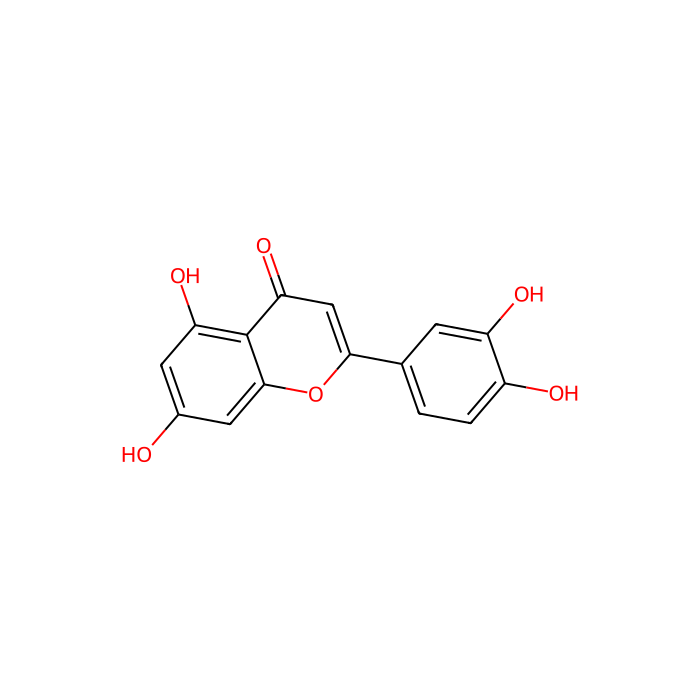
Luteolin - Moligand™, 10mM in DMSO , Agonist of TAS2R14;Agonist of TAS2R39, CAS No.491-70-3, Agonist of TAS2R14;Agonist of TAS2R39

CAS: 491-70-3 Cat. No.: L409168 Formule: C15H10O6 Poids moléculaire: 286.24 Beilstein Registry Number: 292084 Numéro CE: 207-741-0
DISPONIBLE À COMMANDE
GRADE & PURITY Moligand™ ? Moligand™ — Aladdin's line of ligands and bioactive small molecules. Use for receptor, pathway, and binding studies needing defined small-molecule tools. 10mM in DMSO
Synonyms
Luteoline, Luteolol, Digitoflavone | 4H-1-Benzopyran-4-one, 2-(3,4-dihydroxyphenyl)-5,7-dihydroxy-
Storage
Store at -80°C
Shipped In
Dry ice packs + Cold packs
★
Size
Allemagne (EU)
USA*
Price
Qty
1ml
L409168-1ml
—
3 En stock
24,21€
Enter a quantity for the sizes you want to add.
🧪
Why this grade

Moligand™, 10mM in DMSO Moligand™ for sensitive chromatographic and analytical workflows requiring minimal baseline interference.

🌡

Storage & shipping

Store at -80°C Ships Dry ice packs + Cold packs Check lot-specific COA for exact specifications.

📋

Quality documents

SDS, COA, datasheet, and spec sheet available for download. Lot-specific COA accessible via lot number lookup.

📚

Literature proof

Cited in 223 peer-reviewed publications across chromatography, organic synthesis, and cross-coupling reactions.

Vue d’ensemble

Information

Luteolin (Luteoline, Luteolol, Digitoflavone) is a flavonoid found in Terminalia chebula, which is a non-selective phisphodiesterase PDE inhibitor for PDE1-5 with Ki of 15.0 μM, 6.4 μM, 13.9 μM, 11.1 μM and 9.5 μM, respectively. Phase 2.
In vitro

Luteolin is a flavonoid found in Terminalia chebula, which is a non-selective phisphodiesterase PDE inhibitor for PDE1-5 with Ki of 15.0 μM, 6.4 μM, 13.9 μM, 11.1 μM and 9.5 μM, respectively. Luteolin inhibits LPS-stimulated TNF-alpha production with an IC50 of less than 1 μM. Luteolin inhibites LPS-induced phosphorylation of Akt as well as IkappaBalpha.

In vivo

LD50: Mice >2500mg/kg (i.g.)
Cell Data

cell lines:

Concentrations:

Incubation Time:

Powder Purity:≥97%

Specifications

Synonymes
Luteoline, Luteolol, Digitoflavone | 4H-1-Benzopyran-4-one, 2-(3,4-dihydroxyphenyl)-5,7-dihydroxy-
Spécifications et pureté
Moligand™, 10mM in DMSO
Mécanismes biochimiques et physiologiques
Luteolin (Luteoline, Luteolol, Digitoflavone) is a flavonoid found in Terminalia chebula, which is a non-selective phisphodiesterase PDE inhibitor for PDE1-5 with Ki of 15.0 μM, 6.4 μM, 13.9 μM, 11.1 μM and 9.5 μM, respectively. Phase 2.
Conditions de stockage de stockage
Store at -80°C
Expédié en
Dry ice packs + Cold packs
Ce produit nécessite l'expédition en chaîne froide. Les services terrestres et autres services économiques ne sont pas disponibles.
Grade
Moligand™
Type d'action
AGONIST
Mécanisme d'action
Agonist of TAS2R14;Agonist of TAS2R39
Noms et identifiants
Isomères SMILES
C1=CC(=C(C=C1C2=CC(=O)C3=C(C=C(C=C3O2)O)O)O)O
WGK Allemagne
3
RTECS
LK9275210
Poids moléculaire
286.24
Beilstein
292084
Reaxy-Rn
292084
Reaxys-RN_link_address
https://www.reaxys.com/reaxys/secured/hopinto.do?context=S&query=IDE.XRN=292084&ln=

Documentation

📋 Safety Data Sheet (SDS)

Comprehensive hazard, handling, storage, and regulatory compliance document.

Download SDS →

✅ Certificate of Analysis (COA)

Lot-specific quality data. Enter your lot number to retrieve the exact COA.

Look up COA →

📊 Datasheet

Quick-reference summary of product specifications and applications.

View datasheet →

🔬 Specification Sheet

Full quality attributes and acceptance criteria for this grade.

View spec sheet →

Advanced Data

Cibles associées (humaines)
CYP1A2 Tchem Cytochrome P450 1A2 (1 Activities)
Activity TypeActivity Value -log(M)Mechanism of ActionActivity ReferencePublications (PubMed IDs)
CYP1B1 Tchem Cytochrome P450 1B1 (3 Activities)
Activity TypeActivity Value -log(M)Mechanism of ActionActivity ReferencePublications (PubMed IDs)
DPP4 Tclin Dipeptidyl peptidase 4 (1 Activities)
Activity TypeActivity Value -log(M)Mechanism of ActionActivity ReferencePublications (PubMed IDs)
TTR Tclin Transthyretin (1 Activities)
Activity TypeActivity Value -log(M)Mechanism of ActionActivity ReferencePublications (PubMed IDs)
MMP12 Tchem Macrophage metalloelastase (1 Activities)
Activity TypeActivity Value -log(M)Mechanism of ActionActivity ReferencePublications (PubMed IDs)
CA4 Tclin Carbonic anhydrase 4 (1 Activities)
Activity TypeActivity Value -log(M)Mechanism of ActionActivity ReferencePublications (PubMed IDs)
CA12 Tclin Carbonic anhydrase 12 (1 Activities)
Activity TypeActivity Value -log(M)Mechanism of ActionActivity ReferencePublications (PubMed IDs)
CA7 Tclin Carbonic anhydrase 7 (1 Activities)
Activity TypeActivity Value -log(M)Mechanism of ActionActivity ReferencePublications (PubMed IDs)
CYP1A1 Tchem Cytochrome P450 1A1 (1 Activities)
Activity TypeActivity Value -log(M)Mechanism of ActionActivity ReferencePublications (PubMed IDs)
XDH Tclin Xanthine dehydrogenase/oxidase (1 Activities)
Activity TypeActivity Value -log(M)Mechanism of ActionActivity ReferencePublications (PubMed IDs)
AKR1B1 Tclin Aldose reductase (1 Activities)
Activity TypeActivity Value -log(M)Mechanism of ActionActivity ReferencePublications (PubMed IDs)
NOX4 Tchem NADPH oxidase 4 (1 Activities)
Activity TypeActivity Value -log(M)Mechanism of ActionActivity ReferencePublications (PubMed IDs)
Certificats (CoA, COO, BSE/TSE et tableau d'analyse)
C of A & Other Certificates(BSE/TSE, COO):
Analytical Chart:

Find and download the COA for your product by matching the lot number on the packaging.

2 results found

Lot NumberCertificate TypeDateArticle
I2624544Certificate of AnalysisOct 10, 2026 L409168
L2201020Certificate of AnalysisAug 11, 2026 L409168
Propriétés chimiques et physiques
SolubilitéSolubility (25°C) In vitro DMSO: 38 mg/mL (102.73 mM); Water: 10 mg/mL (27.03 mM); Ethanol: 2 mg/mL (5.4 mM);
Point de fusion (°C)330°C
FAQ et articles
Molecular Basis of Glycosylation Modification and Functional Release in Natural Products
Extraction Methods and Process Selection for Flavonoid Compounds
Mechanisms by Which Flavonoid Natural Products Regulate the Oxidative Stress-Inflammation Axis
Scientific Rationale and Application Assessment of Olive Leaf Extract in Skin Redness Care
Mechanisms of Action, Representative Compounds, and Research Applications of Senolytics
Antidiabetic Mechanisms, Representative Bioactive Compounds, and Research Applications of Natural Products
Regulatory Mechanisms of Aging-Related Nutrient Sensing, Inflammation, and Homeostatic Signaling Pathways
Molecular Mechanisms by Which Natural Products Regulate Adipose Browning
Glycosidic Bond Structure and Cleavage Mechanisms—Chemical and Enzymatic Cleavage of O-, N-, S-, and C-Glycosides
Citations of This Product
Calculateurs de solution
Avis

Avis des clients

Shall we send you a message when we have discounts available?

Remind me later

Thank you! Please check your email inbox to confirm.

Oops! Notifications are disabled.