Inhibiteur de l'enzyme BACE1 (CI 50 = 11,43±0,36 μM). Inhibe la production de bêta dans les modèles cellulaires. Favorise la clairance de la bêta via l'autophagie dans des modèles cellulaires. Inhibiteur PI3K compétitif non ATP. Réduit les défauts cogniti
Conditions de stockage de stockage
Conserver à -20°C
Expédié en
Glacière + blocs de glace
Note
Se référer à la FDS pour plus d'informations. Besoin de plus de conseils sur la solubilité, l'utilisation et la manipulation ? Veuillez consulter notre page de questions fréquemment posées (FAQ) pour plus de détails.
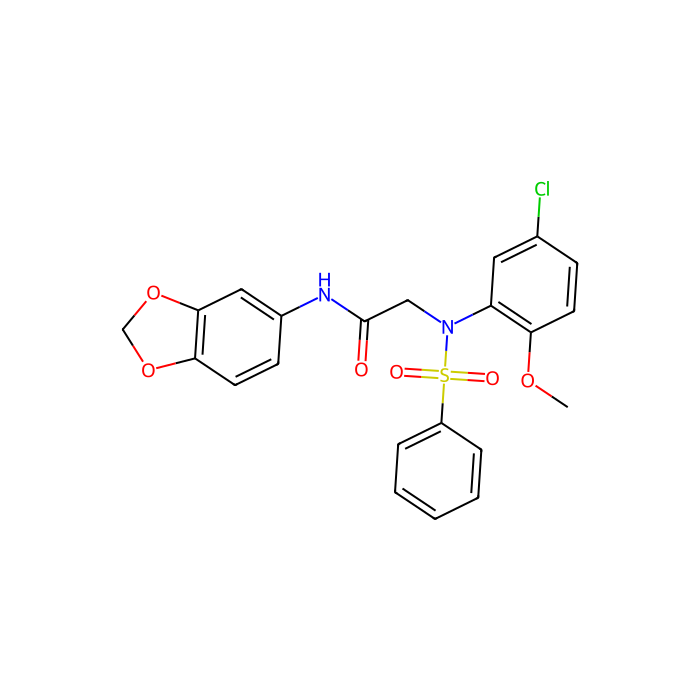
This compound belongs to the class of organic compounds known as sulfanilides. These are organic aromatic compounds containing a sulfanilide moiety, with the general structure RS(=O)(=O)NC1=CC=CC=C1.
External Descriptors
Not available
1. Djoumbou Feunang Y, Eisner R, Knox C, Chepelev L, Hastings J, Owen G, Fahy E, Steinbeck C, Subramanian S, Bolton E, Greiner R, and Wishart DS. ClassyFire: Automated Chemical Classification With A Comprehensive, Computable Taxonomy. Journal of Cheminformatics, 2016, 8:61.
Determine the necessary mass, volume, or concentration for preparing a solution.
Dilution Calculator
Determine the dilution needed to prepare a stock solution.
Reconstitution Calculator
Avis
Avis des clients
Application Protocols
No tested applications are provided for this item. As a general-purpose research small molecule, recommended procedures depend on your assay platform.
Generic handling protocol for small-molecule test articles (not item-specific):
Stock preparation: Dissolve in anhydrous DMSO to a convenient concentration (e.g., 10–50 mM). Record exact mass, purity, and salt form to enable molarity corrections.
Aliquoting: Dispense single-use aliquots in low-bind tubes/plates to avoid repeated freeze–thaw. Backfill with inert gas if air-sensitive behavior is suspected.
Working solutions: Dilute into assay media to the minimal DMSO percentage tolerated (commonly 0.1–1% v/v). Mix thoroughly and verify absence of precipitation.
Documentation: Note lot number, preparation date, and storage conditions on each aliquot. Confirm identity/purity if results are decision-critical.
For specific bioassay, analytical, or synthetic protocols, consult your institutional SOPs and method validations.
Biological Roles
No biological target or mechanism of action is provided for LX-2343 in the Product Data. Therefore, specific roles in metabolism, signaling, or pathway modulation cannot be assigned for this item.
General considerations for small-molecule research compounds (not item-specific):
If used as a tool compound, clearly document the proposed target, binding evidence (biochemical KD/IC50, cellular EC50), and selectivity panel results. Use orthogonal assays and counter-screens (e.g., reporter interference, redox activity, aggregation control with detergent) to rule out artifacts.
Verify colloidal aggregation risk (e.g., detergent-sensitive inhibition, dynamic light scattering). Include controls such as 0.01% Tween 20 and assess Hill slopes.
Record and report the exact lot, salt form, and purity when publishing biological findings to ensure reproducibility.
Note: No clinical, diagnostic, or veterinary uses are claimed or supported. This product is for research use only.
Buffer Applications
LX-2343 is not a buffering reagent. Buffer formulation guidance is generally not applicable.
If you need to deliver this compound in buffered systems (general advice):
Prepare concentrated DMSO stocks and dilute into assay buffers (e.g., phosphate, HEPES) to the minimal effective final DMSO concentration compatible with your assay (often ≤0.1–1% v/v).
Pre-wet plasticware with buffer containing the vehicle to mitigate compound adsorption. Mix thoroughly and verify apparent solubility (no visible precipitate, stable baseline in UV/LC detection).
Consider pH effects on ionizable compounds: if the structure indicates acidic/basic groups, adjust buffer pH to favor solubility while maintaining biological relevance.
Green Alternatives
Because LX-2343 is a discrete research compound rather than a process solvent or reagent, “green alternative” considerations primarily concern the choice of solvents and workflows used with it rather than substitution of the molecule itself.
Greener handling strategies (general guidance; not item-specific):
Prefer aqueous buffers with minimal DMSO (≤0.1–0.5% v/v) in biological assays where feasible. Validate assay performance at lower co-solvent levels.
For analytical/sample prep, use acetonitrile or ethanol instead of halogenated solvents where method robustness allows. Optimize gradient elution to reduce solvent consumption.
Implement micro-scale assays and high-density formats (384/1536-well) to minimize compound and solvent usage.
Employ closed-vial automated liquid handling to reduce VOC exposure and waste.
Illustrative comparison of common solvents (general, literature-based):
DMSO: Excellent solvency; low volatility; moderate EHS profile; good choice for stock solutions.
Acetonitrile: Widely used for LC; lower toxicity than DMF/DMAC; flammable; manage waste.
Ethanol: Renewable feedstock options; good for some preparations; assay-dependent tolerance.
Halogenated solvents (e.g., DCM): Avoid when possible; if required, ensure proper capture and waste segregation.
Pharmaceutical Uses
No pharmacopeial status, excipient role, or manufacturing application is provided for LX-2343. It is supplied strictly for research use only.
General context (not item-specific):
Early discovery compounds are sometimes used as internal standards, reference materials, or tool compounds in preclinical research. Such uses require confirmed identity, purity, and stability data (CoA, spectral files) and do not imply suitability for clinical or GMP applications.
If you intend to use this compound in regulated environments (e.g., GLP bioanalysis), establish chain-of-custody, qualified reference standards, and stability-indicating methods (ICH Q1A(R2) principles). This listing does not claim compliance with GMP, USP/EP/JP monographs, or compendial testing.
Physical Properties
Item-specific physicochemical data have not been disclosed in the Product Data. Do not assume values for experimental design.
Appearance: Not specified for this item; refer to CoA/Spec Sheet.
Melting point (MP): Not specified for this item; refer to CoA/Spec Sheet.
Boiling point (BP): Not specified for this item; refer to CoA/Spec Sheet.
Density: Not specified for this item; refer to CoA/Spec Sheet.
Refractive index: Not applicable/unknown for solids; Not specified for this item; refer to CoA/Spec Sheet.
Solubility profile: Not specified for this item; refer to CoA/Spec Sheet.
LogP/logD, pKa: Not specified for this item; refer to CoA/Spec Sheet.
UV-Vis characteristics (ε, λmax): Not specified for this item; refer to CoA/Spec Sheet.
General guidance for research small molecules (literature/practice, not item-specific):
Most drug-like screening compounds are DMSO-soluble at 10–50 mM and can be diluted into aqueous assay buffers containing 0.1–1% DMSO. Confirm the actual solubility for this item experimentally.
If poor aqueous solubility is encountered, consider co-solvents (DMF, ethanol) or surfactants (0.01–0.05% Tween 20) compatible with your assay. Always verify that vehicles do not confound readouts.
Hygroscopicity and polymorphism can alter MP and solubility; use consistent handling and record lot-specific behavior.
Quality and Grades
Grade/Purity: Not specified for this item; refer to CoA/Spec Sheet.
Context and expectations for research small molecules:
Typical library/screening compounds are supplied at >95% purity by HPLC with characterization by 1H NMR and MS. Verify the exact purity, residual solvent content, and counter-ion/salt form on the CoA for your lot.
UV/LC suitability: If you plan quantitative HPLC/UPLC, ensure the impurity profile and UV cutoff enable detection at your method wavelength. Low UV background and a single dominant peak are preferred for analytical development.
Salt/solvate state: The counter-ion (e.g., HCl, TFA) and any solvation (e.g., H2O, MeOH) can affect assay concentration calculations. Confirm the free base/acid versus salt mass fraction on the CoA.
Stability: Ask for any provided stability data (bench-top, refrigerated, freeze-thaw). For screening cascades, aliquot to minimize freeze–thaw cycles and track lot/aliquot IDs.
Implications for bioassays: Impurities can produce false-positive/negative signals. If SAR decisions depend on this compound, consider in-house verification (orthogonal HPLC method, HRMS, NMR) before use in critical studies.
Reaction and Applications
This product is listed in a small-molecule/compound library category and is typically used as a test article in discovery research rather than as a synthetic reagent. No manufacturer applications are provided beyond research use.
Research applications (general; not item-specific):
As a screening hit/probe candidate in biochemical, biophysical, or cell-based assays to interrogate pathways or phenotypes. Use appropriate controls (vehicle, inactive analogs) and orthogonal assays to confirm activity.
Analytical reference: May serve as a reference standard for method development (HPLC/LC-MS, stability-indicating assays) once purity and identity are confirmed.
Physicochemical profiling: Determine solubility, permeability (e.g., PAMPA), lipophilicity (shake-flask logD), and stability (chemical, microsomal) as part of developability assessment.
Not typically applicable:
Named reactions or catalytic roles are generally not relevant for this item unless you are derivatizing it. If you plan to use it as a scaffold for synthesis, consult Synthetic Utility for generic considerations and ensure you possess the structural information and IP freedom to operate.
Reaction Conditions
No reaction role is defined for LX-2343 in the Product Data, so there are no item-specific reaction conditions to report.
General guidance if derivatizing once the structure is known (not item-specific):
Solvents: Choose based on substrate polarity and stability (e.g., DMF/DMSO/MeCN for polar couplings; toluene/THF/EtOAc for less polar transformations). Maintain anhydrous conditions for moisture-sensitive steps.
Temperatures: 0–25°C for sensitive couplings and protecting-group manipulations; 60–120°C (sealed-vessel) for robust SNAr or Buchwald–Hartwig couplings, as compatible with the scaffold.
Catalysts/bases: For aryl halides, Pd(0)/phosphine ligands or Cu-mediated couplings; for amide formations, carbodiimides or uronium reagents with base (DIPEA). Verify compatibility with any heterocycles or reducible groups.
Monitoring: Use LC-MS and UPLC to track conversions and detect degradation; quench and work up under conditions that preserve labile motifs.
These are general, literature-based practices and not specifications for LX-2343.
Safety and Handling
Safety information provided with this listing is limited. Treat as a research-use-only small molecule of unknown hazard profile.
Research Use: For research use only.
GHS Classification: Not specified for this item; refer to SDS.
Signal Word: Not specified for this item; refer to SDS.
Hazard Statements (H-codes): Not specified for this item; refer to SDS.
Pictograms: Not specified for this item; refer to SDS.
General laboratory precautions (good practice; defer to SDS for authoritative guidance):
PPE: Wear lab coat, safety glasses, and appropriate gloves (e.g., nitrile). Use in a chemical fume hood to avoid inhalation of dusts/vapors/aerosols.
Avoid contact with skin and eyes; prevent inhalation and ingestion. Wash thoroughly after handling.
Incompatibilities: Unknown; as a precaution, segregate from strong oxidizers, strong acids/bases until specific compatibility is known.
Spill/accident response: Contain solids with inert absorbent, avoid dust formation, and dispose of according to institutional chemical waste procedures.
Special risks for small molecules: Some heteroatom-containing organics may be light- or air-sensitive. Minimize exposure to light, moisture, and elevated temperature. If peroxide-forming functional groups are suspected (ethers, enolizable solvents), test before concentration—however, no such functionality is specified for this item.
First-aid (overview): Move to fresh air if inhaled; rinse skin/eyes with water for 15 minutes if contacted; seek medical attention as needed. Always consult the SDS for the specific lot.
Solvent Selection
Item-specific solubility data are not provided. The following guidance reflects common practice for small-molecule research compounds (general literature/practice; not item-specific):
Primary stock solvent: DMSO is typically preferred due to broad solvency and compatibility with biochemical and cell-based assays. Begin with a small-scale solubility screen (e.g., 1–50 mM) to establish practical limits.
Alternative solvents: DMF, methanol, ethanol, or acetonitrile can be used for analytical sample prep. For non-aqueous reactions or analytics, dichloromethane or ethyl acetate may be suitable if compatible with the compound and instrumentation.
Aqueous buffers: Many drug-like molecules have limited water solubility. If aqueous work is required, co-solvent systems (e.g., 5–20% DMSO or ACN in buffer) or pH adjustment to ionize acidic/basic groups can help. Validate that vehicles do not interfere with your assay.
Practical tips:
Warm (25–37°C) and vortex/sonicate to assist dissolution; avoid prolonged heating.
Filter solutions (0.2 µm PTFE/nylon) before quantitative analytics to remove particulates.
Record actual solvent batch, water content, and final DMSO percentage in biological assays.
Small comparison (general):
DMSO: Highest solvency, excellent for stocks, low volatility; potential cytotoxicity at >0.5–1% v/v in cells.
DMF: Strong solvency; higher toxicity, hygroscopic; avoid in live-cell assays.
Ethanol/MeOH: Useful for quick dissolutions and chromatography; assay tolerance varies.
Storage and Reconstitution
Storage Conditions (item-specific): Store at -20°C. Shipped in an ice chest with ice pads.
Long-term handling best practices (general; not item-specific):
Keep container tightly closed under dry, inert atmosphere (e.g., desiccated cabinet or argon/nitrogen backfill) to minimize moisture uptake and oxidation, particularly for heteroatom-rich scaffolds.
Light protection: Use amber vials or foil wrap if the compound is chromophoric or suspected to be light-sensitive. Absent specific data, default to protecting from light.
Aliquoting: Upon receipt, equilibrate to room temperature before opening to prevent condensation, then immediately subdivide into single-use aliquots to limit freeze–thaw cycles.
Reconstitution (general guidance):
Solvent choice: Start with anhydrous DMSO for concentrated stocks (e.g., 10–50 mM). If higher solubility is needed, consider DMF or co-solvent mixtures consistent with downstream use.
Procedure: Weigh the required amount quickly, add pre-warmed solvent, vortex/sonicate briefly to dissolve, then sterile-filter if solutions are used in cell-based assays (0.2 µm PTFE for organic-rich solutions).
Stability of solutions: Store DMSO stocks at -20°C to -80°C in sealed, inerted vials. Avoid more than 3–5 freeze–thaw cycles. Discard solutions showing precipitation, discoloration, or unexpected LC-MS profiles.
Always consult the lot-specific CoA/SDS for authoritative stability and safety information.
Structure and Identity
Concise identity summary for a research small molecule screening compound.
SKU: L276484
Product Name: LX-2343
CAS: 333745-53-2
PubChem CID: 1000980
InChIKey: 456759 (as provided)
SMILES: Not specified for this item; refer to CoA/Spec Sheet.
Molecular Formula: Not specified for this item; refer to CoA/Spec Sheet.
Molecular Weight: Not specified for this item; refer to CoA/Spec Sheet.
Structural features (general guidance):
Functional groups, ring systems, and stereochemistry are not provided in the current Product Data. If structural elucidation is required for SAR or analytical development, request the full specification and spectral package (1H/13C NMR, HRMS, HPLC/UPLC traces) from the CoA/Spec Sheet.
2D description: Not available from provided data. If you are building screening libraries or docking models, obtain the canonical SMILES/InChI to generate standardized 2D/3D depictions and tautomer/ionization states at experimental pH.
Notes for cheminformatics workflows:
Without a definitive structure, computed properties (logP, pKa, polar surface area) cannot be reported. Use the PubChem CID and CAS to retrieve structure for in silico work, then standardize (stereo, salt/solvate state) before property calculation.
Synthetic Utility
Specific functional groups and reactivity for LX-2343 are not disclosed in the Product Data. As such, its use as a general synthetic reagent cannot be described.
General considerations if employing the molecule as a scaffold (not item-specific):
If structural information reveals modifiable handles (e.g., aryl halides, nitriles, esters, amines), standard cross-coupling, reductive amination, hydrolysis, or amide-bond formation strategies may enable analog generation.
Before derivatization, confirm the compound’s salt/solvate state and protect sensitive motifs (e.g., aldehydes, enolizable ketones) as required.
Maintain an analytical panel (UPLC, HRMS, 1H/13C NMR) for each intermediate to ensure integrity and avoid misassignment in SAR.
If you plan IP or library expansion, check freedom-to-operate and any known patents associated with the CAS/CID.
Without a provided structure, no specific named reactions or reagent behaviors can be recommended for this item.
Target Specificity
Not applicable. This product is not an antibody or affinity reagent, and no biological target or selectivity profile is provided in the Product Data.
Target name/epitope: Not specified for this item; refer to CoA/Spec Sheet.
We use cookies to ensure the website functions properly and, where permitted, to improve your experience. You can manage your preferences at any time in Settings. Learn more in our Cookie Policy.
Shall we send you a message when we have discounts available?
Remind me later
Thank you! Please check your email inbox to confirm.
Products are supplied to verified businesses, institutions, and qualified professionals for research and development use only. Not for use in humans, animals, diagnosis, or therapy.

 A2215358