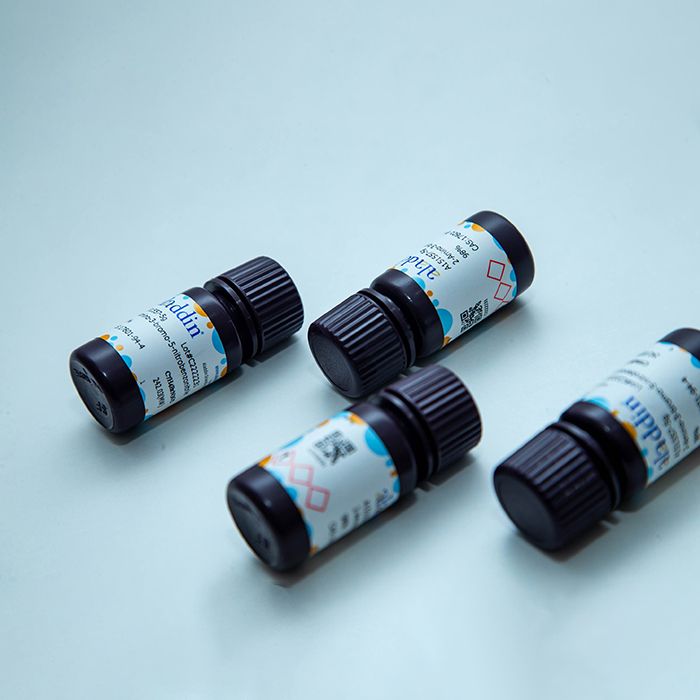
QUALITÉ & PURETÉMoligand™?Moligand™ — Aladdin's line of ligands and bioactive small molecules. Use for receptor, pathway, and binding studies needing defined small-molecule tools.≥98%
Moligand™, ≥98% Moligand™ pour les flux de travail chromatographiques et analytiques sensibles nécessitant une interférence de ligne de base minimale.
🌡
Stockage & expédition
Store at -20°C Expédition Ice chest + Ice pads. Consultez le COA spécifique au lot pour les spécifications exactes.
📋
Documents qualité
SDS, COA, fiche technique et fiche de spécifications disponibles au téléchargement. COA spécifique au lot accessible via la recherche par numéro de lot.
📚
Preuve documentaire
Cité dans 0 publications à comité de lecture couvrant la chromatographie, la synthèse organique et les réactions de couplage croisé.
Vue d’ensemble
LY3372689 (Formulaic Ia) is an orally active O-GlcNAcase (OGA) enzyme inhibitor. LY3372689 can be used for tauopathies research, including Alzheimer’s disease.
In Vivo
LY3372689 shows a dose-dependent change in OGA enzyme occu-pancy (EO) following a single oral dose with a maximum EO of greater than 90% in rat . MCE has not independently confirmed the accuracy of these methods. They are for reference only.
Form:Solid
Spécifications
Synonymes
Ceperognastat | Formulaic Ia
Spécifications et pureté
Moligand™, ≥98%
Mécanismes biochimiques et physiologiques
Ceperognastat (LY3372689) is O-GlcNAcase (OGA) enzyme inhibitor. Ceperognastat can be used for tauopathies research, including Alzheimer’s disease.
Conditions de stockage de stockage
Store at -20°C
Expédié en
Ice chest + Ice pads
Ce produit nécessite l'expédition en chaîne froide. Les services terrestres et autres services économiques ne sont pas disponibles.
Certificats (CoA, COO, BSE/TSE et tableau d'analyse)
C of A & Other Certificates(BSE/TSE, COO):
Analytical Chart:
Propriétés chimiques et physiques
Solubilité
DMSO : 250 mg/mL (651.99 mM; Need ultrasonic)
Calculateurs de solution
Molarity Calculator
Determine the necessary mass, volume, or concentration for preparing a solution.
Dilution Calculator
Determine the dilution needed to prepare a stock solution.
Reconstitution Calculator
Avis
Avis des clients
Application Protocols
The following are general, non-item-specific protocols for handling small-molecule screening ligands. Adjust to your assay and consult the CoA/SDS.
Preparing DMSO stock solutions:
Equilibrate vial to room temperature in a desiccator. Briefly centrifuge to collect material at the bottom.
Add anhydrous DMSO to target concentration (e.g., 10–50 mM), vortex and sonicate briefly if needed. Confirm clarity visually.
Optional: Quantify concentration by qNMR using an internal standard.
Aliquot into amber, low-bind tubes (10–50 µL) and store at −20°C. Avoid repeated freeze–thaw; use single-use aliquots.
Plate preparation for biochemical assays:
Prepare serial dilutions in DMSO (e.g., 3-fold or 10-fold) and backfill with DMSO to equalize vehicle.
Transfer to assay buffer to achieve final DMSO 0.1–1% v/v. Mix gently and incubate 5–15 min before reading/initiating the assay.
Include vehicle-only, positive control (if available), and orthogonal detection controls.
Solubility/aggregation checks:
Nephelometry or visual inspection for precipitation; add 0.01% nonionic detergent only if assay-compatible.
Run a detergent-sensitive enzyme counterscreen to flag colloidal behavior.
Biophysical confirmation (if target protein available):
DSF/NanoDSF: 0–200 µM ligand, verify ΔTm; confirm with orthogonal SPR/MST/ITC as needed.
Documentation:
Record batch/lot, stock concentration, solvent details, dilution scheme, plate maps, and timing.
Biological Roles
Item-specific status:
No target annotation, mechanism of action, or endogenous role is provided for LY3372689. It is supplied strictly for research use as a screening ligand candidate.
General context for small-molecule ligands in research (non-clinical):
Serve as chemical tools to perturb protein function in vitro or in cells, enabling validation of biochemical pathways and hypothesis testing.
When linked to a validated target, such ligands can support target engagement studies (e.g., CETSA, NanoBRET) and pathway mapping through dose–response experiments and temporal profiling.
Absent a defined target, phenotypic screening can reveal functional bioactivity that guides follow-up deconvolution (chemoproteomics, CRISPR modifier screens, expression profiling).
Assay interference awareness:
Certain chemotypes are prone to PAINS-like behavior or redox/fluorescence artifacts. Without structural information, include orthogonal assay formats and counterscreens to exclude nonspecific mechanisms (aggregation, metal chelation, redox cycling).
Documentation and traceability:
Record batch ID, precise concentrations, solvent percentages, and timing to ensure reproducibility and to enable cross-study comparisons if the compound later receives a target assignment.
Important limitation:
No biological roles or activities are claimed or implied for this specific item; any observed effects must be experimentally validated in the user’s system.
Buffer Applications
This product is not a buffering agent and has no disclosed acid/base properties in the Product Data.
Applicability:
Not typically used to prepare buffers or to control pH. Avoid using unknown small molecules as buffer components.
Practical pointers when using in buffered systems (general):
Prepare concentrated DMSO stocks and dilute into pre-equilibrated assay buffers (e.g., HEPES, PBS) keeping final DMSO ≤0.1–1% v/v as tolerated.
If precipitation is observed, adjust ionic strength/pH of the buffer within assay constraints or incorporate permissible co-solvent.
Filter buffers (0.22 µm) and degas to minimize bubble/particulate artifacts in optical/biophysical assays.
For pH-sensitive targets:
Since the compound’s pKa is unknown, test dose–response across a narrow pH range to detect pH-coupled potency shifts due to ionization or target conformational changes.
Green Alternatives
Greener choices typically revolve around solvent and process selection for handling small-molecule ligands. The compound’s intrinsic structure is unknown; thus, the focus is on media and logistics.
Stock/dilution solvents (comparison – general guidance):
DMSO: Benchmark for solvency and stability; moderate environmental profile but hard-to-remove in waste streams.
Ethanol: Bio-based option; limited solvency for highly lipophilic compounds; higher volatility may complicate dosing precision.
Glycerol/PEG400: Low volatility, benign profiles; viscosity complicates high-throughput dispensing and may affect assays.
Propylene carbonate/Cyrene: Emerging greener aprotics; compatibility with biological assays varies and must be validated.
Practical green strategies:
Minimize DMSO by preparing the highest validated stock concentration and dispensing micro-volumes to achieve ≤0.1–1% final.
Use aqueous buffers with pH adjustment or cyclodextrin carriers to reduce organic co-solvent demand when feasible.
Consolidate analytical runs and adopt UPLC to reduce solvent volumes.
Implement solvent recycling for ACN/MeOH in analytics where permitted.
Trade-offs to consider:
Greener co-solvents may alter target conformation, assay windows, or signal backgrounds; always run solvent-matched controls.
Stability in water-rich media may be limited for some scaffolds; confirm by time-course LC–MS.
Packaging/logistics:
Choose amber glass and right-size vials to reduce headspace and waste; maintain cold chain to extend shelf life and reduce re-synthesis/re-purchase emissions.
Pharmaceutical Uses
Regulatory/usage status:
For research use only; not for human or veterinary use. No pharmacopeial status is provided.
Relevance to pharmaceutical R&D (non-clinical, general):
May serve as a reference material or hit/lead candidate in early discovery screening campaigns.
Useful as a spike-in standard for developing analytical methods (HPLC/UPLC–MS) to quantify stability, solubility, or recovery in formulation-like matrices.
Solubilization studies with DMSO-seeded aqueous media, cosolvents (EtOH, PEG400), surfactants (Polysorbate 80) or cyclodextrins may help define developability risk, if the structure later justifies such work.
Solid-state characterization (DSC/TGA, PXRD) can be informative for stability; not specified for this item and should be generated in-house if needed.
Important limitations:
No claims regarding therapeutic use, safety, efficacy, or dosage are made or implied for this item.
Do not use in manufacturing or clinical applications without appropriate regulatory qualification and full CMC data.
Physical Properties
Item-specific values are not provided in the Product Data. Use the CoA/Spec Sheet for authoritative numbers.
Item-specific data:
Appearance: Not specified for this item; refer to CoA/Spec Sheet.
Molecular weight: Not specified for this item; refer to CoA/Spec Sheet.
Molecular formula: Not specified for this item; refer to CoA/Spec Sheet.
Melting/boiling point, density, refractive index, UV/Vis cutoff, logP/logD, pKa: Not specified for this item; refer to CoA/Spec Sheet.
Practical guidance (general for small-molecule ligands):
Solubility screening: Begin with DMSO (typically up to 10–50 mM), then test miscibility into aqueous buffers (final DMSO 0.1–1% v/v) and secondary co-solvents (EtOH, MeOH, PEG400) as needed.
Aqueous behavior: Without a known structure, acid/base properties are unknown; assess pH-dependent solubility (pH 3, 7.4, 9) if biological assays are planned.
Hygroscopicity/light sensitivity: Absent data, store desiccated, protected from light, and minimize freeze–thaw.
Turbidity or precipitation upon dilution from DMSO into buffer; measure by Nephelometry or plate-based OD600/Scattered light.
Determine kinetic solubility via serial dilution and 1–2 h equilibration; quantify by UPLC.
If chromophoric, collect UV–Vis spectrum to estimate λmax and potential interference in absorbance assays (label as method development data, not product specs).
Quality and Grades
Item-specific (from Product Data):
Grade/Purity designation: Moligand™
Storage: −20°C; shipped cold.
No purity percentage, stabilizers, or impurity limits are specified for this item; refer to CoA/Spec Sheet.
What Moligand™ implies (program overview, not a specification):
Designed for discovery screening and ligand identification workflows.
Typically delivered as analytically verified small molecules intended for in vitro use in biochemical, biophysical, or cell-based assays.
Identity/purity are normally supported by analytical data (e.g., LC–MS, NMR, HPLC). For this specific item, consult the accompanying CoA for exact methods and acceptance criteria.
Considerations for professional users:
If purity is critical for SAR or quantitative pharmacology, confirm by independent HPLC/UPLC and LC–MS under your methods. Do not assume a numeric purity in the absence of a stated value.
If salt form, hydrate state, or polymorph impacts your assay, verify form by NMR/HRMS/elemental analysis or PXRD as appropriate.
Trace residual solvents, water content, or counterions can influence solubility and assay interference; check the CoA for these details if provided, or measure (KF, GC, IC) in-house.
Documentation: Retain batch CoA and SDS with the sample; reference the batch number in all reports for reproducibility.
Reaction and Applications
This product is a research ligand (Moligand™) rather than a synthetic reagent. Its primary value lies in discovery and target interrogation, not as a stoichiometric reactant.
Typical research applications (general for screening ligands):
Orthogonal biophysical confirmation: NMR ligand-observed (STD, WaterLOGSY), protein-observed (HSQC) if protein is available.
Early ADME profiling: solubility, lipophilicity, metabolic stability, permeability (PAMPA/MDCK), and protein binding to contextualize potency data.
Practical tips:
Establish a solubility ceiling empirically in DMSO before committing to plate prep; visually inspect for particulates after dilution into assay buffer.
Include vehicle and colloidal aggregation controls (e.g., low % detergent, DLS or enzyme counterscreens) to mitigate false positives.
Confirm concentration by quantitative NMR or UV (if chromophoric) to reduce dosing error.
Track batch and freeze–thaw history; use single-use aliquots.
Not a typical reagent for named synthetic reactions: In the absence of structural information, do not plan Grignard/cross-coupling/etc. with this item. If chemical modification is intended (probe derivatization), obtain or determine the structure first and design from functional handles.
Reaction Conditions
Not applicable as a general reagent: specific reaction conditions cannot be recommended without a known structure or intended transformation.
If using the compound in binding/biological assays (general guidance):
Stock preparation: Dissolve in anhydrous DMSO at the highest concentration that remains visually clear after 24 h at room temperature, then store aliquots at −20°C.
Assay dilution: Add to assay buffer to reach desired final concentration with 0.1–1% DMSO v/v. Mix gently and verify absence of precipitate (visual or nephelometry).
Stability: Verify by LC–MS before and after the assay window (e.g., 0 and 4–24 h) to confirm that observed activity is not due to degradation products.
If attempting chemical modification (general):
Determine structure first and run small-scale reactions under inert atmosphere with dry solvents as needed. Monitor by LC–MS and TLC; quench cautiously given unknown functional groups.
Safety and Handling
Always consult the SDS for authoritative safety information. The Product Data do not include hazard classifications.
Item-specific hazard info:
Signal word: Not specified for this item; refer to SDS.
GHS hazard statements/classification/pictograms: Not specified for this item; refer to SDS.
General laboratory precautions for unknown small molecules:
Engineering controls: Work in a chemical fume hood; avoid aerosol/ dust formation. Use dedicated balances or weigh boats with covers.
PPE: Lab coat, safety glasses, and appropriate chemical-resistant gloves (e.g., disposable nitrile). Upgrade to face protection and double-gloving if aerosolizable powders are handled.
Avoid ingestion/inhalation/skin contact; do not pipette by mouth. Keep away from food areas.
Incompatibilities (general): Strong oxidizers/reductants, strong acids/bases, and reactive metals may be incompatible depending on functional groups—unknown here; segregate storage and test on small scale.
Spill/accidental release: Contain with inert absorbent, avoid dust, ventilate area, and collect for disposal per institutional guidelines.
First aid (overview): If on skin/eyes—rinse with water for 15 minutes; if inhaled—move to fresh air; if ingested—rinse mouth. Seek medical attention; provide SDS.
Waste: Dispose as organic chemical waste; incineration-compatible. Deactivate bioassay plates with appropriate solvent and collect as hazardous waste.
Transport: Ship as nonclinical research chemical per site rules; maintain cold chain as provided.
Solvent Selection
With no disclosed structure, select solvents using a tiered screening approach common to screening libraries.
Primary stock solvent (general practice):
DMSO is the default for small-molecule libraries owing to broad solvency, low volatility, and compatibility with most bioassays. Prepare concentrated stocks (e.g., 10–50 mM) as allowed by solubility.
Secondary/co-solvents for method development:
Polar protic: Water (with pH adjustment), MeOH, EtOH; consider cyclodextrin inclusion for hydrophobes.
Polar aprotic: DMF, NMP (use sparingly in bioassays); Acetonitrile for chromatography.
Green-leaning options: Glycerol, propylene carbonate, PEG400—useful for stabilization but may affect assay readouts.
Assay-media compatibility:
Keep final DMSO ≤0.1–1% v/v in biochemical/cell assays, validated by your system controls.
If precipitation occurs on dilution, pre-dilute in DMSO, then add buffer slowly with mixing; consider surfactant traces (0.01% Tween-20) only if assay-compatible.
Chromatography and analytics:
LC–MS: Water/ACN with 0.1% FA or NH4F/NH4HCO3 for negative mode. Verify ionization in both ESI polarities.
NMR: DMSO-d6 first-line; CD3OD or CDCl3 contingent on solubility and stability.
When to choose alternatives:
For air/moisture-sensitive motifs (unknown here), strictly anhydrous solvents under inert gas may be required. For light-sensitive compounds, amber vials and minimal UV exposure are recommended.
Storage and Reconstitution
Item-specific (from Product Data):
Storage conditions: Store at −20°C.
Shipping: Ice chest + ice pads.
Appearance: Not specified for this item; refer to CoA/Spec Sheet.
Reconstitution (general guidance for small molecules):
Solvent: Use anhydrous DMSO as the first-line solvent unless otherwise indicated by the CoA. If alternative solvents are needed (EtOH, MeOH, DMF), validate stability and assay compatibility.
Concentration: Prepare the highest concentration that remains clear and stable at room temperature for at least 1–2 h; 10–50 mM is common but must be empirically verified.
Filtration: If particulates persist, pass through a PTFE or PVDF 0.2 µm syringe filter into an amber vial.
Aliquoting: Dispense single-use aliquots (10–50 µL) to avoid freeze–thaw cycles. Purge headspace with inert gas if oxidation sensitivity is suspected.
Handling and stability:
Protect from light and moisture; store desiccated in sealed containers. Minimize bench-time during handling.
For aqueous working solutions, prepare fresh on the day of use unless stability is established by LC–MS.
Track the number of freeze–thaw events and discard aliquots showing precipitation or discoloration.
Expiry and documentation:
No shelf-life is specified for this item; refer to CoA/Spec Sheet. Maintain inventory logs linking batch ID, receipt date, storage history, and any in-house QC results.
Structure and Identity
Brief item-specific summary followed by what is and is not known for this library ligand.
Molecular formula: Not specified for this item; refer to CoA/Spec Sheet.
Molecular weight: Not specified for this item; refer to CoA/Spec Sheet.
SMILES: Not specified for this item; refer to CoA/Spec Sheet.
InChIKey: Not specified for this item; refer to CoA/Spec Sheet.
Structural features (general guidance):
The precise 2D structure, functional groups, and stereochemistry have not been provided in the Product Data. Consult the CoA/SDS or vendor structure disclosure for detailed features.
As a coded small molecule (LY-series), it is typically a discrete organic compound intended for screening and ligand discovery. Without structure, no assumptions should be made about ionization state, hydrogen bond capacity, or aromaticity.
How to verify identity in the lab (general practice):
Record 1H/13C NMR in a suitable deuterated solvent selected after limited solubility screening.
Acquire high-resolution LC–MS (positive/negative mode as needed) and compare with reference mass/retention (from CoA when available).
Optional: FTIR and HPLC/UPLC purity profile under your method to establish an in-house baseline.
Synthetic Utility
This item is supplied as a discrete small-molecule ligand for screening, not as a general synthetic building block.
Applicability to synthesis:
Without a disclosed structure and functional groups, it is not possible to recommend transformations, protection strategies, or coupling methodologies.
If derivatization is desired (e.g., analog synthesis, probe attachment), obtain the structure and assess available handles (amines, alcohols, halides) to plan modifications (amide couplings, SNAr, cross-couplings, click chemistry, etc.).
Analytical support for synthetic follow-up (general):
Establish a reference LC–MS/HPLC method and NMR fingerprint of the supplied lot. These data serve as benchmarks when preparing analogs.
If a chiral center is present (unknown here), incorporate chiral HPLC/SFC methods early for enantiopurity assessment.
Retrosynthetic planning note:
LY-series codes typically correspond to internally developed scaffolds; published routes (if any) would need to be sourced from the primary literature/patents linked to the CAS. Absent those, no synthetic route or reactivity can be inferred.
Target Specificity
Item-specific information:
No target, pathway, or selectivity profile is provided for LY3372689 in the Product Data.
Guidance for establishing specificity (general best practices):
Use orthogonal assays (biochemical vs. biophysical vs. cellular) to confirm on-target engagement.
Include broad counterscreens against common off-targets or interference mechanisms (redox, aggregation, metal chelation).
Determine basic selectivity panels relevant to the hypothesized class (e.g., kinases, GPCRs, proteases) once initial activity is observed.
Apply concentration–response with proper vehicle controls and replicate across batches/lots when available.
Foire aux questions
What is the purity of this product?
This product is supplied at ≥98% purity (chemical assay). Lot-specific values are stated on the Certificate of Analysis.
How should this product be stored?
Store at ?20 °C. Freezer storage is required to maintain the specified shelf life.
What is Moligand??
Moligand? is one of Aladdin Scientific's premium product lines, formulated for high-purity applications across multiple workflows. Compared to standard grades in the same workflow, Moligand? products typically offer tighter specifications, more rigorous QC, and stronger lot-to-lot consistency.
How is this product shipped?
This product ships in an insulated container with ice pads. Unpack on arrival and transfer it to the storage condition stated above.
What are the CAS number, molecular formula and molecular weight?
The CAS Number is 2241514-56-5, the molecular formula is C16H22FN5O3S, and the molecular weight is 383.44 g/mol.
What documentation is provided?
Available product documentation, including Certificates of Analysis (COA), Safety Data Sheets (SDS), and specification sheets, is shown in the product document area. Document availability and access follow the current site policy.
Besoin d'aide pour choisir la qualité ?
Notre guide de sélection des qualités couvre la pureté, le statut du stabilisant et l'adéquation à l'application pour toutes les variantes de notre catalogue.
Nous utilisons des cookies pour garantir le bon fonctionnement du site et, lorsque cela est autorisé, pour améliorer votre expérience. Vous pouvez gérer vos préférences à tout moment dans les Paramètres. Pour en savoir plus, consultez notre Politique relative aux cookies.
Souhaitez-vous que nous vous envoyions un message lorsque des réductions seront disponibles?
Me rappeler plus tard
Merci ! Veuillez vérifier votre boîte de réception e-mail pour confirmer.
Products are supplied to verified businesses, institutions, and qualified professionals for research and development use only. Not for use in humans, animals, diagnosis, or therapy.