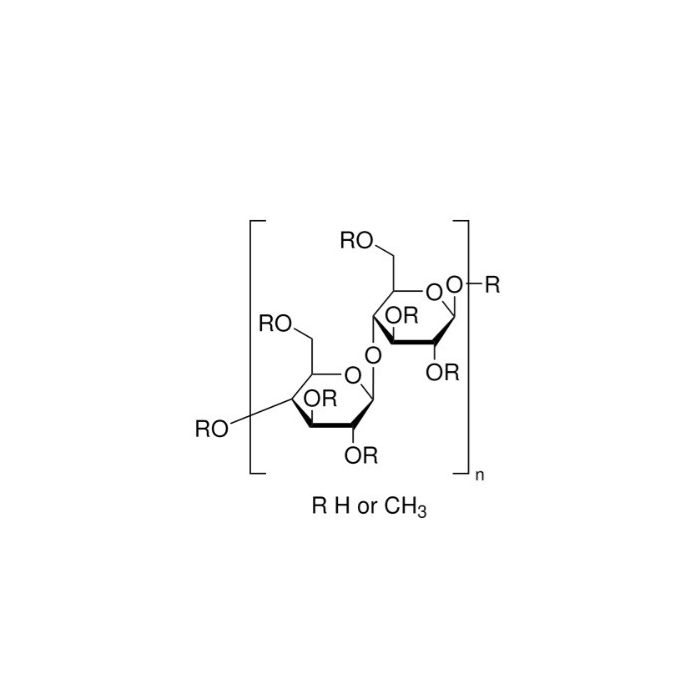
Méthylcellulose - 3500-560mPa - s, solution aqueuse à 2% à 20 ℃ , CAS No.9004-67-5

CAS: 9004-67-5 Cat. No.: M742525 Numéro CE: 618-391-7 PubChem CID: 51063134
DISPONIBLE À COMMANDE
GRADE & PURITY 3500-5600mPa · s, 2% aqueous solution at 20 ℃
Storage
Température ambiante, charge d'argon
Shipped In
Normal
★
Size
Allemagne (EU)
USA*
Price
Qty
100g
M742525-100g
Sur commande · 8–12 semaines
14,66€
500g
M742525-500g
1 En stock
2 En stock
50,24€
Enter a quantity for the sizes you want to add.
🧪
Why this grade

3500-560mPa - s, solution aqueuse à 2% à 20 ℃ for sensitive chromatographic and analytical workflows requiring minimal baseline interference.

🌡

Storage & shipping

Température ambiante, charge d'argon Ships Normal Check lot-specific COA for exact specifications.

📋

Quality documents

SDS, COA, datasheet, and spec sheet available for download. Lot-specific COA accessible via lot number lookup.

📚

Literature proof

Cited in 161 peer-reviewed publications across chromatography, organic synthesis, and cross-coupling reactions.

Vue d’ensemble

La méthylcellulose est un polymère hydrosoluble, non ionique, à liaisons glucosidiques hydrophiles, dérivé du polysaccharide cellulose.

Objectif

La méthylcellulose a été utilisée
dans les essais de formation de colonies
pour l'évaluation de la motilité des spermatozoïdes
pour la génération de sphéroïdes
dans la préparation de billes d'agar

Specifications

Spécifications et pureté
3500-560mPa - s, solution aqueuse à 2% à 20 ℃
Mécanismes biochimiques et physiologiques
La méthylcellulose permet de stabiliser les mélanges d'huile, d'eau et d'air, comme la mousse, par émulsification. La méthylcellulose est utilisée comme liant et épaississant pour divers adhésifs[1][2] et comme traitement de la constipation.
Conditions de stockage de stockage
Température ambiante, charge d'argon
Expédié en
Normal
Noms et identifiants
Pubchem Sid
Sourires canoniques
[*]OC[C@H]1O[C@@H](O[C@@H]2[C@@H](CO[*])O[C@@H](O[*])[C@H](O[*])[C@H]2O[*])[C@H](O[*])[C@@H](O[*])[C@@H]1O[*]
IUPAC Name
(5R)-2,3,4-trimethoxy-6-(methoxymethyl)-5-[(2S)-3,4,5-trimethoxy-6-(methoxymethyl)oxan-2-yl]oxyoxane
InChIKey
YLGXILFCIXHCMC-JHGZEJCSSA-N
INCHI
1S/C20H38O11/c1-21-9-11-13(23-3)15(24-4)18(27-7)20(30-11)31-14-12(10-22-2)29-19(28-8)17(26-6)16(14)25-5/h11-20H,9-10H2,1-8H3/t11?,12?,13?,14-,15?,16?,17?,18?,19?,20+/m1/s1
Isomères SMILES
COCC1[C@H](C(C(C(O1)OC)OC)OC)O[C@H]2C(C(C(C(O2)COC)OC)OC)OC
WGK Allemagne
1
RTECS
FJ5959000
PubChem CID
51063134

Documentation

📋 Safety Data Sheet (SDS)

Comprehensive hazard, handling, storage, and regulatory compliance document.

Download SDS →

✅ Certificate of Analysis (COA)

Lot-specific quality data. Enter your lot number to retrieve the exact COA.

Look up COA →

📊 Datasheet

Quick-reference summary of product specifications and applications.

View datasheet →

🔬 Specification Sheet

Full quality attributes and acceptance criteria for this grade.

View spec sheet →

Advanced Data

Taxonomic Classification

Taxonomy Tree

KingdomOrganic compounds
SuperclassOrganic oxygen compounds
ClasseOrganooxygen compounds
SubclassCarbohydrates and carbohydrate conjugates
Intermediate Tree Nodes Glycosyl compounds
Direct ParentO-glycosyl compounds
Alternative Parents Disaccharides  Oxanes  Oxacyclic compounds  Dialkyl ethers  Acetals  Hydrocarbon derivatives  
Molecular FrameworkAliphatic heteromonocyclic compounds
Substituents O-glycosyl compound - Disaccharide - Oxane - Oxacycle - Organoheterocyclic compound - Ether - Dialkyl ether - Acetal - Hydrocarbon derivative - Aliphatic heteromonocyclic compound
DescriptionThis compound belongs to the class of organic compounds known as o-glycosyl compounds. These are glycoside in which a sugar group is bonded through one carbon to another group via a O-glycosidic bond.
External Descriptors Not available
Structure 3D
Modèle de structure chimique interactif


Certificats (CoA, COO, BSE/TSE et tableau d'analyse)
C of A & Other Certificates(BSE/TSE, COO):
Analytical Chart:

Find and download the COA for your product by matching the lot number on the packaging.

16 results found

Lot NumberCertificate TypeDateArticle
H2612762Certificate of AnalysisAug 01, 2026 M742525
H2612763Certificate of AnalysisAug 01, 2026 M742525
H2612764Certificate of AnalysisAug 01, 2026 M742525
H2612765Certificate of AnalysisAug 01, 2026 M742525
J2619076Certificate of AnalysisAug 01, 2026 M742525
F2605278Certificate of AnalysisMay 28, 2026 M742525
F2611711Certificate of AnalysisMay 28, 2026 M742525
F2611712Certificate of AnalysisMay 28, 2026 M742525
F2611713Certificate of AnalysisMay 28, 2026 M742525
H2604086Certificate of AnalysisMay 28, 2026 M742525
J2418635Certificate of AnalysisApr 09, 2026 M742525
J2418637Certificate of AnalysisApr 09, 2026 M742525
J2418639Certificate of AnalysisApr 09, 2026 M742525
J2418640Certificate of AnalysisApr 09, 2026 M742525
J2418641Certificate of AnalysisApr 09, 2026 M742525
J2418645Certificate of AnalysisApr 09, 2026 M742525
Propriétés chimiques et physiques
SensibilitéMoisture sensitive
Poids moléculaire454.500 g/mol
XLogP3-1.000
Hydrogen Bond Donor Count0
Hydrogen Bond Acceptor Count11
Rotatable Bond Count12
Exact Mass454.241 Da
Monoisotopic Mass454.241 Da
Topological Polar Surface Area102.000 Ų
Heavy Atom Count31
Formal Charge0
Complexity496.000
Isotope Atom Count0
Defined Atom Stereocenter Count2
Undefined Atom Stereocenter Count8
Defined Bond Stereocenter Count0
Undefined Bond Stereocenter Count0
The total count of all stereochemical bonds0
Covalently-Bonded Unit Count1
FAQ et articles
Microcrystalline Cellulose (MCC): A Comprehensive Primer and Selection Guide—Structural Features, Key Performance Metrics, and Application Scenarios
Materials Can “Switch”: How Smart Polymers Respond to Temperature, pH, and Light (with Experimental Selection Tips & Product Navigation)
Understanding Hydrophilic Polymers in Aqueous Systems: Hydration Mechanisms, Structural Knobs, and Task-Oriented Selection Guide (Including Tables 1–3)
FGF2-Induced Angiogenesis Model: Standard Operating Procedure (Protocol)
Functional Framework of Starch Metabolism-Related Enzymes in Food Science Research and Mechanistic Analysis of Quality Regulation
Key Judgments in Medical Hydrogel R&D: From Polymer Source and Crosslinking Strategy to Sterilization Planning, Scale-Up Feasibility, and Quality Control
Injectable Thermosensitive Gels: Gelation Behavior, Rheological Properties, and Drug Release Characteristics
From Structure to Rheology: Thickening, Stabilization, and Selection Logic of Cellulose Ethers for Personal Care Applications
Analysis of the Production Process of Hydroxypropyl Methylcellulose (HPMC) for Putty: Understanding Differences in Substitution Structure and Gelation Temperature from High-Ratio and Low-Ratio Formulations
Types, Mechanisms of Action, Key Quality Indicators, and Selection and Application of Common Cellulose Ethers in Wall Putty
Influencing Factors and Control Strategies for Blistering in Neutral Wall Putty: An Experimental Analysis Based on HPMC Dosage, Viscosity, and Ground Calcium Carbonate Fineness
How to Select Binding/Gel Materials for Neutral Wall Putty? A Comparison of Pregelatinized Starch, PVA, and Redispersible Polymer Powder Based on Four Application Trials
Causes and Mechanism Analysis of Delamination During Sanding of Water-Resistant Putty
What Are the Differences Between Polyvinyl Alcohol 1788, 2488, and 2699? Understanding Workability, Bonding Strength, and Relative Water Resistance from the Perspective of Degree of Polymerization and Degree of Hydrolysis
Why Do Rust Spots Appear on Neutral Wall Putty? Iron Sources, Moisture Migration, Oxidative Color Development, and Prevention Measures
Common Problems and Formulation Adjustment Strategies for Neutral Putty Under High Summer Temperatures
Differences and Application Selection of Cassava- and Corn-Based Pregelatinized Starch in Neutral Putty Formulations
The Role, Selection, Cracking Risk Analysis, and Dosage Control of Bentonite in Neutral Putty
Experimental Applications of Carboxymethyl Cellulose (CMC) Solution in Enzyme Assays, Suspension Systems, and Functional Materials
Citations of This Product
Calculateurs de solution
Avis

Avis des clients

Shall we send you a message when we have discounts available?

Remind me later

Thank you! Please check your email inbox to confirm.

Oops! Notifications are disabled.