Dicarboxylic acid or derivatives - Carboxylic acid ester - Dialkyltin salt - Sulfenyl compound - Organic metal salt - Dialkyltin - Carbonyl group - Organosulfur compound - Organooxygen compound - Organometallic compound - Organic post-transition metal moeity - Organic oxide - Organic tin salt - Organic oxygen compound - Hydrocarbon derivative - Aliphatic acyclic compound
Description
This compound belongs to the class of organic compounds known as dicarboxylic acids and derivatives. These are organic compounds containing exactly two carboxylic acid groups.
External Descriptors
Not available
1. Djoumbou Feunang Y, Eisner R, Knox C, Chepelev L, Hastings J, Owen G, Fahy E, Steinbeck C, Subramanian S, Bolton E, Greiner R, and Wishart DS. ClassyFire: Automated Chemical Classification With A Comprehensive, Computable Taxonomy. Journal of Cheminformatics, 2016, 8:61.
Determine the necessary mass, volume, or concentration for preparing a solution.
Dilution Calculator
Determine the dilution needed to prepare a stock solution.
Reconstitution Calculator
Avis
Avis des clients
Application Protocols
No standardized bioassay or analytical application protocols are specified for this item.
• Process-focused guidance (general)
Catalysis screening: Prepare a stock solution quantified by tin content. Run a temperature–loading matrix under dry, inert conditions. Track conversion (GC/LC) and color metrics (if relevant) vs. a blank and a non-tin comparator catalyst.
PVC stabilization trials: Use a two-roll mill or Brabender mixer to assess initial color and heat stability (Congo red/thermally aged plaque tests). Record torque/temperature profiles and color change over time.
Post-reaction cleanup: Include a metal-scavenging step in the protocol; analyze residual Sn by ICP-OES/MS.
These are general/literature practices; tailor to your substrates and equipment. For research use only.
Biological Roles
This product is an organotin mercaptide intended for chemical/process research, not for biological systems.
• General notes (literature)
Organotin compounds are synthetic organometallics with no known beneficial physiological role. Some organotins exhibit significant toxicity to aquatic organisms and may disrupt enzymatic functions by binding to thiol-containing residues, but the extent is highly structure-dependent.
Methyltin species can occur as environmental degradation products from industrial uses; their biotransformation involves oxidation/hydrolysis to inorganic tin species.
• Laboratory relevance
Avoid use in biological assays or cell culture unless the objective is specifically to study organotin toxicity or metal–thiol interactions under controlled conditions.
• Compliance
For research use only. Not intended for food, drug, cosmetic, household, or agricultural applications.
Buffer Applications
Not typically applicable. Methyltin mercaptide is an organometallic catalyst/stabilizer and is not used to prepare aqueous buffer systems. In aqueous media it may hydrolyze and liberate thiols, compromising buffer integrity and producing strong odors. For relevant information, see Reaction & Applications and Solvent Selection.
Green Alternatives
When evaluating methyltin mercaptide for catalysis or stabilization, consider environmental, health, and regulatory drivers. Organotin compounds are effective but raise EHS concerns.
• Potential alternatives (literature/general)
PVC stabilization: Ca/Zn or Ba/Zn carboxylates; hydrotalcites; epoxidized vegetable oils. These systems avoid organotin and can meet many thermal stability targets with careful formulation.
Transesterification/polyesterification: Titanium alkoxides (e.g., Ti(OiPr)4), zirconium complexes, bismuth carboxylates, and zinc salts; organic catalysts (e.g., TBD, DBU) for certain monomers.
Urethane catalysis: Bismuth neodecanoate, zinc octoate, and tertiary amine catalysts reduce tin exposure.
• Trade-offs
Activity/selectivity: Organotin catalysts often provide high rates and color hold; alternatives may require higher loadings or different process windows.
Stability/odor: Tin mercaptides can introduce sulfur odor; Ca/Zn or Ti catalysts reduce odor but may alter color development or hydrolytic stability.
Regulatory landscape: Many sectors prefer non-tin systems due to restrictions in specific applications; verify regional compliance.
• Comparison snapshot (general)
Methyltin mercaptide: High activity; robust at elevated temperatures; organotin EHS profile; sulfur odor potential.
Ca/Zn stabilizers: Lower toxicity; may need co-stabilizers/lubricants; sometimes lower initial color performance.
Ti/Zr catalysts: Strong esterification catalysts; sensitive to water/alcohol impurities; can induce gelation in some systems.
Recommendation: Screen greener candidates early; quantify performance vs. EHS using standardized metrics (dose to achieve target, color/thermal index, residual metal ppm, recyclability).
Pharmaceutical Uses
This product is not an excipient and is not intended for pharmaceutical formulation. Organotin mercaptides are generally avoided in drug product manufacture due to toxicity concerns and regulatory constraints.
• Process chemistry note (general)
If used in research-scale synthetic steps as a catalyst, stringent downstream purification and metal-residue controls (e.g., ICH Q3D for elemental impurities) would be necessary. However, non-tin alternatives are typically preferred.
• Status
No pharmacopeial monograph is associated with this generic material. For research use only.
Physical Properties
Item-specific physical constants have not been provided on this listing. Do not treat literature values as specifications.
• Item-specific values
Appearance: Not specified for this item; refer to CoA/Spec Sheet.
Molecular weight: Not specified for this item; refer to CoA/Spec Sheet.
Density, refractive index, viscosity: Not specified for this item; refer to CoA/Spec Sheet.
Melting/boiling point, vapor pressure: Not specified for this item; refer to CoA/Spec Sheet.
Solubility: Not specified for this item; refer to CoA/Spec Sheet.
• General/literature characteristics for methyltin mercaptides (non-specific)
Physical state: Typically colorless to pale yellow liquids or viscous oils at ambient temperature; low volatility compared to simple organotins due to bulky thiolate ligands.
Solubility profile: Generally insoluble in water; soluble in many organic media (aromatic hydrocarbons, chlorinated solvents, esters, and ketones). Aliphatic hydrocarbon solubility varies with ligand alkyl length/polarity.
Thermal behavior: Designed for thermal robustness under polymer-processing conditions; decomposition at elevated temperatures can yield tin oxides/sulfides and liberate thiol/mercaptan fragments. Specific onset temperatures depend on ligand identity.
Odor: May have characteristic mercaptan-like odor due to trace free thiols; handle in well-ventilated areas.
• Use note
For precise numerical properties (bp/mp, density, refractive index, solvent miscibility limits), consult the product’s CoA/SDS and validate under your laboratory conditions before process design.
Quality and Grades
• Item-specific grade/purity
Grade/Purity: Not specified for this item; refer to CoA/Spec Sheet.
• Practical implications
For catalysis and polymer stabilization tasks, trace impurities (water, free thiol, inorganic halides, residual chlorostannanes) can affect activity, color hold, and odor. Request the CoA for purity, assay basis (organotin content as % Sn or % active), acid value, free sulfur species, and color (Gardner/APHA) where relevant.
If UV-critical processes are planned (e.g., optical polymer production), low-UV absorbance and low chromophore content may be required; verify via UV-Vis specs when available.
Stabilizer content: Some commercial methyltin mercaptides are supplied neat without stabilizers; others may include antioxidant packages. Confirm any additives on the CoA, as they may influence downstream formulations.
• Quality terminology (general guidance)
“Technical” grades target process uses where color and odor are controlled within typical industrial limits.
“High-purity” or “analytical” designations (when offered) imply tighter control of volatile content, chloride, and sulfur speciation—beneficial for reproducible catalysis.
• Recommendations
For sensitive synthetic applications, request: tin assay (%Sn), active content (% methyltin mercaptide), free mercaptan (ppm), chloride (ppm), water (Karl Fischer), and viscosity at a stated temperature. In the absence of published specs, qualify a lot in-house under your process-relevant tests.
Heat stabilizer for PVC and related chlorinated polymers: Methyltin mercaptides scavenge HCl and inhibit chain dehydrochlorination during melt processing, maintaining color and mechanical properties. Activity depends on ligand set and Sn content.
Lewis-acid catalysis: Effective catalysts for transesterification and polyesterification (e.g., polycondensation of diols with diesters; ring-opening polymerization of lactones). Ligated tin increases selectivity and thermal stability.
Urethane/urethane-modified systems: Can catalyze reactions of isocyanates with polyols (less common than tertiary amines and dibutyltin dilaurate but reported for certain formulations).
• Mechanistic notes (literature)
PVC stabilization: Tin center coordinates to allylic chloride sites; thiolate ligands can neutralize HCl and regenerate active tin species through ligand exchange, forming tin–chloride/oxide/mercaptide equilibria.
Transesterification: Tin activates carbonyls via coordination, while thiolate/alkoxide exchange facilitates acyl transfer.
• Practical tips
Moisture control: Water promotes hydrolysis to tin oxides and free thiols, diminishing activity and increasing odor—use dry substrates/solvents and sealed equipment.
Dosing: Activity is typically referenced to tin content (ppm–low wt% range, process-dependent). Begin with small screening matrices; optimize temperature/time to balance conversion and color.
Byproducts/compatibility: Monitor for sulfur carryover and potential catalyst poisoning by strong chelators (phosphines, multidentate amines) or acids.
• Notes for laboratory use
Because commercial “methyltin mercaptide” can represent a family of complexes, confirm ligand identity before mechanistic studies. Calibrate catalyst loading by ICP-OES (Sn) where exact assay is required.
Reaction Conditions
Item-specific optimal conditions are not provided; the following are general literature guidelines for organotin mercaptide catalysts. Do not treat as specifications.
• Transesterification/polyesterification (general)
Catalyst basis: Dose by tin content (ppm to low wt% relative to monomer). Start low and titrate upward.
Temperature: Commonly 120–200 °C depending on monomer volatility and thermal stability.
Atmosphere: Dry, inert (N2/Ar) to limit hydrolysis and oxidative discoloration; continuous removal of alcohol byproduct (vacuum or sweep gas) to drive equilibrium.
Solvents: Often bulk polymerizations; when used in solution, aromatics (toluene/xylene) or high-boiling esters can be suitable.
• Ring-opening polymerization of lactones (reported)
Loadings: 0.01–1 mol% Sn equivalents; temperatures 80–160 °C depending on monomer.
Control: Monitor molecular weight and dispersity; quench with acid/alcohol and employ metal scavengers if needed.
• PVC stabilization (processing context)
Incorporation: As part of additive packages; dosed to achieve target tin ppm in the resin. Process temperatures typically 160–200 °C during extrusion/calendering. Validate color hold and torque/plate-out in your equipment.
• Workup/purification
For small-molecule synthesis, remove residual tin via silica/alumina passes, sulfide/thiol resin scavengers, or precipitation as insoluble salts (optimize to minimize product loss).
Always verify on small scale; adjust conditions to substrate sensitivity and EHS requirements.
Safety and Handling
• Regulatory/labeling for this item
Signal word: Not specified for this item; refer to SDS.
H-statements: Not specified for this item; refer to SDS.
GHS classification/pictograms: Not specified for this item; refer to SDS.
• General hazards of organotin mercaptides (literature/industry experience)
Toxicity: Organotin compounds can be harmful by inhalation, ingestion, or skin absorption; some are corrosive/irritant and may cause systemic toxicity with prolonged exposure. Avoid aerosol generation.
Odor/volatiles: May release trace mercaptans, causing strong odors; ensure effective local exhaust ventilation.
Hydrolysis: Contact with moisture/acids can promote ligand exchange or hydrolysis to tin oxides/sulfides, potentially releasing thiols (irritant, odorous).
• Personal protective equipment (good practice)
Wear chemical-resistant gloves (e.g., nitrile or butyl; verify compatibility), lab coat, and splash goggles/face shield when splashing risk exists.
Use in a fume hood; avoid breathing vapors or mists. Ensure access to eyewash and safety shower.
• Incompatibilities and storage cautions (general)
Avoid strong oxidizers and strong acids/bases that may decompose the mercaptide ligands.
Prevent contact with moisture to limit hydrolysis; keep containers tightly closed under dry air or inert gas if possible.
• First-aid overview (consult SDS for authoritative guidance)
Skin/eye contact: Immediate decontamination with copious water for ≥15 min; remove contaminated clothing; seek medical attention.
Inhalation: Move to fresh air, monitor breathing; medical evaluation is recommended.
Ingestion: Rinse mouth; do not induce vomiting; seek urgent medical care.
• Fire response
Use dry chemical, CO2, or foam; combustion may produce tin oxides, sulfur oxides, and irritating fumes. Firefighters should wear SCBA.
• Waste
Treat as hazardous organometallic waste; segregate from aqueous/oxidizing streams. Follow institutional and local regulations.
Solvent Selection
This product is an organotin mercaptide complex rather than a typical laboratory solvent. Solvent selection here concerns dissolving/handling it in reactions or formulations.
• Polarity/miscibility (general/literature)
Expected to be immiscible with water and miscible with many organic solvents: aromatics (toluene, xylene), chlorinated solvents (DCM, chloroform), esters (ethyl acetate), and ketones (MEK, MIBK). Solubility in aliphatic hydrocarbons (hexanes) depends on ligand hydrophobicity.
• Practical choices
Aromatic hydrocarbons: Good balance of solvency and thermal stability for catalysis trials and additive let-down solutions.
Esters/ketones: Useful for coatings or polymer-processing concentrates; monitor for any transesterification if reactive substrates are present.
Chlorinated solvents: Excellent solvency but consider EHS constraints and waste handling.
• Handling concentrates
Prepare masterbatches/stock solutions at defined tin concentrations (e.g., by % Sn or mmol Sn/mL) for accurate dosing.
• Comparison (general)
Relative to butyltin catalysts, methyltin mercaptides often show similar solubility trends but can differ in activity/selectivity; adjust solvent choice to substrate compatibility and odor management (closed systems preferred).
Note: Verify actual solubility and stability of your specific lot/ligand set experimentally; item-specific data are not provided.
Storage and Reconstitution
• Storage conditions (item-specific)
Store at room temperature, desiccated (as listed). Keep container tightly closed to minimize moisture ingress and odor release. Shipped at ambient temperature (Normal).
• Handling/stability (general)
Protect from moisture and strong acids/oxidizers. If long-term storage is anticipated, consider blanketing with dry nitrogen and using amber containers to limit light exposure.
Upon opening, record the date and consider tracking headspace and Karl Fischer moisture on critical lots.
• Reconstitution/use
This item is typically supplied as a neat liquid/oil. If dilution is required, prepare solutions in dry, compatible organic solvents (e.g., toluene, esters, or ketones) and label by tin concentration for accurate dosing.
Mix gently to homogenize before sampling; viscous materials may benefit from mild warming (e.g., 30–40 °C) to reduce viscosity—avoid overheating and exposure to air.
• Shelf-life
Not specified for this item; refer to CoA/Spec Sheet. Monitor for changes in color, odor, or viscosity, which can indicate hydrolysis or oxidation.
• Research use note
For research use only. Not for human or animal consumption or household use.
Structure and Identity
• Item-specific identifiers
CAS: 57583-35-4 (product listing)
InChIKey: 432047 (as provided; note: truncated/incomplete format in listing)
SMILES: Not specified for this item; refer to CoA/Spec Sheet.
Molecular formula: Not specified for this item; refer to CoA/Spec Sheet.
Molecular weight: Not specified for this item; refer to CoA/Spec Sheet.
• Naming/context
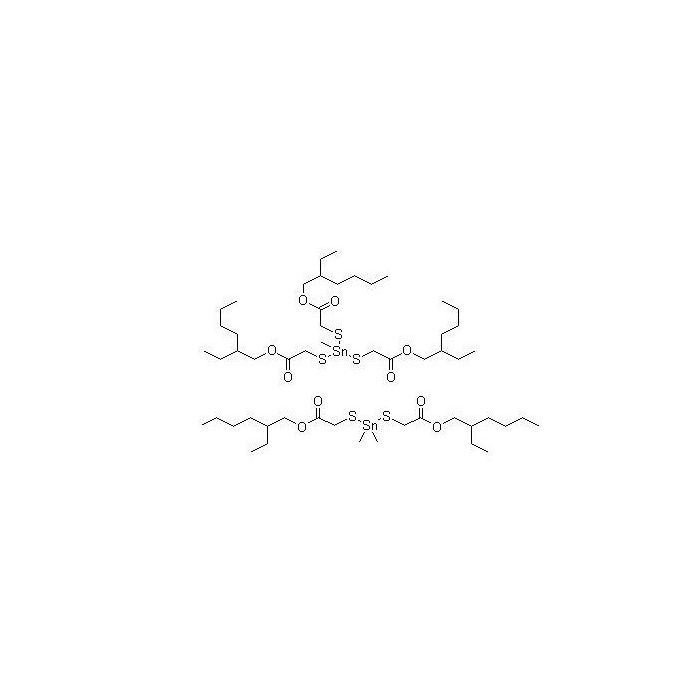
Product name: Methyltin mercaptide (often denotes an organotin(IV) species bearing one Sn–CH3 bond and multiple Sn–S(thiolate) ligands; commercial materials may be defined mixtures rather than a single molecular entity). (general/literature)
• Structural features (general/literature description of this class)
Core element: tetravalent tin (Sn(IV)) with at least one covalent Sn–C bond (methyl) and two or more Sn–S bonds to thiolate (mercaptide) ligands derived from thiols/mercaptoesters.
Coordination: Organotin mercaptides commonly exhibit four- to six-coordinate tin centers (distorted tetrahedral to octahedral), depending on ligand denticity and aggregation in the condensed phase.
Functional groups: Tin–carbon (sp3) bond; tin–sulfur bonds to thiolate; ligands may contain ester or alkyl chains (supplier-specific). No stereocenters are inherent to the Sn–CH3 unit; chiral environments can arise from chiral thiolate ligands.
• 2D structural description (general/literature)
A central Sn atom is bonded to one methyl group (–CH3) and to sulfur atoms of one or more mercaptide ligands (RS–). The remaining coordination sites may be occupied by additional thiolates or intramolecularly chelating mercaptoacylate groups, forming a neutral organotin complex.
• Identity caveat
Because “methyltin mercaptide” is a functional/commercial designation, exact ligand identity and stoichiometry should be confirmed on the product CoA/Spec Sheet for structure-specific work.
Synthetic Utility
• Functional motifs and reactivity (general/literature)
Lewis-acidic Sn(IV) center coordinates to carbonyl oxygens, activating esters and lactones toward nucleophilic attack—useful in transesterification, polyesterification, and ring-opening polymerizations.
Thiolate ligation modulates tin’s electrophilicity and thermal stability, providing a balance between activity and resistance to deactivation at high temperatures.
• Applications in synthesis
Polycondensation: Diol–diester condensations to polyesters; catalyst loadings tuned by %Sn for rate/color control.
Fine-chemistry transesterifications: Exchange of alkoxy groups in esters and carbonates under relatively mild conditions compared with purely thermal processes.
Selective transformations in sulfur-tolerant systems where conventional acid catalysts might overreact or cause corrosion.
• Retrosynthetic value
As a catalyst rather than a stoichiometric reagent, it reduces the need for strong mineral acids, enabling neutral or near-neutral conditions that preserve acid-labile functionalities.
• Practical considerations
Limit exposure to nucleophilic chelators (phosphines, strong multidentate amines) that can sequester tin and suppress activity.
Residual sulfur-containing ligands can co-elute with products; plan purification accordingly (adsorptive treatments, metal scavengers, acid washes—validate for your substrate).
Note: Exact performance depends on the specific mercaptide ligands present; consult CoA and perform pilot screens.
Target Specificity
Not applicable. This product is not a biological targeting reagent (e.g., antibody, inhibitor with a defined biomolecular target). No antigen, epitope, clone, or species reactivity information is associated with this item.
We use cookies to ensure the website functions properly and, where permitted, to improve your experience. You can manage your preferences at any time in Settings. Learn more in our Cookie Policy.
Shall we send you a message when we have discounts available?
Remind me later
Thank you! Please check your email inbox to confirm.
Products are supplied to verified businesses, institutions, and qualified professionals for research and development use only. Not for use in humans, animals, diagnosis, or therapy.

 D2610268