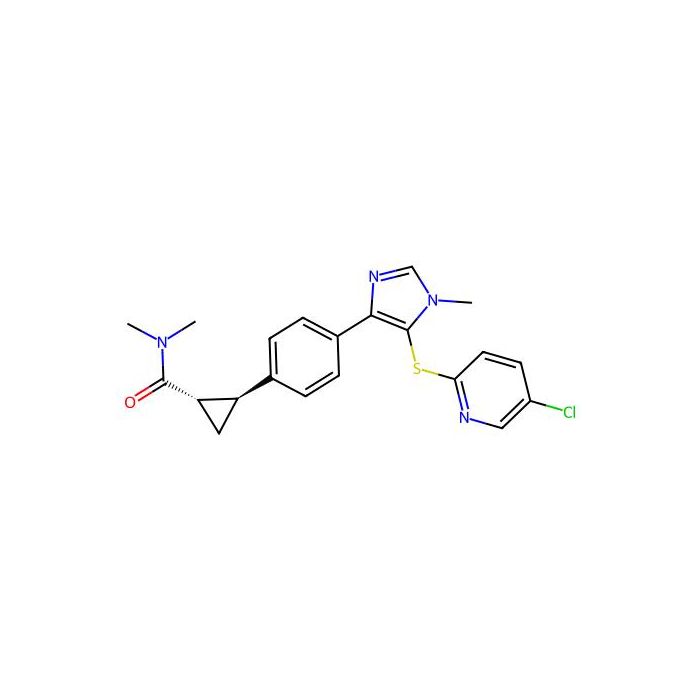
MK-3168 (12C) is a FAAH inhibitor with IC 50 values of 1.0, 5.5, 1.7 nM for human, rhesus, rat, respectively. MK-3168 shows good brain uptake and FAAH-specific signal. 11 C MK-3168 can be used as FAAH PET tracer.
Spécifications
Conditions de stockage de stockage
Store at -20°C
Expédié en
Ice chest + Ice pads
Ce produit nécessite l'expédition en chaîne froide. Les services terrestres et autres services économiques ne sont pas disponibles.
Type d'action
INHIBITOR
Noms et identifiants
Poids moléculaire
412.94
Données avancées
Certificats (CoA, COO, BSE/TSE et tableau d'analyse)
C of A & Other Certificates(BSE/TSE, COO):
Analytical Chart:
Calculateurs de solution
Molarity Calculator
Determine the necessary mass, volume, or concentration for preparing a solution.
Dilution Calculator
Determine the dilution needed to prepare a stock solution.
Reconstitution Calculator
Avis
Avis des clients
Application Protocols
Tested applications, recommended dilutions, and positive controls are not specified for this item in the Product Data.
Because no validated protocols are provided for MK-3168 (12C), users should develop and qualify procedures appropriate for their assay format (biochemical, cell-based, or analytical) and verify compound integrity and concentration by LC–MS/UV.
For detailed, product-specific protocols, refer to the CoA/Spec Sheet or contact technical support with your use case.
Biological Roles
Item-specific biological targets, pathways, or mechanisms for MK-3168 (12C) are not provided in the Product Data. No target specificity or mode-of-action claims are made here.
General considerations for small molecules in research (non-clinical, literature-based):
Tool compounds are often used to probe biochemical pathways by modulating a protein or pathway of interest in vitro or in cells. When an unlabeled (12C) form is paired with a stable isotope–labeled analog, the latter can serve as an internal standard for quantitative bioanalysis, while the 12C form represents the analyte in biological matrices.
Prior to use in biological systems, researchers typically characterize passive stability (buffer, serum), protein binding, and permeability (e.g., PAMPA, Caco-2). Without structure, no predictions are made here.
For reproducibility, document vehicle concentration, exposure time, and any pre-incubation or wash steps. Validate that the compound does not interfere with assay reporters (fluorescence quench, absorbance overlap) at intended concentrations.
For definitive biological roles specific to MK-3168, consult primary literature, internal screening data, or the compound’s discovery disclosure where available.
Buffer Applications
This item is not a buffer component. However, compounds like MK-3168 (12C) are commonly delivered to assays via buffered systems. Practical considerations (general, not item-specific):
Vehicle control: Prepare buffered assay media (e.g., HEPES or PBS-based) containing the same final DMSO percentage as treated wells (often 0.1–0.5% v/v) to control for vehicle effects.
Solubility management: If precipitation occurs upon dilution into buffer, increase dilution steps, adjust temperature, or include tolerated levels of co-solvent or nonionic surfactant (e.g., 0.01% polysorbate), ensuring no impact on assay biology.
pH considerations: If the compound is ionizable (unknown here), buffering near ±1 pH unit of its pKa can improve solubility and reduce drift during longer incubations. Avoid buffers that may chemically react with functional groups (e.g., primary amines with aldehyde-containing buffers).
Adsorption minimization: Use low-binding plastics/glass and pre-rinse with vehicle to reduce compound loss to surfaces, which can be substantial for hydrophobic molecules.
Item-specific buffer compatibility, pKa, and solubility are not provided; consult the CoA/Spec Sheet or perform a short solubility/compatibility screen in your assay buffer.
Green Alternatives
Without item-specific solvent and stability data, greener choices should be considered within general small-molecule handling constraints:
Prefer water-rich systems: Where feasible, use aqueous buffers with minimal DMSO (≤0.1–1% v/v) instead of neat organic media for assay delivery.
Favor lower-toxicity organics: When preparing analytical standards, prefer ethanol or acetonitrile over DMF/NMP where solubility allows. Avoid halogenated solvents unless analytically necessary.
Reduce solvent volumes: Employ higher-concentration master stocks to minimize total DMSO introduced into assays. Use microvolumetric dispensing to lower waste.
Illustrative comparison (general, not item-specific):
| Use case | Conventional choice | Greener alternative | Trade-offs |
|---|---|---|---|
| Stock solution | DMF/NMP | DMSO or EtOH (if soluble) | Solubility limits may require co-solvents |
| LC–MS diluent | MeCN + 0.1% FA | Water/MeCN (higher water %) | Peak shape may change; validate method |
| Assay vehicle | 2–5% DMSO | ≤0.5% DMSO + surfactant | Risk of precipitation; verify compatibility |
Implement green-by-design practices: right-sizing batch scale, using reusable glassware, and consolidating shipments on cold packs to reduce environmental impact while preserving material quality.
Pharmaceutical Uses
No pharmacopeial status or excipient role is provided for this item. This product is supplied strictly for research use only and is not intended for human or veterinary use.
Appropriate research-focused uses (non-clinical):
Reference standard: Utilize the unlabeled MK-3168 (12C) as a quantitation target with a stable isotope–labeled internal standard in bioanalytical method development (LC–MS/MS), process development samples, or stability studies.
Discovery support: Employ as a tool compound during hit validation, SAR exploration, or DMPK method development, provided structural and purity data are available from the CoA.
Formulation feasibility (preclinical research): Conduct small-scale solubility screening in biorelevant vehicles to inform assay delivery; not for clinical formulation.
Regulatory note: No claims are made regarding GMP manufacture, ICH stability, pharmacopoeial monographs, or clinical suitability. If you require certified reference material (CRM) status or GMP documentation, contact us for custom options.
Physical Properties
Item-specific physical constants:
Melting point: Not specified for this item; refer to CoA/Spec Sheet.
Boiling point: Not specified for this item; refer to CoA/Spec Sheet.
Density: Not specified for this item; refer to CoA/Spec Sheet.
Solubility (water/organics): Not specified for this item; refer to CoA/Spec Sheet.
LogP/logD, pKa, refractive index: Not specified for this item; refer to CoA/Spec Sheet.
General guidance for small-molecule handling (literature/practice-based, not item-specific):
Solubility screening typically starts with DMSO (10–50 mg/mL), then evaluates miscible co-solvents (DMF, MeCN, ethanol) and aqueous buffers with incremental co-solvent (0.1–2% v/v DMSO) as needed for assays.
If the compound is amphiphilic or neutral aromatic, warming (room temperature to ~40 °C), brief sonication, or serial dilution can help dissolve recalcitrant materials without degrading most stable scaffolds.
If acidic or basic ionizable groups are present (unknown here), solubility may increase in appropriately adjusted pH buffers. Avoid extreme pH if the scaffold contains hydrolysis-prone linkages (e.g., esters, lactams, imines).
Light- or moisture-sensitive molecules benefit from amber vials, desiccation, and minimized headspace. Use inert gas backfill for long-term storage where appropriate.
For authoritative values relevant to your experiment design (e.g., exact aqueous solubility, pKa), consult the item’s CoA or validated internal measurements.
Quality and Grades
Item-specific information:
Grade/Purity: Not specified for this item; refer to CoA/Spec Sheet.
Stabilizers/Antioxidants/Additives: Not specified for this item; refer to CoA/Spec Sheet.
Context and expectations (general guidance for small-molecule research materials):
Research-grade small molecules are typically qualified by LC–MS purity (area %) and 1H NMR identity; additional orthogonal methods (HRMS, 13C NMR, HPLC with multiple detection wavelengths) may be supplied on request. If a specific purity threshold (e.g., ≥95% by HPLC) is required by your assay, confirm on the CoA for this lot.
For discovery screening, low-UV-absorbing impurities and residual solvents can affect readouts (UV/fluorescence). If you will use LC–UV or MS-based quantitation, review the UV spectra and residual solvent profile in the CoA.
If a stabilizer is present (not specified here), it will be listed on the CoA and may affect certain bioassays; consider performing a vehicle control containing the stabilizer at matched concentration.
Batch-to-batch comparability: Record lot numbers and retain aliquots for cross-study reproducibility. Where possible, confirm identity/purity in-house before large screening campaigns.
For regulated workflows, this product is for research use only and is not intended for diagnostic or GMP manufacturing. If a specific grade (AR, HPLC, USP/EP) is required, contact us for availability or custom manufacture.
Reaction and Applications
This product is positioned as a small-molecule entry in a compound library. No specific synthetic or catalytic role is provided in the Product Data. Accordingly, consider the following general research applications (non-clinical, not target-specific):
Chemical biology/tool-compound workflows: Use MK-3168 (12C) as an unlabeled reference in parallel with stable isotope–labeled analogs for target engagement assays (e.g., thermal shift, CETSA), target occupancy measurements by LC–MS, or internal standards in quantitative bioanalysis.
Screening and SAR: Incorporate into primary/secondary biochemical or cell-based screening cascades to evaluate activity trends. Maintain rigorous plate mapping, DMSO normalization, and include vehicle controls.
Orthogonal analytics: Prepare calibration curves in LC–MS/LC–UV to support exposure, stability, or metabolite identification work. The unlabeled (12C) form serves as the analyte when a 13C-labeled analog is used as internal standard.
Stability and compatibility checks: Assess chemical stability across storage conditions and assay buffers (pH, oxidative stress, light). Run time-course LC–MS to confirm integrity over the assay window.
Note: No named reactions or specific mechanisms are asserted for MK-3168 (12C) since structural information is not provided. If you intend to derivatize or immobilize the molecule, obtain the full structure and functional group map before planning chemistry.
Reaction Conditions
No reaction conditions are specified for MK-3168 (12C) in the Product Data, and the compound is not offered as a reagent for performing chemical reactions.
General, non-item-specific guidance relevant to handling in solution:
Stock preparation: Dissolve in DMSO to a convenient concentration (e.g., 10–50 mM) with gentle warming or brief sonication if needed. Filter (0.2 µm PTFE) to remove particulates for assays sensitive to light scattering.
Stability checks: Perform short-term stability tests at intended assay temperature and duration (e.g., 4–48 h at room temperature or 37 °C) by LC–MS to detect degradation. Avoid repeated freeze–thaw by aliquoting.
Photostability: If unknown, protect from light during prolonged incubations.
If you plan to use MK-3168 (12C) in any chemical reaction (e.g., conjugation), first obtain full structural information and consult literature precedents for compatible solvents, temperatures, and catalysts specific to its functional groups.
Safety and Handling
Item-specific safety data from Product Data:
GHS Classification: Not specified for this item; refer to SDS.
Signal Word: Not specified for this item; refer to SDS.
H-Statements: Not specified for this item; refer to SDS.
Pictograms: Not specified for this item; refer to SDS.
Storage and shipping (item-specific):
Storage Conditions: Store at -20 °C.
Shipped In: Ice chest + Ice pads.
General laboratory safety guidance (not item-specific; follow your institutional EHS and SDS):
PPE: lab coat, safety glasses, and appropriate chemically resistant gloves. Avoid inhalation of dust/aerosols and skin contact. Work in a fume hood when handling powders or volatile solvents.
Incompatibilities are unknown from Product Data; as a precaution, segregate from strong oxidizers/reducers and acids/bases until compatibility is confirmed.
First aid (overview): In case of skin/eye contact, rinse with water for at least 15 minutes; seek medical attention if irritation persists. If inhaled, move to fresh air; if ingested, do not induce vomiting—seek medical attention immediately. Always consult the SDS for MK-3168 for authoritative instructions.
Waste: Collect in appropriate organic waste streams. If target identity is potent/unknown, treat as hazardous research chemical and follow local regulations.
Risk management: Minimize freeze–thaw cycles; protect from moisture and light unless stability data indicate otherwise.
Solvent Selection
Item-specific solvent properties are not provided. Use the following general, chemistry-led approach to choose solvents for MK-3168 (12C):
Primary stock solvent: DMSO is the default for many discovery compounds due to broad solvency and assay compatibility up to ~0.1–1% v/v in aqueous buffers. Prepare a concentrated master stock (e.g., 10–50 mM) to minimize DMSO carryover.
Secondary options: DMF, acetonitrile, ethanol, and isopropanol can be effective. For highly lipophilic scaffolds, consider co-solvent systems (DMSO + ethanol; DMSO + PEG 400) or surfactant-assisted vehicles (e.g., 0.01–0.05% polysorbate or Pluronic) if compatible with the assay.
Aqueous compatibility: If ionizable groups are suspected, evaluate solubility vs pH (phosphate, HEPES, or citrate buffers). Keep organic co-solvent ≤1% v/v for sensitive cell-based readouts unless otherwise validated.
Adsorption control: Low-binding polypropylene plates/tubes can reduce loss of hydrophobic compounds to plastics. Include 0.01–0.1% nonionic surfactant if adsorption is problematic and assay-tolerated.
Light/oxidation: If the scaffold could be photo- or air-sensitive (unknown here), use amber vials, minimize headspace, and consider inert atmosphere during long incubations.
Quick comparison (general):
DMSO: broad solvency; excellent for stocks; generally assay-compatible.
MeCN/EtOH: fast evaporation; useful for LC–MS calibration solutions.
DMF/NMP: strong solvency but less preferred for bioassays; assess toxicity/compatibility carefully.
Storage and Reconstitution
Item-specific instructions from Product Data:
Storage Conditions: Store at -20 °C.
Shipping: Ice chest + Ice pads.
Additional best practices (general guidance; not item-specific):
Protect from moisture and light unless stability data indicate otherwise. Store in a tightly sealed, chemically compatible vial. Consider inert gas backfill for long-term storage.
Aliquot upon receipt to avoid repeated freeze–thaw cycles. Typical aliquots are sized to single-use working solutions for assay days.
Reconstitution: If no solvent is specified on the CoA, begin with an anhydrous DMSO master stock (e.g., 10–50 mM). Mix by gentle vortexing and brief sonication. If needed, warm to 25–40 °C to aid dissolution. Filter through 0.2 µm (PTFE) for particle-sensitive applications.
Working solutions: Dilute master stock into assay buffer immediately before use, keeping final DMSO content consistent across controls and treatments (commonly 0.1–0.5% v/v, assay-dependent).
Stability: Absent item-specific data, assume room-temperature working stability of hours, not days. Verify by LC–MS if prolonged incubations are required.
Any specific solvent, concentration limits, or shelf-life claims are not specified for this item; refer to CoA/Spec Sheet and SDS for definitive guidance.
Structure and Identity
Item-specific identifiers from Product Data:
Product Name: MK-3168 (12C)
CAS: 1242441-26-4
InChIKey: Not specified for this item; refer to CoA/Spec Sheet.
SMILES: Not specified for this item; refer to CoA/Spec Sheet.
Molecular Formula: Not specified for this item; refer to CoA/Spec Sheet.
Molecular Weight: Not specified for this item; refer to CoA/Spec Sheet.
Notes and general interpretation:
The “(12C)” notation indicates the unlabeled, natural-abundance carbon isotope version (i.e., not 13C-enriched). This is typically used as the standard reference form to complement isotopically labeled analogs in analytical or mechanistic studies.
Structural features (rings, heteroatoms, stereochemistry) are not provided in the Product Data. Please consult the CoA/SDS or primary literature for MK-3168 for detailed structural elucidation (2D connectivity, functional groups, and any stereocenters).
For internal records, link the CAS to your ELN/LIMS and attach the corresponding reference spectra (NMR/HRMS/LC–MS) if available from your QC workflow.
2D structure description:
Not specified for this item; refer to CoA/Spec Sheet. If you require an annotated skeletal diagram (functional group map, polar surface area, HBD/HBA counts), request the structure package from your purchasing contact or consult original literature disclosures of MK-3168.
Synthetic Utility
Based on the Product Data, MK-3168 (12C) is offered as a finished small molecule within a compound library and is not presented as a functionalized building block or reagent.
Not typically used as a synthetic reagent: In the absence of disclosed functional groups, we do not recommend planning cross-couplings, condensations, or protection/deprotection strategies that assume particular reactivity.
Derivatization: If analytical tagging, biotinylation, or photoaffinity labeling is desired, obtain the full structure and identify a site for modification that minimally perturbs physicochemical properties and putative activity. Validate any derivative independently.
Reference benchmarking: The 12C form can serve as the parent comparator when synthesizing isotopologues for ADME or mechanistic studies.
Conclusion: Treat MK-3168 (12C) as a tool compound for screening and analytics rather than a synthetic intermediate, unless you have the structural disclosure and a defined derivatization plan.
Target Specificity
No target, pathway, or binding profile is provided in the Product Data for MK-3168 (12C).
Target/epitope, species reactivity, isotype/clone (where applicable) are not relevant to this small-molecule product and are not specified.
For any intended use as a chemical probe, consult primary literature or internal screening data to establish specificity, potency, and off-target liabilities before interpreting biological results.
Foire aux questions
How should this product be stored?
Store at ?20 °C. Freezer storage is required to maintain the specified shelf life.
How is this product shipped?
This product ships in an insulated container with ice pads. Unpack on arrival and transfer it to the storage condition stated above.
What are the CAS number, molecular formula and molecular weight?
The CAS Number is 1242441-26-4, the molecular formula is C21H21ClN4OS, and the molecular weight is 412.94 g/mol.
What documentation is provided?
Available product documentation, including Certificates of Analysis (COA), Safety Data Sheets (SDS), and specification sheets, is shown in the product document area. Document availability and access follow the current site policy.
Nous utilisons des cookies pour garantir le bon fonctionnement du site et, lorsque cela est autorisé, pour améliorer votre expérience. Vous pouvez gérer vos préférences à tout moment dans les Paramètres. Pour en savoir plus, consultez notre Politique relative aux cookies.
Souhaitez-vous que nous vous envoyions un message lorsque des réductions seront disponibles?
Me rappeler plus tard
Merci ! Veuillez vérifier votre boîte de réception e-mail pour confirmer.
Products are supplied to verified businesses, institutions, and qualified professionals for research and development use only. Not for use in humans, animals, diagnosis, or therapy.