≥100mesh, fro GC/LC column pour les flux de travail chromatographiques et analytiques sensibles nécessitant une interférence de ligne de base minimale.
🌡
Stockage & expédition
Room temperature,Argon charged Expédition Normal. Consultez le COA spécifique au lot pour les spécifications exactes.
📋
Documents qualité
SDS, COA, fiche technique et fiche de spécifications disponibles au téléchargement. COA spécifique au lot accessible via la recherche par numéro de lot.
📚
Preuve documentaire
Cité dans 25 publications à comité de lecture couvrant la chromatographie, la synthèse organique et les réactions de couplage croisé.
Vue d’ensemble
Molecular sieves are crystalline metal aluminosilicates having a 3-dimensional interconnecting network of silica and alumina tetrahedra. Natural water of hydration is removed from this network by heating to produce uniform cavities which selectively adsorb molecules of a specific size. The 3A form is made by substituting potassium cations for the inherent sodium ions of the 4A structure, reducing the effective pore size to ~3?, excluding diameter >3?, e.g., ethane. The 4 to 8-mesh type is normally used in gas-phase applications. Molecular sieves are considered a universal drying agent in polar and nonpolar media.
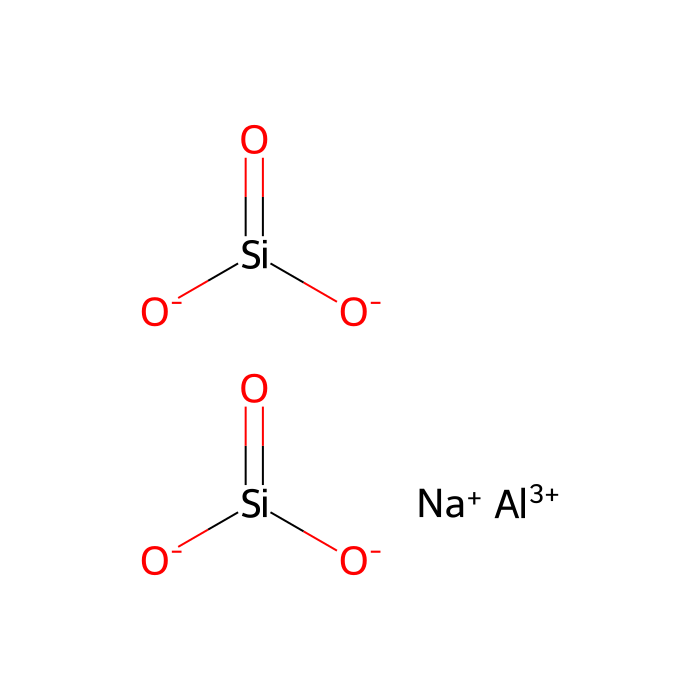
Post-transition metal silicate - Silicate - Inorganic sodium salt - Inorganic post-transition metal salt - Inorganic oxide - Inorganic salt - Inorganic metalloid salt
Description
This compound belongs to the class of inorganic compounds known as post-transition metal silicates. These are inorganic compounds in which the largest oxoanion is silicate, and in which the heaviest atom not in an oxoanion is a post-transition metal.
External Descriptors
Not available
1. Djoumbou Feunang Y, Eisner R, Knox C, Chepelev L, Hastings J, Owen G, Fahy E, Steinbeck C, Subramanian S, Bolton E, Greiner R, and Wishart DS. ClassyFire: Automated Chemical Classification With A Comprehensive, Computable Taxonomy. Journal of Cheminformatics, 2016, 8:61.
Nous utilisons des cookies pour garantir le bon fonctionnement du site et, lorsque cela est autorisé, pour améliorer votre expérience. Vous pouvez gérer vos préférences à tout moment dans les Paramètres. Pour en savoir plus, consultez notre Politique relative aux cookies.
Souhaitez-vous que nous vous envoyions un message lorsque des réductions seront disponibles?
Me rappeler plus tard
Merci ! Veuillez vérifier votre boîte de réception e-mail pour confirmer.
Products are supplied to verified businesses, institutions, and qualified professionals for research and development use only. Not for use in humans, animals, diagnosis, or therapy.

 E2615343