This compound belongs to the class of organic compounds known as maleimides. These are compounds containing a 2,5-pyrroledione moiety.
External Descriptors
Not available
1. Djoumbou Feunang Y, Eisner R, Knox C, Chepelev L, Hastings J, Owen G, Fahy E, Steinbeck C, Subramanian S, Bolton E, Greiner R, and Wishart DS. ClassyFire: Automated Chemical Classification With A Comprehensive, Computable Taxonomy. Journal of Cheminformatics, 2016, 8:61.
Determine the necessary mass, volume, or concentration for preparing a solution.
Dilution Calculator
Determine the dilution needed to prepare a stock solution.
Reconstitution Calculator
Avis
Avis des clients
Application Protocols
No validated, item-specific application protocols are provided for this SKU. For research planning, consult standard literature protocols for:
Thiol–maleimide bioconjugation in buffered aqueous media.
Copper-catalyzed azide–alkyne cycloaddition (CuAAC) on small molecules and biomolecules.
Refer to lab SOPs and peer-reviewed methods to tailor conditions to your substrates. Always verify on small scale and consult the SDS/CoA for this specific item before use.
Biological Roles
This product is a synthetic reagent used in bioconjugation workflows; it does not have an intrinsic biological role. The following describes how its functional groups interface with biomolecules in research contexts (literature/general).
Maleimide–thiol chemistry in biomolecules
The maleimide ring undergoes rapid Michael addition with cysteine thiols on peptides and proteins at pH ~6.5–7.5, providing site-selective labeling when cysteine residues are accessible and uniquely reactive.
Resulting thioether bonds are generally stable under physiological conditions but can undergo exchange in thiol-rich or basic environments; subsequent capping or hydrolysis to succinimide thioethers can modulate stability.
Alkyne handle for bioorthogonal ligation
The terminal alkyne participates in copper(I)-catalyzed azide–alkyne cycloaddition (CuAAC) with azide-bearing probes (fluorophores, affinity tags, polymers), providing a modular route to build multifunctional bioconjugates.
Appropriate copper-chelating ligands and reductants are recommended to protect sensitive biomolecules during CuAAC.
Typical research uses (no clinical claims)
Site-directed attachment of reporters or linkers to cysteine-containing proteins, followed by installation of azide-bearing moieties via click chemistry (or the reverse sequence using azido-maleimides).
Preparation of thiol-terminated oligonucleotide or peptide conjugates with alkyne functionality for downstream surface immobilization or assembly.
Buffer Applications
This compound is not a buffering agent and is not used to control pH. However, its performance in aqueous conjugation chemistry depends on the buffer environment (literature/general guidance).
Suitable buffers for thiol–maleimide conjugation
Phosphate or citrate buffers at pH 6.5–7.0 help maximize thiol selectivity while minimizing maleimide hydrolysis.
Avoid primary amine-containing buffers (e.g., Tris) during conjugation, as nucleophiles can compete with thiols; if unavoidable, keep concentrations low and reaction times short.
Include 1–5 mM EDTA when working with biomolecules to chelate trace metals that may catalyze side reactions.
Suitable media for CuAAC
t-BuOH/H2O (1:1), DMF/H2O, or ACN/H2O with CuSO4/sodium ascorbate and stabilizing ligands (e.g., THPTA) are commonly used. Degas if oxygen sensitivity is a concern.
Practical tips
Maintain thiols in their reduced state (e.g., pre-treat with TCEP, not DTT during maleimide coupling as DTT can consume maleimide).
Perform conjugations promptly after dissolving to limit hydrolysis and side reactions.
Item-specific buffer specifications: Not specified for this item; refer to CoA/Spec Sheet.
Green Alternatives
While N-Propargylmaleimide itself is the functional coupling reagent, greener choices can often be made for solvents, catalysts, and processing conditions in its typical applications.
Greener solvent choices (general)
Replace dichloromethane with ethyl acetate or 2-MeTHF for extractions and chromatography when compatible with polarity/selectivity needs.
Use acetonitrile or ethanol/water blends instead of DMF/DMSO when solubility allows; they are easier to remove and generally lower in toxicity.
Aqueous/bioconjugation context
Conduct thiol–maleimide conjugations in buffered aqueous media (phosphate/citrate at pH 6.5–7.0) with minimal co-solvent (≤10–20%).
For CuAAC, consider water-rich media with modern, benign ligands (e.g., THPTA) to reduce copper loading; rigorously remove copper post-reaction with scavengers or chelating resins.
Energy and waste reduction
Run ligations at ambient temperature where kinetics permit.
Employ micellar catalysis (e.g., nonionic surfactants) for certain click transformations to reduce organic solvent usage (assess compatibility with maleimide stability).
Comparison snapshot (illustrative; literature)
THF vs 2-MeTHF: 2-MeTHF is bio-derived and less peroxide-prone; may offer similar solubility for this substrate.
DCM vs EtOAc: EtOAc is less hazardous and biodegradable; monitor selectivity during purification.
Trade-offs
Highly polar substrates or sensitive biomolecules may still require DMF/DMSO for solubility or stability; balance EHS gains against performance.
Pharmaceutical Uses
This product is offered for research use only. It is not an API and has no approved therapeutic indications. In pharmaceutical and bioprocess R&D, N-Propargylmaleimide may serve in process development and conjugation chemistry (literature/general context).
Potential roles in formulation/manufacturing R&D
Heterobifunctional linker component for preparing prototype antibody, protein, or peptide conjugates in discovery workflows (maleimide for cysteine conjugation; alkyne for downstream diversification via click chemistry).
Surface or polymer functionalization in device R&D to enable ligand presentation or diagnostic surfaces.
Regulatory/compendial status
No pharmacopeial monograph is known for this specific compound; any GMP use would require full qualification. For this catalog item, no GMP grade is indicated.
Analytical considerations
Process development typically monitors residual reagents and byproducts (e.g., unreacted maleimide, hydrolyzed maleamic acid) by HPLC/LC–MS, and assesses copper residues after CuAAC where applicable.
Item-specific pharma grade or excipient status: Not specified for this item; refer to CoA/Spec Sheet.
No clinical or therapeutic claims are made; the product is for research use only.
Physical Properties
Only limited item-specific property data are provided for this listing. Where values are not specified, consult the CoA/SDS for definitive specifications.
Item-specific (from Product Data)
Appearance: Not specified for this item; refer to CoA/Spec Sheet.
Molecular formula: Not specified for this item; refer to CoA/Spec Sheet.
Molecular weight: Not specified for this item; refer to CoA/Spec Sheet.
Literature/general properties (reference, not item specifications)
Physical state: commonly reported as a solid at ambient conditions (literature).
Solubility: typically soluble in polar aprotic organic solvents (e.g., acetonitrile, DMF, DMSO, THF, dichloromethane); limited solubility in water; hydrolytically labile toward strong base (literature).
Volatility: low; alkyne moiety is not significantly volatile when embedded in this framework (literature).
Other analytical specs (water content, UV cutoff, metal content, RI, logP, pKa, mp/bp): Not specified for this item; refer to CoA/Spec Sheet.
Practical notes (general)
Maleimide double bond can isomerize or hydrolyze under basic aqueous conditions; handle under neutral to mildly acidic conditions when possible.
Propargyl group is stable and suitable for CuAAC and other alkyne transformations.
Quality and Grades
Item-specific quality information
Grade/Purity: Not specified for this item; refer to CoA/Spec Sheet.
Stabilizers/Inhibitors: Not specified for this item; refer to CoA/Spec Sheet.
How to interpret common grades for this class of reagent (general guidance)
Research/reagent grade maleimides are typically assessed for purity by HPLC/GC and for identity by NMR/IR/MS. Low peroxide and low moisture are desirable to prevent undesired side reactions (e.g., Michael addition, hydrolysis), but specific limits must be confirmed on the CoA for this SKU.
Bioconjugation-grade materials may include specifications for residual metals, UV absorbance profile, and stability in aqueous buffers.
Practical considerations for this item
If using for thiol-maleimide bioconjugation, verify purity by HPLC and absence of ring-opened maleamic acid by NMR prior to use, especially after prolonged storage.
If trace-metal-sensitive downstream click chemistry is planned, confirm residual copper/metal specifications or pre-purify after CuAAC.
For chromatography-based applications, check the UV background and impurity profile at application wavelengths; if not specified, run a quick scan to ensure compatibility.
Documentation
For definitive acceptance criteria (purity %, residual solvents, water content, stabilizers), rely on the lot-specific CoA/Spec Sheet. Do not substitute literature values for product specifications.
Reaction and Applications
N-Propargylmaleimide is a versatile dual-function reagent that integrates two orthogonal handles, enabling sequential or convergent coupling strategies in chemical biology, polymer chemistry, and materials modification.
Key reactivity modes (literature/general)
Thiol–maleimide conjugation (Michael addition): rapid, chemoselective reaction with cysteine or thiol-terminated polymers under mildly acidic to neutral conditions (pH ~6.5–7.5). Provides stable thioether linkages; retro-Michael or exchange can occur under basic or thiol-rich conditions—optimize pH and quench residual thiols to stabilize.
Azide–alkyne cycloaddition (CuAAC): terminal alkyne undergoes copper(I)-catalyzed click with azides to form 1,4-disubstituted triazoles; typically uses CuSO4/sodium ascorbate or preformed Cu(I) sources with appropriate ligands (e.g., TBTA, THPTA) to suppress copper-induced side reactions on biomolecules.
Strain-promoted alternatives: the alkyne handle can also participate in ruthenium-catalyzed azide–alkyne cycloadditions (RuAAC) when specific regiochemistry is desired.
Applications
Bioconjugation: site-selective labeling of cysteine-containing proteins/peptides, followed by installation of azide-bearing probes via CuAAC (or vice versa with azido-maleimide reagents for complementary sequence).
Polymer and surface functionalization: grafting to thiol-terminated polymers or self-assembled monolayers, then further diversification through click chemistry to introduce functionality (fluorophores, ligands, crosslinkers).
Modular linker synthesis: serves as a building block in heterobifunctional crosslinkers where maleimide ensures thiol selectivity and the alkyne provides a secondary ligation site.
Practical tips
Keep maleimide moiety protected from prolonged basic aqueous exposure; perform conjugations promptly after dissolution.
For sequential ligations, complete and purify the first step before initiating the second to avoid cross-reactivity.
Reaction Conditions
Representative conditions are provided as general literature guidance; they are not item-specific specifications. Optimize for your system.
Thiol–maleimide conjugation (bioconjugation)
Solvent/buffer: 50–100 mM phosphate or citrate buffer, pH 6.5–7.0; 5–20% DMF, DMSO, or acetonitrile as co-solvent if needed.
Temperature/time: 20–25°C; 5–60 minutes for small molecules; 0.5–2 h for proteins depending on accessibility.
Stoichiometry: 1.0–1.5 equiv maleimide per thiol; excess may be required for sterically hindered sites.
Notes: Avoid primary amine buffers; exclude competing thiols (e.g., DTT). Quench residual maleimide with a low concentration of cysteine or mercaptoethanol if necessary after coupling.
CuAAC (azide–alkyne click)
Catalyst: CuSO4 (0.1–1 mol%) + sodium ascorbate (reducing agent) with a stabilizing ligand such as TBTA/THPTA (0.2–2 mol%). Alternatively, use preformed Cu(I) sources under inert atmosphere.
Solvent: t-BuOH/H2O (1:1), DMF/H2O, or ACN/H2O; degas as needed.
Temperature/time: 20–40°C; 0.5–4 h depending on substrate.
Workup: Remove copper with chelating resins or scavengers; purify by chromatography or dialysis (for bioconjugates).
Stability considerations
Maleimide hydrolyzes under basic conditions (pH >7.5) to maleamic acid, reducing thiol reactivity; minimize exposure time and adjust pH accordingly.
Light and heat are generally tolerated briefly, but prolonged exposure can promote side reactions—store as recommended and prepare fresh solutions.
Safety and Handling
Safety details specific to this item (GHS, pictograms, H-statements) are not provided in the listing; consult the SDS for authoritative information.
Item-specific hazard information
Signal word: Not specified for this item; refer to SDS.
H-statements: Not specified for this item; refer to SDS.
GHS classification/pictograms: Not specified for this item; refer to SDS.
General hazard profile (literature/good practice)
Maleimides are electrophiles and may be skin/eye irritants and potential sensitizers. Avoid contact and inhalation of dust or vapors.
Terminal alkynes are combustible; keep away from ignition sources and oxidizing agents.
Personal protective equipment (PPE)
Wear lab coat, safety glasses or face shield, and suitable chemical-resistant gloves (e.g., nitrile). Use in a fume hood to minimize exposure.
Handling and storage cautions
Store tightly closed at room temperature (per Product Data). Protect from moisture, strong bases, strong nucleophiles, and strong oxidants.
For aqueous work, use neutral to mildly acidic buffers (pH ~6–7) to minimize maleimide hydrolysis.
First-aid overview (general)
Skin/eye contact: Rinse immediately with copious water for at least 15 minutes; remove contaminated clothing; seek medical evaluation.
Inhalation: Move to fresh air; seek medical attention if symptoms persist.
Ingestion: Rinse mouth; do not induce vomiting; obtain medical attention.
Waste disposal
Collect in halogenated or non-halogenated organic waste (as appropriate to solvent matrix). Dispose in accordance with institutional and local regulations.
Solvent Selection
N-Propargylmaleimide combines an electrophilic maleimide and a relatively nonpolar propargyl chain, giving overall good solubility in polar aprotic organic solvents and limited aqueous compatibility.
Limited: alcohols (may promote side reactions under basic conditions), water (hydrolysis risk for maleimide ring at elevated pH).
Choosing a solvent by task
Thiol–maleimide conjugation in aqueous media: use phosphate or citrate buffers at pH 6.5–7.0 with 5–20% co-solvent (DMF, DMSO, or acetonitrile) to aid dissolution while minimizing hydrolysis.
CuAAC (azide–alkyne click): typical mixed solvent systems include t-BuOH/H2O, DMF/H2O, or acetonitrile/H2O; ensure substrate solubility and oxygen control for efficient catalysis.
Small-molecule synthesis/purification: DCM or EtOAc for extractions and normal-phase chromatography; for greener alternatives, consider 2-MeTHF or EtOAc instead of DCM/THF where feasible.
Comparison snapshot (general)
DMSO/DMF: highest solvating power, fully miscible with water, but harder to remove and may complicate workup.
Acetonitrile/EtOAc: good balance of polarity and volatility; easier removal.
THF/2-MeTHF: useful for organometallic steps; THF forms peroxides over time—monitor and manage accordingly (not specific to this item).
Storage and Reconstitution
Item-specific storage/shipping
Storage conditions: Room temperature (per Product Data). Store in a tightly closed container, protected from moisture and strong bases/nucleophiles.
Shipped in: Normal (ambient) conditions.
Solution preparation (general guidance)
Dissolution: Prepare stock solutions in dry, oxygen-free acetonitrile, DMF, DMSO, or THF. For bioconjugation, prepare immediately before use to minimize hydrolysis of the maleimide.
Aqueous use: Dissolve in minimal dry co-solvent, then dilute into pH 6.5–7.0 buffer. Avoid prolonged exposure to pH >7.5.
Storage of solutions
Organic stock solutions are best stored at 2–8°C under inert gas in amber vials and used within a few days. Long-term solution storage is not recommended due to potential hydrolysis or side reactions.
Freeze–thaw
If preparing aliquots of solution for repeated use, minimize freeze–thaw cycles. For solid material, ensure container is well sealed between uses to limit moisture uptake.
Stability testing
For critical applications, verify integrity by NMR or HPLC prior to use, especially after extended storage at room temperature.
Reconstitution specifics (concentration, solvent system): Not specified for this item; refer to CoA/Spec Sheet.
Structure and Identity
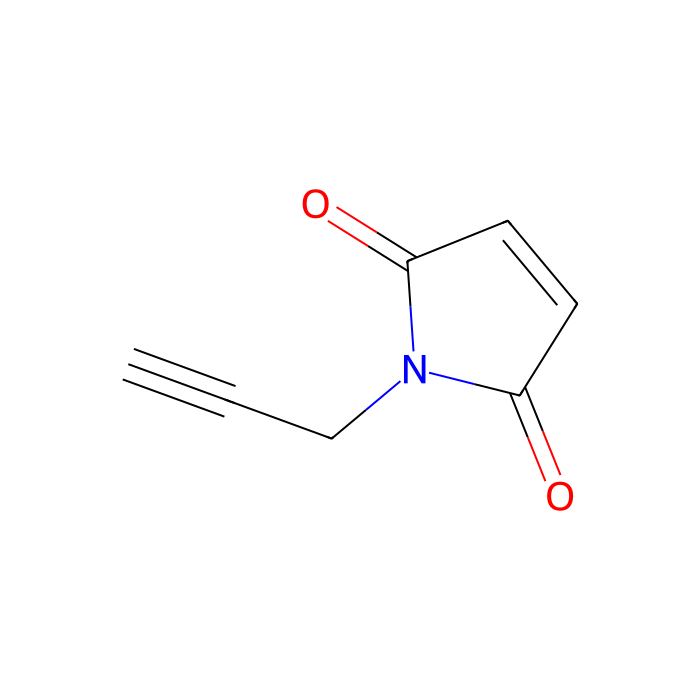
N-Propargylmaleimide is a bifunctional small molecule featuring a maleimide electrophile and a terminal alkyne handle, enabling orthogonal conjugation strategies in chemical biology and materials science.
Item-specific identifiers (as provided)
SKU: N302765
CAS: 209395-32-4
PubChem CID: 10214393
InChIKey: 253875 (as provided; note: non-standard format in listing)
SMILES: Not specified for this item; refer to CoA/Spec Sheet.
Literature/computed identity (for reference; not item-specific)
Structural features: five-membered cyclic imide (maleimide) bearing two carbonyls conjugated to an alkene (maleimide C=C), N-substituted with a propargyl group (–CH2–C≡CH) providing a terminal alkyne.
The imide ring is a five-membered cyclic imide with two carbonyls at positions 1 and 3. The C2–C3 bond is unsaturated (maleimide alkene). The ring nitrogen (N1) is substituted by a propargyl chain (–CH2–C≡CH), presenting a terminal alkyne for click-type reactions. No stereocenters are present; geometry derives from the planar imide and linear alkyne.
Synthetic Utility
As a heterobifunctional electrophile/alkyne, N-Propargylmaleimide is a compact and powerful synthon for stepwise assembly of complex architectures (literature/general).
Functional group leverage
Maleimide: activated Michael acceptor; reacts with soft nucleophiles (thiols) rapidly and with selectivity; participates in Diels–Alder chemistry with dienes under suitable conditions; can be hydrogenated or further elaborated after conjugation.
Propargyl alkyne: terminal alkyne compatible with CuAAC (1,3-dipolar cycloaddition), RuAAC, Sonogashira-type couplings after conversion to appropriate derivatives (e.g., iodination), and radical additions under specific conditions.
Retrosynthetic value
Enables convergent modular synthesis: first install the maleimide on thiol-bearing substrates, then diversify via click chemistry to append labels, ligands, or polymer chains; or perform click first and reserve maleimide for late-stage thiol coupling.
Materials and surface chemistry
Convenient handle for grafting onto thiol-terminated polymers (e.g., PEG-SH) or self-assembled monolayers on gold, followed by installation of azide-tagged payloads.
Protecting-group strategy
Maleimide is sensitive to strong nucleophiles/base; sequence planning should minimize exposure to conditions that cause ring-opening. The alkyne is generally robust to many transformations and purification steps.
Orthogonality
The two reactive sites allow orthogonal bond formations under distinct conditions, enabling sequential ligations with minimal cross-reactivity when conditions are chosen carefully.
Target Specificity
This product is a small-molecule chemical reagent and does not have a biological target, antigen, clone, or isotype. No target specificity information is provided for this SKU.
We use cookies to ensure the website functions properly and, where permitted, to improve your experience. You can manage your preferences at any time in Settings. Learn more in our Cookie Policy.
Shall we send you a message when we have discounts available?
Remind me later
Thank you! Please check your email inbox to confirm.
Products are supplied to verified businesses, institutions, and qualified professionals for research and development use only. Not for use in humans, animals, diagnosis, or therapy.

 C2224422