GRADE & PURITYMoligand™?Moligand™ — Aladdin's line of ligands and bioactive small molecules. Use for receptor, pathway, and binding studies needing defined small-molecule tools.10 mM in DMSO
Moligand™, 10 mM in DMSO Moligand™ for sensitive chromatographic and analytical workflows requiring minimal baseline interference.
🌡
Storage & shipping
Store at -80°C Ships Dry ice packs + Cold packs Check lot-specific COA for exact specifications.
📋
Quality documents
SDS, COA, datasheet, and spec sheet available for download. Lot-specific COA accessible via lot number lookup.
📚
Literature proof
Cited in 0 peer-reviewed publications across chromatography, organic synthesis, and cross-coupling reactions.
Vue d’ensemble
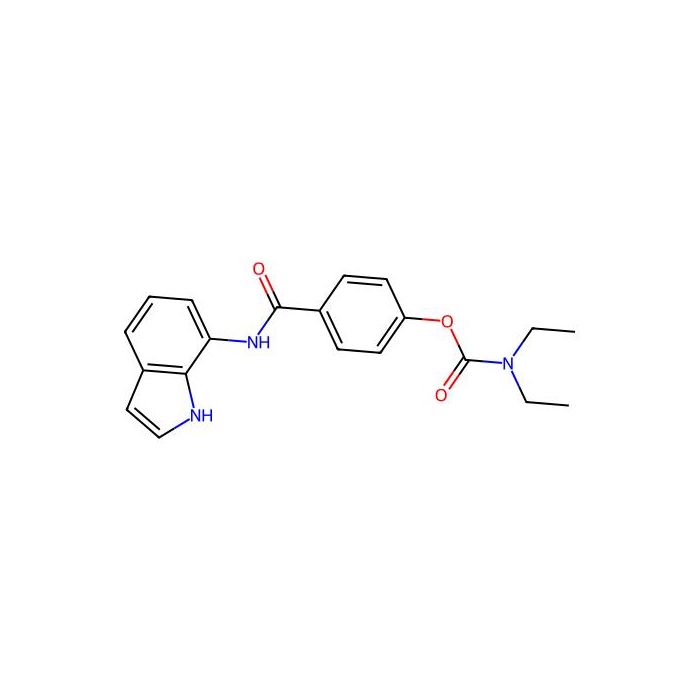
NAB-14 is a potent, selective, orally active and non-competitive GluN2C/2D antagonists with an IC 50 of 580 nM for GluN1/GluN2D. NAB-14 shows >800-fold selective for recombinant GluN2C and GluN2D over GluN2A and GluN2B. NAB-14 can cross the blood-brain-barrier.
Specifications
Spécifications et pureté
Moligand™, 10 mM in DMSO
Conditions de stockage de stockage
Store at -80°C
Expédié en
Dry ice packs + Cold packs
Ce produit nécessite l'expédition en chaîne froide. Les services terrestres et autres services économiques ne sont pas disponibles.
Grade
Moligand™
Type d'action
ANTAGONIST
Noms et identifiants
Isomères SMILES
CCN(CC)C(=O)OC1=CC=C(C=C1)C(=O)NC2=CC=CC3=C2NC=C3
PubChem CID
46862257
Documentation
📋 Safety Data Sheet (SDS)
Comprehensive hazard, handling, storage, and regulatory compliance document.
Certificats (CoA, COO, BSE/TSE et tableau d'analyse)
C of A & Other Certificates(BSE/TSE, COO):
Analytical Chart:
Calculateurs de solution
Molarity Calculator
Determine the necessary mass, volume, or concentration for preparing a solution.
Dilution Calculator
Determine the dilution needed to prepare a stock solution.
Reconstitution Calculator
Avis
Avis des clients
Application Protocols
No vendor-validated biological or analytical application protocols are provided for NAB-14 in the Product Data. The following generic protocols support typical small-molecule screening use and should be adapted to your system.
DMSO stock preparation
Weigh compound quickly to minimize ambient exposure. Prepare 10–50 mM stock in anhydrous DMSO. Vortex and sonicate briefly if needed; avoid heating unless stability is known.
Clarify by centrifugation (≥10,000 g, 5 min) and/or 0.2 µm PTFE filtration. Aliquot and store at −80°C.
Dose–response assay setup (biochemical)
Serially dilute stock in assay buffer with matched vehicle to maintain constant final DMSO (≤1% v/v typical). Include positive/negative controls and a no-enzyme or heat-inactivated control as appropriate.
Record precipitation or turbidity; discard data if microprecipitates are visible.
Biophysical binding (SPR/MST/ITC)
Determine compound solubility in running buffer with minimal DMSO (often 1–5% for SPR). Run solvent correction and reference subtraction.
LC–MS analytical check
Prepare 0.1–0.5 mg/mL in ACN/water (1:1) + 0.1% formic acid; inject on a short C18 column with a 5–95% ACN gradient over 5–10 min to verify purity/identity.
These are general guidelines; tailor concentrations and conditions to your assay sensitivity and the compound’s behavior.
Biological Roles
No endogenous biological role or pathway participation is provided for NAB-14 in the Product Data. As a Moligand-grade library compound, it should be treated as a research chemical with unknown or context-dependent bioactivity unless validated experimentally.
General considerations for small-molecule probes
If evaluating biological effects, establish concentration–response relationships and verify on-target activity using genetics (e.g., knockdown/knockout) or chemical orthologs.
ADME-relevant traits (permeability, stability, plasma protein binding, microsomal stability) are compound-specific and not provided here; profile empirically as needed.
Data stewardship
Record lot number and storage/handling history in ELN for reproducibility.
If using in cells or organisms, ensure compliance with institutional biosafety and chemical safety policies.
Summary
Biological functions: Not specified for this item; refer to primary literature if available for CAS 1237541-73-9 or CID 46862257.
This material is for research use only; no clinical or diagnostic use is intended or implied.
Buffer Applications
NAB-14 is not a buffering agent, and no buffer-forming properties (pKa values or buffering ranges) are provided. Consequently, it is not typically used to prepare buffer systems.
Practical notes for use of buffers with small-molecule stocks
Prepare NAB-14 primary stocks in DMSO, then dilute into assay buffers (e.g., PBS, HEPES, Tris) while monitoring for precipitation.
Maintain a constant final DMSO percentage across control and treated samples to avoid vehicle effects.
If compound binds nonspecifically to plastics, consider low-binding tubes/plates or add non-ionic detergents at low levels.
Conclusion: No specific buffer recipes or buffering capacities apply to this item.
Green Alternatives
While NAB-14 is a small-molecule library member rather than a solvent or bulk reagent, greener choices can be made for its handling, dissolution, and analytics.
Greener solvent considerations for preparation/analysis (general)
Prefer water-based assay buffers with minimal DMSO (≤0.1–1% v/v), validating activity and solubility.
Where organic co-solvent is necessary, consider ethanol or isopropanol as lower-toxicity options for certain assays (recognizing protein effects and lower solubilizing power versus DMSO/DMF).
For extractions/workups, ethyl acetate and 2-MeTHF are greener than chlorinated solvents; ensure compound stability and partitioning are acceptable.
Illustrative comparison (general guidance; not product-specific specs)
Ethanol: greener, renewable; moderate solubilizer. Tradeoff: can perturb proteins/cells at modest %.
2-MeTHF: biorenewable, lower peroxide tendency than THF. Tradeoff: limited miscibility with water; less useful for assay stocks.
Operational green practices
Use high-concentration master stocks to minimize solvent volumes and shipping footprint; aliquot to reduce waste from freeze–thaw.
Employ UPLC with shorter columns and water-rich gradients to reduce solvent consumption in QC analytics.
Consolidate shipments on dry ice/cold packs (as provided) to minimize packaging materials.
Pharmaceutical Uses
No pharmacopeial status, excipient role, or manufacturing application is provided for NAB-14. This compound is supplied strictly for research use (screening, discovery, and method development) and is not intended for human or veterinary use.
Research/manufacturing context (general)
May serve as a reference or tool compound in non-clinical studies once identity/purity and performance are verified by the end user.
If incorporated into pre-formulation studies, characterize solubility across biorelevant media, chemical stability (pH 2–9), and photostability. None of these parameters are specified for this item and must be established empirically.
Regulatory note: No claims of GMP compliance, DMF availability, or compendial conformity are made here; consult Aladdin if a regulated-use pathway is contemplated.
Labeling and traceability
Clearly label as “For research use only.” Maintain chain-of-custody and documentation (CoA, SDS, batch/lot) in your QA system if used in GLP/GxP-adjacent studies.
Conclusion: NAB-14 has no declared pharmaceutical or excipient use in the Product Data.
Physical Properties
Item-specific physicochemical specifications are not provided in the Product Data and should be taken from the CoA/Spec Sheet when available. Do not treat the following as product specifications—these are general screening considerations.
Appearance: Not specified for this item; refer to CoA/Spec Sheet.
Melting/boiling point: Not specified for this item; refer to CoA/Spec Sheet.
Density/refractive index: Not specified for this item; refer to CoA/Spec Sheet.
Solubility: Not specified for this item; refer to CoA/Spec Sheet. Practical guidance: begin with DMSO (analytical grade, water ≤0.1% if solubility-critical), then test miscible co-solvents (DMF, MeOH, ACN) as needed for assay buffer compatibility.
pKa/logP/logD: Not specified for this item; refer to CoA/Spec Sheet. If required for modeling, compute in silico (e.g., using ACD/Percepta, ChemAxon) and verify experimentally (shake-flask, potentiometric pKa).
Fit-for-purpose characterization (general)
Perform a small-scale solubility screen (1–10 mg) across assay-relevant media (100% DMSO; 50% DMSO/50% water or buffer; PBS; cell media) and note precipitation upon dilution.
For UV detection workflows, determine λmax and extinction coefficient in DMSO or buffer by scan (200–400 nm) to select HPLC detection wavelengths.
For hygroscopic or polymorphic solids, DSC/TGA and PXRD can be helpful; no such behavior is specified for this item.
Quality and Grades
Grade/Purity: Moligand™ (as listed). While item-specific purity assays are not provided here, Moligand-grade compounds are typically intended for ligand screening, binding assays, and early discovery workflows.
What Moligand™ generally implies (context; not product specification)
Emphasis on suitability for biochemical/biophysical screening (e.g., target engagement, thermal shift, SPR, BLI, enzymology) where consistent impurity backgrounds and solubility are important.
Typically accompanied by identity confirmation (e.g., MS, NMR) and a purity method (often HPLC/UPLC-UV or LC–MS). For NAB-14, the exact methods and acceptance criteria are not specified; refer to the CoA/Spec Sheet.
UV background and fluorescence: Not specified for this item. If using optical readouts, pre-screen for inner-filter or compound fluorescence effects.
User guidance for QC on receipt
Verify identity via LC–MS against expected m/z from literature/database (CID 46862257) and check purity by analytical HPLC (two orthogonal methods recommended if feasible).
Record and track lot-specific CoA in ELN/LIMS to ensure reproducibility across campaigns.
Stabilizers/inhibitors
No stabilizers are listed for this item. If any are present in a specific lot, they will be disclosed on the CoA/Spec Sheet.
Reaction and Applications
This product is supplied as a finished small molecule for research screening and discovery; it is not primarily intended as a synthetic reagent. Accordingly, no item-specific synthetic or catalytic applications are provided.
Research applications (general for Moligand-grade compounds)
Enzymatic assays: Determine IC50/Ki/Kd where appropriate; confirm mechanism via orthogonal formats to rule out assay artifacts.
Cellular profiling: If used, evaluate solubility, permeability, and non-specific toxicity; titrate DMSO carefully.
Chemoproteomics: If structural alerts permit, consider derivatization for immobilization or photoaffinity labeling; no structural details are provided here, so feasibility is unknown.
Assay development tips
Pre-clear compound by centrifugation and/or filtration to remove microprecipitates before dose-response testing.
Run detergent controls (e.g., 0.01–0.05% Tween-20) and aggregation counterscreens (e.g., DLS) to exclude colloidal inhibition.
Include redox and fluorescence interference controls where relevant (e.g., Amplex Red, autofluorescence scans, absorbance at assay λ).
Note: Any specific biological target associations for NAB-14 are not provided in the Product Data and should not be inferred without primary literature and vendor documentation.
Reaction Conditions
Reaction conditions are not applicable to NAB-14 as supplied; it is not provided for use as a reagent or catalyst, and no transformation-specific data are included in the Product Data.
If you intend to modify the compound (general guidance)
Characterize thoroughly before and after modification (LC–HRMS, NMR) to confirm identity and purity.
Use dry, oxygen-free conditions if the scaffold proves air/moisture sensitive (unknown for this item). Protect from light during reactions until photostability is known.
Choose solvents based on scaffold solubility: DMSO, DMF, ACN, and dichloromethane are common, but greener alternatives should be considered where possible.
Analytical conditions for QC (general)
LC–MS: Develop a short gradient (e.g., water/ACN + 0.1% formic acid) to confirm retention time and mass; adjust to compound polarity once known.
HPLC purity: Employ at least two orthogonal methods (C18 reversed-phase and either phenyl-hexyl or HILIC depending on polarity).
Because no item-specific reactivity or stability data are provided, do not infer reaction conditions from this listing; consult structural information and the primary literature tied to the CAS/CID if derivatization is planned.
Safety and Handling
GHS classification and hazard statements are not provided in the Product Data for NAB-14. Always consult the SDS for definitive safety information.
GHS status: Not specified for this item; refer to SDS.
Signal word / Hazard statements / Pictograms: Not specified for this item; refer to SDS.
General laboratory precautions for small-molecule research compounds
PPE: lab coat, safety glasses, and appropriate chemically resistant gloves (nitrile is commonly suitable). Handle powders in a fume hood to avoid inhalation of dust/aerosols.
Avoid ingestion, inhalation, and skin or eye contact. Wash thoroughly after handling. Do not pipette by mouth.
Incompatibilities: Unknown for this item; segregate from strong oxidizers/reducers, strong acids/bases until specific incompatibilities are known from SDS/CoA.
Spill response: For solids, gently cover with dampened disposable towels to minimize dust, collect mechanically; for solutions, absorb with inert material. Dispose in accordance with institutional and local regulations.
First aid (overview; defer to SDS): Eye/skin contact—rinse with water for ≥15 min; inhalation—move to fresh air; ingestion—rinse mouth, seek medical advice. Provide SDS to medical personnel.
Waste: Treat as organic chemical waste; do not discharge to drains. Label with full identity and hazards when known.
Special notes
If the compound is moisture- or light-sensitive (not specified here), handle under dry/inert atmosphere and protect from light as a precaution until confirmed otherwise.
Solvent Selection
Item-specific solvent preferences are not provided. The following decision guide supports rapid deployment in screening and assay contexts.
Primary solvent for stocks
DMSO (anhydrous, low-water) is the default for small-molecule libraries. Start at 10–50 mM stocks depending on solubility and assay needs. Filter (0.2 µm PTFE) if particulates persist.
Dilution strategy into assay media
Pre-dilute concentrated DMSO stock into an intermediate organic:aqueous mixture (e.g., 20–50% DMSO in buffer) to minimize precipitation; then step into final assay buffer keeping final DMSO ≤0.1–1% v/v as your assay tolerates.
Co-solvent options (general guidance)
DMF or NMP: strong solubilizers for polar/neutral compounds; assess assay compatibility and cytotoxicity if using in cell-based assays.
MeOH or ACN: useful for analytical sample prep (HPLC/LC–MS); watch for protein denaturation in binding assays.
2-MeTHF or EtOAc: limited aqueous miscibility—more suitable for extractions than for biological assays.
Simple comparison (general)
DMSO: highest success rate for diverse chemotypes; broadly assay-compatible at low %.
DMF: similar solvation power; higher background risk in some readouts.
MeOH/ACN: volatile, analytical-friendly; limited use for storage stocks due to evaporation.
Always confirm solubility/compatibility empirically for NAB-14; no definitive solubility data are specified for this item.
Storage and Reconstitution
Storage conditions (as provided): Store at −80°C.
Shipping: Shipped on dry ice packs + cold packs to maintain low temperature during transit.
Appearance: Not specified for this item; refer to CoA/Spec Sheet.
Best practices for handling and reconstitution (general)
Upon receipt, keep sealed and cold; allow the shipping container to equilibrate to −20 to −80°C before unpacking to limit condensation. Open vials only after they reach ambient temperature in a desiccated environment to prevent moisture uptake.
For solid material: Briefly spin down, open in a dry box or desiccated hood, and weigh quickly. If hygroscopicity is unknown, assume sensitivity and minimize exposure.
For solution format (if supplied): Confirm concentration and solvent on the label/CoA. Avoid repeated freeze–thaw; aliquot immediately.
Reconstitution guidance
Preferred solvent: anhydrous DMSO for primary stocks unless the CoA indicates otherwise. Start at 10–50 mM; adjust based on solubility.
Filtration: If particulates persist, filter through 0.2 µm PTFE. Do not use aqueous filters for DMSO-rich solutions.
Aliquoting: Prepare single-use aliquots in low-bind tubes or plates. Store at −80°C. Avoid more than 2–3 freeze–thaw cycles.
Stability notes
Light/moisture/air sensitivity: Not specified for this item; protect from light and moisture as a precaution until stability is known.
Shelf life: Not specified for this item; refer to CoA/Spec Sheet and verify periodically by LC–MS/HPLC.
Structure and Identity
NAB-14 (SKU N1495613) is supplied as a Moligand-grade small molecule from Aladdin’s small-molecule/compound library. This listing is intended for research screening and discovery workflows.
Chemical name: Not specified for this item; refer to CoA/Spec Sheet.
CAS: 1237541-73-9
PubChem CID: 46862257
InChIKey: Not specified for this item; refer to CoA/Spec Sheet.
SMILES: Not specified for this item; refer to CoA/Spec Sheet.
Molecular formula: Not specified for this item; refer to CoA/Spec Sheet.
Molecular weight: Not specified for this item; refer to CoA/Spec Sheet.
Structural features (general guidance)
Functional groups, ring systems, heteroatoms, and stereochemistry are not provided in the product data. For exact substructure annotations (aromatics, heterocycles, HBA/HBD counts, rotatable bonds), consult the CoA/Spec Sheet or the referenced CID entry.
2D structure description: Not specified for this item; refer to CoA/Spec Sheet.
Notes for identity verification (research best practice)
Cross-validate CAS and CID prior to informatics registration.
If available, match vendor CoA spectral data (1H NMR, 13C NMR, HRMS) with in-house QC.
If de novo confirming identity, orthogonal methods such as LC–HRMS with accurate mass and MS/MS fragmentation, and 1D/2D NMR are recommended.
Synthetic Utility
NAB-14 is offered as a finished small molecule for screening, not as a synthetic building block or reagent. No reactive handles or transformation guidance are provided in the Product Data.
General options if derivatization is contemplated (subject to structure availability)
If the structure (from CoA or CID) reveals modifiable positions, medicinal chemistry tactics such as bioisosteric replacement, polarity tuning, or attachment of solubilizing tails may be considered to explore SAR. Without the structural details, such strategies cannot be specified here.
For target deconvolution or chemoproteomics, one might design linkable analogs (alkyne/azide tags, biotin handles, or photoaffinity groups) on non-critical regions, but feasibility depends entirely on the actual scaffold.
Procurement and IP considerations
Check literature and database entries associated with CAS 1237541-73-9 / CID 46862257 for protected structures or use constraints prior to analog synthesis or scale-up.
Bottom line: Treat NAB-14 as a screening entity rather than a general-purpose synthon; no specific synthetic utilities are provided for this item.
Target Specificity
No target, pathway, or mechanism information is provided for NAB-14 in the Product Data. Therefore, no claims are made regarding selectivity, potency, or on/off-target profiles.
Guidance for establishing target specificity (general)
Use orthogonal binding/functional assays (e.g., enzymatic inhibition plus biophysical binding confirmation such as SPR or ITC).
Employ counterscreens against related targets to map selectivity, and include broad panels where feasible to uncover liabilities.
In cells, support claims with genetic tools (knockout/knockdown, rescue) and chemical probes (inactive analogs, structure–activity relationships).
Documentation
Record and report lot number and exact assay conditions; small differences in solvent, pH, or protein prep can affect apparent specificity.
Conclusion: Target specificity for NAB-14 is not specified for this item; consult primary references linked to CAS 1237541-73-9 / CID 46862257 if available.
Need help choosing the grade?
Our grade selection guide covers purity, stabilizer status, and application suitability for all variants in our catalog.
We use cookies to ensure the website functions properly and, where permitted, to improve your experience. You can manage your preferences at any time in Settings. Learn more in our Cookie Policy.
Shall we send you a message when we have discounts available?
Remind me later
Thank you! Please check your email inbox to confirm.
Products are supplied to verified businesses, institutions, and qualified professionals for research and development use only. Not for use in humans, animals, diagnosis, or therapy.