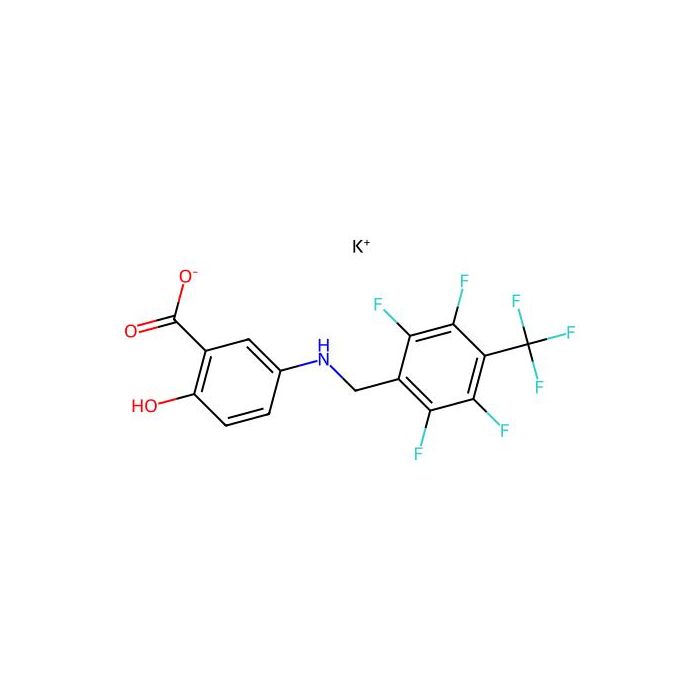
Nelonemdaz (Salfaprodil) potassium is an NR2B-selective and uncompetitive antagonist of N-methyl-D-aspartate (NMDA) . Nelonemdaz potassium is also a free radical scavenger. Nelonemdaz potassium has excellent neuroprotection against NMDA- and free radical-induced cell death
In Vitro
Nelonemdaz potassium (10-300 μM) shows apparent neuroprotection against 300 μM N-methyl-d-aspartate (NMDA) at doses as low as 30 μM. Nelonemdaz potassium (10-500 μM) inhibits the electrophysiologic response of cultured cortical neurons to 300 μM NMDA in a concentration-dependent manner. Nelonemdaz potassium (0.1-1 μM) produces a marked reduction of Fe 2+ -induced neurotoxicity, even at doses of 0.1 to 0.3 μM. Nelonemdaz potassium (0.1-1 μM) blocks the degeneration of neurons and glia in cortical cell cultures. Nelonemdaz potassium (0-350 μM) effectively scavenges superoxide radicals (IC 50 =63.07±1.44 μM), nitric oxide (IC 50 =155.8±4.88 μM), and hydroxyl radicals (IC 50 =58.45±1.74 μM). Nelonemdaz potassium (0.78-12.5 μM) decreases the amount of antimycin A-induced ROS/RNS formation in a dose-dependent manner, with an IC 50 of 2.21±0.11 μM. Nelonemdaz potassium (0.19-12.5 μM) inhibits malondialdehyde (MDA) formation with an IC 50 of 2.72±0.26 μM. Nelonemdaz potassium (0-125 μM) effectively reduces iron-ascorbate-induced lipid peroxidation (IC 50 =24.56±0.07 μM). MCE has not independently confirmed the accuracy of these methods. They are for reference only.
In Vivo
Nelonemdaz potassium (0.5-20 mg/kg; i.v.) reduces cerebral infarct evolving 24 h after 60-mins occlusion of the middle cerebral artery occlusion (MCAO) substantially and dose dependently . Nelonemdaz potassium (5 mg/kg; i.v.) protects white matter such as axons and myelin as well as gray matter from ischemic brain injury . MCE has not independently confirmed the accuracy of these methods. They are for reference only. Animal Model: Male Sprague-Dawley rats (260 to 300 g) (clip occlusion model) Dosage: 0.5-20 mg/kg Administration: I.v. administration 5 mins after reperfusion Result: Produced a large neuroprotective effect, with a maximal reduction in infarct volume of 66% at doses of 2.5 to 5 mg/kg. Not observed neuronal damage in the most vulnerable cortical area after administration of 5 mg/kg. Animal Model: Male Sprague-Dawley rats (260 to 300 g) (intraluminal thread occlusion model) Dosage: 5 mg/kg Administration: I.v. administration 30 mins after reperfusion Result: Did not change physiologic variables such as arterial pH, PCO 2 , PO 2 , and hematocrit. Reduced infarct volume evolving in the cortex and the striatum substantially. Reduced white matter damage in the striatum and external capsule markedly.
Form:Solid
IC50& Target:NMDA
Spécifications
Spécifications et pureté
≥98%
Mécanismes biochimiques et physiologiques
Nelonemdaz (Salfaprodil) potassium is an NR2B-selective and uncompetitive antagonist of N-methyl-D-aspartate (NMDA) . Nelonemdaz potassium is also a free radical scavenger. Nelonemdaz potassium has excellent neuroprotection against NMDA- and free radical-
Conditions de stockage de stockage
Store at 2-8°C,Desiccated
Expédié en
Wet ice
Ce produit nécessite l'expédition en chaîne froide. Les services terrestres et autres services économiques ne sont pas disponibles.
Certificats (CoA, COO, BSE/TSE et tableau d'analyse)
C of A & Other Certificates(BSE/TSE, COO):
Analytical Chart:
Propriétés chimiques et physiques
Solubilité
DMSO : 200 mg/mL (474.71 mM; Need ultrasonic)
Poids moléculaire
421.310 g/mol
XLogP3
Hydrogen Bond Donor Count
2
Hydrogen Bond Acceptor Count
11
Rotatable Bond Count
4
Exact Mass
420.995 Da
Monoisotopic Mass
420.995 Da
Topological Polar Surface Area
72.400 Ų
Heavy Atom Count
27
Formal Charge
0
Complexity
496.000
Isotope Atom Count
0
Defined Atom Stereocenter Count
0
Undefined Atom Stereocenter Count
0
Defined Bond Stereocenter Count
0
Undefined Bond Stereocenter Count
0
The total count of all stereochemical bonds
0
Covalently-Bonded Unit Count
2
Calculateurs de solution
Molarity Calculator
Determine the necessary mass, volume, or concentration for preparing a solution.
Dilution Calculator
Determine the dilution needed to prepare a stock solution.
Reconstitution Calculator
Avis
Avis des clients
Application Protocols
No tested application protocols are provided in the Product Data for this item.
General recommendations for small-molecule screening:
Prepare a primary stock (e.g., 10–50 mM) in DMSO under dry conditions; store as single-use aliquots at 2–8°C or frozen depending on stability (verify by your own study).
Filter stocks (0.2 µm PTFE) if particulate is observed.
For assay setup, aim for a final DMSO concentration of 0.1–1% v/v unless your assay tolerates more; confirm absence of precipitation after dilution.
Document lot number, stock concentration verification (UV or qNMR), and freeze–thaw history in your ELN for traceability.
Biological Roles
Item-specific (Product Data): No biological/biochemical role is specified. Research use only.
General note for researchers:
For any hypothesized biological targets, pathways, or enzyme interactions associated with Nelonemdaz potassium in the literature, consult primary sources and verify activity with your in-house assays. Do not infer mode-of-action without corroborating data.
Practical guidance for lab evaluations:
Establish orthogonal readouts (e.g., biochemical potency, biophysical binding, and cell-based phenotypes) to confirm on-target effects.
Determine assay interference liabilities (aggregation at high micromolar, fluorescence/absorbance overlap, redox activity) before interpreting screening hits.
Evaluate matrix effects (protein binding, serum additives) if using complex media.
If needed, perform microsomal stability, plasma stability, and solubility/permeability panels to contextualize in vitro data. These are general research evaluations and are not clinical claims.
Buffer Applications
Not typically applicable. Nelonemdaz potassium is a small-molecule research compound rather than a buffering agent. If dissolution in buffers is required for assays, select buffers based on your pH window and analytical compatibility.
Practical tips (general):
Screen standard biological buffers (e.g., PBS, HEPES, MOPS) for solubility and stability at your working concentration.
Keep final organic cosolvent (e.g., DMSO) low to avoid perturbing buffer ionic strength and assay conditions.
Green Alternatives
This section discusses greener choices for solvents and handling rather than an alternative to the compound itself, since Nelonemdaz potassium is a specific research entity.
Solvent optimization (general):
Prefer water or aqueous buffers when solubility permits; these are greener than most organics.
If an organic cosolvent is required, prioritize ethanol or isopropanol over more hazardous options. DMSO, while not fully “green,” is widely accepted for screening and can minimize overall solvent volumes due to high solubilizing power.
Process and waste minimization:
Use microplate-scale assays and miniaturized analytics (UPLC, SFC) to reduce solvent consumption.
Opt for volatile mobile phases compatible with mass spectrometry (ammonium formate/acetate) to facilitate solvent recycling and reduce persistent salt waste.
Comparative considerations (general):
Water/buffer: greenest, minimal hazard; limited by solubility/stability.
Ethanol/IPA: renewable sources possible; assay compatibility must be checked.
DMSO: effective solubilizer that enables very small stock volumes, indirectly reducing waste.
Packaging and handling:
Store desiccated at 2–8°C as specified to prolong shelf life, reducing discard frequency and overall environmental burden.
Pharmaceutical Uses
No excipient or pharmacopeial status is provided in the Product Data. This product is supplied strictly for research use only.
Formulation context for research (general):
For in vitro assays, prepare concentrated DMSO stocks and dilute into assay media, monitoring for precipitation.
For in vivo preclinical formulation research (where institutionally permitted), typical vehicles might include aqueous buffer with solubilizers (e.g., cyclodextrins, polysorbates) or co-solvent systems; confirm compound suitability and follow institutional approvals. No clinical or therapeutic claims are made.
Documentation:
For any formulation or stability work, rely on CoA/Spec Sheet for identity/purity and develop stability-indicating methods to support your study design.
Physical Properties
Item-specific (Product Data):
Appearance: Not specified for this item; refer to CoA/Spec Sheet.
Molecular weight: Not specified for this item; refer to CoA/Spec Sheet.
Commonly reported or literature-type data (no item-specific specifications):
Melting point, boiling point, density, refractive index, logP/logD, pKa, and UV cutoffs are not provided in the Product Data. If needed for method development or formulation, consult primary literature for Nelonemdaz potassium or request the CoA/Spec Sheet.
Potassium salts of organic acids or phenols often exhibit enhanced water affinity; however, exact solubility of Nelonemdaz potassium is not specified for this item.
Solubility screening strategy (general): test in water, aqueous buffers (physiological pH range), and polar aprotic solvents (DMSO, DMF) at small scale, then quantify by UV/Vis or HPLC if chromophore present.
Hygroscopicity: Many potassium salts can be moderately hygroscopic. Use desiccation as indicated in Storage Conditions; minimize atmospheric exposure during weighing.
Quality and Grades
Item-specific (Product Data):
Grade/purity: Not specified for this item; refer to CoA/Spec Sheet.
Guidance on interpreting grade and documentation (general):
When grade or purity is unspecified, rely on the lot-specific CoA for assay/purity (e.g., HPLC/UPLC area%), residual solvent levels, and identity confirmation (NMR/HRMS). If your application is analytical or screening-based, request low-UV-absorbing or LC-MS-optimized material when needed.
For compound library use, ensure purity and identity thresholds meet your screening QC (commonly ≥95% purity by an orthogonal analytical method) unless a different threshold is acceptable for preliminary SAR.
Stabilizers and additives:
Not specified for this item; refer to CoA/Spec Sheet. If stabilizers are present, they can influence UV baselines and bioassay backgrounds. Confirm before setting analytical methods.
Impurity profile considerations (general):
If developing LC methods, record retention time and UV spectra for the main peak, track related substances across lots, and verify salt stoichiometry where applicable (e.g., K+ counterion content by ICP-OES).
Reaction and Applications
Given the catalog context (small-molecule and compound library), Nelonemdaz potassium is primarily intended as a research chemical standard or screening tool rather than a synthetic reagent.
Item-specific (Product Data): Manufacturer applications: Not provided.
Research use contexts (general for library compounds):
Reference standard in LC/LC–MS method development and validation (retention-time markers, calibration curves) when a CoA is available.
Tool compound for in vitro screening, target deconvolution workflows, or phenotypic assays, contingent on end-user verification of identity, purity, and stability.
Stability studies: evaluate solution stability across pH, light exposure, and temperature to define assay-compatible handling.
Analytical tips (general):
Prepare a DMSO primary stock; confirm concentration by UV if chromophore exists or by quantitative NMR (qNMR) for absolute assay.
Establish an HPLC assay with gradient elution (water + volatile buffer vs acetonitrile or methanol). Monitor for counterion effects and potential ion-pairing with K+.
Not typically used as a reagent in named organic reactions unless the free acid/base is targeted for derivatization; if synthetic transformations are intended, first convert to the neutral form as appropriate.
Reaction Conditions
No specific reaction conditions are provided for this item, and it is not primarily intended as a synthetic reagent. If the compound is to be modified in research settings, adopt general, literature-informed practices appropriate to its confirmed functional groups (which should be verified from CoA/Spec Sheet or primary references).
General guidance for handling salts during transformations:
Convert to the neutral species when needed for coupling or protection steps; thoroughly dry the intermediate to avoid water-promoted side reactions.
Select solvents to match polarity and solubility constraints (e.g., DMSO/DMF for polar substrates; MeCN, acetone, or alcohols for moderate polarity) and verify stability by test reactions on milligram scale.
Monitor by LC-MS to detect minor degradation pathways; adjust temperature and pH accordingly.
Purification:
Reverse-phase preparative HPLC is often effective for polar salts; lyophilization from volatile buffers can provide clean solids while preserving counterion balance.
Safety and Handling
Item-specific (Product Data):
Research use note: For research use only.
Storage: Store at 2–8°C, desiccated. Shipped on wet ice.
Signal word (GHS): Not specified for this item; refer to SDS.
H-statements: Not specified for this item; refer to SDS.
GHS classification/pictograms: Not specified for this item; refer to SDS.
General laboratory safety (defer to SDS as authoritative):
Personal protective equipment: lab coat, safety glasses, and appropriate chemical-resistant gloves (e.g., nitrile). Handle in a fume hood to avoid inhalation of dust or aerosols.
Avoid ingestion, inhalation, and skin/eye contact. Wash thoroughly after handling.
Incompatibilities (general for organic potassium salts): strong oxidizers or strong acids/bases may lead to decomposition or salt exchange; verify compatibility before mixing.
First-aid overview: In case of skin or eye contact, rinse with water for at least 15 minutes and remove contaminated clothing; seek medical attention if irritation persists. If inhaled, move to fresh air. If swallowed, rinse mouth and seek medical advice. Follow institutional SOPs.
Waste and spill response:
Small spills: avoid dust generation, collect with inert absorbent, and dispose per local regulations.
Waste: accumulate as organic laboratory waste unless otherwise directed by your institution’s EHS guidance.
Always consult the product’s SDS for definitive hazard classification and response measures.
Solvent Selection
Item-specific (Product Data): None reported for solubility; see CoA/Spec Sheet.
General guidance for potassium salts of small molecules:
Aqueous media: Water and buffers (pH 6–8) are often first-line solvents. Conduct a quick solubility check at your working pH/ionic strength.
Polar aprotic: DMSO is typically used for high-concentration stocks for screening assays; DMF may be an alternative. Filter sterilize when needed.
Mixed systems: For aliquots intended for cell-free enzymology or binding assays, pre-dissolve in a small volume of DMSO, then dilute into buffer to minimize precipitation.
Polarity and miscibility (general):
DMSO and water are fully miscible and commonly compatible with high-throughput screening. Avoid high DMSO percentages if downstream biology is sensitive; typical final DMSO levels are 0.1–1% v/v (assay-dependent).
Comparison (general):
Water/buffer: lowest background, best for salt forms if soluble; limited for hydrophobes.
DMSO: maximal solubilizing power; may affect biological assays at higher %.
Methanol/ethanol: workable for analytics but may not be suitable for all bioassays.
Storage and Reconstitution
Item-specific (Product Data):
Storage conditions: Store at 2–8°C, desiccated.
Shipping: Wet ice.
Reconstitution and handling (general guidance):
Allow container to equilibrate to room temperature in a desiccator before opening to prevent moisture condensation.
For stock solutions, consider DMSO or water/buffer depending on solubility; actual solvent choice and concentration should be confirmed experimentally, as item-specific solubility is not provided.
Prepare single-use aliquots to avoid repeated freeze–thaw cycles. Protect from light if chromophoric groups are suspected; verify by stability testing.
Label aliquots with solvent, concentration, date, and lot number. Store sealed to minimize moisture uptake.
Stability notes:
No item-specific stability specifications are provided. For ongoing projects, establish a stability-indicating HPLC/LC-MS method and re-check potency/purity at defined intervals.
If a solid needs to be dried prior to use:
Brief vacuum drying at ambient or mild temperature in a desiccator can remove adventitious moisture. Avoid elevated temperatures unless compatibility is established.
Always refer to the CoA/Spec Sheet and SDS for lot-specific guidance and safety information.
Structure and Identity
Brief overview: Nelonemdaz potassium is listed here as a research-use small molecule (potassium salt form) in Aladdin Scientific’s small-molecule/compound library.
Item-specific (Product Data):
Product name: Nelonemdaz potassium (SKU: N648222)
CAS: 916214-57-8
Category path: 全部 / 可售 / 小分子和化合物库
Molecular formula: Not specified for this item; refer to CoA/Spec Sheet.
Molecular weight: Not specified for this item; refer to CoA/Spec Sheet.
InChIKey: Not specified for this item; refer to CoA/Spec Sheet.
SMILES: Not specified for this item; refer to CoA/Spec Sheet.
Structural features (general description):
Potassium salt form indicates the presence of an anionic site (e.g., carboxylate, sulfonate, phenolate, or similar) paired with K+; exact functional groups are not provided in the Product Data.
2D structure: Not specified in the Product Data. Consult CoA/Spec Sheet for definitive connectivity and functional groups.
Identification guidance (general):
For unambiguous identity confirmation, use orthogonal methods: HRMS (exact mass), 1H/13C NMR (solvent selection per solubility), and, if needed, HPLC/UPLC with UV or MS detection.
Match measured spectra to the certificate of analysis (CoA) for this lot whenever possible.
Synthetic Utility
Given its listing as a defined small-molecule entity (potassium salt), Nelonemdaz potassium is generally used as a reference material or tool compound rather than a building block.
Item-specific (Product Data): No synthetic-grade designation or derivatization guidance is provided.
General synthetic considerations:
If derivatization is planned, you may first convert the potassium salt to the corresponding neutral form (e.g., acidification to obtain the free acid/phenol) or exchange the counterion via ion-exchange resin.
Confirm functional groups from CoA/Spec Sheet or literature before attempting coupling or protection reactions.
Track salt stoichiometry and residual inorganic content (e.g., K+) if using the material in moisture-sensitive transformations.
Analytical support:
Use NMR (including 31P or 19F if applicable to the structure), HRMS, and LC-MS to characterize any derivatives and confirm that salt exchange or neutralization did not introduce impurities.
Target Specificity
No target specificity data (e.g., biological target, epitope, or receptor profile) is provided in the Product Data for this item. If you intend to use Nelonemdaz potassium as a tool compound for a particular target, consult the primary literature and confirm specificity via orthogonal assays (biochemical, biophysical, and cellular) before drawing conclusions.
Foire aux questions
What is the purity of this product?
This product is supplied at ≥98% purity (chemical assay). Lot-specific values are stated on the Certificate of Analysis.
How should this product be stored?
Store at 2–8 °C, desiccated. Keep the container tightly closed with desiccant — the material is moisture-sensitive.
How is this product shipped?
This product ships chilled on wet ice. Unpack on arrival and transfer it to the storage condition stated above.
What are the CAS number, molecular formula and molecular weight?
The CAS Number is 916214-57-8, the molecular formula is C15H7F7KNO3, and the molecular weight is 421.31 g/mol.
What documentation is provided?
Available product documentation, including Certificates of Analysis (COA), Safety Data Sheets (SDS), and specification sheets, is shown in the product document area. Document availability and access follow the current site policy.
Nous utilisons des cookies pour garantir le bon fonctionnement du site et, lorsque cela est autorisé, pour améliorer votre expérience. Vous pouvez gérer vos préférences à tout moment dans les Paramètres. Pour en savoir plus, consultez notre Politique relative aux cookies.
Souhaitez-vous que nous vous envoyions un message lorsque des réductions seront disponibles?
Me rappeler plus tard
Merci ! Veuillez vérifier votre boîte de réception e-mail pour confirmer.
Products are supplied to verified businesses, institutions, and qualified professionals for research and development use only. Not for use in humans, animals, diagnosis, or therapy.