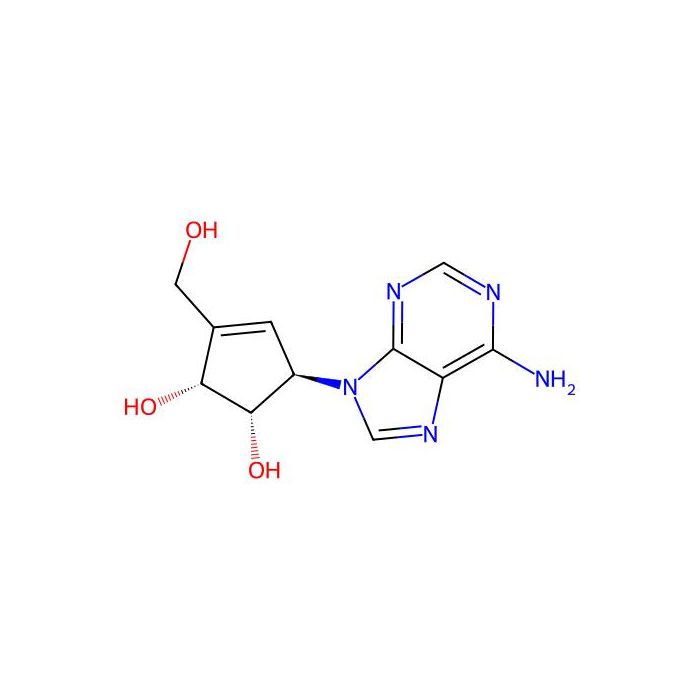
This compound belongs to the class of organic compounds known as 1,3-substituted cyclopentyl purine nucleosides. These are nucleoside analogues with a structure that consists of a cyclobutane that is substituted a the 1-position with a hydroxyl group and at the 3-position with either a purine base.
External Descriptors
Not available
1. Djoumbou Feunang Y, Eisner R, Knox C, Chepelev L, Hastings J, Owen G, Fahy E, Steinbeck C, Subramanian S, Bolton E, Greiner R, and Wishart DS. ClassyFire: Automated Chemical Classification With A Comprehensive, Computable Taxonomy. Journal of Cheminformatics, 2016, 8:61.
Certificats (CoA, COO, BSE/TSE et tableau d'analyse)
C of A & Other Certificates(BSE/TSE, COO):
Analytical Chart:
Propriétés chimiques et physiques
Poids moléculaire
263.250 g/mol
XLogP3
-2.000
Hydrogen Bond Donor Count
4
Hydrogen Bond Acceptor Count
7
Rotatable Bond Count
2
Exact Mass
263.102 Da
Monoisotopic Mass
263.102 Da
Topological Polar Surface Area
130.000 Ų
Heavy Atom Count
19
Formal Charge
0
Complexity
379.000
Isotope Atom Count
0
Defined Atom Stereocenter Count
3
Undefined Atom Stereocenter Count
0
Defined Bond Stereocenter Count
0
Undefined Bond Stereocenter Count
0
The total count of all stereochemical bonds
0
Covalently-Bonded Unit Count
1
Calculateurs de solution
Molarity Calculator
Determine the necessary mass, volume, or concentration for preparing a solution.
Dilution Calculator
Determine the dilution needed to prepare a stock solution.
Reconstitution Calculator
Avis
Avis des clients
Application Protocols
Tested/validated applications for this specific catalog item: Not specified for this item; refer to CoA/Spec Sheet.
Because no item-specific protocols are supplied in the Product Data, users should consult peer-reviewed literature and internal SOPs for method details involving Neplanocin A in biochemical, cellular, or analytical workflows.
General best practices (non-binding, not product claims):
Document stock concentration, solvent, and lot number in lab records.
Include vehicle-only and positive/negative controls where appropriate.
For sterile applications, filter final working solutions (0.2 µm) rather than heat-sterilizing.
These notes are provided solely as planning aids and are not validated conditions for this specific lot.
Biological Roles
Functional class (literature):
Carbocyclic adenosine analog and well-known probe of the methylation (one-carbon) cycle via inhibition of S-adenosyl-L-homocysteine hydrolase (SAHH). By limiting SAHH activity, intracellular SAH accumulates, which can inhibit many SAM-dependent methyltransferases. This allows researchers to modulate DNA, RNA, protein, and metabolite methylation to study epigenetic and metabolic consequences.
Mechanistic notes (literature/general):
Carbocyclic framework resists acid-catalyzed cleavage relative to ribosides and can be phosphorylated by nucleoside kinases in cells; phosphorylated forms have been implicated in mechanism-based inactivation of SAHH. The adenine chromophore supports UV detection at ~260 nm for tracking uptake/metabolism in biochemical assays.
Perturbation of the SAM/SAH ratio is a key readout; global hypomethylation or locus-specific methylation changes can be monitored by LC–MS, ELISA-like methylation assays, or bisulfite/NGS workflows (methods context).
Cellular transport and metabolism (general):
Uptake typically occurs via equilibrative nucleoside transporters; intracellular phosphorylation by adenosine kinase and subsequent metabolism may occur, depending on system.
Scope and limitations:
Effects are system- and dose-dependent; off-target interactions with other adenosine-processing enzymes/transporters are possible in complex biological matrices. Include proper vehicle and inactive-analog controls where feasible.
All biological roles above are literature-based context to inform experimental design; they are not item-specific performance claims.
Buffer Applications
Neplanocin A is not a buffering reagent and is not used to prepare defined pH buffers. Accordingly:
Not typically applicable. For experiments employing Neplanocin A, standard biological buffers (e.g., PBS, HEPES, Tris) are selected based on the assay needs, not because of any buffering capacity of the compound itself.
Ensure that the chosen buffer and pH (commonly near neutral, pH 6–8) are compatible with nucleoside stability and the biological system under study.
If sterile conditions are required, filter-sterilize the final working solution (0.2 µm) rather than attempting heat sterilization, which may degrade nucleoside analogs.
Green Alternatives
For Neplanocin A, “green” considerations center on solvent and process choices during dissolution, purification, and analysis rather than replacing the molecule itself (a specific biochemical probe).
Safer solvent choices for dissolution (general guidance):
Prefer water or aqueous buffers whenever compatible with the intended assay.
If an organic cosolvent is necessary, minimize DMSO final concentration (≤1% v/v in biological media is a common target) and avoid chlorinated solvents.
Small comparison (general; not product specs):
| Use case | Preferred option | Alternatives | Tradeoffs |
|---|---|---|---|
| Stock prep for bioassays | Water/buffer (pH 6–8) | DMSO | Water is benign; DMSO offers higher solubility but requires vehicle control |
| Analytical HPLC | Water/MeOH with volatile buffer | Water/ACN | MeOH is less toxic; ACN offers stronger elution and lower viscosity |
| Workup/washing | Aqueous media/EtOH | IPA | EtOH is widely acceptable; IPA may reduce solubility |
Operational greening tips:
Use microscale preparations to reduce solvent volumes.
Reuse mobile phases when permissible and dispose of organic waste per local regulations.
Favor ambient-temperature dissolution with sonication over heating.
Note: No greener “substitute compound” exists for the exact biochemical role of Neplanocin A; alternatives would be other mechanistic probes with different selectivity and hazard profiles, which should be chosen based on experimental goals.
Pharmaceutical Uses
This product is supplied strictly for research use only; it is not intended for human or veterinary use, and no clinical/therapeutic claims are made.
Formulation/excipient status:
Neplanocin A is not an excipient and has no compendial excipient status in major pharmacopeias to the best of general knowledge. Any mention in the literature pertains to its role as a research tool compound.
Process/analytical context in pharmaceutical research (general):
May be used as a reference analyte for method development in LC–UV/LC–MS to assess nucleoside analog quantification, stability-indicating methods, and transporter/kinase assay platforms.
In preclinical research settings, solutions are often prepared in DMSO or aqueous vehicles for in vitro assays; if used in ex vivo matrices, appropriate matrix-matched calibration and stability assessments are needed.
Manufacturing considerations (general):
Not manufactured under GMP unless explicitly stated on documentation. For any regulated use, qualification and additional testing would be required (identity by NMR/HRMS, impurity profiling, residual solvents, water content).
Refer to the CoA/Spec Sheet for any item-specific quality attributes; none are specified in the provided Product Data.
Physical Properties
Item-specific specifications (this lot):
Appearance: Not specified for this item; refer to CoA/Spec Sheet.
Grade/Purity: Not specified for this item; refer to CoA/Spec Sheet.
Literature/general properties for carbocyclic adenosine analogs (for context only; not product specifications):
Physical state: typically solid (nucleoside analogs are commonly crystalline solids).
Polarity: polar due to diol and heteroaromatic amine functionalities; engages in extensive hydrogen bonding.
Solubility trends: increased solubility in polar protic solvents (water, aqueous buffers) and polar aprotics (DMSO); limited solubility in nonpolar solvents. Exact solubility values for this item are not specified; refer to CoA/Spec Sheet.
Acid/base behavior: adenine moiety can be protonated under acidic conditions; diol can form boronate esters with boronic acids (analytical/derivatization context). pKa values for this specific compound are not specified here.
Thermal properties:
Melting point, boiling point, decomposition temperature: Not specified for this item; refer to CoA/Spec Sheet. Nucleoside analogs often show melting with decomposition at elevated temperatures (literature), so gentle thermal handling is advisable.
Other descriptors:
LogP/logD, refractive index, density: Not specified for this item; refer to CoA/Spec Sheet.
Note: Use the product’s CoA/SDS for definitive physico-chemical data applicable to this catalog item. Literature descriptors above are provided only to aid solvent and method selection by experienced users.
Quality and Grades
Item-specific grade/purity: Not specified for this item; refer to CoA/Spec Sheet.
How to interpret typical grades (general guidance):
Research/Biochemistry grade: indicates suitability for in vitro biochemical assays; residual solvent and UV-absorbing impurities are usually controlled, but consult CoA for exact impurity profile.
HPLC grade (when applicable to solvents) emphasizes low non-volatile residue and low UV background; for small molecules like this, “≥98% (HPLC)” commonly denotes chromatographic assay purity, not a solvent grade.
Reference standard/analytical grade (if stated) implies tighter identity and purity verification (orthogonal techniques, e.g., NMR, HRMS), often with an accompanying detailed CoA.
Stabilizers/additives:
None are indicated for this item. If stabilizers were present, they would be listed on the CoA/SDS. The absence of such information implies neat material, but always verify lot documentation.
Practical quality notes for nucleoside analogs (general):
Trace moisture is common in polar solids; drying under vacuum at ambient temperature can improve weighing accuracy (avoid heat if decomposition is possible).
Purity verification: quick check by HPLC (reverse-phase, water/ACN with 0.1% formic acid or ammonium acetate), UV at ~260 nm for adenine chromophore, and MS for confirmation.
For cell-based work, endotoxin/bioburden are typically not controlled unless specifically stated; sterile filtration of solutions is recommended when needed.
Reaction and Applications
This compound is primarily a biochemical tool rather than a commodity reagent; its value lies in modulating the cellular methylation cycle and nucleoside metabolism in research settings.
Research applications (literature/general):
Acts as a carbocyclic adenosine analog widely used to probe S-adenosyl-L-homocysteine (SAH) hydrolase activity. Inhibition of SAH hydrolase elevates intracellular SAH, an endogenous product inhibitor of S-adenosyl-L-methionine (SAM)-dependent methyltransferases, thereby modulating global transmethylation reactions for mechanistic studies.
Utilized to investigate epigenetic regulation (DNA/RNA/histone methylation) and methyl cycle flux, and to study nucleoside transport/phosphorylation pathways.
Assay and analytical utility:
Serves as a reference standard in LC-UV/MS methods due to the adenine chromophore (absorbance near 260 nm) and predictable ionization (ESI+ preferred for MS of protonated species, general).
Practical tips (general):
Prepare concentrated DMSO or aqueous stocks under clean conditions; store aliquots to avoid repeated freeze–thaw of solutions.
Maintain near-neutral pH for aqueous work. Strong acid/base may promote degradation of the adenine linkage over time.
When used in cell culture, include vehicle controls (e.g., DMSO at matched final concentration) and consider time-course studies to distinguish primary from secondary methylation effects.
Related comparisons:
Other SAH hydrolase inhibitors (literature) include 3-deazaneplanocin analogs and adenosine dialdehyde; selection depends on desired potency, cell permeability, and selectivity profiles.
Reaction Conditions
Because Neplanocin A is primarily used as a biochemical probe rather than as a reagent/starting material, “reaction conditions” are most relevant to solution preparation and analytical/assay workflows.
Solution preparation (general guidance; not item-specific specs):
Stock solutions: commonly prepared at 10–50 mM in DMSO or at lower millimolar concentrations in water/aqueous buffer (pH ~7). Filter sterilize (0.2 µm) if needed. Avoid strong acid/base.
Stability: store aliquots at low temperature for solutions (e.g., −20 °C) and protect from light; minimize freeze–thaw cycles. Solid stability at room temperature is item-specific; this product lists Room temperature storage for the solid.
Analytical methods (general):
HPLC: reverse-phase (C18), mobile phase water (0.1% formic acid or ammonium acetate) and methanol/acetonitrile; monitor at 254–265 nm. Typical retention is short to moderate due to polarity.
MS detection: ESI positive yields [M+H]+; add volatile buffer (e.g., 5–10 mM ammonium acetate) for improved peak shape.
Enzymology/cell studies (general context, not performance claims):
Dosing ranges, exposure times, and temperatures are highly system-dependent; start with a titration spanning low to mid micromolar and include time-course controls. Maintain vehicle consistency across treatments.
All conditions above are literature-style guidance to assist experimental planning; consult your lab’s validated SOPs and the item-specific CoA/SDS for constraints and compatibility.
Safety and Handling
Regulatory/SDS note:
For research use only. Always consult the item-specific SDS for authoritative hazard classification and response measures.
Item-specific hazard information (from Product Data):
Signal Word: Not specified for this item; refer to SDS.
H-Statements: Not specified for this item; refer to SDS.
GHS Classification: Not specified for this item; refer to SDS.
Pictograms: Not specified for this item; refer to SDS.
General laboratory precautions for nucleoside analogs (good practice; not item-specific):
PPE: laboratory coat, safety glasses, and appropriate chemical-resistant gloves (e.g., nitrile). Avoid inhalation of dust and contact with skin/eyes.
Engineering controls: handle powders in a fume hood or ventilated enclosure to minimize dust exposure. Use microbalance practices for accurate weighing.
Hygiene: wash hands thoroughly after handling. Do not eat, drink, or smoke in work areas.
Handling considerations:
Solutions: prepare stock solutions using clean, dry glassware. Filter sterilize through 0.2 µm PTFE/PES if aseptic use is intended.
Incompatibilities: strong acids/bases and strong oxidizers may compromise nucleoside integrity (general). Avoid prolonged exposure to elevated temperatures.
Thermal/photostability: keep away from direct sunlight; store solutions at low temperature when possible to limit degradation.
First-aid overview (refer to SDS for details):
Eye/skin contact: rinse with water for several minutes; remove contaminated clothing.
Inhalation: move to fresh air; seek medical attention if symptoms persist.
Ingestion: rinse mouth; seek medical advice. Provide SDS to responders.
Solvent Selection
Polarity and functional groups (general):
Neplanocin A is a polar, hydrogen-bonding small molecule (adenine base + vicinal diol on a carbocyclic ring). Expect strong interactions with protic solvents and limited solubility in nonpolar media.
Practical dissolution strategy (general guidance; not item-specific specs):
Primary choices: water or aqueous buffers (pH 6–8), and polar aprotic solvents such as DMSO.
Secondary choices: methanol, ethanol. Isopropanol may be less effective. Avoid nonpolar solvents (e.g., hexanes, toluene).
For stock solutions in biological assays: DMSO (e.g., 10–50 mM) is commonly used, then diluted into aqueous media to ≤1% DMSO final to minimize vehicle effects (general best practice).
Gentle warming (≤40 °C) and sonication can aid dissolution. Filter (0.2 µm) if clarity is required.
Chromatography considerations:
Reverse-phase LC: water/acetonitrile or water/methanol with volatile modifiers (e.g., 0.1% formic acid or 5–20 mM ammonium acetate) provide good peak shape for adenine nucleosides.
Normal-phase is less suitable due to high polarity; HILIC can be effective for analytical separations.
Comparison (general):
Water/buffer: best biological compatibility; may require time to dissolve fully.
DMSO: excellent solvency and stability for concentrates; must control final DMSO percentage.
Methanol/ethanol: workable for prep and analytical purposes; consider compatibility with downstream biology.
Note: Exact solubility limits for this item are not specified; consult the CoA or perform a small-scale solubility screen.
Storage and Reconstitution
Item-specific storage (from Product Data):
Storage Conditions (solid): Room temperature.
Shipped In: Not specified for this item; refer to CoA/Spec Sheet.
Reconstitution (item-specific instructions are not provided):
Not specified for this item; refer to CoA/Spec Sheet.
General guidance for reconstitution and solution handling (literature/common practice; not product specifications):
Solvents: dissolve in water/buffer (pH ~6–8) or DMSO. Start with small volumes and aid dissolution by gentle swirling or brief sonication. Avoid strong acids/bases.
Concentrates: prepare aliquotted stock solutions (e.g., 10–50 mM in DMSO) to limit freeze–thaw. Label vials with concentration, solvent, date, and lot.
Storage of solutions: keep at 2–8 °C for short-term (hours–days) or −20 °C for longer term (weeks–months), protected from light. Verify stability by HPLC if solutions are stored for extended periods.
Thawing: warm to room temperature and vortex to ensure homogeneity; avoid repeated freeze–thaw cycles by using single-use aliquots.
Always defer to the product’s CoA and SDS for definitive instructions and stability limits applicable to this catalog item.
Structure and Identity
Neplanocin A is a carbocyclic adenosine analog used as a biochemical probe in methylation and nucleoside metabolism studies.
Item-specific identifiers (from Product Data):
SKU: N667963
Product Name: Neplanocin A
CAS: 72877-50-0
PubChem CID: 72968
InChIKey: 427461 (as provided)
SMILES: Not specified for this item; refer to CoA/Spec Sheet.
Molecular Formula: Not specified for this item; refer to CoA/Spec Sheet.
Molecular Weight: Not specified for this item; refer to CoA/Spec Sheet.
Structural features (general chemistry/literature description):
Carbocyclic nucleoside bearing an adenine base N9-linked to a cyclopentenyl “sugar” (a cyclopentene ring) instead of a ribofuranose.
The carbocyclic ring typically presents vicinal diol functionality (trans-2′,3′-diol) and an unsaturation within the ring (cyclopentene), enabling hydrogen bonding and conferring polarity.
Heteroaromatic purine core (adenine) contributes to basicity at N1 and exocyclic 6-amino group hydrogen-bonding.
No stereocenters on the purine; stereochemical descriptors apply to the cyclopentenyl ring substituents (literature).
2D structural description (general):
A bicyclic purine (6-aminopurine, “adenine”) attached via its N9 to a substituted five-membered carbocycle. The carbocycle bears two hydroxyl groups on adjacent carbons and contains a C=C bond; there is no anomeric oxygen (distinguishing it from ribonucleosides). This C–N linkage is more resistant to acid-catalyzed cleavage than typical N-glycosidic bonds of ribonucleosides (general observation for carbocyclic analogs).
Synthetic Utility
Neplanocin A is generally employed as a finished biochemical probe rather than a building block; nonetheless, several synthetic/derivatization considerations are relevant (general literature context):
Functional handles:
Vicinal diol on the carbocycle permits selective protection (e.g., acetonide, silyl ethers) and subsequent derivatization (esterification, carbonate formation) to modulate lipophilicity and permeability in SAR studies.
Adenine exocyclic amine can undergo acylation, sulfonylation, or carbamate formation under controlled conditions.
Retrosynthetic perspective:
Accessed via construction of a suitably substituted cyclopentenyl unit followed by N9-alkylation of adenine (or coupling of protected adenine derivatives), or through ring-closing strategies starting from sugar-derived cyclopentenes (literature). The carbocyclic nature avoids an anomeric oxygen, impacting protecting-group strategy and stability.
Use as a reference standard:
Employed to benchmark activity/selectivity against SAH hydrolase in enzymatic assays. Synthetic chemists preparing analogs frequently compare chromatographic retention, UV spectra (~260 nm), and MS response to Neplanocin A.
Cautions in synthesis/handling:
Purine N9-alkylation regioselectivity and preservation of trans-diol stereochemistry are key synthetic challenges. Acidic or strongly basic conditions risk ring opening or purine degradation; mild conditions and temporary protection are typically used.
These points are general literature guidance and do not imply that this catalog item is intended as a synthetic intermediate.
Target Specificity
Item-specific target information: Not specified for this item; refer to CoA/Spec Sheet.
Note: While literature frequently studies Neplanocin A in the context of S-adenosyl-L-homocysteine hydrolase and methylation biology, this section reports only catalog-verified target details. No target, isoform, or selectivity data are provided in the Product Data for SKU N667963.
Foire aux questions
How should this product be stored?
Store at room temperature.
What are the CAS number, molecular formula and molecular weight?
The CAS Number is 72877-50-0, the molecular formula is C11H13N5O3, and the molecular weight is 263.25 g/mol. InChIKey XUGWUUDOWNZAGW-VDAHYXPESA-N.
What documentation is provided?
Available product documentation, including Certificates of Analysis (COA), Safety Data Sheets (SDS), and specification sheets, is shown in the product document area. Document availability and access follow the current site policy.
Nous utilisons des cookies pour garantir le bon fonctionnement du site et, lorsque cela est autorisé, pour améliorer votre expérience. Vous pouvez gérer vos préférences à tout moment dans les Paramètres. Pour en savoir plus, consultez notre Politique relative aux cookies.
Souhaitez-vous que nous vous envoyions un message lorsque des réductions seront disponibles?
Me rappeler plus tard
Merci ! Veuillez vérifier votre boîte de réception e-mail pour confirmer.
Products are supplied to verified businesses, institutions, and qualified professionals for research and development use only. Not for use in humans, animals, diagnosis, or therapy.