Nor-NOHA acetate - Moligand™,10mM in DMSO , CAS No.1140844-63-8

CAS: 1140844-63-8 Cat. No.: N580567 Formule: C9H20N4O7 Poids moléculaire: 296.28 PubChem CID: 16760508
DISPONIBLE À COMMANDE
GRADE & PURITY Moligand™ ? Moligand™ — Aladdin's line of ligands and bioactive small molecules. Use for receptor, pathway, and binding studies needing defined small-molecule tools. 10mM in DMSO
Synonyms
Nω-Hydroxy-nor-L-arginine acetate | Nω-Hydroxy-nor-L-Arginine diacetate salt | N-OMega-hydroxy-L-norarginine acetate | N-Hydroxy-nor-L-arginine acetate | Nω-hydroxy-nor-Arginine
Storage
Store at -80°C
Shipped In
Dry ice packs + Cold packs
★
Size
Allemagne (EU)
USA*
Price
Qty
1ml
N580567-1ml
Sur commande · 8–12 semaines

652,45€

762,66€
Enregistrer 110,20 € (14.45%)
Enter a quantity for the sizes you want to add.
🧪
Why this grade

Moligand™,10mM in DMSO Moligand™ for sensitive chromatographic and analytical workflows requiring minimal baseline interference.

🌡

Storage & shipping

Store at -80°C Ships Dry ice packs + Cold packs Check lot-specific COA for exact specifications.

📋

Quality documents

SDS, COA, datasheet, and spec sheet available for download. Lot-specific COA accessible via lot number lookup.

📚

Literature proof

Cited in 0 peer-reviewed publications across chromatography, organic synthesis, and cross-coupling reactions.

Specifications

Synonymes
Nω-Hydroxy-nor-L-arginine acetate | Nω-Hydroxy-nor-L-Arginine diacetate salt | N-OMega-hydroxy-L-norarginine acetate | N-Hydroxy-nor-L-arginine acetate | Nω-hydroxy-nor-Arginine
Spécifications et pureté
Moligand™,10mM in DMSO
Conditions de stockage de stockage
Store at -80°C
Expédié en
Dry ice packs + Cold packs
Ce produit nécessite l'expédition en chaîne froide. Les services terrestres et autres services économiques ne sont pas disponibles.
Grade
Moligand™
Type d'action
ACTIVATOR
Noms et identifiants
Sourires canoniques
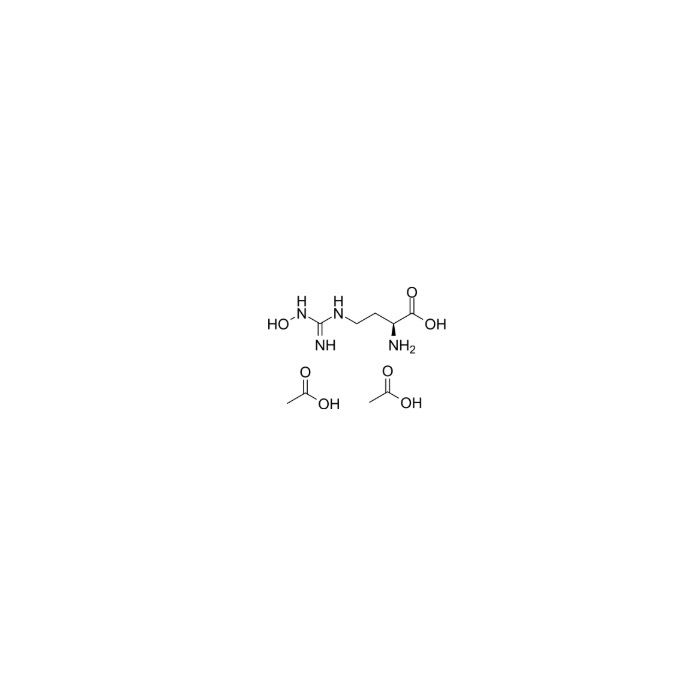
CC(=O)O.CC(=O)O.C(CN=C(N)NO)C(C(=O)O)N
IUPAC Name
acetic acid;(2S)-2-amino-4-[[amino-(hydroxyamino)methylidene]amino]butanoic acid
InChIKey
PQFYTZJPYBMTCT-QTNFYWBSSA-N
INCHI
1S/C5H12N4O3.2C2H4O2/c6-3(4(10)11)1-2-8-5(7)9-12;2*1-2(3)4/h3,12H,1-2,6H2,(H,10,11)(H3,7,8,9);2*1H3,(H,3,4)/t3-;;/m0../s1
Isomères SMILES
CC(=O)O.CC(=O)O.C(CN=C(N)NO)[C@@H](C(=O)O)N
PubChem CID
16760508
Poids moléculaire
296.28

Documentation

📋 Safety Data Sheet (SDS)

Comprehensive hazard, handling, storage, and regulatory compliance document.

Download SDS →

✅ Certificate of Analysis (COA)

Lot-specific quality data. Enter your lot number to retrieve the exact COA.

Look up COA →

📊 Datasheet

Quick-reference summary of product specifications and applications.

View datasheet →

🔬 Specification Sheet

Full quality attributes and acceptance criteria for this grade.

View spec sheet →

Advanced Data

Taxonomic Classification

Taxonomy Tree

KingdomOrganic compounds
SuperclassOrganic acids and derivatives
ClasseCarboxylic acids and derivatives
SubclassAmino acids, peptides, and analogues
Intermediate Tree Nodes Amino acids and derivatives - Alpha amino acids and derivatives - Alpha amino acids
Direct ParentL-alpha-amino acids
Alternative Parents N-hydroxyguanidines  Fatty acids and conjugates  Amino acids  Monocarboxylic acids and derivatives  Carboxylic acids  Carboximidamides  Organopnictogen compounds  Organic oxides  Monoalkylamines  Imines  Hydrocarbon derivatives  Carbonyl compounds  
Molecular FrameworkNot available
Substituents L-alpha-amino acid - Fatty acid - N-hydroxyguanidine - Amino acid - Guanidine - Carboximidamide - Monocarboxylic acid or derivatives - Carboxylic acid - Organic nitrogen compound - Organic oxygen compound - Organopnictogen compound - Organic oxide - Hydrocarbon derivative - Primary amine - Organooxygen compound - Organonitrogen compound - Primary aliphatic amine - Imine - Carbonyl group - Amine - Aliphatic acyclic compound
DescriptionThis compound belongs to the class of organic compounds known as l-alpha-amino acids. These are alpha amino acids which have the L-configuration of the alpha-carbon atom.
External Descriptors Not available
Structure 3D
Modèle de structure chimique interactif


Certificats (CoA, COO, BSE/TSE et tableau d'analyse)
C of A & Other Certificates(BSE/TSE, COO):
Analytical Chart:
Propriétés chimiques et physiques
Solubilité≤5mg/ml in DMSO;1mg/ml in dimethyl formamide
SensibilitéMoisture sensitive
Poids moléculaire296.280 g/mol
XLogP3
Hydrogen Bond Donor Count7
Hydrogen Bond Acceptor Count9
Rotatable Bond Count5
Exact Mass296.133 Da
Monoisotopic Mass296.133 Da
Topological Polar Surface Area209.000 Ų
Heavy Atom Count20
Formal Charge0
Complexity213.000
Isotope Atom Count0
Defined Atom Stereocenter Count1
Undefined Atom Stereocenter Count0
Defined Bond Stereocenter Count0
Undefined Bond Stereocenter Count0
The total count of all stereochemical bonds0
Covalently-Bonded Unit Count3
Calculateurs de solution
Avis

Avis des clients

Application Protocols

No item-specific, validated protocols are supplied. The following general procedures are commonly used in research with ionic, water-soluble enzyme inhibitors like Nor-NOHA acetate. Optimize for your system.

A. Preparing stock solutions (general)

  • Weigh quickly to limit moisture uptake. Dissolve in water or assay buffer to desired concentration, or prepare a concentrated DMSO stock (e.g., 10–100 mM, as solubility permits; verify empirically). Vortex and, if needed, sonicate briefly. Sterile-filter for cell-based work.

B. Enzyme inhibition assay (general)

  • Prepare serial dilutions in buffer to span expected activity (e.g., low µM to mM range depending on enzyme/source). Pre-incubate inhibitor with enzyme (e.g., 5–15 min) and initiate reaction with substrate (L-arginine). Maintain constant final DMSO across wells when used. Read out urea or ornithine formation via a compatible colorimetric/LC-MS method.

C. Cell-based experiments (general)

  • Dilute aqueous or DMSO stocks into culture medium to the desired final concentration, keeping DMSO ≤0.5–1% v/v. Include vehicle controls and confirm medium compatibility. Monitor pH and osmolality.

D. Storage of working solutions (general)

  • Keep aqueous working solutions refrigerated and use within a few days. For longer-term use, aliquot concentrated stocks and store frozen; avoid repeated freeze–thaw.

Note: Concentrations, incubation times, and assay formats are not specified for this item and must be established empirically.

Biological Roles

General literature context (for research use only):

  • Nor-NOHA is the Nω-hydroxylated analog of nor-arginine, used extensively as a tool inhibitor of arginase isoforms (Arg1/Arg2) in studies of the urea cycle and L-arginine–nitric oxide axis.
  • By modulating arginase activity, Nor-NOHA is employed to probe L-arginine partitioning between arginase and nitric oxide synthase (NOS) pathways, aiding investigations into nitrogen metabolism, redox signaling, and polyamine/ornithine biosynthesis.
  • The guanidinium/N-hydroxyl motif enables strong interaction with the metal-containing active site of arginase in biochemical assays (literature mechanistic rationale).

Experimental modalities where it is commonly used (literature):

  • Enzyme kinetics with purified Arg1/Arg2 to determine inhibition mode and potency under defined buffer conditions.
  • Cell-based assays to study arginine utilization, nitric oxide readouts, and downstream metabolite profiling (with careful control of extracellular arginine and DMSO levels).
  • Chemical biology: probe-dependent validation, competition assays, and orthogonal readouts to confirm on-target effects.

Notes:

  • No medical or therapeutic claims are made. This product is supplied strictly for laboratory research.
  • Potency/selectivity values are assay-dependent and are not specified for this item; consult primary literature and validate under your conditions.
Buffer Applications

As an ionic, amino-acid–derived salt, Nor-NOHA acetate is well suited to aqueous preparation. Item-specific buffer instructions are not provided; the following are general, literature-based practices for tool compounds of this class.

  • Stock preparation (general): Dissolve in ultrapure water or assay buffer (e.g., HEPES, PBS) at near-neutral pH. Alternatively, prepare a concentrated DMSO stock and dilute into buffer immediately before use.
  • pH considerations: Maintain pH 6.8–7.6 to preserve the Nω-hydroxyl–guanidino integrity and minimize side reactions; avoid strong acids/bases.
  • Ionic strength: Moderate ionic strength (e.g., 100–200 mM total salts) is commonly compatible with enzyme assays, but optimize to your target.
  • Filtration: If sterility is needed, pass through a 0.22 µm PES or PVDF filter. Highly charged compounds can adsorb to some membranes—pre-rinse filters.
  • Compatibility: Works with common biological buffers (HEPES, Tris, phosphate). Avoid high concentrations of transition metals in buffer, which may complex with guanidino/N–O groups in some contexts.

Not specified for this item; refer to CoA/Spec Sheet for any product-specific preparation or pH stability notes. Always run a small pilot to confirm solubility and assay compatibility under your exact buffer composition and temperature.

Green Alternatives

Green chemistry for this product focuses on solvent choices and waste minimization in biochemical workflows rather than replacing the compound itself.

  • Prefer water and aqueous buffers as the primary medium for preparation and assays whenever compatible with your protocol (greenest option).
  • If concentrated stocks are necessary, use DMSO judiciously and maintain low final DMSO content in assays to reduce VOC footprint.
  • Avoid chlorinated solvents for any ancillary sample handling; if organic extraction is needed for analytics, consider ethanol or isopropanol as safer alternatives when compatible.

Small comparison (general):

  • Water/buffer: minimal environmental impact; may require antimicrobial controls and refrigerated storage.
  • DMSO: widely accepted for HTS stocks; higher embodied energy and potential worker exposure—implement sealed vials/plates.

Operational tips:

  • Prepare higher-concentration master stocks to reduce container count and rinse waste.
  • Use closed, low-dead-volume dispensing to minimize evaporative losses.
  • Consolidate aqueous waste streams and avoid unnecessary pH adjustments that could generate salts or require neutralization steps.

Note: There is no direct “green substitute” for Nor-NOHA acetate when its specific biochemical activity is required; sustainability gains come from solvent selection, right-sizing batches, and efficient cold-chain logistics.

Pharmaceutical Uses

This product is offered for laboratory research use only.

  • Compendial status: Not specified for this item; no pharmacopeial monograph is indicated. Refer to CoA/Spec Sheet if regulatory status is needed.
  • Typical role: Biochemical tool compound for target validation and mechanistic studies in discovery research; not used as an excipient.
  • Formulation research context (general): When used in preclinical assays or in vitro studies, researchers may formulate stock solutions in water or DMSO and dilute into physiological buffers. Adsorption to plastics is expected to be low for strongly ionic species, but empirical checks are recommended for low-concentration studies.
  • Manufacturability considerations (general): Highly polar salts are hygroscopic; controlled humidity and low-temperature storage improve stability during handling.

No therapeutic, diagnostic, or clinical use is claimed or supported. Do not use in humans or animals except as permitted by institutional approvals for laboratory studies.

Physical Properties

Item-specific specifications are not provided in the Product Data. Do not use the following general notes as specifications; consult the CoA/Spec Sheet for authoritative numbers.

  • Appearance: Not specified for this item; refer to CoA/Spec Sheet.
  • Molecular Weight: Not specified for this item; refer to CoA/Spec Sheet.
  • Molecular Formula: Not specified for this item; refer to CoA/Spec Sheet.
  • Melting point / decomposition: Not specified for this item; refer to CoA/Spec Sheet.
  • Boiling point: Not applicable for ionic amino-acid salts (decompose before boiling; literature generality).
  • Density: Not specified for this item; refer to CoA/Spec Sheet.
  • Refractive index: Not applicable to solids; not typically reported for this class (general note).
  • pKa(s) (literature, qualitative): Multiple ionizable centers typical of amino-acid/guanidinium systems; cationic at physiological pH.
  • Solubility (literature, qualitative): Generally highly soluble in water and aqueous buffers; poor in nonpolar solvents. DMSO and methanol/water mixtures are commonly used for stock solutions in biochemical assays.
  • LogP (literature, qualitative): Expected to be very low/negative given multiple charges and hydrogen-bond donors/acceptors.

Notes for handling (general): Hygroscopicity can be a concern for highly polar salts; keep containers tightly closed and minimize atmospheric exposure during weighing to preserve assay accuracy.

Quality and Grades
  • Grade/Purity (item-specific): Moligand™. This denotes supply targeted for use in small-molecule screening libraries and ligand discovery workflows, emphasizing identity, consistency, and suitability for biochemical assays.

What Moligand™ typically implies (general guidance; not a specification):

  • Identity verification: LC/MS and/or NMR confirmation of the expected structure and counterion.
  • Assay readiness: Clean chromatographic profiles to minimize off-target assay interference; residual solvent limits appropriate for screening use.
  • Reformatting friendliness: Material amenable to dissolution in common assay solvents (water, buffers, DMSO) and plating operations.

Item-specific notes:

  • Stabilizers, trace metals, residual solvents, water content, and UV cutoffs are Not specified for this item; refer to CoA/Spec Sheet.
  • If you require a specific salt stoichiometry (e.g., mono- vs diacetate) or stereochemical assignment, request the current CoA to confirm.

Recommendations for QC on receipt (best practice):

  • Verify mass and appearance, record lot number, and, if critical to your application, perform quick-check LC/MS or qNMR against your internal reference.
  • For HTS: Prepare a small DMSO stock and run a PAINS/interference pre-screen if your assay format is dye- or metal-dependent, even though guanidinium amino acids are generally low-risk for such artifacts.
Reaction and Applications

This compound is primarily a bioactive small molecule rather than a synthetic reagent. As such, it is not typically employed as a stoichiometric reagent or solvent in classical organic transformations.

Applicable uses (research/biochemical context):

  • Employed as a tool compound in studies of L-arginine metabolism, particularly assays interrogating the urea cycle and nitric oxide pathway enzymes (literature).
  • Utilized in enzyme kinetics, target engagement, and structure–activity relationship (SAR) explorations around arginase-binding chemotypes (literature).

If considering chemical transformations (general notes):

  • The Nω-hydroxyguanidino group is highly polar and strongly basic; typical synthetic manipulations require protection strategies and are not commonly performed on the acetate salt form.
  • Acidic or basic conditions and oxidants may compromise the N–O functionality; mild, aqueous-compatible derivatizations (e.g., isotopic labeling via carboxylate coupling) are more plausible.

Conclusion:

  • For synthetic chemistry, select other building blocks (e.g., protected amino acid analogs) rather than Nor-NOHA acetate. For biochemistry and chemical biology assays, proceed to Biological Roles, Target Specificity, and Application Protocols sections for in-depth practical guidance.
Reaction Conditions

This section is generally not applicable because Nor-NOHA acetate is used as a bioactive probe rather than as a reagent in organic transformations.

If you are performing biochemical assays (general guidance; not item-specific):

  • Solvent: Water or assay buffers; DMSO for concentrated stocks.
  • Temperature: Typical enzyme assays at 20–37°C; avoid extended exposure to elevated temperatures.
  • pH: Near neutral (~7.0–7.5) unless your enzyme requires otherwise.
  • Atmosphere: Ambient; protect aqueous solutions from microbial contamination.
  • Metals: Limit excess transition metals in buffer unless required, as chelation/interaction with the guanidino/N–O functionality can occur.

No yields, conversion data, or synthetic reaction conditions are provided for this item. For synthetic applications, consult literature specific to protected analogs.

Safety and Handling

Authoritative safety information must be taken from the product SDS.

  • GHS Classification: Not specified for this item; refer to SDS.
  • Signal Word: Not specified for this item; refer to SDS.
  • Hazard Statements (H-Statements): Not specified for this item; refer to SDS.
  • Pictograms: Not specified for this item; refer to SDS.

General laboratory handling guidance (for amino-acid–like ionic solids; not item-specific):

  • PPE: Lab coat, safety glasses, and appropriate chemical-resistant gloves. Avoid inhalation of dust and contact with skin or eyes.
  • Engineering controls: Handle powders in a fume hood or ventilated enclosure to limit airborne dust.
  • Incompatibilities: Strong oxidizers and strong acids/bases may degrade N-hydroxyl/guanidino functionalities (general caution). Avoid prolonged exposure to moisture; hygroscopic uptake may alter mass and concentration.
  • First aid (overview): If inhaled, move to fresh air; if on skin/eyes, rinse with water for several minutes; if ingested, rinse mouth. Seek medical attention as per SDS guidance.
  • Spill & disposal: Collect gently to minimize dust; dissolve residues in water and dispose according to institutional and local regulations.

Special risks (general):

  • N-hydroxylated amino-acid derivatives are typically nonvolatile solids; main risks relate to dust generation and potential irritancy. Always defer to the SDS for hazard classification and exposure limits.
Solvent Selection

Nor-NOHA acetate is a highly polar, ionic amino-acid–derived salt. Solvent choice should prioritize maintaining full dissolution and chemical integrity.

  • Primary solvents (general/literature):
    • Water / aqueous buffers (pH 6–8): Typically excellent solubility and chemical stability for short- to medium-term assays.
    • DMSO: Common for preparing concentrated freezer stocks for HTS; miscible with assay buffers upon dilution.
    • Methanol/water mixtures: Useful for analytical sample prep and LC injection solutions.
  • Limited or poor solvents: Nonpolar organics (e.g., hexane, toluene, diethyl ether) and weakly polar aprotics (e.g., dichloromethane) due to ionic character.
  • pH considerations (general): Maintain near-neutral pH to preserve the Nω-hydroxyl–guanidino functionality; extreme pH may lead to hydrolysis or oxidative changes.

Comparison (general):

  • Water/buffer: maximal biocompatibility; limited long-term storage if microbial control is lacking.
  • DMSO: excellent stock stability at low temperatures; ensure final assay DMSO ≤0.5–1% v/v to avoid biological artifacts.

Practical tips:

  • Filter or centrifuge to remove particulates before sensitive assays.
  • For plate-based screening, pre-dissolve in DMSO, then dilute into buffer with mixing to avoid local supersaturation.
  • If exact aqueous solubility is critical, run a small solubility screen under your assay conditions (temperature, ionic strength, pH).
Storage and Reconstitution

Item-specific conditions:

  • Storage Conditions: Store at -80°C (as provided in Product Data). Maintain under dry conditions.
  • Shipped In: Dry ice packs + Cold packs to preserve integrity during transit.
  • Appearance: Not specified for this item; refer to CoA/Spec Sheet.

General reconstitution guidance (not a specification):

  • Allow container to equilibrate to room temperature in a desiccator before opening to prevent condensation.
  • Reconstitute in water, aqueous buffer (near-neutral pH), or DMSO. Mix thoroughly. If needed, sonicate briefly to aid dissolution. Avoid strong acids/bases.
  • For sterile applications, pass through a 0.22 µm filter after dissolution.

Aliquoting and stability (general best practices):

  • Prepare single-use aliquots and store frozen to avoid repeated freeze–thaw.
  • Suggested storage of solutions (general): DMSO stocks at ≤ -20°C to -80°C; aqueous stocks refrigerated for short term or frozen for longer term. Protect from light if your assay indicates sensitivity.

Specifications such as exact solubility limits, solution stability, and permissible freeze–thaw cycles are Not specified for this item; refer to CoA/Spec Sheet. Always test a small aliquot for integrity (e.g., LC/MS) after storage under your chosen conditions.

Structure and Identity

Nor-NOHA acetate is a small-molecule, amino-acid–derived salt widely used as a biochemical tool compound.

  • SKU: N580567
  • Product Name: Nor-NOHA acetate
  • CAS: 1140844-63-8 (item-specific)
  • CID: 16760508 (item-specific)
  • InChIKey: 284232 (item-specific; as provided)
  • SMILES: Not specified for this item; refer to CoA/Spec Sheet.
  • Molecular Formula: Not specified for this item; refer to CoA/Spec Sheet.
  • Molecular Weight: Not specified for this item; refer to CoA/Spec Sheet.

Structural features (general/literature description):

  • Nor-NOHA is the Nω-hydroxy analog of nor-arginine (an L-arginine homolog with a shortened side chain), typically isolated as an acetate salt.
  • Functional groups (literature): alpha-amino acid backbone (α-amino and α-carboxylate), and an Nω-hydroxyguanidino moiety capable of strong hydrogen bonding and cationic interactions.
  • Ionic character (literature): Zwitterionic/ionic behavior in water; acetate counterion(s) balance cationic sites.

2D structure in words (literature):

  • An α-amino acid core with the side chain terminating in a substituted guanidine bearing an N-hydroxyl group; protonation state and acetate association depend on pH. No stereochemical data are specified for this item; the common research form is based on the L-amino acid scaffold.
Synthetic Utility

Nor-NOHA acetate is not commonly utilized as a versatile building block in synthetic organic chemistry due to its high polarity and multifunctional, strongly basic Nω-hydroxyguanidino group.

Potential, but uncommon, uses (general):

  • Reference standard: Employed as a comparator in SAR campaigns exploring arginase-binding chemotypes.
  • Derivatization: Limited mild derivatizations (e.g., isotopic labeling at the carboxylate or amide coupling at the α-carboxyl) may be feasible under aqueous/peptide-like conditions, though protection strategies are typically required and beyond routine practice.

Reactive features (general):

  • Multiple ionizable centers complicate selective acylation/alkylation.
  • The N–O bond is sensitive to strong reducing/oxidizing environments; harsh reagents should be avoided.

Recommendation:

  • For synthetic routes, choose protected amino-acid derivatives or simpler guanidine precursors. Use Nor-NOHA acetate primarily as a bioactive probe in biochemical experiments rather than as a synthetic intermediate.
Target Specificity

Item-specific bioassay data are not provided. The following reflects general literature context for Nor-NOHA used as a research tool.

  • Primary target class (literature): Arginase enzymes (Arg1 and Arg2), manganese-dependent hydrolases that convert L-arginine to urea and L-ornithine.
  • Mode of action (literature): Acts as a competitive inhibitor at/near the L-arginine binding site; the Nω-hydroxylated guanidino group coordinates within the active site environment.
  • Selectivity considerations (literature): Employed to preferentially modulate arginase over nitric oxide synthase (NOS) in pathway-dissection studies; actual selectivity and potency depend on conditions and are not specified for this item.

Important:

  • Exact IC50/Ki values, isoform selectivity, and off-target profiles are assay-dependent and Not specified for this item; consult primary literature and determine under your assay conditions.

Foire aux questions

What is Moligand??
Moligand? is one of Aladdin Scientific's premium product lines, formulated for high-purity applications across multiple workflows. Compared to standard grades in the same workflow, Moligand? products typically offer tighter specifications, more rigorous QC, and stronger lot-to-lot consistency.
How should this product be stored?
Store at ?80 °C. Ultra-low temperature storage is required to maintain the specified shelf life.
How is this product shipped?
This product ships frozen with dry ice and cold packs. Unpack on arrival and transfer it to the storage condition stated above; handle dry ice with insulated gloves in a ventilated area.
What are the CAS number, molecular formula and molecular weight?
The CAS Number is 1140844-63-8, the molecular formula is C7H16N4O5, and the molecular weight is 296.28 g/mol. InChIKey PQFYTZJPYBMTCT-QTNFYWBSSA-N.
What documentation is provided?
Available product documentation, including Certificates of Analysis (COA), Safety Data Sheets (SDS), and specification sheets, is shown in the product document area. Document availability and access follow the current site policy.

Need help choosing the grade?

Our grade selection guide covers purity, stabilizer status, and application suitability for all variants in our catalog.

View Moligand™ grade guide →

Souhaitez-vous que nous vous envoyions un message lorsque des réductions seront disponibles?

Me rappeler plus tard

Merci ! Veuillez vérifier votre boîte de réception e-mail pour confirmer.

Oups ! Les notifications sont désactivées.