≥99% pour les flux de travail chromatographiques et analytiques sensibles nécessitant une interférence de ligne de base minimale.
🌡
Stockage & expédition
Store at -20°C,Desiccated Expédition Ice chest + Ice pads. Consultez le COA spécifique au lot pour les spécifications exactes.
📋
Documents qualité
SDS, COA, fiche technique et fiche de spécifications disponibles au téléchargement. COA spécifique au lot accessible via la recherche par numéro de lot.
📚
Preuve documentaire
Cité dans 0 publications à comité de lecture couvrant la chromatographie, la synthèse organique et les réactions de couplage croisé.
Spécifications
Spécifications et pureté
≥99%
Conditions de stockage de stockage
Store at -20°C,Desiccated
Expédié en
Ice chest + Ice pads
Ce produit nécessite l'expédition en chaîne froide. Les services terrestres et autres services économiques ne sont pas disponibles.
This compound belongs to the class of organic compounds known as pyridinecarboxylic acids and derivatives. These are compounds containing a pyridine ring bearing a carboxylic acid group or a derivative thereof.
External Descriptors
Not available
1. Djoumbou Feunang Y, Eisner R, Knox C, Chepelev L, Hastings J, Owen G, Fahy E, Steinbeck C, Subramanian S, Bolton E, Greiner R, and Wishart DS. ClassyFire: Automated Chemical Classification With A Comprehensive, Computable Taxonomy. Journal of Cheminformatics, 2016, 8:61.
Certificats (CoA, COO, BSE/TSE et tableau d'analyse)
C of A & Other Certificates(BSE/TSE, COO):
Analytical Chart:
Propriétés chimiques et physiques
Poids moléculaire
464.500 g/mol
XLogP3
Hydrogen Bond Donor Count
4
Hydrogen Bond Acceptor Count
8
Rotatable Bond Count
7
Exact Mass
464.219 Da
Monoisotopic Mass
464.219 Da
Topological Polar Surface Area
126.000 Ų
Heavy Atom Count
32
Formal Charge
0
Complexity
491.000
Isotope Atom Count
0
Defined Atom Stereocenter Count
0
Undefined Atom Stereocenter Count
0
Defined Bond Stereocenter Count
0
Undefined Bond Stereocenter Count
0
The total count of all stereochemical bonds
0
Covalently-Bonded Unit Count
2
Calculateurs de solution
Molarity Calculator
Determine the necessary mass, volume, or concentration for preparing a solution.
Dilution Calculator
Determine the dilution needed to prepare a stock solution.
Reconstitution Calculator
Avis
Avis des clients
Application Protocols
Validated application data (assay types, dilutions, controls) are not provided for this item. The following is a general, non–item-specific protocol template used for small molecules in cell-based assays.
Example workflow (general):
Stock preparation: Weigh material quickly in a dry environment. Dissolve in anhydrous DMSO to 10–50 mM. Vortex and, if necessary, sonicate briefly. Record exact concentration (normalize to free-base equivalents if required by your study design).
Aliquoting: Dispense single-use aliquots (e.g., 10–50 µL) into low‑bind tubes. Store at −20 °C (see Storage tab). Avoid repeated freeze–thaw.
Working dilution: Immediately before dosing, dilute the DMSO stock into pre‑warmed buffer or culture medium to the desired concentration, keeping final DMSO within system tolerance (often ≤0.1–0.5% v/v).
Controls: Include vehicle control matched for DMSO %, and positive/negative reference controls appropriate to the assay endpoint.
Exposure: Incubate cells according to the assay design (e.g., 4–72 h). Protect from light if photolability is suspected.
Readout and QC: Measure endpoints (viability, reporter, imaging). In parallel, confirm solution integrity by LC–UV/MS at time‑zero and end‑point for representative wells.
Adjust parameters to your specific model system, and consult institutional SOPs.
Biological Roles
Item-specific biological targets or mechanisms are not provided in the catalog entry. The following context is general and literature-based; it is not a claim about this specific lot/item.
Compound class (literature context): NSI‑189 has been reported as a small-molecule probe studied in CNS-related research. The phosphate salt is a counter‑ion form designed to improve aqueous handling compared with the free base.
Use in research: Employed as a test article to explore cellular responses and signaling pathways in neuronal or other mammalian cell models. Researchers typically assess effects on gene expression, viability, morphology, or reporter assays under controlled in vitro conditions.
Biochemical handling: As an amine–phosphate salt, it is commonly dissolved in water or DMSO, then diluted into culture media. Adsorptive losses can occur on certain plastics; preconditioning or using low-bind labware may improve dose accuracy (general practice).
Metabolism and transport (general): Cationic, heteroatom-rich small molecules may exhibit pH-dependent permeability and transporter interactions; experimental characterization (Caco‑2/MDCK, microsomes/S9, hepatocytes) is recommended for ADME studies.
Important limitations:
No medical, diagnostic, or therapeutic use is intended or implied. All experimentation should follow institutional approvals, good cell culture practice, and appropriate controls. For any biological conclusions, corroborate with orthogonal assays and concentration–response analyses.
Buffer Applications
Nsi‑189 phosphate is not a buffering agent. However, appropriate buffer selection is important when preparing solutions for biological experiments with this compound.
General guidance (non–item-specific):
Common buffers: PBS (pH ~7.2–7.4), HEPES (pH 7.2–7.6), or acetate/citrate (pH 4.5–6.0) depending on solubility and assay requirements. Mildly acidic to neutral pH typically maintains protonation and solubility of amine–phosphate salts.
Ionic strength: Excess phosphate from buffers can influence complexation/ionic strength; consider low‑phosphate buffers (HEPES) if phosphate interference is a concern in analytical or biochemical assays.
Preparation tips:
Prepare a concentrated DMSO stock, then dilute into pre-warmed buffer with vigorous mixing to avoid local supersaturation.
Filter sterilize (0.22 µm) if sterility is required.
Record final buffer composition and pH, as these influence activity and stability.
Not applicable:
No specific pKa values or buffering ranges are provided for this compound; buffer capacity derives from the chosen buffer system, not from Nsi‑189 phosphate itself.
Green Alternatives
Greener-alternative assessment primarily applies to solvents and bulk reagents. For a specialized research small molecule like Nsi‑189 phosphate, substitution with a “green alternative” is generally not applicable because the compound itself is the object of study.
Nonetheless, you can apply green chemistry principles to how you use it:
Solvent choice (preparation/use): Prefer water or aqueous buffers when feasible; minimize DMSO percentage while maintaining solubility and assay performance.
Scale minimization: Use microscale assays and high-throughput formats to reduce material consumption and waste.
Waste management: Segregate halogenated vs non‑halogenated solvent waste; avoid unnecessary use of chlorinated solvents in analytical workflows.
Energy efficiency: Dissolve at ambient temperature; avoid prolonged heating. Employ sonication judiciously.
Packaging and handling: Consolidate shipments, and store appropriately to extend shelf life and reduce reorders and associated transport impacts.
Comparison (contextual, non–item-specific):
For stock solution solvent, consider water/buffer or ethanol (where compatible) instead of higher-toxicity or higher-impact solvents. DMSO remains a practical choice due to low volatility and relatively favorable EHS profile compared to many aprotic solvents, but minimize concentration consistent with experimental needs.
Bottom line: The molecule is not replaceable in studies focused on NSI‑189 itself; optimize the surrounding workflow to align with green chemistry goals.
Pharmaceutical Uses
No pharmacopeial status, excipient role, or clinical-use information is provided for this catalog item. The product is labeled For research use only and is not intended for human or veterinary use.
General R&D/formulation context for small-molecule phosphate salts (non–item-specific):
Preclinical formulation: Phosphate salts are often selected to improve aqueous solubility and enable oral or parenteral prototype formulations during discovery-stage studies.
Vehicle systems: Aqueous buffers (pH adjusted), co-solvent systems (e.g., water/PEG/ethanol), or cyclodextrin complexes may be explored to achieve target concentrations while controlling osmolality and pH.
Stability considerations: Monitor pH-dependent salt–free base interconversion, hydrolytic stability, and potential polymorphism/hydration state changes under ICH‑like stress conditions.
Analytics: Establish stability‑indicating methods (e.g., RP‑HPLC with photodiode array and MS). Quantify counter‑ion content if dose is normalized to free‑base equivalents.
Compliance note:
Any development beyond bench research requires appropriate quality systems, safety assessments, and regulatory pathways; this product is not supplied under GMP and is not accompanied by clinical documentation.
Physical Properties
Only limited item-specific data are provided. Do not treat the following as specifications.
Item-specific values:
Appearance: Not specified for this item; refer to CoA/Spec Sheet.
Molecular weight: Not specified for this item; refer to CoA/Spec Sheet.
Molecular formula: Not specified for this item; refer to CoA/Spec Sheet.
Melting point, boiling point, density, refractive index, logP/logD, pKa, UV cutoff: Not specified for this item; refer to CoA/Spec Sheet.
General/literature guidance for organic phosphate salts (non–item-specific):
State: Typically a solid (often crystalline or microcrystalline); phosphate salts may be hygroscopic.
Aqueous behavior: Protonated amine–phosphate salts generally exhibit enhanced water solubility compared with the corresponding free base. Solubility may increase with acidity (pH < pKa of the conjugate acid) and decrease in basic media.
Thermal behavior: Many organic phosphate salts have higher melting points relative to the corresponding free base and can decompose before melting; avoid prolonged exposure to elevated temperatures unless stability is documented.
Partitioning: Salt formation decreases apparent logP and increases logD dependence on pH (literature, general acid–base chemistry).
Practical note:
For quantitative properties (solubility limits, pKa, extinction coefficients) required for method development or formulation, obtain the lot-specific CoA or technical data sheet. Where critical, confirm experimentally (e.g., saturation shake-flask, potentiometric titration).
Quality and Grades
Item-specific quality details are limited in the record.
Grade/Purity: Not specified for this item; refer to CoA/Spec Sheet.
Stabilizers/Inhibitors: Not specified for this item; refer to CoA/Spec Sheet.
Identity testing: Refer to the CoA for analytical identity confirmation (commonly NMR, LC–MS/HRMS, HPLC/UPLC purity, and water content if applicable). Where critical, perform orthogonal confirmation (e.g., qNMR, IR, elemental analysis).
Interpreting common grades (general guidance):
Research grade: Suitable for discovery biology/chemistry and method development. Not intended for diagnostic, clinical, or GMP manufacturing use.
Reference standard/analytical grade (if stated on CoA): Emphasis on high chemical purity, well-characterized identity, and tight control of residual solvents and counter‑ion stoichiometry.
Practical implications for this item:
As a phosphate salt, assay values may be reported on an anhydrous basis or include defined hydration; verify basis on CoA to correctly prepare molar solutions.
For sensitive in vitro applications, review chromatographic purity, peak homogeneity, and known related substances (impurity profile) on the provided CoA.
Documentation:
This product is labeled For research use only. For any regulated application, request and review detailed specifications, test methods, and stability data from the CoA/Spec Sheet.
Reaction and Applications
This product is primarily a bioactive research compound rather than a synthetic reagent. As such, its most relevant uses are in discovery biology and analytical chemistry rather than in preparative reactions.
Applications (general, non–item-specific):
Pharmacology and chemical biology screening: Employed as a test article in cell‑based and biochemical assays to interrogate pathway responses. Typical working concentrations range from low nM to low µM; optimize empirically to balance activity and cytotoxicity.
Reference standard/analytical control: Utilized for LC–MS/LC–UV method development, system suitability, and calibration in studies where NSI‑189 phosphate is monitored.
Stability studies: Salt-to-free‑base interconversion and hydrolytic stability can be profiled across pH to inform formulation.
Not typically applicable:
Named synthetic reactions (e.g., cross-coupling, Grignard): This compound is not commonly used as a reagent, catalyst, or building block. For synthetic methodology, refer instead to the “Synthetic Utility” section for high-level notes on derivatization and SAR.
Practical considerations:
Use amber vials if photolability is suspected; minimize assay drift by preparing fresh dilutions immediately before use.
Record batch/lot, exact solvent composition, and time-in-solution to support data integrity and reproducibility.
Reaction Conditions
This product is not typically used as a reagent in synthetic transformations; therefore, classical reaction-condition guidance (solvents, catalysts, temperatures, yields) is not applicable.
Stock solutions: Prepare at 10–50 mM in DMSO or at an empirically determined concentration in water/buffer. Gentle warming (≤37 °C) and sonication can aid dissolution. Avoid strong base.
Working solutions: Dilute into assay buffer or culture media immediately before use. Keep the final DMSO content low (commonly ≤0.1–0.5% v/v) as required by the biological system.
Sterility: If needed, filter sterilize through 0.22 µm PVDF/nylon filters. Avoid cellulose ester filters if adsorption is observed.
Stability checks: Confirm short‑term stability by analytical LC at time‑zero and after the typical assay window. Protect from light if photolability is suspected.
Note:
For any chemical transformations you plan to perform on the scaffold, develop reaction conditions de novo and confirm with small‑scale scouting experiments; no reaction-condition specifications are provided for this item.
Safety and Handling
Regulatory and hazard details in the item record are incomplete. Always consult the SDS for authoritative guidance and local regulations before use.
GHS information (item-specific):
Signal word: Not specified for this item; refer to SDS.
Hazard statements (H-phrases): Not specified for this item; refer to SDS.
GHS classification & pictograms: Not specified for this item; refer to SDS.
General laboratory precautions (good practice for small organic salts):
PPE: Lab coat, suitable gloves (e.g., nitrile), and safety glasses as a minimum. Use in a fume hood when weighing powders or preparing stock solutions to avoid dust/aerosol exposure.
Handling: Phosphate salts can be hygroscopic; minimize air exposure, cap promptly, and work in a low‑humidity environment if possible. Avoid generating dust; use antistatic tools.
Incompatibilities: Strong oxidizers, strong bases (which can free-base the salt), and reactive acylating or alkylating agents. Avoid contact with moisture if anhydrous assay is required.
First aid (overview): If inhaled: move to fresh air; seek medical attention if symptoms occur. Skin/eye contact: rinse with water for several minutes; remove contaminated clothing; seek medical advice if irritation persists. If ingested: rinse mouth; do not induce vomiting; obtain medical attention.
Spill/cleanup: Avoid dust; gently collect and place in suitable container. Wash area with water–detergent solution.
Disposal:
Collect as organic laboratory waste consistent with institutional and local regulations. Do not discharge to drains without authorization.
Solvent Selection
Objective: prepare reliable stock and working solutions while preserving integrity of the phosphate salt.
Item-specific solubility data: Not specified for this item; refer to CoA/Spec Sheet.
General guidance for amine–phosphate small molecules (non–item-specific):
Primary solvents:
Water / buffered aqueous media: Often suitable due to salt form; adjust pH to mildly acidic–neutral (≈ pH 4–7) to maintain protonation and solubility.
DMSO: Universal organic cosolvent for bioactive small molecules; enables high‑concentration stocks (e.g., 10–50 mM). Dilute into aqueous media with vigorous mixing to avoid precipitation.
Secondary solvents: Methanol, ethanol, or aqueous mixtures may assist dissolution for analytical sample prep.
Avoid/Use with caution: Strongly basic solutions (risk of converting to free base and precipitating), nonpolar solvents (e.g., hexanes, toluene) where salts are typically insoluble.
Comparison (general):
Water vs. DMSO: Water offers direct biological compatibility; DMSO offers higher solubility and stability for frozen stocks. A combined approach—concentrated DMSO stocks diluted into buffer just prior to use—often balances solubility with assay requirements.
Practical tips:
Warm gently (room temperature to 37°C) and vortex/sonicate to aid dissolution; avoid prolonged heating.
Filter sterilize (0.22 µm) if sterility is required and the compound is stable to filtration.
Document final solvent composition (especially % DMSO) for reproducibility in biological assays.
Storage and Reconstitution
Item-specific handling:
Recommended storage: Store at −20 °C, desiccated (as provided in Product Data). Keep container tightly closed to minimize moisture ingress.
Shipping conditions: Shipped in ice chest with ice pads to limit thermal excursions.
Research Use Note: For research use only.
General best practices for organic phosphate salts (non–item-specific):
Container: Use amber, airtight vials with desiccant. If hygroscopic, consider handling in a dry box or with active desiccation.
Stability: Avoid repeated warming/cooling cycles. Record date opened and cumulative time at ambient temperature.
Reconstitution guidance (general):
Aqueous route: Dissolve in sterile water or suitable buffer (pH 4–7) with gentle mixing. If sterility is required, filter through a 0.22 µm membrane. Confirm target concentration by UV or LC where possible.
DMSO route: Prepare concentrated DMSO stock (e.g., 10–50 mM), aliquot, and store at −20 °C. Thaw on ice, mix thoroughly, and use immediately after dilution into the assay medium.
Aliquoting: Prepare single-use aliquots to avoid freeze–thaw. Document solvent composition and concentration on each aliquot.
Disposal and housekeeping:
Return promptly to −20 °C after use. Wipe vial threads before capping to prevent crystallization and moisture ingress. Dispose of unused solutions according to institutional chemical waste procedures.
Structure and Identity
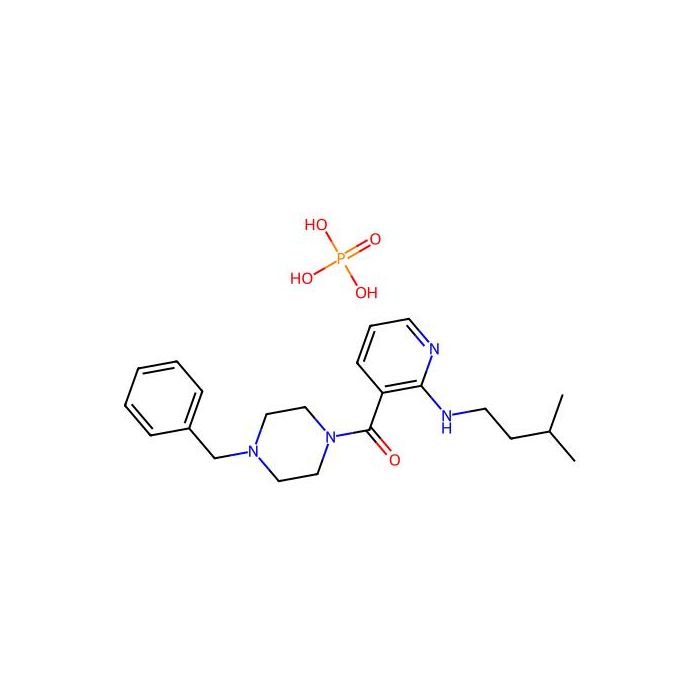
Brief overview: Nsi-189 phosphate is supplied as a research-use small-molecule phosphate salt. The product record does not include a resolved structural description; therefore, only catalog identifiers are listed below.
Product name (catalog): Nsi-189 phosphate (SKU: N979920)
CAS: 1270138-41-4
PubChem CID: 50922680
InChIKey: 210857 (as provided in item data)
SMILES: Not specified for this item; refer to CoA/Spec Sheet.
Molecular formula: Not specified for this item; refer to CoA/Spec Sheet.
Molecular weight: Not specified for this item; refer to CoA/Spec Sheet.
Structural features (item-specific):
Not specified for this item; refer to CoA/Spec Sheet.
Context from literature (non–item-specific, for orientation only):
NSI‑189 is described in literature as a small heteroaromatic, amine-containing scaffold; the “phosphate” denotes the protonated amine(s) paired with phosphate as counter‑ion, typically increasing aqueous solubility. No assertion is made here about the exact substitution pattern of this specific catalog item; consult primary spectral/structural documentation (CoA, NMR, HRMS) for definitive identity.
2D description (general):
As a phosphate salt, expect an organic cation paired with phosphate anion(s); salts commonly present as crystalline or amorphous, potentially hygroscopic solids. Exact ring systems, stereochemistry, and tautomerism are not provided in the item data.
Synthetic Utility
Nsi‑189 phosphate is primarily a formulated salt of a specific bioactive small molecule and is not commonly used as a synthetic building block or reagent.
General considerations (non–item-specific):
Derivatization/SAR: Researchers may derivatize the parent scaffold (free base) to probe structure–activity relationships (SAR). Typical transformations include N‑alkyl modifications, heteroaromatic substitutions, and counter‑ion exchanges to modulate solubility and permeability.
Counter‑ion exchange: The phosphate salt can sometimes be converted to the free base via basification and extraction, followed by re‑salt formation with alternative acids (e.g., HCl, mesylate) if different solid‑state or solubility properties are desired. This must be done with appropriate characterization to confirm identity and stoichiometry.
Analytical support: For any synthetic manipulation, track identity by LC–MS and NMR, and verify purity and residual inorganic content (ion chromatography or ICP for phosphorus) when converting between salt forms.
Limitations:
Because the compound’s pharmacophore is fixed, its value lies in biological evaluation rather than as a general-purpose reagent. If you require a functional synthon, select simpler building blocks designed for coupling, protection/deprotection, or cross‑coupling chemistry.
Target Specificity
No item-specific target, receptor, enzyme, or binding data are provided for this catalog entry.
Antigen/epitope, clone, isotype, or species reactivity fields do not apply to small molecules and are therefore not relevant here.
If target engagement is pertinent to your study, consult primary literature for NSI‑189 and generate orthogonal evidence (e.g., cell-based phenotypic assays, biochemical binding, thermal shift/DSF, CETSA) to establish specificity under your conditions.
Foire aux questions
What is the purity of this product?
This product is supplied at ≥99% purity (chemical assay). Lot-specific values are stated on the Certificate of Analysis.
How should this product be stored?
Store at ?20 °C, desiccated. Keep the container tightly closed with desiccant — the material is moisture-sensitive.
How is this product shipped?
This product ships in an insulated container with ice pads. Unpack on arrival and transfer it to the storage condition stated above.
What are the CAS number, molecular formula and molecular weight?
The CAS Number is 1270138-41-4, the molecular formula is C22H33N4O5P, and the molecular weight is 464.500 g/mol. InChIKey LWHMGALTTIYPJU-UHFFFAOYSA-N.
What documentation is provided?
Available product documentation, including Certificates of Analysis (COA), Safety Data Sheets (SDS), and specification sheets, is shown in the product document area. Document availability and access follow the current site policy.
Nous utilisons des cookies pour garantir le bon fonctionnement du site et, lorsque cela est autorisé, pour améliorer votre expérience. Vous pouvez gérer vos préférences à tout moment dans les Paramètres. Pour en savoir plus, consultez notre Politique relative aux cookies.
Souhaitez-vous que nous vous envoyions un message lorsque des réductions seront disponibles?
Me rappeler plus tard
Merci ! Veuillez vérifier votre boîte de réception e-mail pour confirmer.
Products are supplied to verified businesses, institutions, and qualified professionals for research and development use only. Not for use in humans, animals, diagnosis, or therapy.