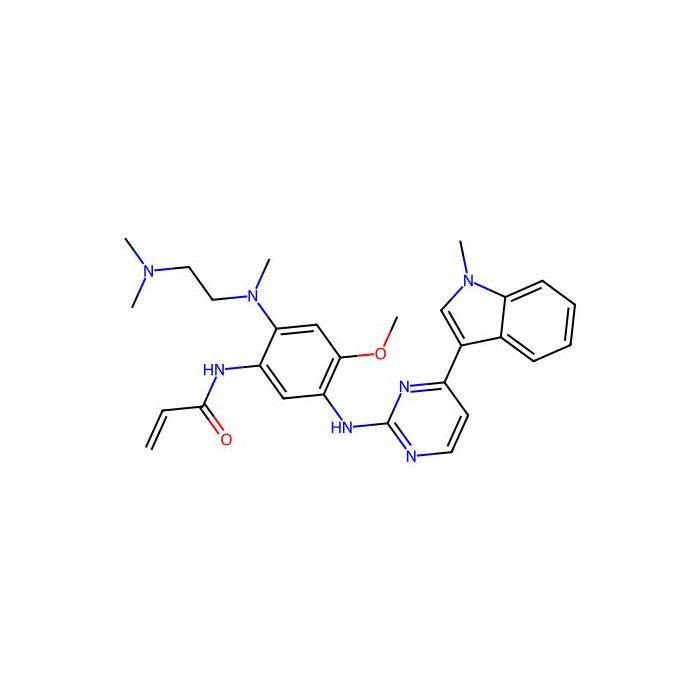
Osimertinib-d 6 is a deuterium labeled osimertinib. Osimertinib is a covalent, orally active, irreversible, and mutant-selective EGFR inhibitor with an apparent IC50 of 12 nM against L858R and 1 nM against L858R/T790M. Osimertinib overcomes T790M-mediated resistance to EGFR inhibitors in lung cancer.
In Vitro
Osimertinib (AZD9291) (0-10 μM; 72 hours) dramatically inhibits cell proliferation with IC 50 s of 41, 26, 41, and 31 nM, respectively. Osimertinib (0-10 μM; 72 hours) inhibits cell proliferation (Ba/F3 cells harboring a T790M mutation, exon 19del+T790M, or L858R+T790M) with IC 50 s of 6, 7, and 74 nM, respectively. Osimertinib (0-10 μM; 72 hours) inhibits Ba/F3 cells harboring EGFR exon 20 insertion mutations (IC 50 ranging from 16-701 nM for A763_Y764insFQEA (FQEA), Y764_V765insHH (HH), A767_V769dupASV (ASV), and D770_N771insNPG (NPG) cells). Osimertinib shows high levels of phenotype potency in both sensitizing-mutant (mean IC 50 of 8 nM in PC-9) and T790M (mean IC 50 of 11 and 40 nM in H1975 and PC-9VanR respectively) EGFR cell lines. Osimertinib has much less activity towards wild-type EGFR (mean IC 50 of 650 and 461 nM in Calu3 and H2073 respectively). Osimertinib (0.1 μM; 48 hours) induces apoptosis in Ba/F3 cells (apoptosis rate of 40.9% and 90% in EGFR exon 19del+T790M, EGFR L858R+T790M respectively). MCE has not independently confirmed the accuracy of these methods. They are for reference only. Cell Proliferation AssayCell Line: PC-9, H3255, PC-9ER, and H1975 cells Concentration: 0.0001, 0.001, 0.01, 0.1, 1, 10 μM Incubation Time: 72 hours Result: Dramatically inhibited cell proliferation (IC 50 =41,26, 41, 31 nM, respectively) Cell Proliferation AssayCell Line: Ba/F3 cells (harboring a T790M mutation, exon 19del+T790M, or L858R+T790M) Concentration: 0.0001, 0.001, 0.01, 0.1, 1, 10 μM Incubation Time: 72 hours Result: Inhibited cell proliferation (IC 50 = 6, 7, 74 nM, respectively) Apoptosis AnalysisCell Line: Ba/F3 cells (harboring EGFR exon 20 insertion mutations) Concentration: 0.0001, 0.001, 0.01, 0.1, 1, 10 μM Incubation Time: 72 hours Result: Inhibited cell proliferation (IC 50 = 16, 701, 230, 38 nM, respectively) Apoptosis AnalysisCell Line: Ba/F3 cells(harboring EGFR exon 19del+T790M or EGFR L858R+T790M) Concentration: 0.1 μM Incubation Time: 48 hours Result: Inducted apoptosis with the rate of 40.9% and 90% in EGFR T790M positive mutations cells respectively.
In Vivo
Osimertinib (0.1-25 mg/kg; p.o.; daily for 14 day) induces significant dose-dependent regression in both PC-9 (ex19del) and H1975 (L858R/T790M) tumor xenograft models . MCE has not independently confirmed the accuracy of these methods. They are for reference only. Animal Model: PC-9 (ex19del) and H1975 (L858R/T790M) tumor xenograft models Dosage: 0.1-10 mg/kg (PC-9 xenograft models); 0.5- 25 mg/kg (H1975 xenograft models) Administration: p.o.; daily for 14 day Result: Induced significant dose-dependent regression in both PC-9 (ex19del) and H1975 (L858R/T790M) tumor xenograft models.
Form:Solid