PACAP (1-27) (human - Moligand™, 10mM in Water , Agonist of PAC 1 receptor;Agonist of VPAC 1 receptor;Agonist of VPAC 2 receptor, CAS No.127317-03-7, Agonist of PAC 1 receptor;Agonist of VPAC 1 receptor;Agonist of VPAC 2 receptor

CAS: 127317-03-7 Cat. No.: P421125 Formule: C142H224N40O39S Poids moléculaire: 3147.68 PubChem CID: 44134520
DISPONIBLE À COMMANDE
QUALITÉ & PURETÉ Moligand™ ? Moligand™ — Aladdin's line of ligands and bioactive small molecules. Use for receptor, pathway, and binding studies needing defined small-molecule tools. 10mM in Water
Synonyms
PACAP 1-27|PACAP (1-27), human, ovine, rat|Histidylseryl-alpha-aspartylglycylisoleucylphenylalanylthreonyl-alpha-aspartylseryltyrosylserylarginyltyrosylarginyllysylglutaminylmethionylalanylvalyllysyllysyltyrosylleucylalanylalanylvalylleucinamide
Storage
Protected from light,Store at -80°C
Shipped In
Dry ice packs + Cold packs
★
Taille
Allemagne (EU)
USA*
Prix
Qté
1ml
P421125-1ml
Sur commande · 8–12 semaines

178,67€

209,91€
Enregistrer 31,24 € (14.88%)
Enter a quantity for the sizes you want to add.

Spécifications

Synonymes
PACAP 1-27 | PACAP (1-27), human, ovine, rat | Histidylseryl-alpha-aspartylglycylisoleucylphenylalanylthreonyl-alpha-aspartylseryltyrosylserylarginyltyrosylarginyllysylglutaminylmethionylalanylvalyllysyllysyltyrosylleucylalanylalanylvalylleucinamide
Spécifications et pureté
Moligand™, 10mM in Water
Mécanismes biochimiques et physiologiques
Potent PACAP receptor antagonist (IC 50 = 7.45 nM). Stimulates adenylate cyclase more potently than VIP . High binging affinity in lung. Active in vitro and in vivo .
Conditions de stockage de stockage
Protected from light,Store at -80°C
Expédié en
Dry ice packs + Cold packs
Ce produit nécessite l'expédition en chaîne froide. Les services terrestres et autres services économiques ne sont pas disponibles.
Grade
Moligand™
Type d'action
AGONIST
Mécanisme d'action
Agonist of PAC 1 receptor;Agonist of VPAC 1 receptor;Agonist of VPAC 2 receptor
Noms et identifiants
SMILES
CCC(C)C(C(=O)NC(CC1=CC=CC=C1)C(=O)NC(C(C)O)C(=O)NC(CC(=O)O)C(=O)NC(CO)C(=O)NC(CC2=CC=C(C=C2)O)C(=O)NC(CO)C(=O)NC(CCCNC(=N)N)C(=O)NC(CC3=CC=C(C=C3)O)C(=O)NC(CCCNC(=N)N)C(=O)NC(CCCCN)C(=O)NC(CCC(=O)N)C(=O)NC(CCSC)C(=O)NC(C)C(=O)NC(C(C)C)C(=O)NC(CCCCN)C(=O)NC(CCCCN)C(=O)NC(CC4=CC=C(C=C4)O)C(=O)NC(CC(C)C)C(=O)NC(C)C(=O)NC(C)C(=O)NC(C(C)C)C(=O)NC(CC(C)C)C(=O)N)NC(=O)CNC(=O)C(CC(=O)O)NC(=O)C(CO)NC(=O)C(CC5=CNC=N5)N
IUPAC Name
4-[[2-[[1-[[1-[[1-[[1-[[1-[[1-[[1-[[1-[[1-[[1-[[6-amino-1-[[5-amino-1-[[1-[[1-[[1-[[6-amino-1-[[6-amino-1-[[1-[[1-[[1-[[1-[[1-[(1-amino-4-methyl-1-oxopentan-2-yl)amino]-3-methyl-1-oxobutan-2-yl]amino]-1-oxopropan-2-yl]amino]-1-oxopropan-2-yl]amino]-4-methyl-1-oxopentan-2-yl]amino]-3-(4-hydroxyphenyl)-1-oxopropan-2-yl]amino]-1-oxohexan-2-yl]amino]-1-oxohexan-2-yl]amino]-3-methyl-1-oxobutan-2-yl]amino]-1-oxopropan-2-yl]amino]-4-methylsulfanyl-1-oxobutan-2-yl]amino]-1,5-dioxopentan-2-yl]amino]-1-oxohexan-2-yl]amino]-5-carbamimidamido-1-oxopentan-2-yl]amino]-3-(4-hydroxyphenyl)-1-oxopropan-2-yl]amino]-5-carbamimidamido-1-oxopentan-2-yl]amino]-3-hydroxy-1-oxopropan-2-yl]amino]-3-(4-hydroxyphenyl)-1-oxopropan-2-yl]amino]-3-hydroxy-1-oxopropan-2-yl]amino]-3-carboxy-1-oxopropan-2-yl]amino]-3-hydroxy-1-oxobutan-2-yl]amino]-1-oxo-3-phenylpropan-2-yl]amino]-3-methyl-1-oxopentan-2-yl]amino]-2-oxoethyl]amino]-3-[[2-[[2-amino-3-(1H-imidazol-4-yl)propanoyl]amino]-3-hydroxypropanoyl]amino]-4-oxobutanoic acid
InChIKey
RZGBUJXSKLDAFE-UHFFFAOYSA-N
InChI
1S/C142H224N40O39S/c1-16-75(10)113(179-108(191)66-156-120(201)102(63-109(192)193)173-135(216)104(67-183)176-119(200)88(146)62-84-65-153-70-157-84)139(220)174-101(58-80-28-18-17-19-29-80)133(214)182-114(79(14)186)140(221)175-103(64-110(194)195)132(213)178-106(69-185)136(217)172-100(61-83-39-45-87(189)46-40-83)131(212)177-105(68-184)134(215)164-93(34-27-54-155-142(151)152)126(207)170-98(59-81-35-41-85(187)42-36-81)129(210)163-92(33-26-53-154-141(149)150)124(205)161-89(30-20-23-50-143)122(203)165-94(47-48-107(147)190)127(208)166-95(49-55-222-15)121(202)159-78(13)118(199)180-111(73(6)7)137(218)167-91(32-22-25-52-145)123(204)162-90(31-21-24-51-144)125(206)171-99(60-82-37-43-86(188)44-38-82)130(211)169-97(57-72(4)5)128(209)160-76(11)116(197)158-77(12)117(198)181-112(74(8)9)138(219)168-96(115(148)196)56-71(2)3/h17-19,28-29,35-46,65,70-79,88-106,111-114,183-189H,16,20-27,30-34,47-64,66-69,143-146H2,1-15H3,(H2,147,190)(H2,148,196)(H,153,157)(H,156,201)(H,158,197)(H,159,202)(H,160,209)(H,161,205)(H,162,204)(H,163,210)(H,164,215)(H,165,203)(H,166,208)(H,167,218)(H,168,219)(H,169,211)(H,170,207)(H,171,206)(H,172,217)(H,173,216)(H,174,220)(H,175,221)(H,176,200)(H,177,212)(H,178,213)(H,179,191)(H,180,199)(H,181,198)(H,182,214)(H,192,193)(H,194,195)(H4,149,150,154)(H4,151,152,155)
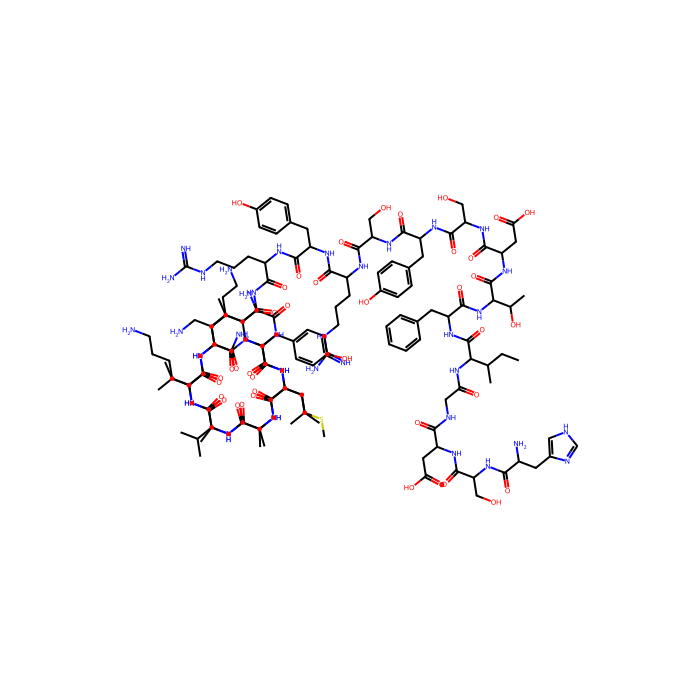
Isomères SMILES
CCC(C)C(C(=O)NC(CC1=CC=CC=C1)C(=O)NC(C(C)O)C(=O)NC(CC(=O)O)C(=O)NC(CO)C(=O)NC(CC2=CC=C(C=C2)O)C(=O)NC(CO)C(=O)NC(CCCNC(=N)N)C(=O)NC(CC3=CC=C(C=C3)O)C(=O)NC(CCCNC(=N)N)C(=O)NC(CCCCN)C(=O)NC(CCC(=O)N)C(=O)NC(CCSC)C(=O)NC(C)C(=O)NC(C(C)C)C(=O)NC(CCCCN)C(=O)NC(CCCCN)C(=O)NC(CC4=CC=C(C=C4)O)C(=O)NC(CC(C)C)C(=O)NC(C)C(=O)NC(C)C(=O)NC(C(C)C)C(=O)NC(CC(C)C)C(=O)N)NC(=O)CNC(=O)C(CC(=O)O)NC(=O)C(CO)NC(=O)C(CC5=CNC=N5)N
PubChem CID
44134520
Poids moléculaire
3147.68

Données avancées

Cibles associées (humaines)
VIPR2 Tchem Vasoactive intestinal polypeptide receptor 2 (0 Activities)
Activity TypeActivity Value -log(M)Mechanism of ActionActivity ReferencePublications (PubMed IDs)
VIPR1 Tchem Vasoactive intestinal polypeptide receptor 1 (0 Activities)
Activity TypeActivity Value -log(M)Mechanism of ActionActivity ReferencePublications (PubMed IDs)
ADCYAP1R1 Tchem Pituitary adenylate cyclase-activating polypeptide type I receptor (0 Activities)
Activity TypeActivity Value -log(M)Mechanism of ActionActivity ReferencePublications (PubMed IDs)
Certificats (CoA, COO, BSE/TSE et tableau d'analyse)
C of A & Other Certificates(BSE/TSE, COO):
Analytical Chart:
Propriétés chimiques et physiques
Sensibilitélight sensitive
Calculateurs de solution
Avis

Avis des clients

Besoin d'aide pour choisir la qualité ?

Notre guide de sélection des qualités couvre la pureté, le statut du stabilisant et l'adéquation à l'application pour toutes les variantes de notre catalogue.

Voir le guide des qualités Moligand™ →

Souhaitez-vous que nous vous envoyions un message lorsque des réductions seront disponibles?

Me rappeler plus tard

Merci ! Veuillez vérifier votre boîte de réception e-mail pour confirmer.

Oups ! Les notifications sont désactivées.