QUALITÉ & PURETÉMoligand™?Moligand™ — Aladdin's line of ligands and bioactive small molecules. Use for receptor, pathway, and binding studies needing defined small-molecule tools.10 mM in DMSO
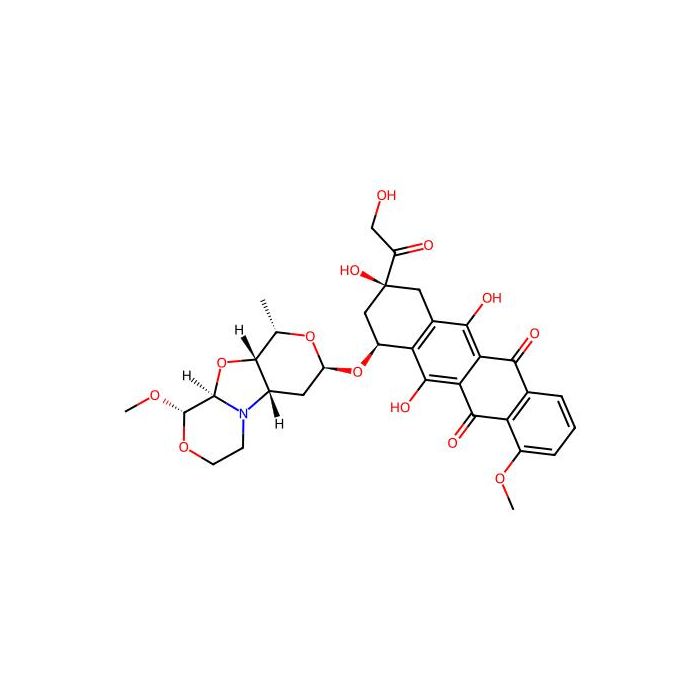
PNU-159682, a metabolite of the anthracycline Nemorubicin, is a highly potent DNA topoisomerase II inhibitor with excellent cytotoxicity. PNU-159682 acts as a more potent and tolerated ADC cytotoxin than Doxorubicin for ADC synthesis. PNU-159682 can be used in EDV-nanocell technology to overcome agent resistance.
Spécifications
Spécifications et pureté
Moligand™, 10 mM in DMSO
Conditions de stockage de stockage
Argon charged,Store at -80°C
Expédié en
Dry ice packs + Cold packs
Ce produit nécessite l'expédition en chaîne froide. Les services terrestres et autres services économiques ne sont pas disponibles.
P305+P351+P338:IF IN EYES: Rinse cautiously with water for several minutes. Remove contact lenses if present and easy to do - continue rinsing.
Calculateurs de solution
Molarity Calculator
Determine the necessary mass, volume, or concentration for preparing a solution.
Dilution Calculator
Determine the dilution needed to prepare a stock solution.
Reconstitution Calculator
Avis
Avis des clients
Application Protocols
No vendor-validated protocols are specified for this item. The following are general, non-item-specific guidelines for handling potent small molecules in cellular or biochemical assays:
Stock preparation (general):
Allow vial to equilibrate to room temperature in a desiccated environment before opening. Dissolve in dry DMSO to a convenient concentration (e.g., 1–10 mM). Vortex gently until fully dissolved.
Filter sterilization (optional): 0.22 μm PTFE for cell-based assays if needed; avoid prolonged exposure to filters that may adsorb aromatic cations.
Assay setup (general):
Dilute working solutions freshly into media/buffer to the desired final concentration, keeping DMSO ≤0.1% v/v when possible.
Include vehicle controls and known class comparators for benchmarking.
Protect from light; use amber plates or cover with foil.
Documentation:
Record stock concentration, solvent, aliquot size, preparation date, and freeze–thaw count.
These steps are provided as general best practices; validate and adapt to your specific assay.
Biological Roles
Biochemical context (literature/general for PNU-159682-class anthracycline analogs):
DNA interaction: Anthracycline scaffolds intercalate between base pairs and can preferentially bind GC-rich regions, altering DNA topology and replication/transcription dynamics.
Topoisomerase II trapping: Related compounds stabilize the cleavable complex of topo II with DNA, leading to double-strand breaks upon collision with replication machinery.
Redox activity: Quinone/hydroquinone cycling may generate reactive oxygen species, contributing to oxidative DNA and membrane damage.
Cellular outcomes: Activation of DNA damage response (DDR) pathways, including ATM/ATR signaling, checkpoint activation, and apoptosis at sufficient insult levels.
Research utility:
Serves as a potent reference in cell-based assays probing DDR, chromatin damage, and repair pathway dependencies.
Useful for benchmarking potency and selectivity windows across cell lines or engineered repair-deficient systems.
Important note:
All statements above are literature/general for the chemotype and are not item-specific claims. This product is labeled For research use only and is not intended for human or veterinary use.
Buffer Applications
This compound is not a buffering reagent and is not typically used to prepare pH buffer systems. For experimental use, it may be diluted into biological buffers (PBS, HBSS, assay media) from an organic stock.
General guidance (non-item-specific):
Prepare a concentrated DMSO stock (e.g., 1–10 mM), then dilute into the target buffer to a final DMSO content ≤0.1% v/v where assay tolerance permits.
Pre-warm buffers to room temperature and add compound last with thorough mixing to avoid local supersaturation and precipitation.
For light-sensitive anthracycline analogs, use amber tubes and minimize exposure during buffer preparation.
No buffer capacity, pKa values, or buffer recipes are provided or implied for this item.
Green Alternatives
As a specialized research ligand, PNU-159682 itself is not replaceable by a “green” alternative without impacting biological mechanism. However, greener choices can be made for handling and formulation solvents and workflow design.
Greener laboratory considerations (general):
Stock solvent choice: Prefer ethanol/water mixtures where feasible for short-term assays, acknowledging potential solubility limits. Otherwise, use DMSO with minimal volumes in final assay (<0.1% v/v).
Process minimization: Prepare concentrated master stocks and aliquot to reduce waste and freeze–thaw cycles.
Light/oxygen control: Use amber vials and argon/nitrogen headspace to extend shelf life and reduce disposals.
Comparison of common solvent options (general):
DMSO: High solvency, low volatility; not biorenewable but low acute environmental hazard. Keep volumes minimal.
Ethanol: Renewable feedstock and lower toxicity; may not dissolve highly aromatic cationic compounds adequately.
PEG-400 or cyclodextrin vehicles: Useful for aqueous delivery; assess assay interference.
Waste management:
Collect all solutions and disposables as cytotoxic organic waste. Avoid drain disposal. Engage institutional green-chemistry programs for solvent recycling where permitted.
Pharmaceutical Uses
This product is supplied strictly for research use only. It is not an excipient, not GMP-grade, and not intended for clinical use, compounding, or in vivo administration in humans.
Context (literature/general):
PNU-159682 has been studied in the scientific literature as a highly potent anthracycline-class metabolite analog and is used as a reference tool compound in preclinical research. These literature notes are provided solely for context and do not constitute a use claim for this item.
Manufacturing/formulation status for this listing:
Pharmacopeia monograph: None specified.
Regulatory status: Not specified; not for drug, household, or cosmetic use.
Excipient/applications: Not applicable.
If your workflow requires GMP documentation, validated impurity profiles, or DMF support, this research-grade Moligand™ listing will not meet those requirements.
Physical Properties
Only limited item-specific physical data are provided for this lot.
Appearance: Not specified for this item; refer to CoA/Spec Sheet.
Molecular weight: Not specified for this item; refer to CoA/Spec Sheet.
Molecular formula: Not specified for this item; refer to CoA/Spec Sheet.
Melting point: Not specified for this item; refer to CoA/Spec Sheet.
Boiling point: Not applicable for a high-MW polycyclic organic under ambient pressure; decomposes before boiling (literature/general for anthracyclines).
Solubility: Not specified for this item; refer to CoA/Spec Sheet. General guidance (literature): many anthracycline analogs exhibit good solubility in polar aprotic solvents (DMSO, DMF) and limited solubility in nonpolar solvents; aqueous solubility depends strongly on salt form and pH due to basic amine(s).
pKa/logP: Not specified for this item; refer to CoA/Spec Sheet. Anthracycline-class compounds typically contain one or more basic centers with pKa ~7–9 and logP values indicative of amphipathicity (literature/general, not specific).
Stability: Sensitive to moisture/oxygen and light due to quinone redox chemistry (literature/general). Follow storage guidance below for best stability.
Quality and Grades
Grade/Purity: Moligand™
About Moligand™ (general program description):
Moligand™ denotes small-molecule ligands prepared and packaged for screening and chemical biology workflows. Lots are typically dispensed under inert gas into low-adsorption containers to minimize oxidative and moisture-induced degradation. This supports assay reproducibility in HTS, SAR, and MoA studies. Item-specific analytical specifications (HPLC purity, residual solvents, water, counterion content) are not listed here.
What is specific to this listing:
This product is argon charged and supplied for research-only applications, aligning with Moligand™ handling standards.
Storage at −80°C is specified for enhanced shelf-life of oxidation- and hydrolysis-sensitive scaffolds.
What is not specified for this item (refer to CoA/Spec Sheet):
Exact purity assay %, chromatographic profile, salt/counterion form, water content, residual metals/solvents, and UV cutoffs.
Implications for end users:
For quantitative biology or medicinal chemistry, request the CoA to confirm purity and counterion prior to use.
If LC–MS or qNMR traceability is needed, retain an analytical reference aliquot and record dilution factors when making stocks.
Reaction and Applications
This product is supplied as a bioactive small molecule for research, not primarily as a synthetic reagent. Accordingly, classical reaction applications (e.g., as a solvent, base, or coupling partner) are not typical.
Research applications (literature/general for PNU-159682-class molecules):
Chemical biology tool compounds in DNA interaction and topoisomerase II poisoning studies, leveraging the anthracycline scaffold’s intercalation propensity and enzyme trapping behavior.
Benchmark control in assays evaluating redox cycling, ROS generation, and DNA damage response signaling.
Comparative SAR reference in screening sets derived from anthracycline/nemorubicin families, enabling potency windowing and mechanistic orthogonality tests.
Assay design tips:
Use sub-micromolar to nanomolar dosing ranges when exploring potency; include serial dilutions to mitigate cytotoxic floor effects (literature/general).
Minimize light exposure and repeated freeze–thaw to maintain activity.
Employ appropriate negative/positive controls (e.g., etoposide or doxorubicin as class comparators) and orthogonal readouts (viability, γH2AX, comet assay) for MoA confirmation.
If you intend to use this compound as a synthetic intermediate, consult primary literature for stability of the glycosidic linkage and quinone functionality under reaction conditions; no reagent use claims are made for this item.
Reaction Conditions
As a bioactive small molecule rather than a reagent, there are no standard “reaction conditions” associated with this product. If undertaking derivatization or conjugation, consider the following general literature guidance for anthracycline-like scaffolds:
Solvents: Dry, oxygen-limited polar aprotics (DMSO, DMF) for mild transformations; aqueous-organic systems for salt formation or bioconjugation.
Temperature: 0–25°C for acylations/carbamylations of phenols to limit side reactions; avoid prolonged heating which may cleave glycosidic linkages.
Catalysts/bases: Non-nucleophilic organic bases (DIPEA, lutidine) in small excess; avoid strong inorganic bases.
Times/yields: Highly substrate- and site-dependent; monitor closely by LC–MS due to potential for multiple minor products.
Workup: Quench carefully, avoid emulsions, and use gentle purification. Protect from light throughout.
These are general considerations only; consult primary literature for any specific transformation of PNU-159682 or closely related analogs.
Safety and Handling
Hazard classifications for this specific item are not provided here; consult the SDS for authoritative details.
Signal word (GHS), H-statements, pictograms: Not specified for this item; refer to SDS.
Likely hazards (literature/general for anthracycline-like research compounds): may be harmful if swallowed, inhaled, or in contact with skin; potential mutagenicity, reproductive toxicity, and specific target organ toxicity cannot be excluded. Treat as a cytotoxic research chemical.
Engineering controls: Handle in a certified chemical fume hood or ventilated enclosure suitable for cytotoxic compounds. Use closed transfer where feasible.
PPE: Lab coat, double nitrile gloves for cytotoxic handling, splash goggles; consider face shield for bulk reconstitution. Change outer gloves frequently.
Incompatibilities: Strong oxidizers/reducers; bases/acids that could degrade glycosidic linkages; prolonged light exposure can promote degradation (literature/general).
Spill and waste: Adsorb with inert material, avoid aerosolization, and dispose of as cytotoxic chemical waste per institutional policy.
First aid (overview): If on skin/eyes, rinse with copious water for 15 minutes. If inhaled, move to fresh air. If ingested, seek medical attention immediately. Provide SDS to responders.
Decontamination: Use detergent/bleach followed by water on non-porous surfaces; validate procedures with your EHS office.
Transportation: Shipped on dry ice/cold packs as provided; keep secondary containment to prevent vial rupture.
Always defer to the SDS and institutional EHS guidance for risk assessment and controls.
Solvent Selection
Item-specific solubility is not provided. The following guidance is based on literature/general experience with anthracycline-like small molecules.
Primary stock solvent: Anhydrous DMSO is typically preferred for potent, polyfunctional aromatic cations due to high solvating power and assay compatibility up to 0.1–1% v/v in many systems.
Alternative solvents: DMF or NMP can dissolve challenging analogs but may be less assay-friendly; ethanol or methanol may work at modest concentrations if the salt form is favorable.
Aqueous systems: Solubility often increases under acidic conditions where the basic amine(s) are protonated. Consider preparing DMSO stock and diluting into buffered aqueous media with surfactant or serum proteins if biologically testing.
Polarity/miscibility (general): DMSO and DMF are fully miscible with water and many organics, simplifying serial dilutions.
Adsorption: Aromatic cationic compounds may adsorb to plastics; low-bind polypropylene, glass vials with silanized surfaces, or addition of small amounts of carrier protein/detergent can mitigate losses.
DMF/NMP: Strong solvency; more extractive to plastics and less desirable in live-cell assays.
Alcohols: Easier to remove; limited solubility for some cationic aromatics.
Always verify solubility empirically for your lot and application.
Storage and Reconstitution
Item-specific storage conditions:
Storage: Argon charged, store at −80°C (as provided in Product Data).
Shipping: Shipped on dry ice packs + cold packs.
General best practices for this chemotype:
Keep vials tightly sealed under inert gas. Minimize headspace oxygen and moisture to limit quinone redox and hydrolysis pathways.
Protect from light with amber vials or foil wrapping.
Reconstitution (general guidance; not a specification):
Thaw the sealed vial to room temperature in a desiccator. Briefly centrifuge to collect contents.
Open under dry inert atmosphere if possible. Dissolve in anhydrous DMSO to prepare a concentrated stock (e.g., 1–10 mM), ensuring complete dissolution before aliquoting.
Dispense single-use aliquots into low-bind tubes, re-cap under argon, and freeze immediately at −80°C.
Avoid repeated freeze–thaw cycles; discard aliquots after the first thaw or within a defined in-use window established by your lab QC.
Stability/shelf life:
Not specified for this item; refer to CoA/Spec Sheet. Establish an internal retest date and verify integrity by LC–MS/HPLC prior to critical studies.
Structure and Identity
PNU-159682 is a small-molecule research ligand widely used in oncology-focused chemical biology as a highly potent anthracycline-type metabolite analog (literature). Item-specific identifiers for this lot are limited in the Product Data.
SKU: P1498606
Product name: PNU-159682
CAS: 202350-68-3
PubChem CID: 9874188
Molecular formula: Not specified for this item; refer to CoA/Spec Sheet.
Molecular weight: Not specified for this item; refer to CoA/Spec Sheet.
SMILES: Not specified for this item; refer to CoA/Spec Sheet.
InChIKey: Not specified for this item; refer to CoA/Spec Sheet.
Structural features (literature/general):
Anthracycline core scaffold with polycyclic quinone–hydroquinone motif capable of redox activity and DNA intercalation in related chemotypes.
Glycosidic/aminosugar region often implicated in topoisomerase II interactions in the anthracycline class.
Multiple hydroxyls and tertiary amine functionality leading to amphipathic behavior and ionizable character.
2D structure description (literature/general):
Planar tetracyclic aglycone bearing quinone carbonyls and phenolic groups, appended to an amino-substituted sugar-like moiety via a C–O glycosidic linkage, consistent with anthracycline-type topologies. Exact substitution pattern for PNU-159682 should be confirmed against primary literature or the CoA.
Synthetic Utility
PNU-159682 is not typically employed as a building block in organic synthesis due to its complexity and sensitivity. Nevertheless, an understanding of its functional groups can inform handling and limited derivatization for probe development (literature/general):
Functional group landscape: Quinone carbonyls (redox-active), multiple phenolic/alcoholic OH groups, a glycosidic linkage, and a basic amine on the sugar-like moiety. These features render it sensitive to strong acids/bases and nucleophiles.
Derivatization concepts: Formation of salts of the amine for solubility modulation; selective acylation or carbamylation of phenols/alcohols; installation of reporter tags through linker chemistry at less essential positions (guided by SAR literature within the anthracycline family).
Incompatibilities: Strong bases/acids can cleave the glycosidic linkage; reducing agents can alter the quinone system; oxidants can over-oxidize phenolic sites.
Purification: Requires gentle chromatographic conditions (neutral alumina or buffered silica) to minimize decomposition; reverse-phase preparative HPLC with acidic modifiers is commonly used in the literature for related scaffolds.
For most users, the value of this compound lies in biological assays rather than as a synthetic intermediate.
Target Specificity
Target specificity data (e.g., exact molecular targets, binding constants, species selectivity) are not provided for this specific catalog item.
Literature/general context for the chemotype:
Anthracycline analogs commonly engage DNA and topoisomerase II, but quantitative target parameters for PNU-159682 should be retrieved from peer-reviewed studies.
For assay design requiring precise target potency or selectivity (Kd, IC50), consult the primary literature and confirm with your own controls. No item-specific values are claimed here.
Foire aux questions
How should this product be stored?
Store at ?80 °C under argon. It is supplied under an argon blanket; reseal under inert gas after each use.
What is Moligand??
Moligand? is one of Aladdin Scientific's premium product lines, formulated for high-purity applications across multiple workflows. Compared to standard grades in the same workflow, Moligand? products typically offer tighter specifications, more rigorous QC, and stronger lot-to-lot consistency.
How is this product shipped?
This product ships frozen with dry ice and cold packs. Unpack on arrival and transfer it to the storage condition stated above; handle dry ice with insulated gloves in a ventilated area.
What are the CAS number, molecular formula and molecular weight?
The CAS Number is 202350-68-3, the molecular formula is C32H35NO13, and the molecular weight is 641.62 g/mol.
What documentation is provided?
Available product documentation, including Certificates of Analysis (COA), Safety Data Sheets (SDS), and specification sheets, is shown in the product document area. Document availability and access follow the current site policy.
Besoin d'aide pour choisir la qualité ?
Notre guide de sélection des qualités couvre la pureté, le statut du stabilisant et l'adéquation à l'application pour toutes les variantes de notre catalogue.
Nous utilisons des cookies pour garantir le bon fonctionnement du site et, lorsque cela est autorisé, pour améliorer votre expérience. Vous pouvez gérer vos préférences à tout moment dans les Paramètres. Pour en savoir plus, consultez notre Politique relative aux cookies.
Souhaitez-vous que nous vous envoyions un message lorsque des réductions seront disponibles?
Me rappeler plus tard
Merci ! Veuillez vérifier votre boîte de réception e-mail pour confirmer.
Products are supplied to verified businesses, institutions, and qualified professionals for research and development use only. Not for use in humans, animals, diagnosis, or therapy.