Determine the necessary mass, volume, or concentration for preparing a solution.
degré d'hydrolyse:87.0-89.0 mol%,Viscosité:80.0-110.0 mPa.s for sensitive chromatographic and analytical workflows requiring minimal baseline interference.
Room temperature Ships Normal Check lot-specific COA for exact specifications.
SDS, COA, datasheet, and spec sheet available for download. Lot-specific COA accessible via lot number lookup.
Cited in 4823 peer-reviewed publications across chromatography, organic synthesis, and cross-coupling reactions.
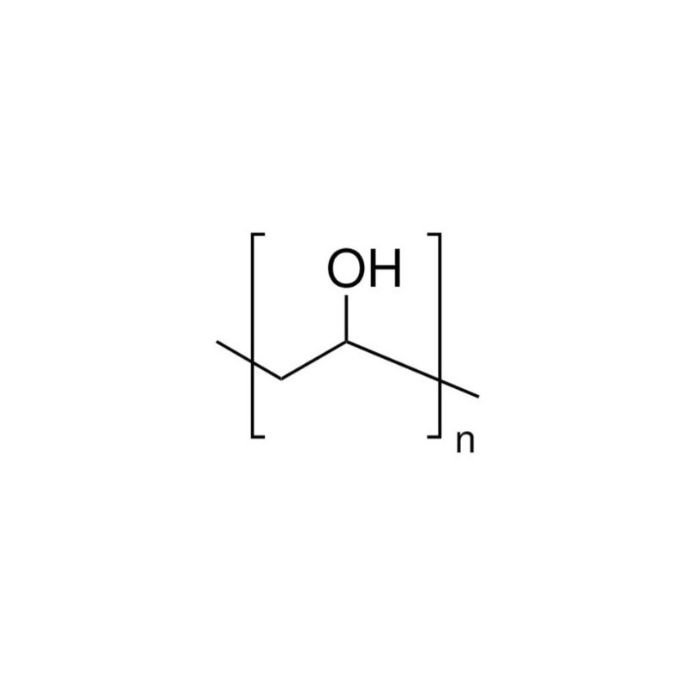
It softens and decomposes at 200℃. Due to the presence of various acetyl group residues in the product, it has different viscosities and properties. It is soluble in water but insoluble in petroleum solvents. Polyvinyl alcohol is a white granular water-soluble synthetic resin. Its chemical name is Polyvinyl alcohol, abbreviated as PVA. The main properties of polyvinyl alcohol are determined by the alcohol degree and polymerization degree of the molecules that constitute the resin. The properties are as follows: ① Water solubility: It is easily soluble in water and insoluble in almost all organic solvents. The dissolution rate increases with the increase of water temperature. ② Viscosity of the aqueous solution: The viscosity of the polyvinyl alcohol aqueous solution is lower than that of other water-soluble polymers. It varies according to the polymerization degree, concentration and temperature. ③ Film-forming property: The aqueous solution of polyvinyl alcohol is easy to form a film. The film has physical properties such as tensile strength and wear resistance, which are superior to other synthetic resins. ④ Hygroscopicity: The hygroscopicity of polyvinyl alcohol is lower than that of other water-soluble polymers, and it is less affected by humidity. ⑤ Resistance to chemicals and oil: It is basically unaffected in weak acids and weak bases. In addition, it also has excellent oil resistance.
Comprehensive hazard, handling, storage, and regulatory compliance document.
Download SDS →Lot-specific quality data. Enter your lot number to retrieve the exact COA.
Look up COA →Full quality attributes and acceptance criteria for this grade.
View spec sheet →Taxonomy Tree
| Kingdom | Organic compounds |
|---|---|
| Superclass | Organic oxygen compounds |
| Classe | Organooxygen compounds |
| Subclass | Enols |
| Intermediate Tree Nodes | Not available |
| Direct Parent | Enols |
| Alternative Parents | Hydrocarbon derivatives |
| Molecular Framework | Aliphatic acyclic compounds |
| Substituents | Enol - Hydrocarbon derivative - Aliphatic acyclic compound |
| Description | This compound belongs to the class of organic compounds known as enols. These are compounds containing the enol functional group, with the structure HO(R)C=CR'. Ketones that have one or more alpha-hydrogen atoms undergo keto-enol tautomerization, the tautomer being an enol. |
| External Descriptors | Not available |
Find and download the COA for your product by matching the lot number on the packaging.
| Lot Number | Certificate Type | Date | Article |
|---|---|---|---|
| Certificate of Analysis | Apr 20, 2026 | P139541 | |
| Certificate of Analysis | Aug 23, 2025 | P139541 | |
| Certificate of Analysis | Aug 20, 2025 | P139541 | |
| Certificate of Analysis | Aug 20, 2025 | P139541 | |
| Certificate of Analysis | Nov 07, 2022 | P139541 | |
| Certificate of Analysis | Jul 05, 2022 | P139541 | |
| Certificate of Analysis | Dec 29, 2021 | P139541 |
| Indice de réfraction | 1.49-1.53 |
|---|---|
| Point de fusion (°C) | 250℃ |
| Poids moléculaire | 44.050 g/mol |
| XLogP3 | 0.500 |
| Hydrogen Bond Donor Count | 1 |
| Hydrogen Bond Acceptor Count | 1 |
| Rotatable Bond Count | 0 |
| Exact Mass | 44.0262 Da |
| Monoisotopic Mass | 44.0262 Da |
| Topological Polar Surface Area | 20.200 Ų |
| Heavy Atom Count | 3 |
| Formal Charge | 0 |
| Complexity | 10.300 |
| Isotope Atom Count | 0 |
| Defined Atom Stereocenter Count | 0 |
| Undefined Atom Stereocenter Count | 0 |
| Defined Bond Stereocenter Count | 0 |
| Undefined Bond Stereocenter Count | 0 |
| The total count of all stereochemical bonds | 0 |
| Covalently-Bonded Unit Count | 1 |