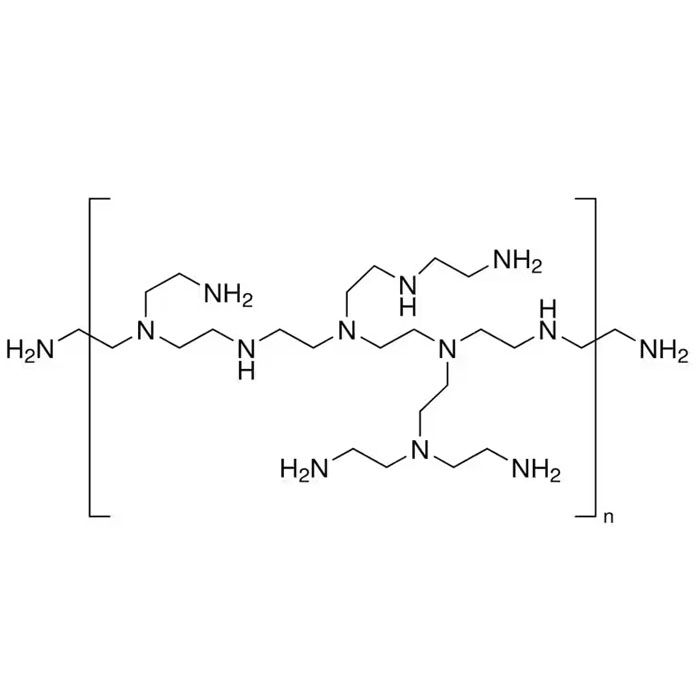
Poly(ethyleneimine) solution(PEI) - M.W. 600000-1000000, ~50% in H2O , CAS No.9002-98-6

CAS: 9002-98-6 Cat. No.: P434393 Formule: H(NHCH2CH2)nNH2 Numéro CE: 618-346-1
DISPONIBLE À COMMANDE
GRADE & PURITY M.W. 600000-1000000, ~50% in H2O
Synonyms
Aziridine | Ethyleneimine, inhibited | NSC124034 | NSC-124034 | PEI 1120 | RCRA waste no. P054 | Dihydroazirene | ETHYLENEIMINE | RCRA waste number P054 | 54P5FEX9FH | EC 205-793-9 | Aziridine (Ethyleneimine), stabilized with 1-2% NaOH | PEI 1000 | Aethyl
Storage
Room temperature,Argon charged
Shipped In
Normal
★
Size
Allemagne (EU)
USA*
Price
Qty
100ml
P434393-100ml
—
5 En stock
60,65€
500ml
P434393-500ml
Sur commande · 8–12 semaines
208,17€
Enter a quantity for the sizes you want to add.
🧪
Why this grade

M.W. 600000-1000000, ~50% in H2O for sensitive chromatographic and analytical workflows requiring minimal baseline interference.

🌡

Storage & shipping

Room temperature,Argon charged Ships Normal Check lot-specific COA for exact specifications.

📋

Quality documents

SDS, COA, datasheet, and spec sheet available for download. Lot-specific COA accessible via lot number lookup.

📚

Literature proof

Cited in 2254 peer-reviewed publications across chromatography, organic synthesis, and cross-coupling reactions.

Vue d’ensemble

Other Notes

Crosslinked polyethylenimine is used as enzyme carrier

Specifications

Synonymes
Aziridine | Ethyleneimine, inhibited | NSC124034 | NSC-124034 | PEI 1120 | RCRA waste no. P054 | Dihydroazirene | ETHYLENEIMINE | RCRA waste number P054 | 54P5FEX9FH | EC 205-793-9 | Aziridine (Ethyleneimine), stabilized with 1-2% NaOH | PEI 1000 | Aethyl
Spécifications et pureté
M.W. 600000-1000000, ~50% in H2O
Conditions de stockage de stockage
Room temperature,Argon charged
Expédié en
Normal
Noms et identifiants
Pubchem Sid508816109
Sourires canoniquesC1CN1
IUPAC Nameaziridine
InChIKeyNOWKCMXCCJGMRR-UHFFFAOYSA-N
INCHI1S/C2H5N/c1-2-3-1/h3H,1-2H2
Isomères SMILES C1CN1
WGK Allemagne 2
RTECS TQ7917000
CAS alternatif 106899-94-9
Numéro ONU 3082
Groupe d'emballage III
Reaxy-Rn 102380
Reaxys-RN_link_address https://www.reaxys.com/reaxys/secured/hopinto.do?context=S&query=IDE.XRN=102380&ln=

Documentation

📋 Safety Data Sheet (SDS)

Comprehensive hazard, handling, storage, and regulatory compliance document.

Download SDS →

✅ Certificate of Analysis (COA)

Lot-specific quality data. Enter your lot number to retrieve the exact COA.

Look up COA →

📊 Datasheet

Quick-reference summary of product specifications and applications.

View datasheet →

🔬 Specification Sheet

Full quality attributes and acceptance criteria for this grade.

View spec sheet →

Advanced Data

Taxonomic Classification

Taxonomy Tree

KingdomOrganic compounds
SuperclassOrganoheterocyclic compounds
ClasseAziridines
SubclassNot available
Intermediate Tree Nodes Not available
Direct ParentAziridines
Alternative Parents Dialkylamines  Azacyclic compounds  Organopnictogen compounds  Hydrocarbon derivatives  
Molecular FrameworkAliphatic heteromonocyclic compounds
Substituents Azacycle - Secondary amine - Secondary aliphatic amine - Aziridine - Organic nitrogen compound - Organopnictogen compound - Hydrocarbon derivative - Organonitrogen compound - Amine - Aliphatic heteromonocyclic compound
DescriptionThis compound belongs to the class of organic compounds known as aziridines. These are organic compounds containing a saturated three-member heterocycle with one amino group and two methylene groups.
External Descriptors azacycloalkane - saturated organic heteromonocyclic parent - aziridines
Structure 3D
Modèle de structure chimique interactif


Mécanismes d'action
Certificats (CoA, COO, BSE/TSE et tableau d'analyse)
C of A & Other Certificates(BSE/TSE, COO):
Analytical Chart:

Find and download the COA for your product by matching the lot number on the packaging.

11 results found

Lot NumberCertificate TypeDateArticle
D2312547Certificate of AnalysisJan 20, 2026 P434393
A2623615Certificate of AnalysisDec 26, 2025 P434393
A2623618Certificate of AnalysisDec 26, 2025 P434393
A2623689Certificate of AnalysisDec 26, 2025 P434393
A2623750Certificate of AnalysisDec 26, 2025 P434393
G2412579Certificate of AnalysisApr 02, 2024 P434393
G2412585Certificate of AnalysisApr 02, 2024 P434393
L2501026Certificate of AnalysisApr 02, 2024 P434393
D2312555Certificate of AnalysisMar 21, 2023 P434393
D2312556Certificate of AnalysisMar 21, 2023 P434393
I2503062Certificate of AnalysisMar 21, 2023 P434393
Propriétés chimiques et physiques
SensibilitéCO2 sensitive
Indice de réfraction1.5290
Point d'ébullition (°C)100 °C
Point de fusion (°C)-10 °C
Poids moléculaire43.070 g/mol
XLogP3-0.400
Hydrogen Bond Donor Count1
Hydrogen Bond Acceptor Count1
Rotatable Bond Count0
Exact Mass43.0422 Da
Monoisotopic Mass43.0422 Da
Topological Polar Surface Area21.900 Ų
Heavy Atom Count3
Formal Charge0
Complexity10.300
Isotope Atom Count0
Defined Atom Stereocenter Count0
Undefined Atom Stereocenter Count0
Defined Bond Stereocenter Count0
Undefined Bond Stereocenter Count0
The total count of all stereochemical bonds0
Covalently-Bonded Unit Count1
FAQ et articles
Non-viral Vectors for Gene Transfection: Polyethyleneimine
Differences Between Transformation and Transfection
Nucleic Acid and Nuclease Decontamination in Biopharmaceutical Manufacturing and Molecular Testing Workflows
Materials Can “Switch”: How Smart Polymers Respond to Temperature, pH, and Light (with Experimental Selection Tips & Product Navigation)
Understanding Hydrophilic Polymers in Aqueous Systems: Hydration Mechanisms, Structural Knobs, and Task-Oriented Selection Guide (Including Tables 1–3)
Biomedical Polymer Insights: Role-Based Task Map, Six Key Material Levers, and a Risk-Driven Evidence Chain (including the Product Navigation Guide and Product Tables 1–3)
dsDNase-Mediated Hydrolysis of Double-Stranded DNA: Enzymatic Characteristics, Methodological Strategies, and Bioanalytical Applications
Research Value of Polyelectrolyte Multilayers: Layer-by-Layer Design of Interfacial Composition, Mass Transport, and Function
What Are Polyamines? Structural Features, Classification and Representative Compounds, Applications, and Synthetic Strategies
Signal Transduction Mechanism of Graphene Biosensors: From Molecular Recognition to Electrical/Optical Signal Readout and Materials Selection
Key Variable in the Long-Term Stability of Waterborne Pigment Concentrates: How Dispersant Molecular Weight Distribution (MWD) Affects Pigment Dispersion, Surface Adsorption-Layer Formation, and Storage Stability
Dispersants, Anti-Redeposition Agents, and Scale-Control Materials in Household Cleaning Formulations: Mechanisms of Action, Selection Logic, and Representative Products
Citations of This Product
Calculateurs de solution
Avis

Avis des clients

Shall we send you a message when we have discounts available?

Remind me later

Thank you! Please check your email inbox to confirm.

Oops! Notifications are disabled.